Gap type is not decided by size alone. The main types of gaps in trading are common gaps, breakaway gaps, runaway gaps, and exhaustion gaps, but the label depends on location, participation, later acceptance or rejection, and whether price behavior supports the first read.
Definition: A trading gap is a visible price discontinuity between one traded area and the next. A gap type classifies the context around that discontinuity, while gap up and gap down describe direction only.
Key Points
- Gap types classify context, not trade action.
- Common, breakaway, runaway, and exhaustion gaps are the main classical labels.
- Gap up and gap down describe direction, not the same classification layer.
- Gap fill behavior can help interpretation, but it does not guarantee the type.
- The label loses quality when later price action contradicts the first reading.
What Types of Gaps in Trading Means
Types of gaps in trading describe the context in which a gap appears and how later behavior affects the label. A classification can point to routine price separation, a possible shift out of a prior area, continuation inside an existing move, or late-stage exhaustion after a stretched advance or decline.
The useful distinction is between direction, classification, and behavior after the gap. A gap up or gap down says where the next trading area opened relative to the prior area. A common, breakaway, runaway, or exhaustion label asks a different question: does the surrounding structure support that interpretation?
A gap type carries more weight when location, participation, and follow-through point in the same direction. The label loses quality when price immediately returns into the prior area, participation does not support the move, or the first read depends only on visual separation.
The Main Types of Trading Gaps
The main classification mistake is treating every large gap as meaningful and every small gap as routine. Size can matter, but it is only one input. Location, previous structure, volume or participation, and later acceptance often carry more diagnostic weight.
| Gap label | Where it usually appears | Common misread | Safer interpretation | Classification weakens if |
|---|---|---|---|---|
| Common gap | Inside an existing range, congestion area, or low-context movement | Assuming every gap starts a new directional move | Routine separation unless later structure shows stronger acceptance | Later structure shows a clear transition out of the prior range rather than routine range behavior |
| Breakaway gap | Near the edge of a range, base, consolidation, or prior resistance/support area | Calling any wide opening a breakout | A breakaway gap becomes more credible when price leaves a prior area and later acceptance supports the separation | The move fails back into the prior range or the breakout area is not accepted |
| Runaway, continuation, or measuring gap | After a directional move is already underway | Treating a mid-move gap as a fresh breakout from a base | A runaway gap reading is stronger when the gap appears within an established move and the new area holds | The gap appears too late after a stretched move or price rejects the new area quickly |
| Exhaustion gap | Late in an extended move, often after strong prior movement | Reading every late gap as automatic reversal evidence | The label is more defensible when strong participation fails to produce durable continuation | Price accepts the new area and continuation remains controlled rather than rejected |
| Gap up or gap down | Any gap where the new traded area opens above or below the prior area | Treating direction as the full type label | Direction describes the move; context classifies the type | The directional label is used without location, participation, or follow-through context |
| Island reversal structure | A separated price area created by one gap into the area and another gap away from it | Calling any failed gap an island reversal | Two-sided separation matters more than the first gap alone | Only one gap exists or the separated area is not clearly isolated |
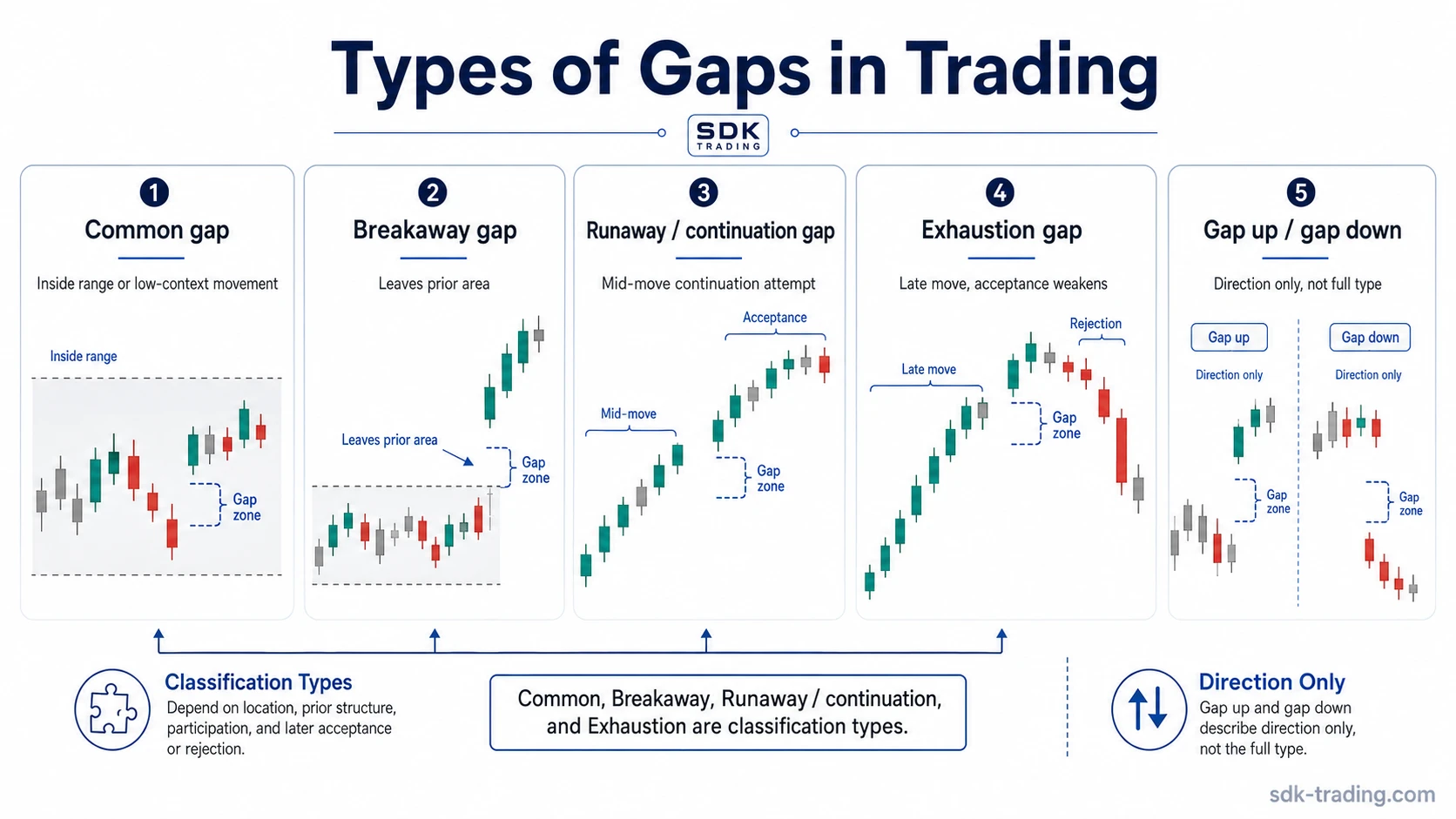
Misread vs Safer Interpretation
A gap label should survive more than a first glance. The empty space on the chart may draw attention, but classification depends on whether the surrounding structure supports or challenges the first reading.
Visual size misread: A large gap can look important because the empty space is obvious. The safer reading is that size raises attention, but does not decide whether the gap is common, breakaway, runaway, or exhaustion. A large gap inside a messy range may still be less meaningful than a smaller gap that leaves a well-defined area and holds.
Immediate fill misread: A fast return into the gap often weakens acceptance, but it does not classify the gap by itself. Gap fill behavior is a clue. The reading becomes more useful when the fill is compared with location, prior trend, volume or participation, and whether price can reclaim or lose the new area afterward.
One-candle misread: The first candle after the gap can be dramatic, but one candle rarely settles the type. A cleaner classification usually needs the next attempts to hold, reject, or revisit the gap area. The label loses quality when the next sequence contradicts the original story.
What Does Not Classify a Gap Type
Several inputs can help interpretation, but none of them should carry the classification alone.
| Input | Why it is not enough | What to compare it with |
|---|---|---|
| Size alone | A large untraded span can appear in different contexts | Location, prior structure, and later acceptance or rejection |
| One candle alone | The first candle may reflect opening imbalance rather than durable control | The next few attempts to hold or lose the new area |
| Volume alone | High activity can appear during breakaway, continuation, or exhaustion conditions | Effort, result, close location, and follow-through |
| Immediate fill alone | A fill can weaken acceptance without proving the original type | Whether price returns to acceptance, rejection, or unresolved balance |
| Narrative or catalyst alone | A news explanation can fit several chart outcomes | Whether the chart structure confirms the claimed shift |
How Gap Type Classification Can Weaken
A gap classification should remain conditional until later behavior supports it. A breakaway label loses quality if price cannot stay outside the prior range. A runaway label becomes less reliable if the gap appears after an already stretched move and the new area is rejected quickly. An exhaustion label becomes weaker if the market accepts the new area and continuation remains orderly.
Classification weakens when: price returns into the prior area, participation contradicts the label, the gap appears in the wrong location for the claimed type, or later structure invalidates the first reading.
Acceptance and rejection are especially important because they show whether the market treats the new area as a valid price zone. A gap that opens into a new area and then holds above or below the gap zone carries a different message from a gap that immediately fails and trades back through the prior area.
Simple Types of Gaps in Trading Example
A classification scenario should not be treated as historical proof or trade instruction. Price has spent several sessions moving sideways under a prior resistance area. The next session opens above that area, leaving a visible untraded span between the last candle of the range and the new opening area. The first read may be a breakaway attempt because the gap appears at the edge of a prior range.
The reading gains support if price holds above the old resistance area and later pullbacks fail to return deeply into the range. The same gap remains unresolved if price drifts back into the prior area and buyers cannot reclaim the new zone. If the gap had appeared much later after an already extended move, the same visual separation could require a different classification.
Where Breakaway and Runaway Gaps Fit
Breakaway and runaway gaps are often confused because both can appear with directional force. The cleaner distinction is sequence. A breakaway reading starts near the boundary of a prior range or base, while a runaway or continuation reading appears only after the move is already underway.
The first question is whether the gap is leaving a prior area or extending an accepted move. If price quickly rejects the new area, both readings weaken, but the failed context is different: the breakaway attempt loses its transition logic, while the runaway attempt loses its continuation logic.
FAQ
What are the main types of gaps in trading?
The main types of gaps in trading are common gaps, breakaway gaps, runaway or continuation gaps, and exhaustion gaps. Gap up and gap down describe direction, while the type label depends on context.
Is a gap up or gap down a gap type?
A gap up or gap down is a direction label. It tells whether the new traded area opened above or below the prior area, but it does not decide whether the gap is common, breakaway, runaway, or exhaustion.
Is a gap fill enough to identify the type?
No. A gap fill can weaken or change the interpretation, but it should be compared with location, participation, prior structure, and later acceptance or rejection.
What is the difference between a breakaway gap and a runaway gap?
A breakaway gap usually appears near a transition out of a prior range or base. A runaway gap usually appears after a directional move is already underway.
Can the first gap type label be revised after later price action?
Yes. The first label can become weaker after later price action. A gap that first looks like a breakaway or continuation attempt may lose that reading if the new area is rejected quickly.