A gap trading strategy starts to break down when the empty price area is treated as enough evidence by itself. A stronger framework first classifies the gap, then checks whether price accepts the new area, rejects it, begins filling it, or exposes the original reading as weak.
Key Points
- A gap trading strategy is a conditional process for reading price discontinuities, not a mechanical instruction.
- The main decision split is whether the gap is being accepted for continuation or rejected into a fill attempt.
- Gap type changes the interpretation because a breakaway, runaway, exhaustion, or island structure carries a different premise.
- Opening volatility, liquidity, catalyst quality, and post-gap behavior can weaken a clean-looking gap.
- The framework fails when it ignores where the gap formed, how price behaves after the gap, and what would invalidate the reading.
What Is a Gap Trading Strategy?
A gap trading strategy is a framework for interpreting a space between one accepted price area and the next active price area. The gap creates a question: has the market accepted a new area, rejected the move, or only reacted to short-lived imbalance?The useful work is not the recognition of the gap alone. The useful work is the sequence after the gap: location, catalyst, participation, liquidity, opening behavior, follow-through, rejection, and failure condition. A gap that appears at the start of a new range break carries a different message from a gap that appears late after a mature move.That is why gap trading strategies are usually safer as diagnostic frameworks than as fixed rule systems. The same visible space on a chart can mean continuation, exhaustion, poor liquidity, news repricing, or only temporary emotional pressure.
Why Gap Strategies Fail When the Gap Is Treated as the Signal
Mechanical gap logic often fails because the visible gap hides several different market conditions. A gap after a clean base can reflect new acceptance outside the old range. A gap after an extended move can reflect late participation. A gap during thin liquidity can look decisive while the market is still unstable.The failure usually comes from compressing all of those conditions into one label. A gap up is not automatically continuation. A gap down is not automatically weakness. A fill attempt is not automatically rejection. A hold above the gap is not automatically durable acceptance.The stronger reading comes from asking what the gap was supposed to prove and then watching whether later behavior supports that premise. If the premise was range separation, price should spend enough time outside the old area to show acceptance. If the premise was exhaustion, weak follow-through and rejection back toward the gap become more important than the gap itself.
Gap Fill vs Continuation: The Main Decision Split
Most gap trading strategy decisions reduce to one early split: the market is either accepting the gap area or challenging it. Acceptance means price can hold in the new area long enough for the gap to look structurally meaningful. Rejection means the market begins moving back toward the untraded space or the prior accepted range.A continuation reading is cleaner when the gap appears with a coherent premise, such as range separation, catalyst repricing, or strong participation after a prior consolidation. A runaway gap belongs in this continuation family when it forms during an already active move and the market continues to accept prices beyond the gap.A fill reading becomes more plausible when the gap fails to attract follow-through, when the open is emotional but unstable, or when price quickly loses the new area. A fill attempt is still only a test. If price moves into the gap but cannot reclaim the prior area, the reading remains unresolved rather than automatically bearish or bullish.
| Decision split | What the market is testing | What strengthens the reading | What weakens the reading |
|---|---|---|---|
| Continuation | Whether the new area is accepted | Price remains outside the old range and follow-through is orderly | Fast return into the prior range or repeated failed expansion |
| Fill attempt | Whether the gap area is being rejected | Price moves back into the untraded space with poor acceptance above or below it | The fill attempt stalls and the market re-accepts the new area |
| Unresolved | Whether the gap was meaningful at all | Clear later acceptance or rejection appears | Mixed candles, poor liquidity, and no durable control shift |
Gap Types That Change the Framework
Gap type matters because each category starts with a different premise. A gap that separates from a prior accepted range asks whether the old range has lost control. A late-trend gap asks whether the move is becoming vulnerable to exhaustion. A continuation gap asks whether the existing trend still has participation behind it.
| Gap type | Main premise | What to watch after the gap | Framework risk |
|---|---|---|---|
| Common gap | A temporary price discontinuity without a strong structural claim | Whether price quickly returns into nearby accepted prices | Overreading a low-information gap |
| Breakaway behavior | A gap that separates from a prior accepted range | Whether price holds outside the old boundary | Calling separation too early when price quickly returns |
| Runaway or continuation behavior | The existing move may still be accepted | Whether follow-through remains controlled rather than emotional | Confusing temporary extension with durable continuation |
| Exhaustion behavior | Late participation may be appearing after a mature move | Whether price rejects the gap area or loses follow-through | Calling exhaustion before rejection is visible |
| Island structure | Price becomes isolated between two gaps | Whether the isolated area remains rejected | Treating any two gaps as a valid island pattern |
A gap classification does not need to become a full taxonomy every time. For strategy work, the main value is knowing which premise is being tested and what would make that premise weaker.
A Safer Gap Trading Framework Sequence
A safer gap trading framework starts with classification and ends with failure conditions. The sequence should reduce interpretation risk before the gap is treated as meaningful.
- Classify the gap. Decide whether the gap looks common, breakaway, continuation, exhaustion, or part of a special structure.
- Identify the premise. Define what the gap is supposed to show: new acceptance, continuation, rejection, or late-stage weakness.
- Check location. Compare the gap with the prior range, trend maturity, nearby supply or demand, and visible untraded space.
- Check catalyst and liquidity. Separate structured repricing from thin, unstable, or news-driven movement.
- Read post-gap behavior. Look for acceptance outside the old area, rejection into the gap, failed follow-through, or unresolved overlap.
- Define the failure condition. State what would make the original reading unreliable before treating the gap as useful evidence.
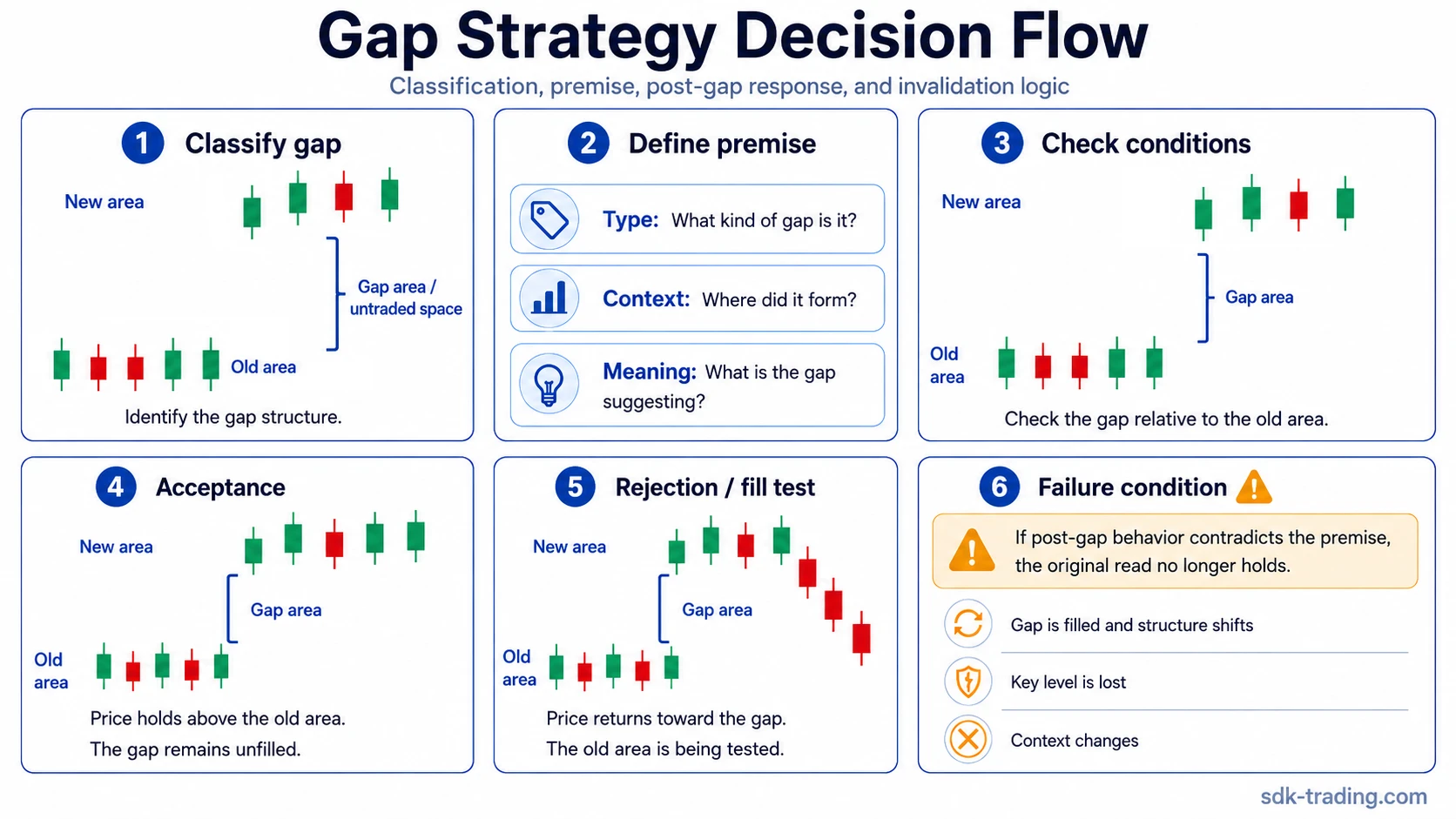
This sequence keeps the focus on interpretation quality. A gap can be visually clean and still be a weak strategic input if the post-gap market does not behave in line with the original premise.
Post-Gap Behavior That Matters Most
The first active price area after the gap often provides better information than the gap itself. Holding outside the previous range is different from immediately returning into old prices. A brief extension followed by a stall is also different from step-by-step acceptance.Volume and liquidity need careful treatment. Higher activity can support the reading when it reflects broad participation, but it can also appear during unstable news repricing or forced movement. Thin liquidity can create a large gap that looks important while offering little evidence of durable acceptance.Opening behavior also needs restraint. A sharp first move after the gap may only show imbalance. The more useful question is whether the market can keep accepting the new area after the first reaction fades.
| Post-gap behavior | Possible interpretation | What would make it less reliable |
|---|---|---|
| Holds outside the old range | Possible acceptance of a new area | Immediate return into the old range |
| Extends briefly, then stalls | Possible weak continuation | No follow-through after the first emotional move |
| Moves back into the gap | Possible rejection or fill attempt | The move stalls inside the gap and acceptance returns outside it |
| Forms heavy overlap near the gap | Unresolved control | No clear acceptance, rejection, or directional pressure |
| Gaps again in the opposite direction | Possible structural rejection | The second gap lacks isolation or follow-through |
Gap Trading Failure Modes
The most useful gap framework is often a failure-mode framework. Instead of asking only what the gap might mean, the better question is what would make that meaning unreliable.
| Condition | Possible reading | What weakens it | Safer treatment |
|---|---|---|---|
| Small unclear gap | Temporary imbalance or low-information discontinuity | No clear separation from the prior accepted area | Treat as background context until stronger structure appears |
| Gap beyond a prior range with acceptance | Possible range separation | Fast return into the old range | Track whether the old boundary becomes accepted or rejected |
| Late gap after an extended move | Possible exhaustion gap | Strong acceptance beyond the gap rather than rejection | Wait for evidence that follow-through is failing before labeling exhaustion |
| Gap into resistance, supply, support, or demand | Possible test of a known reaction area | The market accepts beyond the area rather than rejecting it | Separate location from response; the level alone is not enough |
| News-driven gap with poor liquidity | Possible repricing or temporary dislocation | Wide spreads, disorderly movement, or erratic overlap | Reduce confidence in clean pattern labels until liquidity normalizes |
| Gap fill attempt that fails | Possible rejection of the fill attempt | Price cannot reclaim the old area or stabilize inside the gap | Treat the fill as a test, not as proof of reversal |
| Gap continuation that fails back into the prior range | Possible false continuation | Acceptance disappears after the first expansion | Downgrade the continuation premise and reassess the prior range |
Risk Conditions That Make Gap Readings Unstable
Gap readings become less stable when the market is repricing faster than participation can be evaluated. Thin liquidity, wide spreads, event risk, and abrupt opening movement can all make a gap appear cleaner than it is.Slippage risk is part of the interpretation problem. If the market is moving through price levels too quickly, the chart can show a neat gap while actual execution conditions remain unstable. That does not invalidate every gap reading, but it lowers confidence in any framework that assumes smooth behavior.Event risk creates a second problem. A gap that follows earnings, macro news, regulatory headlines, or other sudden information can reflect rapid repricing rather than a reusable technical pattern. In that environment, the framework should ask whether the market later accepts the new information or rejects the first reaction.
| Risk condition | Why it matters | Safer interpretation |
|---|---|---|
| Thin liquidity | The gap may be exaggerated by weak participation | Wait for more stable acceptance or rejection evidence |
| Large spread or fast opening movement | The chart may look cleaner than the actual market | Treat early prints as noisy until structure becomes readable |
| Order execution risk around the gap | Fast movement can make the practical reading less stable than the chart pattern suggests | Keep the reading conditional until price behavior becomes observable and orderly |
| Strong catalyst but weak follow-through | The first reaction may not be durable | Separate the news reaction from later market acceptance |
| Gap into a mature trend | Late participation can appear after most of the move has already developed | Look for weak expansion, rejection, or return into the gap |
| Overlapping candles after the gap | Control is unclear | Keep the reading unresolved until a cleaner response appears |
Gap Trading Strategy Example in Context
A gap trading example is clearer when the chart is read as a sequence instead of a single signal. The same framework can show a gap above a prior area, a failed hold back into the gap, and a later gap-down structure where a fill attempt remains only a test.
| Chart stage | What appears on the chart | Cleaner interpretation |
|---|---|---|
| Gap above prior area | Price opens above an older boundary and creates visible untraded space. | The gap can support a continuation scenario only if price holds the new area. |
| Failed hold back into gap | Price loses stability above the boundary and starts moving back into the gap. | The continuation premise weakens because the market has not accepted the new area. |
| Gap down and fill test | Price gaps lower, accepts the lower area, and later moves back toward the old gap zone. | A fill attempt is not a complete conclusion unless price can reclaim and hold the old area. |
If a later second gap isolates a small price area from both sides, the structure should be compared with an island reversal rather than treated as a basic gap-fill or continuation question.
How Gap Up and Gap Down Readings Fit the Same Framework
Gap up and gap down readings use the same diagnostic sequence. The direction changes, but the underlying question remains the same: did the market accept a new area, reject the move, or create only temporary dislocation?A gap up can fail if price cannot hold above the prior accepted area. A gap down can fail if price quickly reclaims the old area and rejects lower prices. The direction of the gap does not remove the need to classify the structure, check participation, and define the failure condition.Overnight gaps need the same restraint. They can reflect information that arrived while the market was closed, but the technical reading still depends on how the market behaves after regular participation returns.
Common Mistakes in Gap Trading Strategies
- Reading every gap as a fill candidate. Some gaps are accepted rather than filled, especially when the market has separated from a prior range with clear participation.
- Reading every strong gap as continuation. Late gaps can appear near exhaustion, especially when follow-through weakens after an extended move.
- Ignoring the prior range. A gap beyond a range boundary carries a different premise from a gap inside noisy overlap.
- Ignoring liquidity. Large gaps during unstable conditions can look clean while the market remains hard to interpret.
- Forcing exact labels too early. A gap may stay unresolved until acceptance, rejection, or failed follow-through becomes visible.
When a Gap Trading Strategy Should Stay Unresolved
Some gaps should not be classified aggressively. Mixed candles near the gap, thin participation, failed attempts in both directions, and no clear relationship to the prior range can leave the structure unresolved.An unresolved reading is not a weak conclusion. It is often the most accurate conclusion when the gap has not yet shown acceptance, rejection, or a clean failure condition. The framework becomes more reliable when it allows unclear gaps to remain unclear.
FAQ
What is the main idea behind a gap trading strategy?
The main idea is to classify the gap, identify what the gap is supposed to imply, and then test whether price accepts or rejects the new area. The gap itself is only the starting condition.
Does every gap need to be filled?
No. Some gaps are accepted and remain open for a long time, while others are challenged quickly. A fill attempt becomes more meaningful only when price behavior shows rejection of the new area.
What makes a gap continuation reading weak?
A continuation reading weakens when price fails to hold the new area, returns into the prior range, or shows poor follow-through after the first reaction. Liquidity and event risk can also distort the reading.