An island reversal is a gap pattern where price becomes isolated between two gaps: one gap after the prior move and a second gap in the opposite direction. The pattern can suggest that control has shifted, but the reading only holds while the isolated area remains separated and later price action does not accept back into the gap or island area.The structure is not a guaranteed reversal. It is a diagnostic clue. The useful question is whether price has truly rejected the isolated area, or whether the gaps are being filled and the structure is turning back into ordinary overlap.
Key Points
- An island reversal is defined by price becoming isolated between two opposing gaps.
- The structure usually appears after a prior move, then gaps away from the isolated area in the opposite direction.
- A bullish island reversal forms after downside pressure; a bearish island reversal forms after upside pressure.
- The reading is stronger when the island remains compact, separated, and not quickly accepted back into.
- The reading weakens when the gap fills, overlap increases, or the supposed island becomes ordinary consolidation.
What Is an Island Reversal?
An island reversal is a price pattern where one or more candles are separated from surrounding price action by two gaps in opposite directions. The first gap creates separation from the prior move. The second gap rejects the isolated area by moving away in the opposite direction.That separation is what gives the pattern its name. The candles between the two gaps appear to trade on an “island” because they are disconnected from the price action before and after the pattern.In candlestick and chart-pattern analysis, an island reversal belongs to the gap-pattern family. It can appear as an island top after upside pressure or as an island bottom after downside pressure. In both cases, the pattern is judged by gap integrity, overlap, and later acceptance rather than by the isolated candle group alone.
| Part | What to look for | Why it matters |
|---|---|---|
| Prior move | Price has been moving in one direction before the first gap | Gives the island reversal its directional context |
| First gap | Price separates from the prior accepted area | Creates the first side of the island |
| Isolated area | One candle or a compact group of candles trades away from surrounding price action | Forms the visible island structure |
| Second opposite gap | Price gaps away from the island in the opposite direction | Shows rejection of the isolated area |
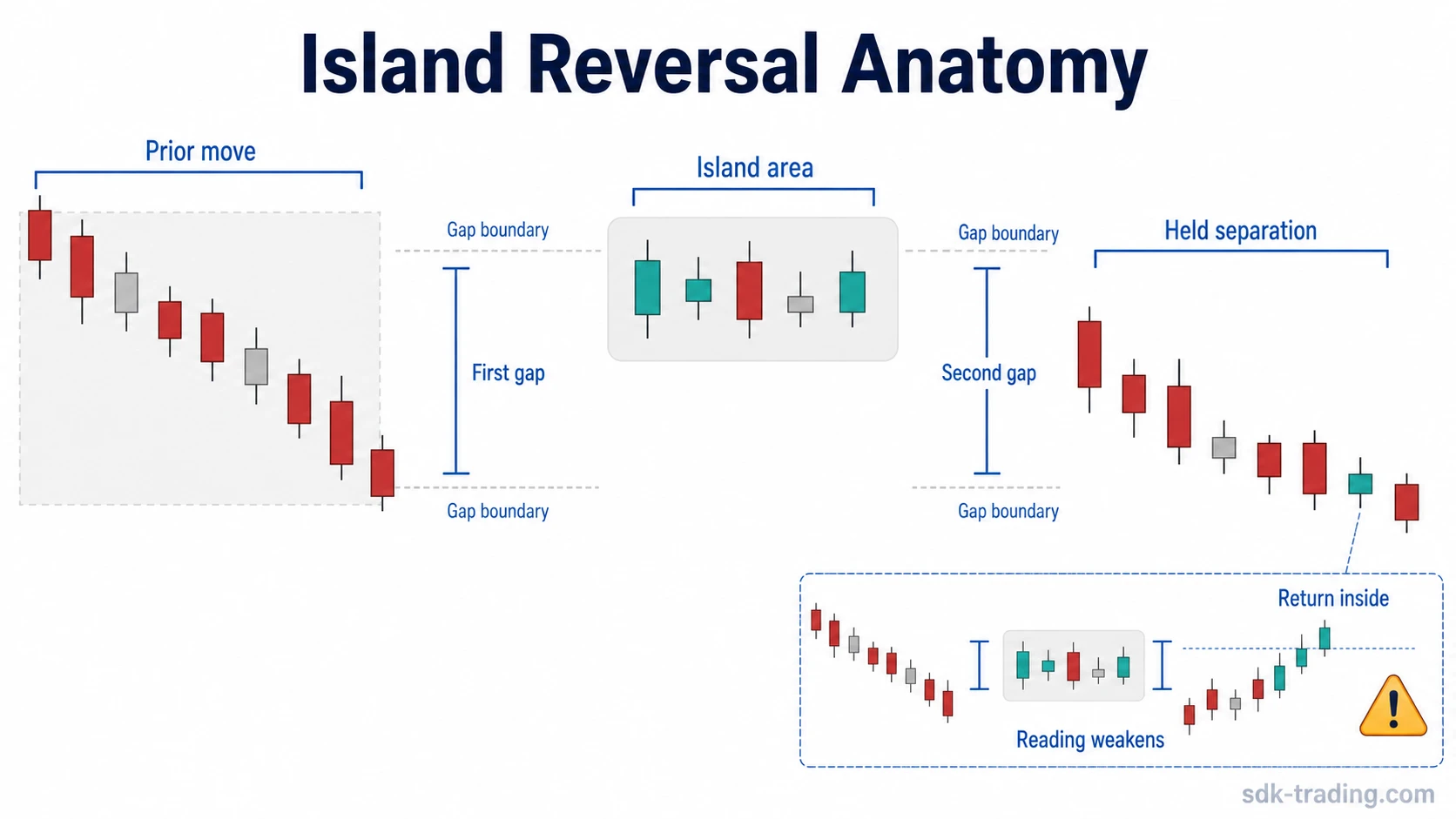
How an Island Reversal Forms
An island reversal forms through a specific sequence: price first separates from the old move, trades briefly in an isolated area, and then gaps away from that isolated area in the opposite direction.
- Prior move. Price advances or declines before the island structure begins.
- First gap. Price gaps in the direction of the prior move and separates from the previous price area.
- Island area. One candle or a small candle group forms away from the prior range.
- Second gap. Price gaps in the opposite direction and leaves the island behind.
- Later test. Price either respects the separation or returns back into the island or gap area.
The second gap is the key structural event. Without it, the chart may only show a gap, a pause, or a late-move extension. The island reversal reading needs both separation and rejection.Volume, range expansion, and clean gap boundaries can support the reading, but they do not prove that a reversal must continue. The pattern becomes more meaningful when the surrounding structure supports the same reading and price does not quickly return into the isolated area.
Bullish vs Bearish Island Reversal
An island reversal can be bullish or bearish. The difference depends on the prior move and the direction of the second gap.
| Version | Typical prior context | Gap sequence | Structural reading |
|---|---|---|---|
| Bullish island reversal | Downside pressure or a decline | Gap down, isolated candles, then gap up | Price rejects the lower island area |
| Bearish island reversal | Upside pressure or an advance | Gap up, isolated candles, then gap down | Price rejects the higher island area |
A bullish island reversal usually appears after price has been moving lower. The first gap pushes price down into an isolated area. The second gap lifts price back above that area, leaving the lower candles separated from the surrounding chart.A bearish island reversal usually appears after price has been moving higher. The first gap pushes price up into an isolated area. The second gap drops price below that area, leaving the upper candles separated from the surrounding chart.Neither version should be treated as a standalone trading system. The pattern creates a reversal scenario; it does not prove that a full reversal must follow.
How to Identify an Island Reversal
A valid island reversal should show a clear two-gap structure. The pattern becomes weaker when the gaps are messy, the island stretches too long, or price quickly returns into the isolated area.
| Check | Stronger reading | Weaker reading |
|---|---|---|
| Prior move | Clear directional move before the first gap | Choppy or unclear prior context |
| First gap | Visible separation from previous price action | Small gap with heavy overlap |
| Island area | Compact candle group or short isolated range | Long sideways area that looks like ordinary consolidation |
| Second gap | Opposite-direction gap away from the island | Minor movement with little separation |
| Overlap | Little or no meaningful overlap with surrounding candles | Wicks and closes repeatedly fill the gap area |
| Later behavior | Price does not quickly accept back into the island | Price returns into the island soon after the second gap |
| Participation | Range and volume may support the shift | Volume alone is treated as proof |
The most important test is not whether a gap exists. It is whether the two gaps keep the island separated. If later price action fills the gap and accepts back inside the island, the structure loses the separation that made it meaningful.
Clean, Weak, and Invalid Island Reversal Readings
The cleanest island reversal has visible separation, a compact island, and no quick return into the isolated area. A weaker version may still have the basic shape, but the boundaries are less reliable. An invalid version loses the isolation altogether.
| Reading quality | Structure | Interpretation |
|---|---|---|
| Clean reading | Clear prior move, first gap, compact island, opposite gap, and no immediate acceptance back into the island | The island structure is intact and the reversal scenario is easier to define |
| Weak reading | Messy gap boundaries, heavy overlap, low participation, or an island that stretches into ordinary consolidation | The chart may still show a two-gap idea, but the isolation is less convincing |
| Invalid reading | Price fills the gap and accepts back inside the island area | The separation is removed, so the island reversal reading fails or becomes unreliable |
A clean reading does not mean certainty. It only means the structure is easier to define. The pattern still needs later price behavior to support the interpretation.A weak reading often appears when traders label any two nearby gaps as an island reversal. If the supposed island is too wide, too overlapped, or too slow to reject, it may be better understood as a consolidation area with gaps around it.An invalid reading appears when price returns into the island and holds there. At that point, the market is no longer treating the isolated area as rejected.
Island Reversal Reading Example in Context
Price has been advancing for several sessions and then gaps above the prior trading area. A small candle group forms above that gap. The move can look like continuation at first because price is still above the old area and the gap appears decisive.The reading changes if the next move gaps lower and leaves that small candle group isolated from both sides. The island reversal idea becomes tempting because the market first accepted a higher area briefly, then rejected it with an opposite gap.The structure is still unresolved if price quickly returns into the island. A stronger reading would show the second gap holding and the isolated area remaining rejected. A weaker reading would show price filling the gap, overlapping the island candles, and removing the separation that made the structure visible.If the move is only a late gap after an extended advance, it may need to be compared with an exhaustion gap before the island reversal label is trusted.
Island Reversal vs Related Gap Patterns
Island reversal overlaps with other gap concepts, but it is not the same as every gap that appears near a turning point.An exhaustion gap can appear late in a move and may precede reversal pressure, but one exhaustion-style gap is not enough to create an island reversal. The island reversal requires two opposing gaps and an isolated price area between them.A runaway gap is different because it usually appears during an active trend and supports continuation. It does not require price to become isolated and then rejected by a second opposite gap.A breakaway gap is also different. It usually marks price leaving a prior range, base, or congestion area. An island reversal can include a strong gap away from an isolated area, but its defining feature is the two-gap isolation.A gap fill can weaken or invalidate the island reversal reading. If price returns into the gap or accepts back inside the island, the market is no longer preserving the separation.
Common Mistakes When Reading Island Reversals
- Treating every gap as an island reversal. A single gap may be meaningful, but it does not create an island structure by itself.
- Ignoring overlap. If candle bodies and wicks repeatedly trade back through the supposed gap area, the separation may be too weak to support a clean island reading.
- Assuming the second gap guarantees a reversal. The second gap creates rejection of the island area, but later price action still decides whether the structure remains intact.
- Treating volume as proof. Strong volume can support the reading when it appears with clean gap separation, but it cannot confirm the whole outcome on its own.
- Turning the pattern into a trade signal. An island reversal is best read as a structural condition: price was isolated, then rejected. Any stronger conclusion needs broader market structure, risk context, and later confirmation.
When the Island Reversal Reading Should Stay Unresolved
Some island reversal candidates should stay unresolved instead of being forced into a bullish or bearish label. This often happens when the island is too wide, the gaps are too small, or price repeatedly trades back into the supposed separation.An unresolved reading is not a weak conclusion. It is often the safer interpretation when the chart has not preserved the gap structure clearly enough. The pattern becomes more useful when the structure clearly shows what would strengthen it, what would weaken it, and what would invalidate it.
FAQ
What does an island reversal mean?
An island reversal means price action has become isolated between two opposing gaps, suggesting a possible shift in control. The reading depends on whether the gap separation remains intact.
Is an island reversal bullish or bearish?
It can be either. A bullish island reversal usually appears after downside pressure and gaps upward out of the island. A bearish island reversal usually appears after upside pressure and gaps downward out of the island.
How do you identify an island reversal?
Look for a prior move, a first gap, a compact isolated candle group, and a second gap in the opposite direction with little or no meaningful overlap.
What invalidates an island reversal?
The reading weakens or fails if price fills the gap, accepts back into the island area, or if the supposed island becomes ordinary overlapping consolidation.
Is an island reversal the same as an exhaustion gap?
No. An exhaustion gap can appear near the end of a move, but an island reversal requires price to be isolated between two opposing gaps.