An exhaustion gap is a late-stage price gap that appears after an extended move, but the gap itself does not prove that the trend is finished. The reading is more defensible when later price action shows weak follow-through, rejection, or a return into the gap instead of clean acceptance in the direction of the prior trend.
Definition: An exhaustion gap is a price gap that appears after a mature advance or decline, leaves visible untraded space, and becomes easier to classify when later candles fail to accept the new price area.Boundary: It is not confirmed by the first gap candle, gap size, or high volume alone. The reading has better support when follow-through weakens, price rejects the new area, or price returns into the gap. It loses force when price holds beyond the gap and continues with clean acceptance.
Key Points
- An exhaustion gap forms late in an existing move, not at the start of a new range break.
- Gap size and high volume can support the reading, but neither confirms exhaustion alone.
- The strongest reading comes from context plus response: mature trend, emotional gap, weak continuation, rejection, or gap fill behavior.
- The reading weakens if price accepts beyond the gap and continues with structure similar to a continuation gap.
What Is an Exhaustion Gap?
An exhaustion gap is a price gap that appears near the late stage of a strong advance or decline. It reflects a sudden jump in price after the trend has already traveled far enough to attract emotional participation, late positioning, or forced reaction from traders who were not positioned earlier.The important distinction is that the first gap candle is only the candidate. A gap is easier to classify as exhaustion after the market shows that the move is losing acceptance. That can appear through shallow follow-through, a rejection back toward the gap, a failure to hold the new area, or a later move back into the untraded space.An exhaustion gap is therefore a diagnostic reading, not a trade command. It describes a possible loss of trend energy after a mature move. It does not automatically mean reversal, and it does not say that every gap must be filled.
How an Exhaustion Gap Forms
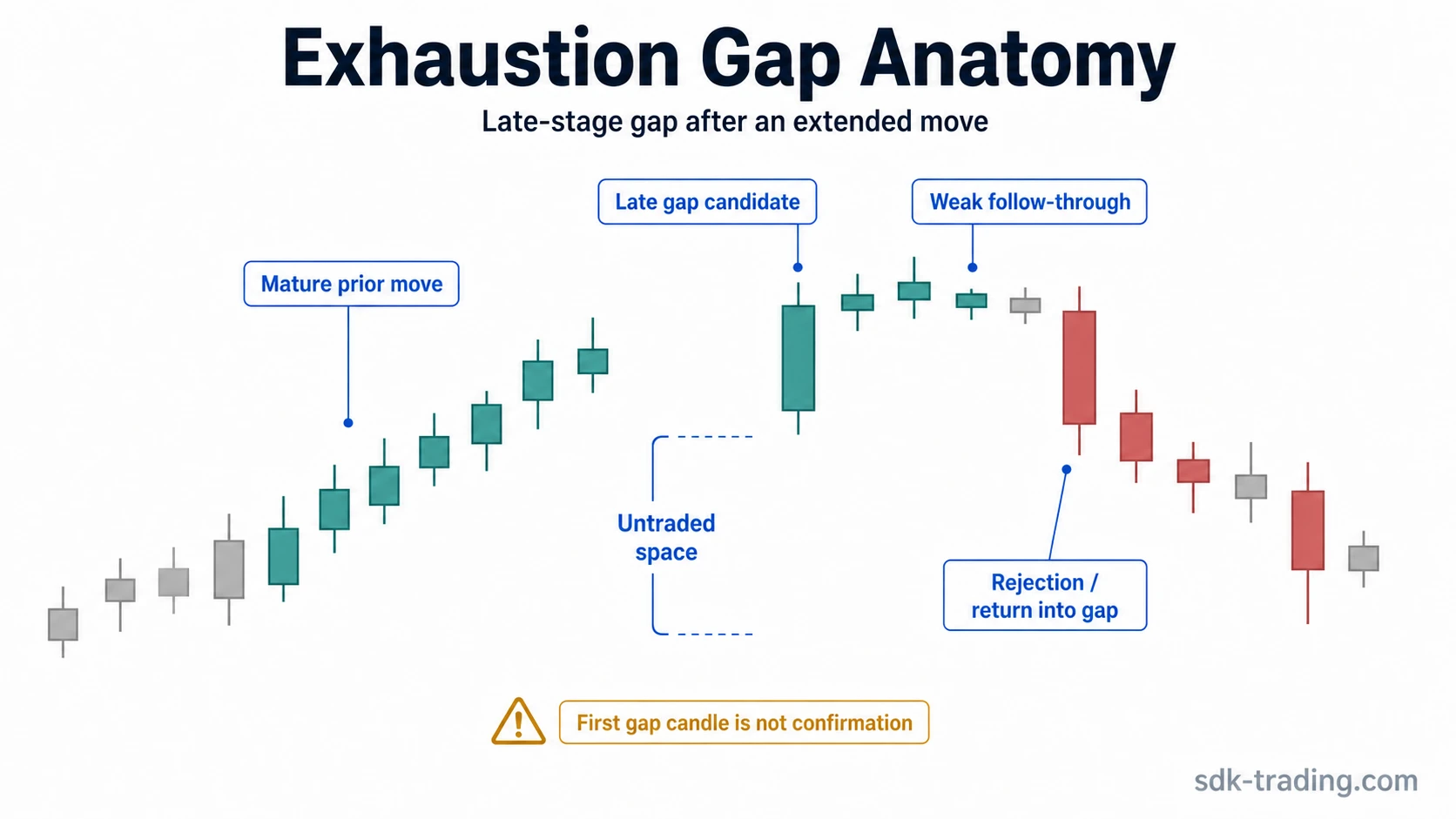
The structure begins with an existing directional move. In a bullish example, price has already advanced for several swings, candles are extended, and participation may become more emotional. Then price opens above the prior session or prior candle range, leaving visible untraded space between the old price area and the new one.That gap can look strong at first. The problem is that a late gap can attract the last wave of participation rather than a fresh trend foundation. If the new area cannot hold cleanly, the gap starts to look less like strength and more like a final expansion attempt.In a bearish example, the same logic appears in reverse. Price has already declined sharply, then gaps lower in the direction of the existing move. If sellers fail to maintain pressure and price starts returning into the gap, the bearish gap may reflect exhaustion rather than clean continuation.The anatomy has four parts: a mature prior move, a gap in the direction of that move, visible untraded space, and later behavior that tests whether the new area is accepted or rejected.
How to Identify an Exhaustion Gap Without Overreading It
The safest reading starts with context. A gap that appears after a long advance or decline has different meaning from a gap that appears after a base, consolidation, or fresh range break. Location matters because exhaustion is about a late-stage move, not the visual gap alone.Volume can add useful context when it expands with the gap, but volume by itself is not confirmation. A high-volume gap can also appear during a strong breakout, a news-driven repricing, or a continuation move with real acceptance. The follow-through after the gap decides whether the participation created acceptance or exposed late-stage instability.
| Reading element | Stronger exhaustion reading | Weak or invalid reading |
|---|---|---|
| Prior trend | The move is already extended and visibly mature. | The gap appears early, after a base, or without clear trend maturity. |
| Gap location | The gap forms in the direction of the existing move after emotional expansion. | The gap clears a boundary and begins a new accepted area. |
| Participation | Activity expands, but later price action fails to confirm clean acceptance. | Participation expands and price continues to hold the new area cleanly. |
| Follow-through | Continuation is shallow, quickly rejected, or unable to extend meaningfully. | Price extends beyond the gap and holds the continuation structure. |
| Gap response | Price returns into the gap or rejects the new extreme area. | The gap remains open while price builds acceptance beyond it. |
A practical scenario is a market that gaps higher after a long rally, prints strong early activity, but then fails to build above the gap. If the next candles stall, reject the new high area, and start moving back into the untraded space, the exhaustion reading has better support. If price instead holds above the gap and continues with orderly acceptance, the same first candle becomes a poor exhaustion read.
Clean, Weak, and Invalid Exhaustion Gap Readings
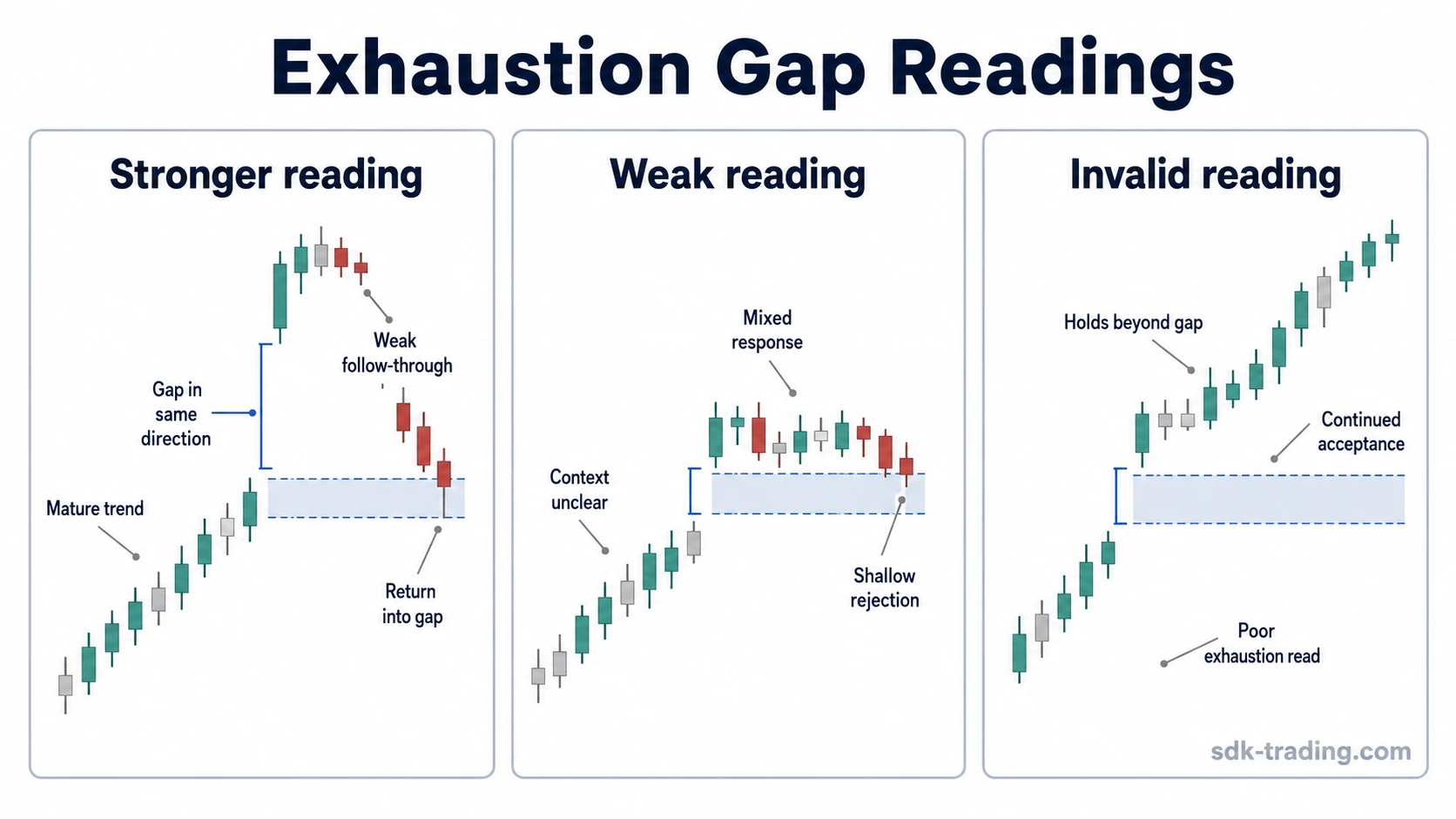
The quality of the reading depends on how much evidence appears after the gap. A clean reading has several conditions aligned. A weak reading has some late-trend features but lacks decisive response. An invalid reading shows that the gap was probably continuation, repricing, or a boundary break instead of exhaustion.
| Reading | What the structure shows | Why the interpretation is stronger or weaker |
|---|---|---|
| Clean exhaustion reading | Extended prior move, gap in the same direction, active participation, weak follow-through, and rejection or return into the gap. | The market fails to accept the new price area after a late expansion attempt. |
| Weak exhaustion reading | Late-trend context is possible, but follow-through is mixed, rejection is shallow, or the prior trend is not clearly mature. | The gap may be exhaustion, but the evidence is not strong enough to separate it from normal pause behavior. |
| Invalid exhaustion reading | Price holds beyond the gap, builds acceptance, and continues in the original direction. | The market is treating the gap as continuation or repricing rather than failed late participation. |
Exhaustion Gap vs Breakaway Gap vs Runaway Gap
Exhaustion gaps are often confused with other gap types because the first candle can look similar. The difference is not only the gap shape. The difference is where the gap appears and what the market does afterward.
| Gap type | Typical location | Later response that supports the reading | Main misread to avoid |
|---|---|---|---|
| Breakaway gap | Near a boundary, base, or consolidation. | Price accepts outside the old area and builds a new range. | Calling a new range break exhaustion too early. |
| Runaway gap | In the middle of a continuing move. | Price holds the gap area and continues with acceptance. | Calling continuation exhaustion before follow-through weakens. |
| Exhaustion gap | Late in an already extended advance or decline. | Follow-through weakens, price rejects the new area, or price returns into the gap. | Treating every large or high-volume gap as a reversal warning. |
A breakaway gap usually shifts the accepted area. A runaway gap usually continues the accepted trend. An exhaustion gap is weaker as a classification until the later response shows that the new area is not being accepted.
Common Mistakes When Reading Exhaustion Gaps
The most common mistake is calling the gap exhaustion because it looks dramatic. A large gap can be emotional, but size does not prove exhaustion. A strong market can gap and continue if buyers or sellers keep accepting the new area.A second mistake is treating high volume as proof. High volume only says activity increased. It does not tell whether the activity created durable acceptance or exposed late participation that could not continue.A third mistake is treating every gap fill as confirmation. A gap can be filled for many reasons, including routine volatility, news digestion, or broader range behavior. The fill matters more when it follows mature trend context and weak continuation after the gap.The better question is not whether the gap is impressive. The better question is whether the market can accept the new area after the gap appears.
When a Return Into the Gap Matters
A return into the gap can support the exhaustion reading when it follows weak continuation, rejection of the new area, or loss of acceptance after an extended move. The return is a response to watch, not a rule that every exhaustion candidate must obey.The return has better diagnostic value when price first fails to hold the new post-gap area and then accepts back into the gap. If price holds beyond the gap and builds acceptance there, the exhaustion argument weakens.This is why gap-fill behavior in stocks should be read as a separate response pattern, not as automatic proof that an exhaustion gap is present.
FAQ
What is an exhaustion gap in trading?
An exhaustion gap is a late-stage gap that appears after an extended move and may show that the trend is losing acceptance. The gap itself is not enough. The reading has better support when later price action shows weak follow-through, rejection, or movement back into the gap.
When does an exhaustion gap reading become stronger?
The reading becomes stronger when the gap appears late in an extended move and later behavior shows weak follow-through, rejection of the new area, or acceptance back into the gap.
How is an exhaustion gap different from a runaway gap?
A runaway gap usually holds and continues in the direction of the existing trend. An exhaustion gap appears later in a mature move and becomes more likely when continuation weakens or price returns into the gap.
How is an exhaustion gap different from a breakaway gap?
A breakaway gap appears near a boundary, base, or consolidation and can begin a new accepted price area. An exhaustion gap appears late in an already extended move and depends on later failure to accept the new area.
When does an exhaustion gap reading weaken?
The reading weakens when price holds beyond the gap, continues accepting the new area, or shows clean follow-through instead of late-stage rejection or movement back into the gap.