Breakaway and runaway gaps can look almost identical on the chart. The primary difference is where the gap appears in the larger price sequence. A breakaway gap leaves structure that previously contained price. A runaway gap appears after a directional move is already established and extends that move.
Core distinction: classify the gap by looking at what existed before it. Leaving a range, base, congestion area, or meaningful boundary supports a breakaway reading. Gapping after the directional leg is already underway supports a runaway reading. Gap size alone does not separate the two.
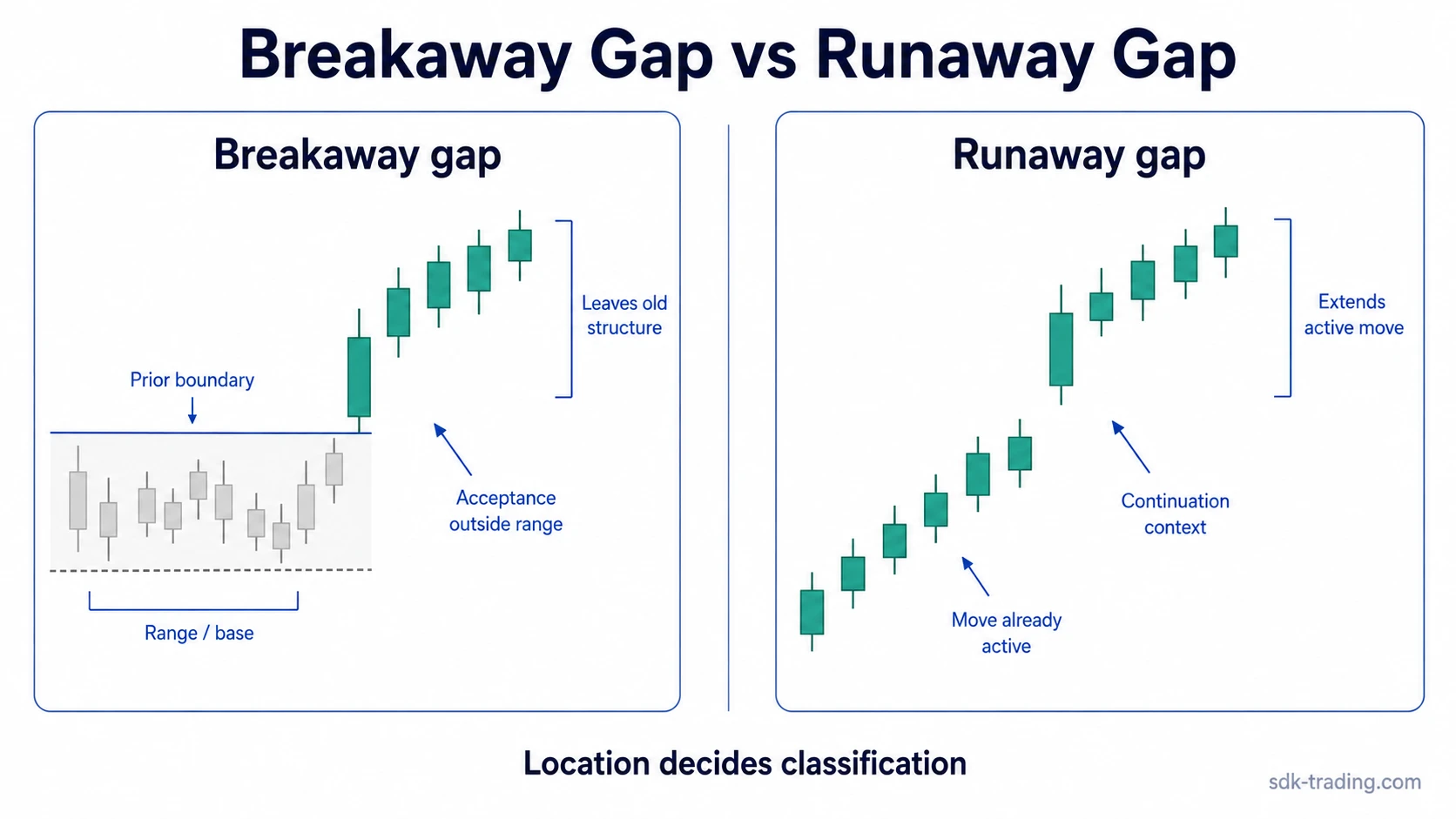
Breakaway Gap vs Runaway Gap: Quick Difference
| Comparison point | Breakaway gap | Runaway gap |
|---|---|---|
| What exists before the gap? | A range, base, congestion area, or meaningful structural boundary | An established directional move |
| Where does the gap occur? | At the transition away from the old structure | Inside the directional leg after that move has already begun |
| Structural job | Creates separation from an area that previously contained price | Extends directional movement that is already established |
| What does not classify it? | Gap size alone, volume alone, or one strong candle after the gap | |
Start by Looking Left of the Gap
The most useful information is usually on the left side of the gap. Before labeling the event, identify whether price was contained by a recognizable structure or was already progressing directionally.
- Identify the pre-gap state. Was price inside a range, base, congestion area, or repeated boundary?
- Check whether a directional leg already existed. Several established directional swings before the gap make a runaway classification more plausible.
- Locate the gap inside that sequence. The first clean separation from prior structure differs from another gap later in the same move.
- Check whether the move was already mature. A late gap followed by immediate stalling may require an exhaustion reading instead of forcing a runaway label.
Classification boundary: breakaway and runaway describe different positions inside the price sequence. They are not different labels for large and small gaps.
What Makes a Breakaway Gap Different
A breakaway gap appears when price separates from a structure that had previously contained it. That structure might be a sideways range, a base, a compression area, or another meaningful boundary.
The defining feature is the transition in market location. Before the gap, price is still inside or immediately against the old structure. After the gap, price is trading beyond it.
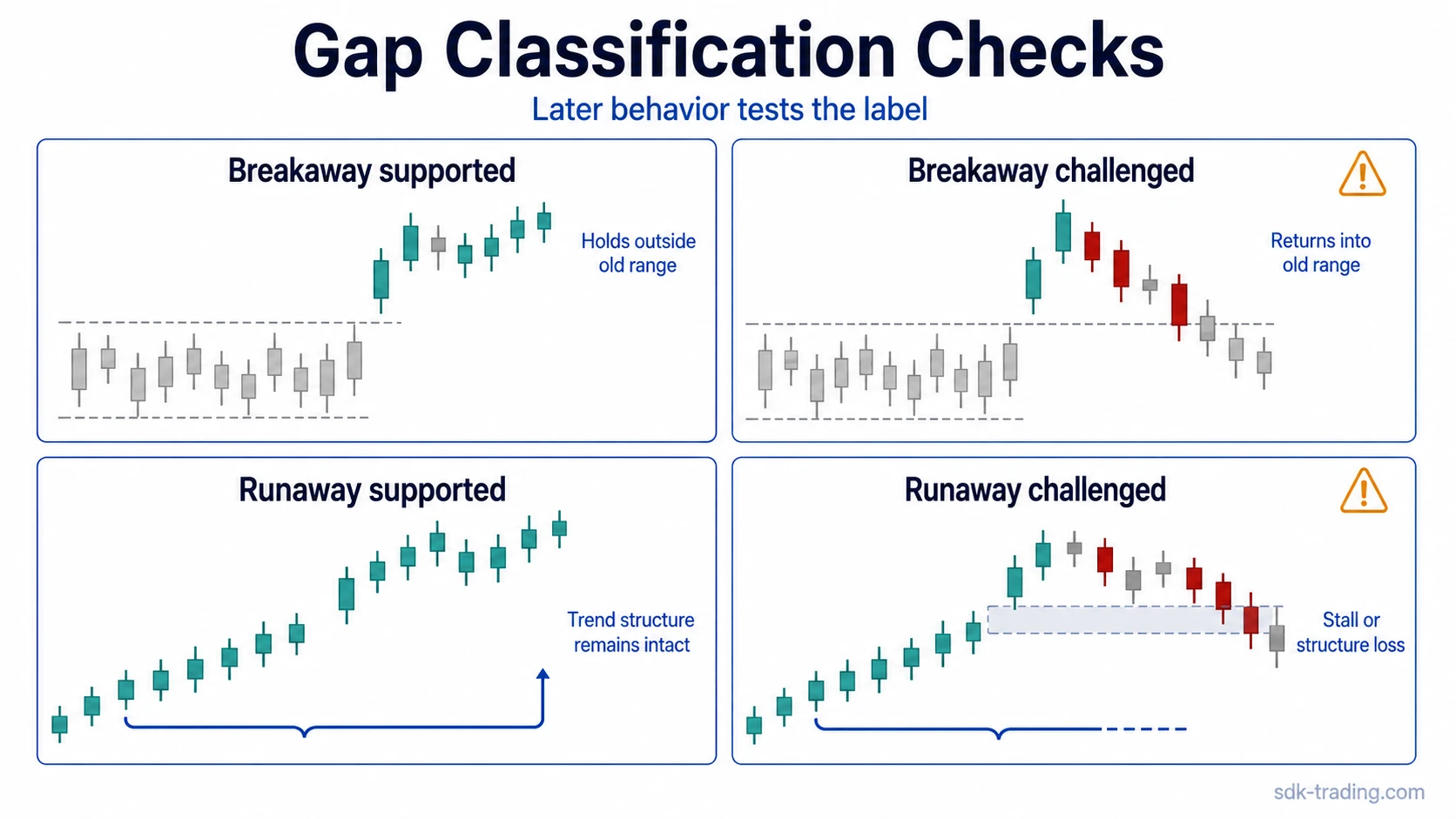
A breakaway reading becomes less convincing if price quickly returns through the boundary and moves back into the same area that was supposed to have been left behind.
What Makes a Runaway Gap Different
A runaway gap appears after the directional move has already begun. Price has moved away from its earlier structure, established directional progression, and then gaps again while that move remains active.
Runaway gap and measuring gap are often used for the same broad mid-move idea. The important feature for classification is that the gap is extending an existing directional leg rather than creating the initial separation from the old structure.
A runaway reading becomes less convincing when the gap appears after an already mature move and is followed by immediate stalling, sharp rejection, or loss of the structure that had supported the advance or decline.
Same Gap Size, Different Structural Location
Consider two charts with gaps of roughly the same size.
In the first chart, price has spent several periods below the same upper boundary. It then opens above that boundary and trades outside the prior range. The relevant feature is the transition out of the old structure, so the gap fits the breakaway classification.
In the second chart, price left its base earlier and has already produced several directional swings. Another gap then appears while the directional leg remains intact. The relevant feature is its position inside an established move, so the gap fits the runaway classification.
Same visible event, different label: similar gap distance does not imply similar structural meaning. The pre-gap sequence determines whether price is leaving an old area or extending movement already underway.
When Neither Label Fits Cleanly
Not every directional gap needs to be forced into breakaway or runaway classification. A gap can appear after a move has already traveled a long distance and then fail to produce meaningful continuation.
If the gap occurs late in the move, price stalls almost immediately, and the prior directional structure starts deteriorating, exhaustion behavior becomes a more relevant question. That differs from a cleaner runaway gap, where the existing directional leg continues to function after the gap.
A short pause before the gap also needs care. A few candles of consolidation inside an active trend do not automatically create a new base. The broader sequence determines whether the gap is leaving meaningful prior structure or merely continuing through a temporary pause.
What Supports or Challenges the Initial Classification
| Post-gap behavior | Structural implication |
|---|---|
| Price remains outside the old range after the first gap | The breakaway classification remains structurally coherent because the prior area is no longer containing price. |
| Directional progression continues after a mid-move gap | The runaway classification remains coherent with the established directional leg. |
| Price quickly returns into the structure it supposedly left | The breakaway interpretation weakens because the structural separation did not persist. |
| A late gap is followed by immediate stalling or reversal | Exhaustion becomes a more relevant classification question. |
| Volume expands but the structural location is unclear | Participation is visible, but volume does not determine whether the gap is breakaway or runaway. |
Why Gap Size, Volume, and Fill Are Secondary
A larger gap is not automatically a breakaway gap. A large displacement can occur after a directional move is already established, while a smaller gap can still create the first meaningful separation from a prior range.
Volume has the same limitation. Strong participation can accompany both the first break from structure and continuation inside an established trend. It can describe activity around the event without identifying its sequence position.
Gap fill behavior also needs to be tied back to the original structure. A return into the old range directly challenges a breakaway reading. For a runaway gap, the more relevant issue is whether the established directional structure remains intact after the return.
Breakaway vs Runaway Gap Classification Checklist
| Question | If yes |
|---|---|
| Was price contained by a meaningful range, base, or boundary immediately before the gap? | Breakaway becomes the first classification to test. |
| Had price already established a directional leg before the gap? | Runaway becomes the first classification to test. |
| Is the classification being based mainly on gap size? | Recheck the pre-gap structure instead. |
| Did the gap appear late in an extended move and immediately lose momentum? | Check whether exhaustion describes the event more precisely. |