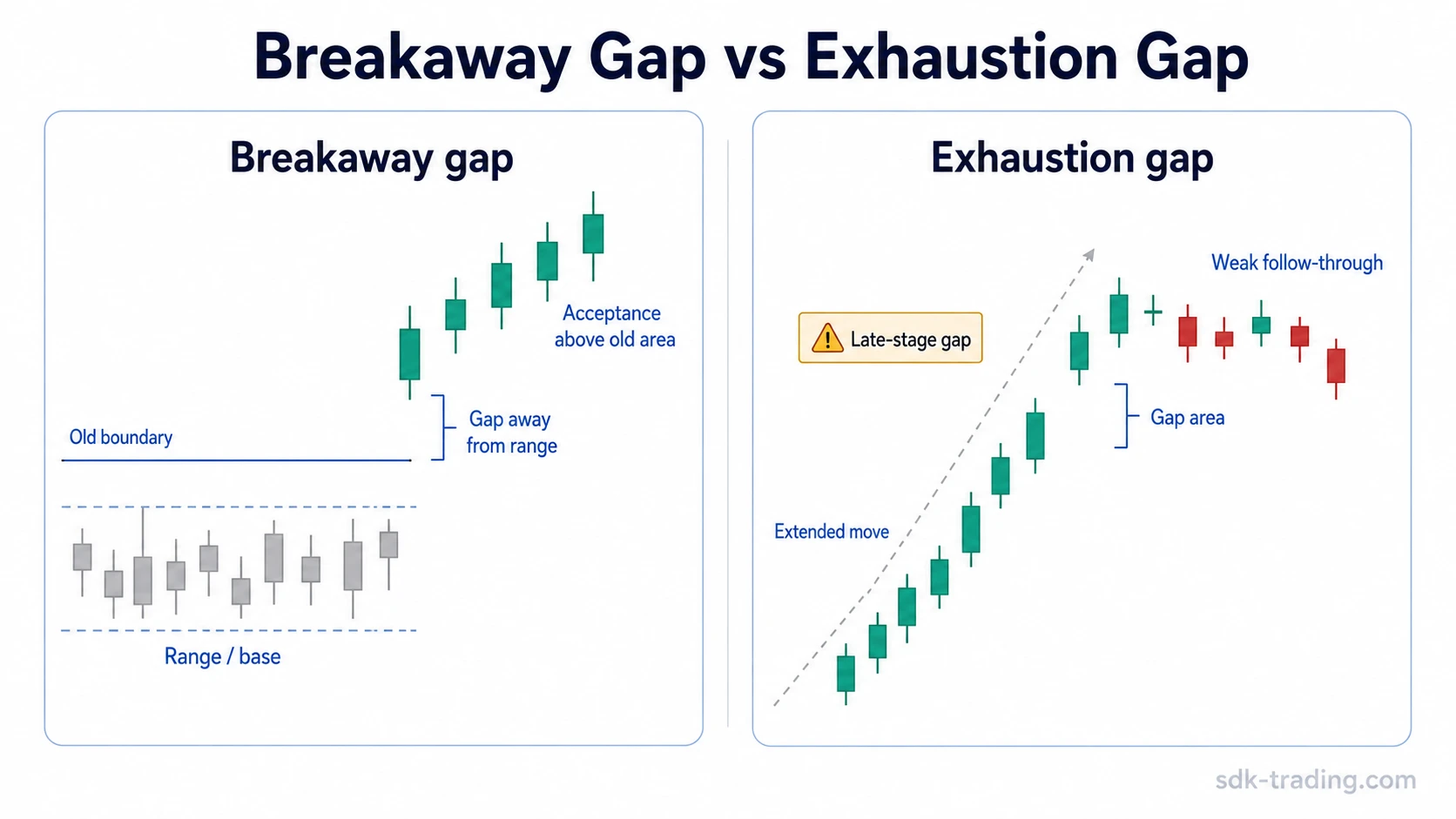
A breakaway gap usually appears when price leaves a range, consolidation, or important boundary and begins a new directional phase. An exhaustion gap usually appears late in an already extended move, where the gap may reflect a final burst of participation before the move weakens, stalls, or reintegrates.The two are often confused because both can be large, emotional, and supported by unusually active volume. The difference is not the gap size alone. The stronger distinction comes from where the gap appears in the structure and how price behaves after the gap opens.
- A breakaway gap is more likely when price gaps away from compression, a base, or a meaningful boundary.
- An exhaustion gap is more likely when the gap appears after a mature directional move.
- High volume can appear in both readings, so volume alone does not classify the gap.
- Post-gap acceptance, rejection, continuation, and reintegration can change the interpretation.
Breakaway Gap vs Exhaustion Gap: The Core Difference
The core difference is structural position. A breakaway gap belongs near the start of a new directional phase, especially when price moves away from a range, base, consolidation, or widely watched boundary. An exhaustion gap belongs near the late part of an existing move, after price has already traveled far enough that participation may be crowded or stretched.A breakaway interpretation is better supported when the gap area is accepted and price does not quickly return into the prior range. An exhaustion interpretation becomes more defensible when the gap fails to hold its extended area, produces poor follow-through, or begins to move back into the prior price path.
Practical distinction: a breakaway gap is judged by whether price has left and accepted a new area beyond an old structure; an exhaustion gap is judged by whether a mature move can still attract clean follow-through after the late gap.
How To Tell A Breakaway Gap From An Exhaustion Gap
The safest comparison starts with context before volume. A large gap that appears after compression has a different meaning from a large gap that appears after a long one-sided move.
| Reading criterion | Breakaway gap lens | Exhaustion gap lens | Misclassification risk |
|---|---|---|---|
| Prior market context | Price has been compressed, range-bound, basing, or pressing against a boundary. | Price has already made an extended directional move before the gap appears. | Ignoring the prior structure can make a late-stage gap look like a fresh breakout. |
| Trend maturity | The gap appears near the beginning of a possible new phase. | The gap appears after a move has already become mature or stretched. | A mature move can still gap strongly, but strength alone does not prove a fresh phase. |
| Boundary or range relationship | The gap moves away from a range edge, base, consolidation, or important reference area. | The gap extends the existing direction without a nearby unresolved boundary being cleared. | A visible gap through no meaningful boundary may be overread as a breakaway. |
| Volume interpretation | Higher volume can support the idea that participation accepted the new area. | Higher volume can also reflect a late surge of participation near the end of a move. | Volume confirms activity, not the gap type by itself. |
| What should happen after the gap | Price should show acceptance outside the prior structure and avoid fast reintegration. | Price may show weak follow-through, rejection, hesitation, or movement back into the prior path. | Early continuation can make an exhaustion gap look healthy before later behavior changes the interpretation. |
| Fill or reintegration behavior | A fast move back into the prior range weakens the breakaway label. | A move back through the gap area can make the exhaustion label more defensible. | Not every breakaway must remain perfectly unfilled, and not every exhaustion gap reverses immediately. |
| What weakens the reading | Failed acceptance beyond the old range, quick return into the base, or no continuation after the gap. | Clean acceptance above or below the gap area, continued structure, and no meaningful rejection. | Classifying too early can lock in the wrong label before the market has tested the gap area. |
| Safer reading lens | Use this lens when the gap changes the structure by leaving an old range or boundary. | Use this lens when the gap extends a move that was already advanced before the gap appeared. | The same candle size can carry opposite meaning depending on phase position. |
Why Size And Volume Are Not Enough
A large gap with high volume can look decisive, but size and activity do not identify the gap type on their own. Breakaway and exhaustion gaps can both appear dramatic because both occur at moments when participation is concentrated.The difference is the source of that participation. In a breakaway reading, the activity is usually tied to price leaving an old structure and being accepted in a new area. In an exhaustion reading, the activity may arrive after a move is already crowded, stretched, or late in its sequence.
Common misread: calling every large, high-volume gap a breakaway gap. A late gap after an extended move may carry exhaustion risk even when the candle or bar looks strong at first.
Same Gap Size, Different Meaning
Consider a market that has spent several sessions pressing against the top of a range. Price then opens above that range with a visible gap, holds above the old boundary, and later tests the area without falling back into the range. That behavior fits a breakaway reading better because the gap changed the prior structure and the new area was accepted.Now consider a similar-sized gap after price has already advanced for many sessions with little rest. The gap opens far from the earlier base, attracts heavy activity, but follow-through becomes uneven and price starts moving back into the gap area. That behavior fits an exhaustion reading better because the gap appeared late and the extended area did not hold cleanly.The initial gap may look similar in both cases. The better question is whether the gap begins a new accepted structure or extends an old move into a vulnerable area.
When The Reading Becomes Weak Or Unclear
Early classification is often fragile. A breakaway gap can fail if price quickly returns into the old range or cannot hold the new area. An exhaustion gap can continue briefly before weakness becomes visible, especially when momentum remains strong for a short period after the gap.The interpretation becomes clearer only after price starts responding to the gap area. Acceptance supports a breakaway interpretation. Rejection, poor follow-through, or reintegration supports an exhaustion interpretation. Mixed behavior keeps the classification uncertain.
Unclear reading: when price does not clearly accept the new area or clearly reject the extended area, the gap should be treated as unresolved rather than forced into either label.
Breakaway and Exhaustion Gap Reference Points
For the full structure of a breakaway gap, focus on the range, consolidation, or boundary that existed before the gap and whether price is accepted beyond it.For the full structure of an exhaustion gap, focus on trend maturity, late-stage participation, weak follow-through, and whether price begins to move back into the gap area.
FAQ
Can a breakaway gap fill?
A breakaway gap can partially or fully fill, especially if acceptance beyond the prior boundary fails. A fast return into the old range weakens the breakaway reading because the market has not held the new area cleanly.
Can an exhaustion gap continue?
An exhaustion gap can continue briefly. The exhaustion reading becomes stronger only when later behavior shows weak follow-through, rejection, hesitation, or movement back into the gap area.
What does volume add to the comparison?
Volume shows activity, but it does not classify the gap by itself. A breakaway reading still needs boundary separation and later acceptance, while an exhaustion reading needs late-stage context and weaker follow-through.