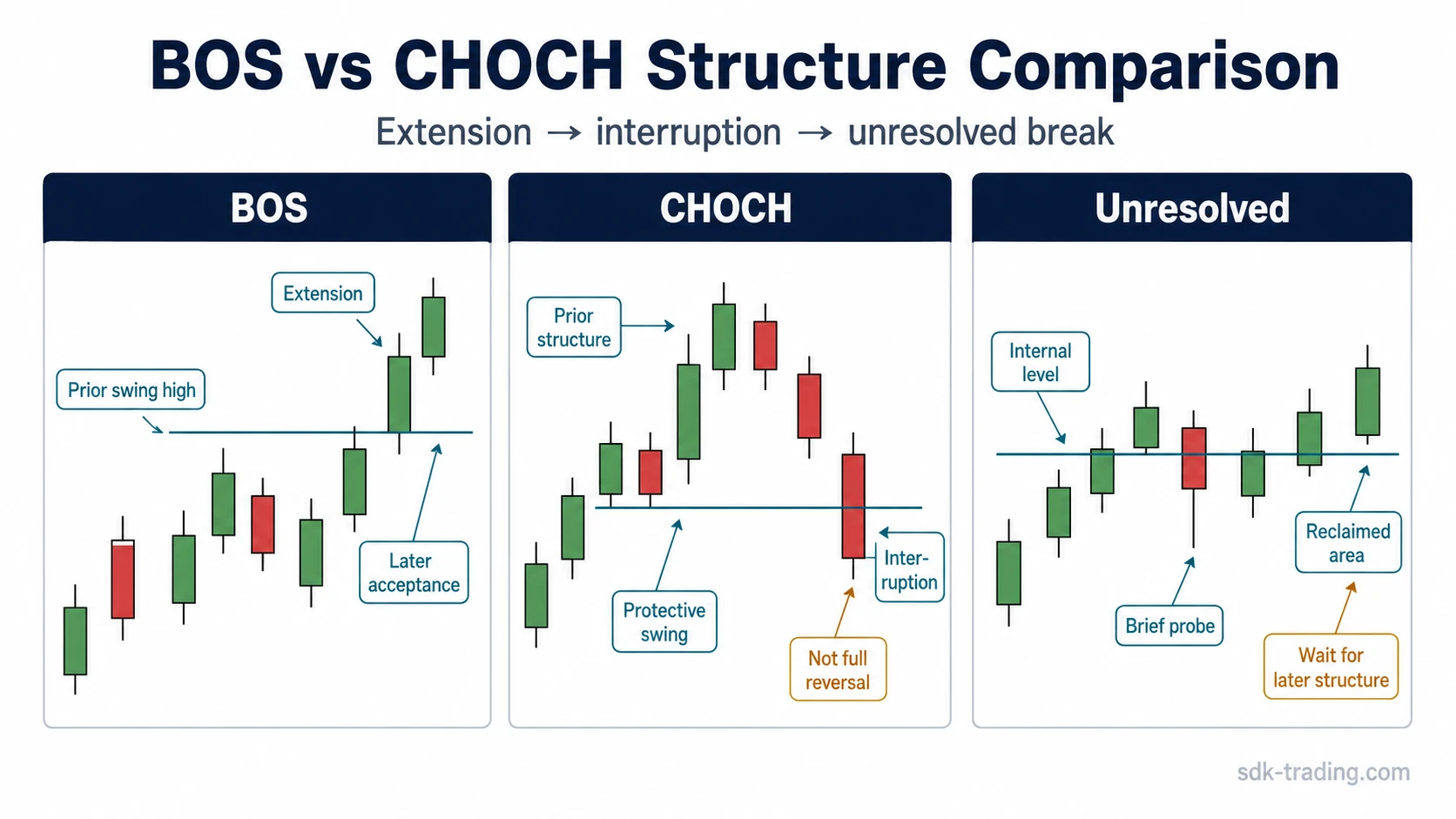
BOS vs CHOCH separates two different market-structure readings. BOS, or break of structure, describes a break that extends the active swing sequence. CHOCH, or change of character, describes a break that interrupts the structure that was previously defining control. A CHOCH can warn that conditions are changing, but it is not a completed reversal by itself.
Core distinction: use BOS when the broken swing continues the active structure. Use CHOCH when the broken swing challenges the structure that had been defining the prior move. Keep the reading unresolved when the break is internal, wick-only, noisy, or not accepted by later price action.
Key Points
- BOS and CHOCH both involve broken structure, but they answer different classification questions.
- BOS usually extends the active sequence of higher highs and higher lows, or lower lows and lower highs.
- CHOCH interrupts the sequence that was previously defining direction and may signal a possible shift.
- A wick through a swing is not enough by itself; the close, acceptance, and later structure affect the reading.
- Internal and external swings should not be mixed when labeling the same move.
- Strong and weak swing labels can change as new price action tests, respects, or erodes the structure around them.
BOS vs CHOCH Quick Comparison
The classification depends on the role of the broken swing inside the structure that existed before the break.
| Concept | What breaks | Structure meaning | Typical reading | What it does not prove |
|---|---|---|---|---|
| BOS | A swing in the direction of the active sequence | The existing structure has extended | Continuation of the current structural leg | That continuation must keep going without failure |
| CHOCH | A swing that was protecting or defining the prior structure | The prior structure has been interrupted | Possible shift in character or control conditions | That a full reversal is already confirmed |
| Unresolved break | An internal level, weak swing, wick probe, or unaccepted break | The structure may not have changed enough to classify cleanly | The reading remains unresolved until later structure gives the break more context | That every broken high or low deserves a major label |
What BOS Means in Market Structure
Break of Structure describes a break of a meaningful swing that extends the active structure. In an advancing sequence, that can mean price breaks above a prior swing high after holding a higher low. In a declining sequence, that can mean price breaks below a prior swing low after holding a lower high.
BOS is a classification of structure extension, not a guarantee that the next candles must continue in the same direction. The reading gains more weight when the broken swing belongs to the active external sequence, the break is accepted rather than only probed, and later structure does not immediately reclaim the broken area.
Bullish BOS: a bullish BOS usually refers to a break above a meaningful swing high inside an active upward sequence.
Bearish BOS: a bearish BOS usually refers to a break below a meaningful swing low inside an active downward sequence.
What CHOCH Means in Market Structure
Change of Character describes a break that interrupts the structure that had been defining the prior move. In an upward sequence, this may happen when price breaks below the swing low that was protecting the advance. In a downward sequence, this may happen when price breaks above the swing high that was protecting the decline.
CHOCH is often confused with reversal confirmation because it can appear early in a shift. A CHOCH only establishes that the prior structure has been challenged. A new directional structure still has to develop before a reversal interpretation gains more support.
Important limitation: a CHOCH can remain weak or unresolved if the break is only a small internal move, a wick through a nearby swing, or a brief probe that price quickly rejects without building accepted structure beyond the level.
How to Decide Whether a Break Is BOS or CHOCH
The decision starts with the swing sequence before the break. A broken high or low has meaning only after it is placed inside the prior structure.
| Question | BOS reading is stronger when | CHOCH reading is stronger when | Unresolved reading is safer when |
|---|---|---|---|
| Which swing broke? | The broken swing is the next trend-side objective in the active sequence. | The broken swing was protecting the prior sequence. | The swing is minor, unclear, or nested inside a larger structure. |
| Was the break with or against the active sequence? | The break follows the direction of the latest accepted structure. | The break cuts against the structure that had been holding. | The active sequence is already messy or overlapping. |
| Is the level internal or external? | The break extends an external swing sequence. | The break challenges a meaningful external swing that defined the prior move. | The break occurs only inside lower-level internal noise. |
| Was it a wick, body close, or accepted break? | Price breaks and later holds beyond the level more clearly. | Price breaks the prior protective swing and later behavior supports the interruption. | Price only wicks through the level and returns quickly without acceptance. |
| What did later structure do? | Later swings continue to respect the extension. | Later swings fail to restore the prior structure. | Later swings overlap, reclaim the level, or fail to confirm either side. |
Strong and Weak Swings Can Change
A swing can begin as an important structural reference and become less reliable as price interacts with it. Strong and weak are therefore contextual labels rather than permanent properties of a high or low.
A protected swing may initially look strong because price moved away from it with clear displacement and the market continued to respect it. Repeated tests, progressively weaker reactions, deeper retracements, or growing acceptance near the level can reduce that strength before the swing is finally broken.
| New evidence | Possible effect on swing quality |
|---|---|
| Strong displacement away from the swing | The swing has more evidence that it is protecting the active structure. |
| Repeated tests of the same area | The swing may become less reliable if each reaction produces less separation. |
| Deeper returns toward the swing | The distance between price and the protected level is shrinking, which can weaken the prior structural advantage. |
| Acceptance around the level | The boundary may be losing its ability to organize price cleanly. |
| Brief sweep of a weak swing | The event may remove local liquidity without changing the larger structure. |
Classification limit: breaking or sweeping a weak swing does not automatically create CHOCH. A meaningful change still requires the break to affect the structure that was actually protecting the prior move, with later price action supporting that interruption.
This also means an earlier classification can be revised. A swing that looked important when it formed may carry less structural weight after several failed reactions, while a newer swing can become the more relevant protective reference as the sequence develops.
Same Scenario, Different Classification
Price advances through a series of higher highs and higher lows. A prior swing high sits above the current range, while the most recent higher low supports the advance. If price breaks above the prior swing high and later holds above that area, the move is more naturally read as BOS because the active upward sequence has extended.
If price instead breaks below the higher low that was protecting the advance, the reading changes. That break challenges the structure that had supported the upward sequence, so it is more naturally read as CHOCH. The label comes from the broken swing’s role, not from a prediction about what must happen afterward.
Neutral classification example: price briefly trades above a prior swing high, then closes back inside the range and fails to build later structure beyond the level. That movement may not deserve a clean BOS label. If the same sequence later breaks the higher low that was supporting the advance, the structure has shifted from possible continuation to interruption. If both moves remain internal and quickly reclaimed, the classification remains unresolved.
Internal and External Structure Matter
Market structure becomes easier to label when internal and external swings are separated. External structure refers to the larger swing sequence that defines the main visible leg. Internal structure refers to smaller swings inside that leg.
A small internal break can look like CHOCH on a lower level while the larger external structure still remains intact. The opposite problem also occurs: a trader may call a major external break “just noise” because smaller internal swings are still messy. BOS vs CHOCH becomes more consistent when both labels are applied to the same structural layer.
Timeframe note: BOS and CHOCH can appear differently across chart scales. A lower-level CHOCH may only be a pullback inside a higher-level BOS sequence. The label should always name the structure being read.
Wick, Body Close, and Acceptance
A wick through a swing high or low starts the classification question, but it does not finish it. A wick can represent a probe, a failed break, or the first sign of pressure near a level. A body close beyond the level can strengthen the reading, but even a close is not universal proof that the structure has accepted the break.
Acceptance depends on later behavior. If price remains beyond the level, forms structure there, and does not immediately reclaim the prior range, the break becomes easier to classify. If price snaps back and later attempts fail, the break may be better treated as a failed probe or unresolved structure.
Classification boundary: wick-only movement, one-candle displacement, or a single close beyond a level should not be treated as automatic BOS or automatic CHOCH without checking the broken swing’s role and the later response.
Bullish and Bearish BOS / CHOCH Examples
Bullish and bearish labels describe the direction of the structural event. They do not create a trade instruction and they do not prove that price must continue in that direction.
| Label | Structure condition | Neutral interpretation |
|---|---|---|
| Bullish BOS | Price breaks above a meaningful swing high in an active upward sequence. | The upward structure has extended. |
| Bearish BOS | Price breaks below a meaningful swing low in an active downward sequence. | The downward structure has extended. |
| Bullish CHOCH | Price breaks above a swing high that was protecting a prior downward sequence. | The downward structure has been interrupted. |
| Bearish CHOCH | Price breaks below a swing low that was protecting a prior upward sequence. | The upward structure has been interrupted. |
Common BOS vs CHOCH Mistakes
Most mislabeling comes from reading the broken level in isolation. The level matters, but the structure around the level decides what the break means.
| Mistake | Cleaner interpretation |
|---|---|
| Treating every broken high or low as BOS | A BOS needs a meaningful swing break that extends the active sequence, not just any nearby high or low. |
| Calling every CHOCH a confirmed reversal | A CHOCH marks interruption first. A new structure still needs to develop before a reversal reading becomes stronger. |
| Ignoring the swing that produced the last BOS | The latest accepted structure helps decide which swing is continuation-side and which swing is protective. |
| Treating strong and weak labels as permanent | Swing quality can change after repeated tests, weaker reactions, deeper retracements, and new accepted structure. |
| Reading wick-only probes as accepted structure | A probe through a level can fail. Later acceptance or rejection decides whether the break has structural weight. |
| Mixing internal and external structures | A lower-level CHOCH does not automatically invalidate a higher-level BOS sequence. |
BOS vs CHOCH vs MSS
MSS, or market structure shift, is often used near CHOCH because both terms describe a possible change in structure. The boundary is not always used consistently across trading education. A conservative approach is to treat CHOCH as the first interruption of prior structure, while reserving stronger shift language for cases where later structure supports the change.
The distinction is whether price extended the prior sequence, interrupted it, or later built enough structure to support a stronger shift reading.
FAQ
Is CHOCH the same as a reversal?
No. CHOCH means the prior structure has been interrupted. A reversal reading needs more than the first interruption, because later structure must support the shift.
Can BOS fail?
Yes. A BOS can fail if price breaks a swing but does not maintain acceptance beyond it. In that case, the break may become a failed extension rather than clean continuation.
Does a wick count as BOS or CHOCH?
A wick can begin the question, but it should not be treated as a complete answer by itself. The broken swing, close, acceptance, and later structure all affect the classification.
Can a strong swing become weak?
Yes. Swing quality is contextual. Repeated tests, weaker reactions, deeper retracements, and increasing acceptance around the level can reduce the structural weight of a swing that previously looked strong.
Can BOS and CHOCH appear on different timeframes?
Yes. A lower-level CHOCH can appear inside a higher-level BOS sequence. The label is clearer when it refers to one structural layer at a time.
What is the simplest way to avoid mislabeling BOS and CHOCH?
Start with the active swing sequence, identify the role of the broken swing, then check whether later price action accepts or rejects the break.
BOS vs CHOCH Final Classification Rule
BOS extends the structure that was already active. CHOCH interrupts the structure that had been defining the prior move. A break that is too small, too internal, too weak, or not accepted by later structure should remain unresolved until the sequence becomes clearer.