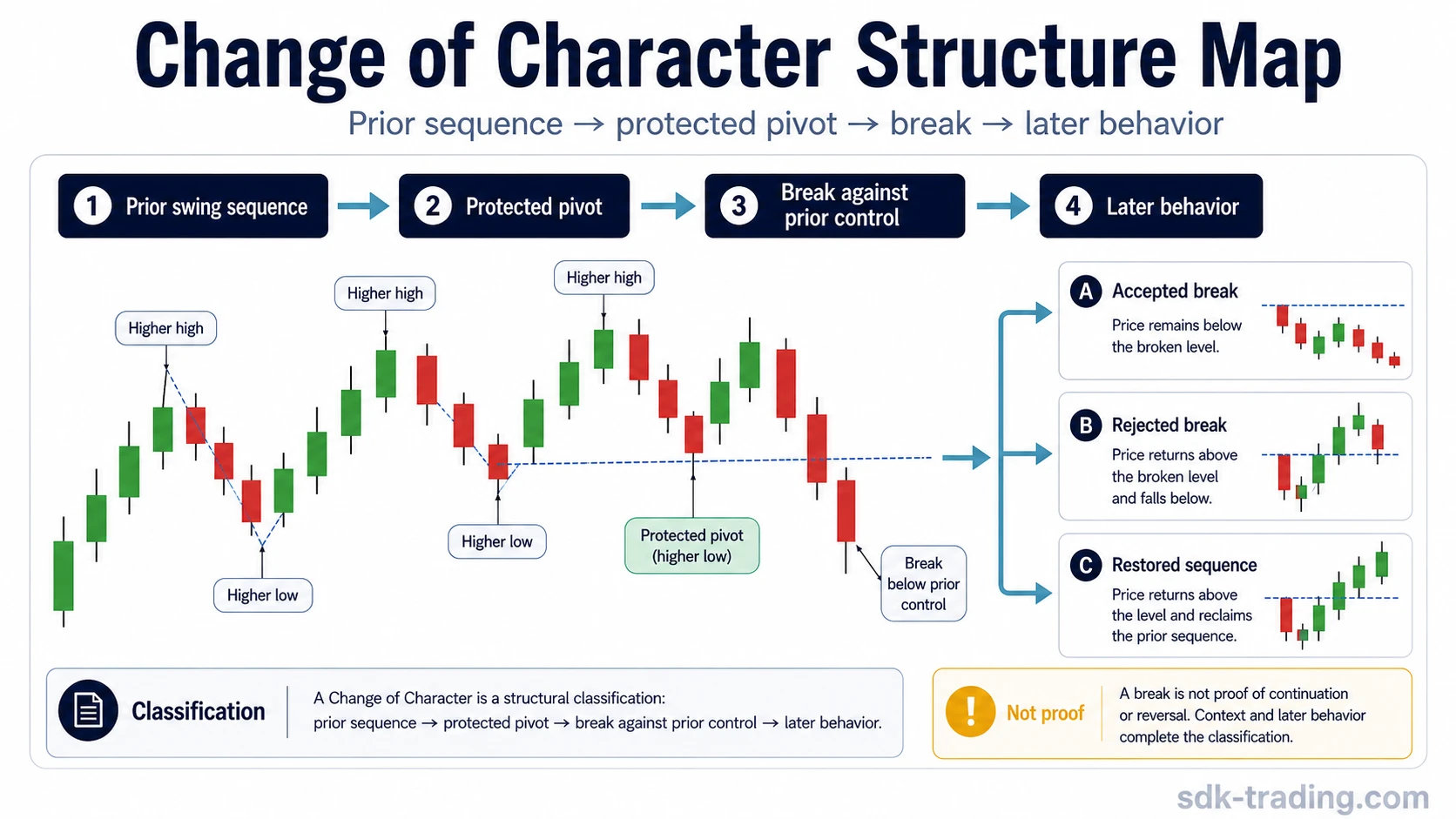
A change of character, often shortened to CHoCH, is a market-structure interruption where price breaks the swing point that previously protected the active sequence.
Change of Character definition: CHoCH occurs when an existing swing sequence loses the boundary that had been defining control. In an uptrend, that usually means a break below the higher low that protected the sequence. In a downtrend, it usually means a break above the lower high that protected the sequence.
CHoCH is a classification of structural interruption. It is not a standalone reversal signal, not a trade setup, and not a buy or sell trigger. The first break only begins the reading; acceptance, rejection, or restoration after that break decides whether the interruption is clean, weak, unresolved, or invalid.
- CHoCH needs prior structure. Without an ordered swing sequence, there is no clean character to interrupt.
- The key reference is the protected pivot: the swing high or swing low that previously defined control.
- A break against that protected pivot can begin a CHoCH reading, but the quality of the reading depends on what follows.
- A clean CHoCH is different from a weak probe, ordinary volatility, or a restored prior sequence.
- CHoCH differs from BOS because BOS extends the active structure, while CHoCH interrupts the structure that was previously in control.
What Is a Change of Character?
A change of character is a shift in the behavior of a swing sequence. The market has been respecting one side of structure, then price breaks the swing point that made that structure readable.
In a rising sequence, buyers keep control by forming higher highs and higher lows. The higher low is important because it protects the upward sequence. If price breaks below that protected higher low, the prior structure has been interrupted. That can begin a bearish CHoCH reading.
In a falling sequence, sellers keep control by forming lower lows and lower highs. The lower high is important because it protects the downward sequence. If price breaks above that protected lower high, the prior structure has been interrupted. That can begin a bullish CHoCH reading.
Important limitation: the break does not prove that a full reversal is underway. CHoCH identifies that prior control has been challenged. It does not confirm the next trend, the next swing target, or a tactical decision by itself.
How CHoCH Forms in Market Structure
A cleaner CHoCH reading starts with a readable sequence, not with a random break. The structure must first show which side has been controlling the swing pattern.
- Prior swing sequence: price forms an ordered HH/HL sequence or an ordered LH/LL sequence.
- Protected pivot: one swing point becomes the boundary that preserves the sequence.
- Break against prior control: price moves through the protected pivot instead of continuing to respect it.
- Post-break behavior: price either accepts the break, rejects it, or restores the old sequence.
- Classification: the reading becomes cleaner, remains unresolved, or becomes invalid depending on that post-break behavior.
Example scenario: in an uptrend, price has been holding higher lows. If price breaks below the higher low that previously protected the sequence, the move can begin a bearish CHoCH reading. The reading remains incomplete if price immediately restores the prior structure or fails to show acceptance below the broken boundary.
The same logic applies in reverse during a downtrend. If price has been respecting lower highs and then breaks above the lower high that protected the sequence, the move can begin a bullish CHoCH reading. The break starts the classification; follow-through, rejection, or restoration completes the reading.
What Makes a CHoCH Clean or Weak?
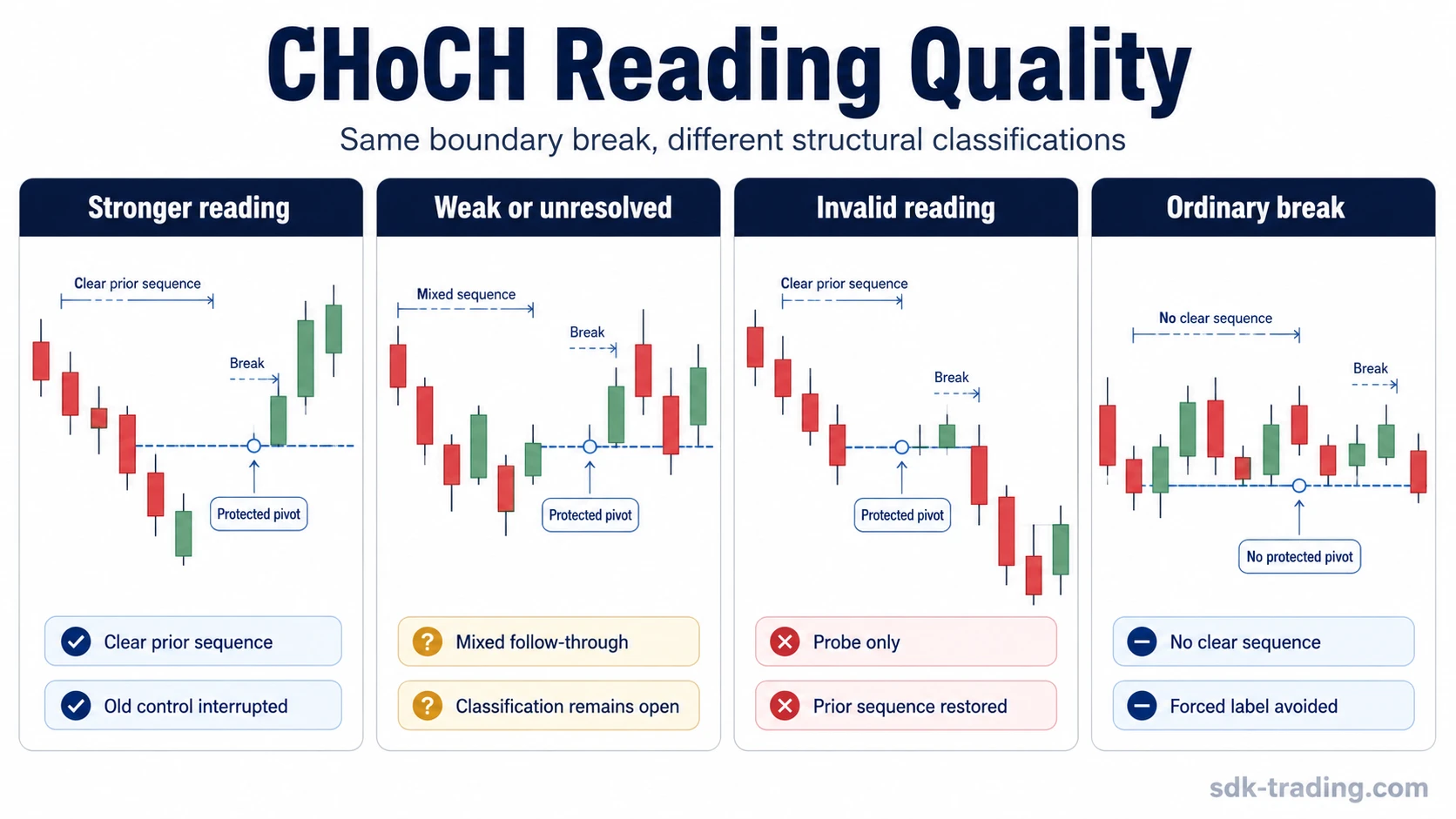
A CHoCH reading becomes stronger when the prior sequence is clear, the protected pivot is not arbitrary, the break changes the structure that had been defining control, and price does not immediately restore the old sequence.
| Criterion | Stronger CHoCH reading | Weak or unresolved reading | Not CHoCH |
|---|---|---|---|
| Prior sequence | Clear HH/HL or LH/LL sequence | Mixed but still visible sequence | No ordered sequence |
| Protected pivot | Boundary is clear and structurally meaningful | Boundary is partly subjective | Boundary is random or forced |
| Break | Breaks the swing point that previously defined control | Only probes, overlaps, or briefly wicks through | Moves inside ordinary range noise |
| Post-break behavior | Does not immediately restore prior control | Shows mixed acceptance or unclear follow-through | Restores the old sequence quickly |
| Classification | Cleaner structural interruption | Unresolved structural question | Invalid CHoCH reading or ordinary break |
Timeframe note: lower-timeframe CHoCH readings can appear more often because smaller structures break more easily. A higher-timeframe break may carry more structural weight, but no timeframe makes CHoCH a complete signal by itself.
Bullish vs Bearish CHoCH
Bullish and bearish CHoCH labels describe the direction of the structural interruption. They do not describe an instruction or a guaranteed outcome.
| CHoCH type | Prior structure | Protected pivot | Interruption | Neutral interpretation |
|---|---|---|---|---|
| Bullish CHoCH | Lower highs and lower lows | Lower high | Price breaks above the lower high that protected the downtrend sequence | Downside control has been interrupted, but reversal is not confirmed by the break alone |
| Bearish CHoCH | Higher highs and higher lows | Higher low | Price breaks below the higher low that protected the uptrend sequence | Upside control has been interrupted, but reversal is not confirmed by the break alone |
The label is cleaner when the prior sequence is visible. If the market is only moving sideways, overlapping, or producing unclear swings, the same break may be better treated as range noise or an unresolved boundary test.
CHoCH vs BOS
CHoCH and BOS both describe breaks in market structure, but they answer different structural questions. Break of Structure describes an extension of the active sequence. CHoCH describes an interruption of the structure that had been defining control.
| Comparison point | CHoCH | BOS |
|---|---|---|
| Main idea | Interrupts the prior controlling sequence | Extends the active swing sequence |
| Reference point | The protected pivot that kept prior control intact | The swing high or swing low that continues the active direction |
| Typical question | Has prior control been interrupted? | Has the active structure extended? |
| Common mistake | Treating the first interruption as confirmed reversal | Treating every break as meaningful without checking sequence quality |
| Safer reading | Check whether the break is accepted, rejected, or restored | Check whether the break fits the existing sequence instead of contradicting it |
In a simple uptrend, a break above a prior swing high may be BOS because it extends the upward sequence. A break below the higher low that protected that sequence may be CHoCH because it interrupts the structure that had been supporting the uptrend.
Clean, Weak, and Invalid CHoCH Readings
The useful distinction is not only whether price crossed a pivot. The more important question is what the break means once the next structural reaction appears.
| Reading type | What happens | Safer classification | What to avoid saying |
|---|---|---|---|
| Clean CHoCH | Prior sequence is clear, protected pivot breaks, and old control is not immediately restored | Cleaner structural interruption | Guaranteed reversal |
| Weak CHoCH | Price breaks the boundary but post-break behavior is mixed, overlapping, or unclear | Unresolved structure | Confirmed control shift |
| Invalid CHoCH | Price briefly probes the boundary, then restores the prior sequence | Failed interruption or ordinary volatility | Hidden reversal signal |
| Not CHoCH | No clear prior sequence or no meaningful protected pivot exists | Range noise, random break, or unclear structure | Forced CHoCH label |
False-positive risk: a wick through a swing point can look important before the next candles clarify the break. A CHoCH reading becomes weaker when price immediately returns into the old structure, when the broken pivot was poorly defined, or when the surrounding swings were already mixed.
Common CHoCH Mistakes
Many weak CHoCH readings come from forcing structure onto price action that is not structured enough. The cleaner approach is to identify the prior sequence first, then identify the protected pivot, then judge what happens after the break.
| Mistake | Why it weakens the reading | Safer interpretation |
|---|---|---|
| Calling any wick a CHoCH | A wick can be only a probe, especially if price immediately returns inside prior structure. | Treat the break as unfinished until later behavior clarifies acceptance or rejection. |
| Ignoring prior structure | Without an ordered sequence, there is no clear character to change. | Confirm that a HH/HL or LH/LL sequence existed before using the CHoCH label. |
| Using a random pivot | A pivot must have structural meaning, not just be a convenient line on the chart. | Use the swing point that actually protected the prior sequence. |
| Treating CHoCH as reversal confirmation | A structural interruption can fail, stall, or become ordinary volatility. | Separate interruption from confirmation and classify the later behavior. |
| Forcing lower-timeframe noise into higher-timeframe meaning | Small breaks can occur inside larger structures without changing the broader reading. | Match the CHoCH reading to the timeframe of the sequence being analyzed. |
Related Market Structure Concepts
CHoCH is easiest to classify when the surrounding swing structure is already clear. The idea connects naturally with higher highs and higher lows, lower highs and lower lows, BOS, protected pivots, and market structure shift language.
Order blocks, fair value gaps, imbalance, and liquidity sweep ideas may appear near CHoCH discussions, but they are separate concepts. They require their own context because CHoCH only classifies whether prior structural control was interrupted and how later behavior responded.
Clean classification model: prior swing sequence -> protected pivot -> break against prior control -> acceptance, rejection, or restoration -> clean, weak, invalid, or ordinary-break classification.
FAQ
Does CHoCH confirm a reversal?
No. CHoCH shows that the structure previously defining control has been interrupted. A reversal reading needs later behavior to support it. The first break alone can remain weak, unresolved, or invalid.
What is the difference between CHoCH and BOS?
BOS extends the active swing sequence. CHoCH interrupts the sequence that was previously defining control. In simple terms, BOS continues the current structural story, while CHoCH challenges it.
Does CHoCH need a prior trend?
CHoCH needs a prior swing sequence. That sequence can be upward or downward, but it must be readable enough to identify the protected pivot. Without a clear sequence, the break may be ordinary range behavior rather than CHoCH.
Why do some CHoCH readings fail?
Some readings fail because the pivot was weak, the prior sequence was unclear, the break was only a probe, or price quickly restored the old structure. In those cases, the safer classification is weak, unresolved, or invalid rather than confirmed reversal.