Higher highs and higher lows describe an upward market-structure sequence where price forms a visible swing high above the previous swing high and then forms a swing low above the previous swing low. The sequence can show rising structure, but it is not a trade signal, a prediction, or proof that continuation must follow.
The common mistake is treating one push above a prior high as a complete higher-high and higher-low reading. A higher high only answers the first part of the structure question. The later pullback matters because the market still needs to show whether the next swing low holds above the prior swing low or falls back into the old range.
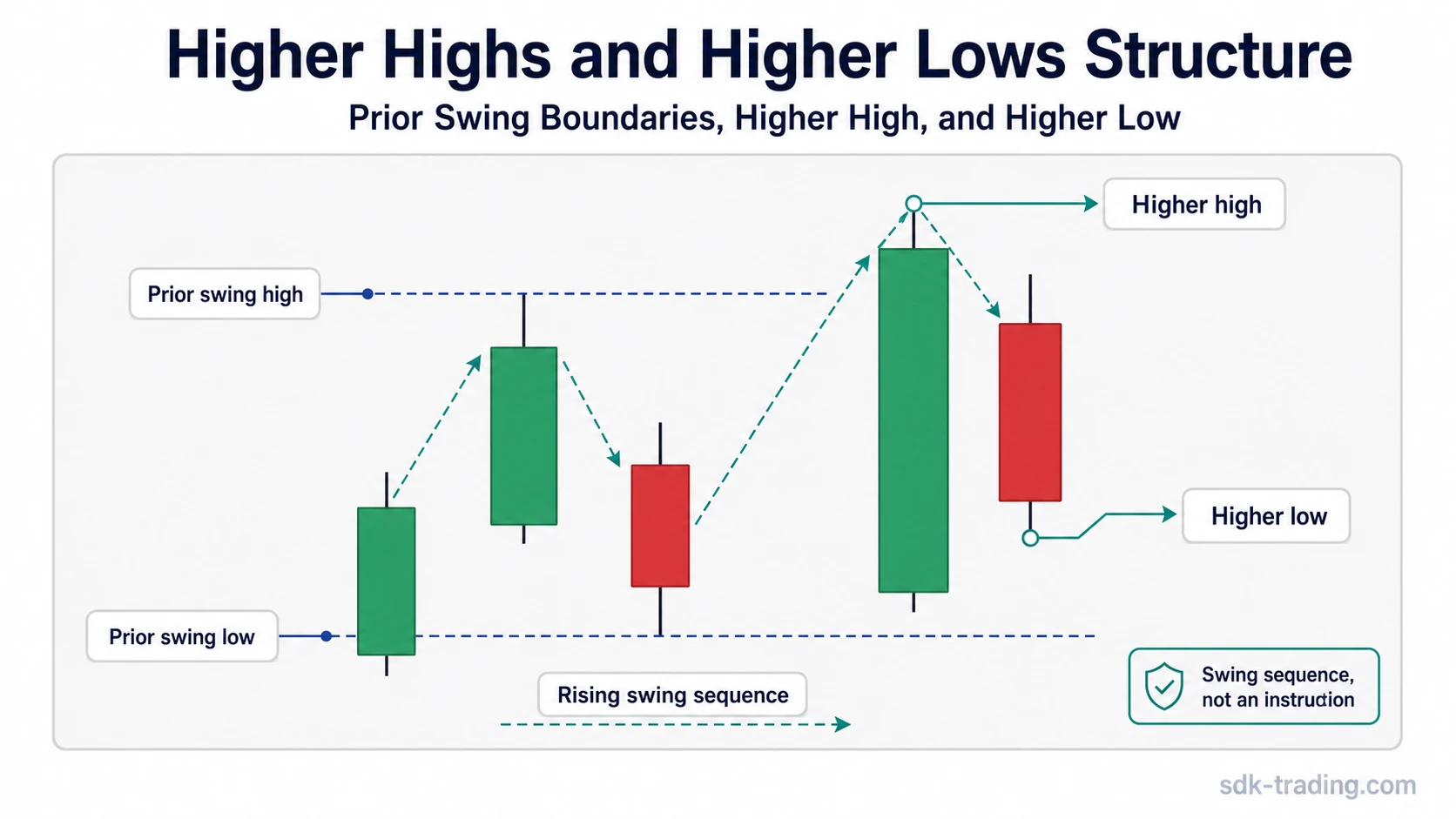
Definition: A higher high is a swing high that forms above the prior visible swing high. A higher low is a swing low that forms above the prior visible swing low. Together, they describe a rising swing sequence rather than an isolated candle event.
Key Points
- Higher highs and higher lows are based on visible swing points, not every small candle movement.
- A higher high starts the structure question; the later pullback decides whether a higher-low sequence is forming.
- The reading is stronger when the prior swing boundaries are clear and later behavior holds above the old swing low.
- The reading weakens when the move above the prior high is shallow, quickly rejected, or followed by a return inside prior structure.
- HH/HL structure can organize context, but it does not decide action, outcome, or continuation certainty by itself.
What Are Higher Highs and Higher Lows?
Higher highs and higher lows are the basic swing sequence often associated with upward market structure. A higher high shows that price has extended beyond a prior swing high. A higher low shows that the following pullback stayed above the prior swing low.
The two terms work together. A higher high without a later higher low may only show a breakout attempt, a temporary extension, or a move that has not yet been tested. A higher low without a prior higher high may show a shallow pullback, but not a complete rising sequence by itself.
The useful reading comes from the relationship between both boundaries. The prior swing high acts as the upper boundary that price must exceed. The prior swing low acts as the lower boundary that the next pullback should respect if the structure is going to remain clean.
Neutral reading: HH/HL structure describes how swings are arranged. It does not say that price must continue higher, that a reversal cannot happen, or that a position should be opened.
How Higher Highs and Higher Lows Form in Market Structure
A rising structure usually develops through a sequence of expansion and pullback. Price first moves above a prior swing high, creating the possible higher high. Then price pulls back. If that pullback forms a swing low above the previous swing low, the sequence begins to show a higher-low structure.
The structure is easier to read when the swings are visible without forcing the chart. A small candle high inside a noisy range is not the same as a structural swing high. A minor pause after a strong candle is not automatically a higher low. The swing has to matter within the timeframe being reviewed.
This is why swing highs and swing lows are the base units of the reading. HH/HL structure is not built from random highs and lows. It is built from swing points that define the visible structure of the move.
| Structure part | What it shows | What still needs confirmation |
|---|---|---|
| Prior swing high | The upper boundary of the earlier structure. | Whether price can move meaningfully beyond it. |
| Higher high | Price has exceeded the prior swing high. | Whether the move is accepted or quickly rejected. |
| Pullback | The market tests whether the new structure can hold. | Whether the pullback stays above the prior swing low. |
| Higher low | The new swing low holds above the prior swing low. | Whether later behavior continues to respect the rising sequence. |
How to Identify Higher Highs and Higher Lows
Identification starts with the prior swing boundaries, not with the latest candle. Mark the prior swing high and the prior swing low. Then observe whether price creates a meaningful extension beyond the high and whether the next pullback holds above the prior low.
A cleaner HH/HL reading usually has four features: a visible prior swing high, a visible prior swing low, a break or extension above the prior high, and a later pullback that forms above the prior low. If one of those features is missing, the reading may still be developing, but it should not be treated as clean.
- Find the prior swing high: Use the last visible high that mattered to the structure, not every small candle top.
- Find the prior swing low: Use the swing low that defines the lower boundary of the previous structure.
- Check the extension: Price should move beyond the prior swing high in a way that is visible for the selected timeframe.
- Wait for the pullback reading: The later swing low should hold above the prior swing low for a cleaner HH/HL sequence.
- Review later behavior: If price returns inside the previous structure, the reading weakens or may need to be reclassified.
Boundary caution: The smaller the swing boundary, the easier it is to overread noise as structure. A minor intrabar high or a shallow pause can create a local high, but that does not always create a meaningful higher high for the broader structure.
Clean, Weak, and Invalid HH/HL Readings
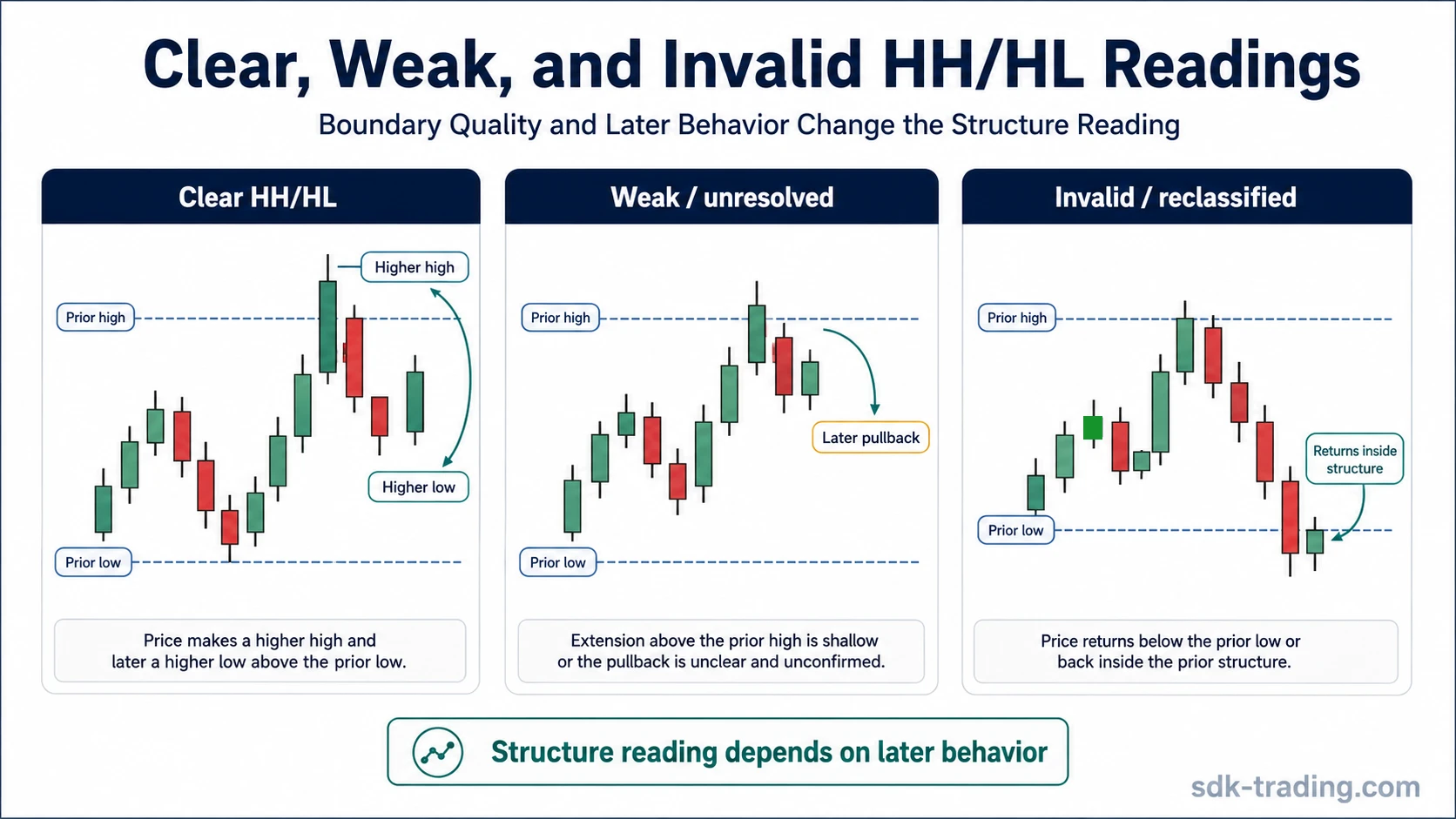
Not every higher-high and higher-low label has the same quality. The reading depends on boundary clarity, the quality of the move through the prior high, and the way price behaves after the pullback begins.
| Reading type | Typical structure | Safer interpretation |
|---|---|---|
| Clean HH/HL | Price breaks a visible prior swing high, then forms a later swing low above the prior swing low. | The rising sequence is structurally clearer, but it still remains context rather than a trading instruction. |
| Weak HH/HL | The prior boundary is unclear, the break is shallow, or the pullback is too small to confirm a structural higher low. | The structure may be developing, but the reading is fragile and can easily be noise inside a larger range. |
| Invalid or reclassified reading | Price moves above a prior high but then falls back below the prior swing low or returns inside the old structure. | The HH/HL label no longer fits cleanly and the move may be better read as a failed extension or another structure type. |
A clean reading does not require perfect symmetry. Markets rarely form textbook swings with equal spacing. The key question is whether the swing sequence is visible enough to separate structure from noise.
Common Misunderstanding: One Pullback Is Not Always a Higher Low
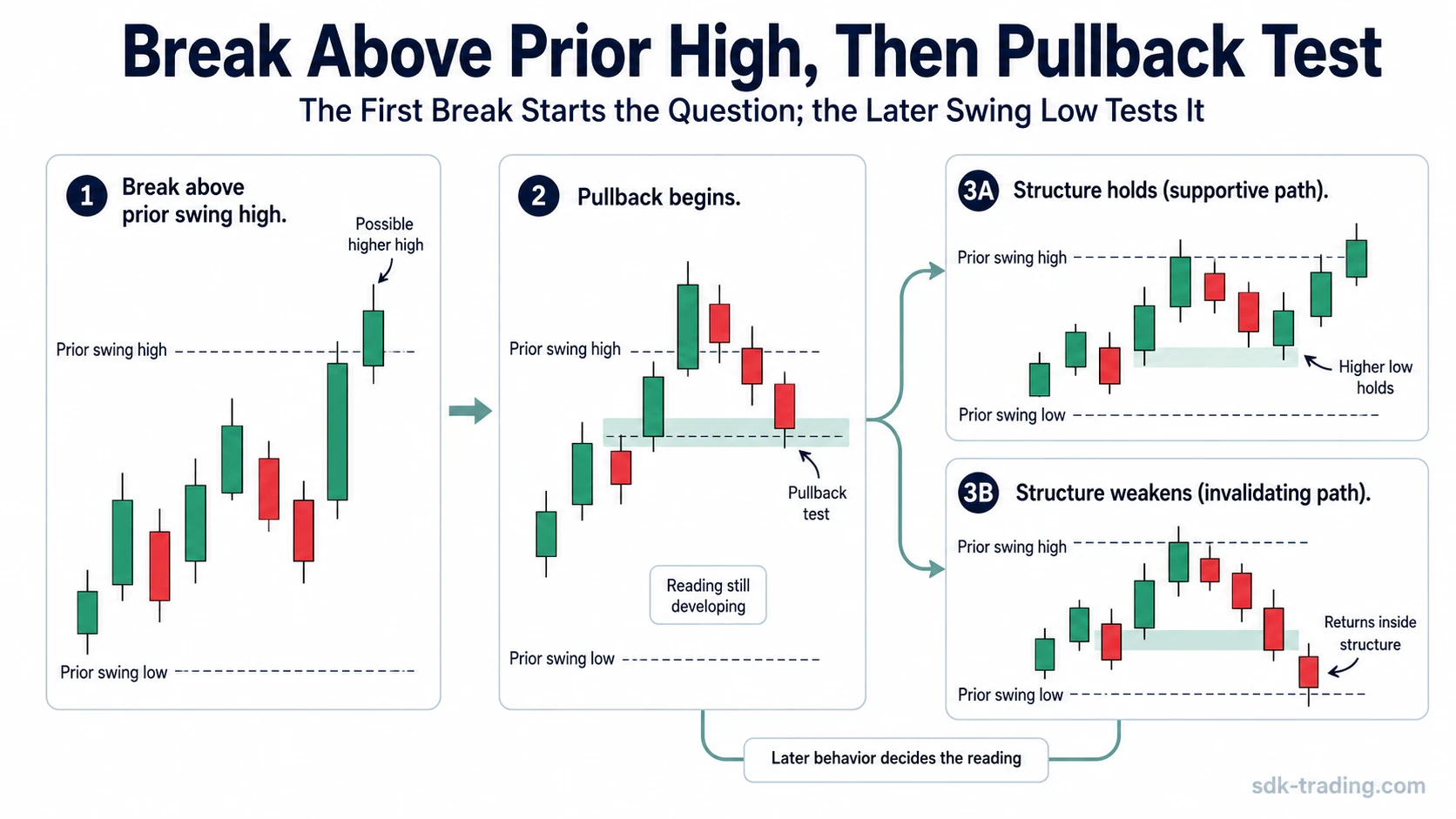
A common scenario is that price pushes above a prior swing high and then pulls back slightly. That can look like a higher-high and higher-low sequence before the structure is actually resolved. If the pullback is only a small pause near the high, it may not be a structural higher low yet.
Illustrative scenario: Price moves above a prior swing high, pauses, and dips slightly. The move creates a possible higher high, but the later dip is not automatically a higher low. The reading becomes cleaner only if the pullback forms a visible swing low above the prior swing low instead of fading back into the previous range.
This distinction matters most in live reading. In hindsight, a chart often looks cleaner because later candles reveal which swing points mattered. In real time, the trader sees a developing structure, not a completed diagram. The safer interpretation is to treat the first push as a question and the later pullback as the test.
POWL Example: Why a Higher High Does Not Always Mean Continuation
A higher high shows that price has moved above a previous visible high. It does not explain whether the move belongs to a healthy continuation structure, a temporary extension, or a broader correction.
The POWL charts below compare two higher highs that formed in different structural conditions. The first followed a strong breakout, a successful pullback, and continued expansion inside an intact rising structure. The second appeared after the earlier rising channel had broken and price had shifted into a wider corrective movement.
Higher high inside a healthy rising structure. In the first phase, price moved above the previous high area with a gap. The breakout created a clear extension beyond the earlier boundary rather than a shallow move above a minor candle high.
Price later returned towards the breakout area. The zone held from above, the rising channel remained intact, and price continued higher.
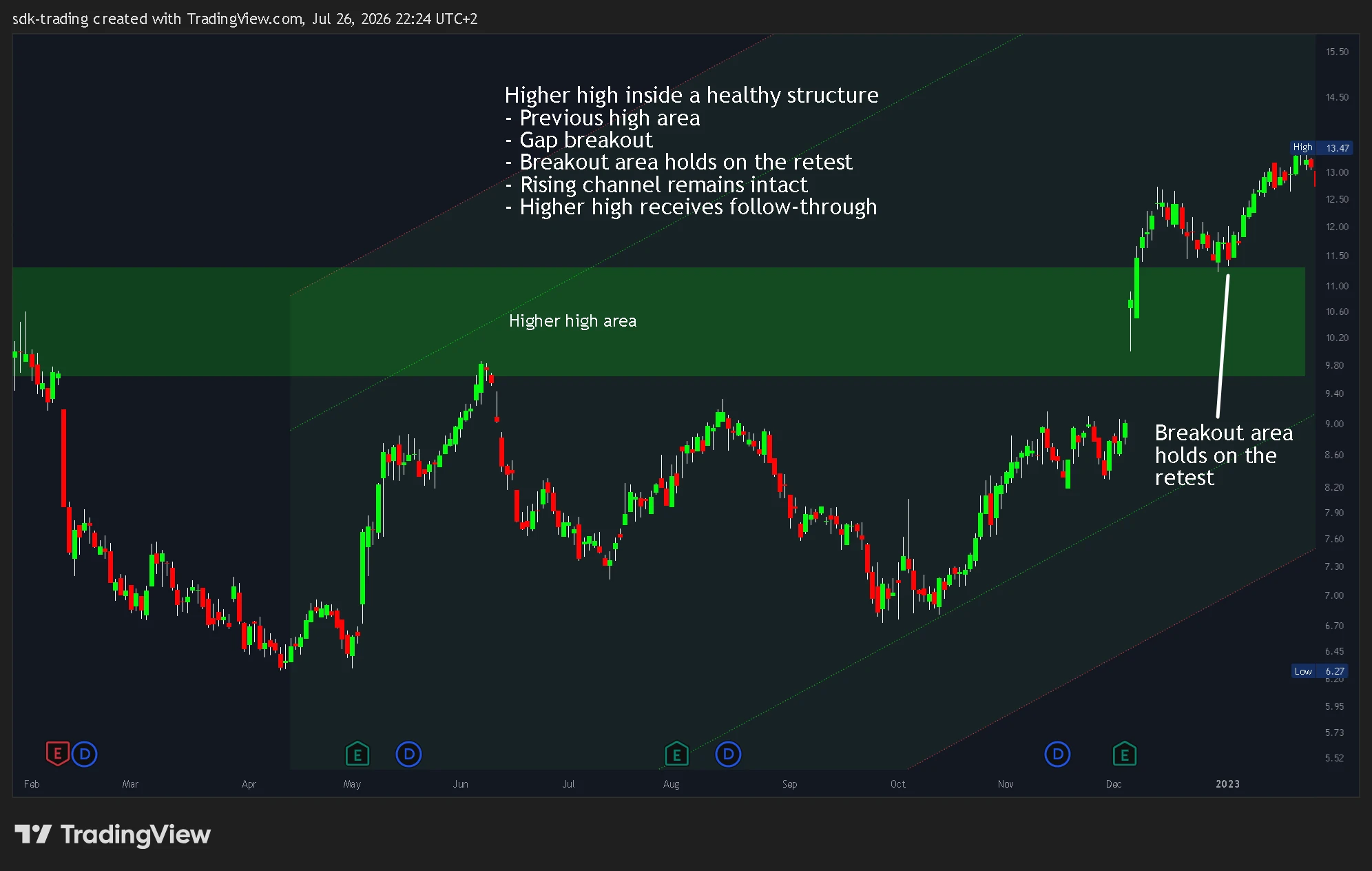
The continuation reading was supported by several related observations:
- Previous boundary: Price moved clearly above a visible previous high area.
- Breakout behavior: The move produced expansion rather than an immediate return into the earlier structure.
- Pullback behavior: The breakout area held when price returned towards it.
- Channel condition: The broader rising channel remained intact.
- Follow-through: Price continued higher after the pullback.
The higher high was not interpreted from the new peak alone. The breakout, retest, channel, and later continuation supported the same structural reading.
Higher high inside a correction. The later POWL structure developed differently. Before the new higher high appeared, price had already broken the earlier rising channel. The market then shifted away from the previous directional rhythm and began forming a broader corrective sequence.
Price subsequently moved above the previous high. That move created a genuine higher high, but it did not immediately restore the earlier rising structure. Price later reversed and continued lower as the correction developed.
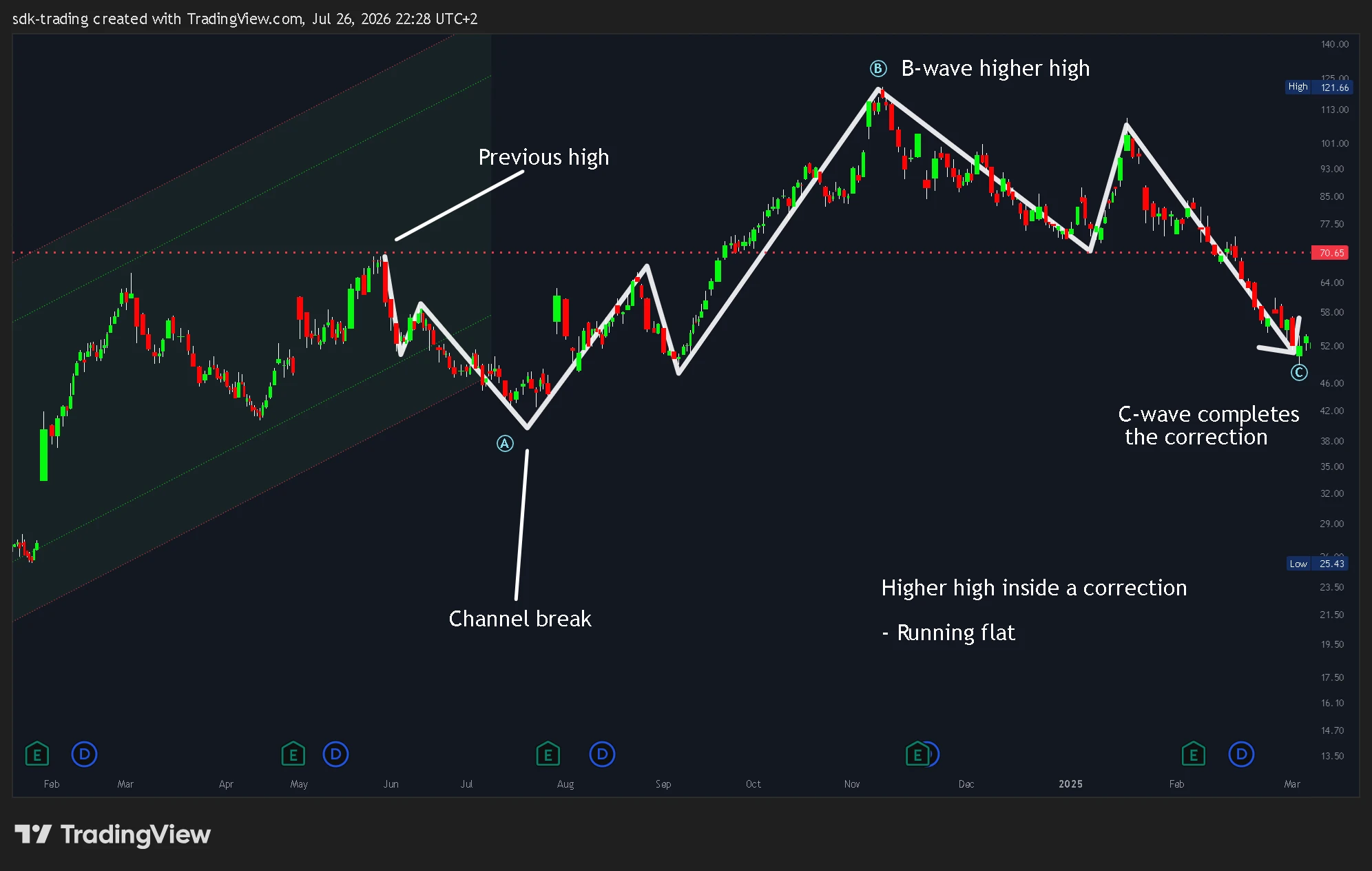
One Elliott Wave interpretation of this movement is an A-B-C correction in which Wave B moved above the previous high before Wave C continued lower. For higher-high and higher-low analysis, the important point is not the pattern name. The important point is that the B-wave higher high did not restore the previous impulsive structure.
| Structural question | Healthy continuation | Corrective movement |
|---|---|---|
| Was the rising channel intact? | Yes. The channel continued to organize the advance. | No. The earlier rising channel had already broken. |
| Did the breakout area hold? | Yes. Price held above the previous high area during the pullback. | The later higher high did not establish a durable continuation structure. |
| Did price receive follow-through? | Yes. Price continued higher after the retest. | No. Price reversed and continued the correction. |
| What did the higher high show? | A higher high supported by the surrounding rising structure. | A higher high formed inside a broader corrective movement. |
Practical lesson: A higher high is an observation, not a complete conclusion. Its meaning depends on the previous boundary, the pullback, the active channel, the quality of follow-through, and the structure that develops afterwards.
Higher Highs and Higher Lows vs Lower Highs and Lower Lows
Higher highs and higher lows describe rising swing structure. Lower highs and lower lows describe the opposite arrangement, where price forms a swing high below the previous swing high and then forms a swing low below the previous swing low.
| Sequence | Swing high behavior | Swing low behavior | Structural reading |
|---|---|---|---|
| Higher highs and higher lows | New swing highs form above prior swing highs. | New swing lows form above prior swing lows. | Rising structure. |
| Lower highs and lower lows | New swing highs form below prior swing highs. | New swing lows form below prior swing lows. | Falling structure. |
The comparison is directional, not predictive. A rising sequence can weaken, and a falling sequence can fail. The label describes the current arrangement of swing points, not the certainty of the next move.
How Swing Highs and Swing Lows Fit the Sequence
HH/HL structure depends on swing selection. If the selected swing points are too small, almost any chart can be forced into a rising or falling label. If the selected swing points are too broad, important local structure may be ignored. The useful reading usually matches the timeframe and the decision context being studied.
A major swing high may define the larger boundary, while a minor swing high may only matter inside a smaller pullback. The same chart can therefore show a minor HH/HL sequence inside a broader sideways or weakening structure. This is not a contradiction. It means the timeframe and swing scale must be named before the structure is interpreted.
Scale note: HH/HL labels are only as useful as the swing points behind them. A clean label on a very small swing can still be weak if the larger structure remains unresolved.
Where HH/HL Fits Among Market Structure Concepts
Higher highs and higher lows are one way to describe the arrangement of swing points. They are related to broader market-structure language, but they should not be merged with every nearby concept.
A break of structure focuses on price moving through a meaningful prior boundary. HH/HL structure asks whether the later swing sequence supports a rising arrangement after that move. CHOCH and MSS are usually used for different structural questions around character change or broader shift, so they should not replace the simpler HH/HL reading unless the chart context supports that distinction.
The practical value is organization. HH/HL structure helps separate a rising sequence from random movement, but the label should remain conditional when the boundaries are unclear, the pullback has not formed, or price quickly returns inside prior structure.
FAQ
Are higher highs and higher lows enough to act on by themselves?
No. Higher highs and higher lows describe swing structure. They can organize market context, but the reading still depends on broader structure, timeframe, and risk context.
Can one candle create a higher high?
A candle can move above a prior high, but a useful higher-high reading depends on whether that high is a meaningful swing boundary for the timeframe being reviewed.
When is a higher low not clean?
A higher low is not clean when the pullback is too small to define a meaningful swing, when the prior swing low is unclear, or when price quickly returns inside the previous structure.
Do higher highs and higher lows always mean an uptrend?
They often describe rising structure, but the reading depends on timeframe, swing quality, and later behavior. A small HH/HL sequence can also appear inside a larger range or unresolved structure.