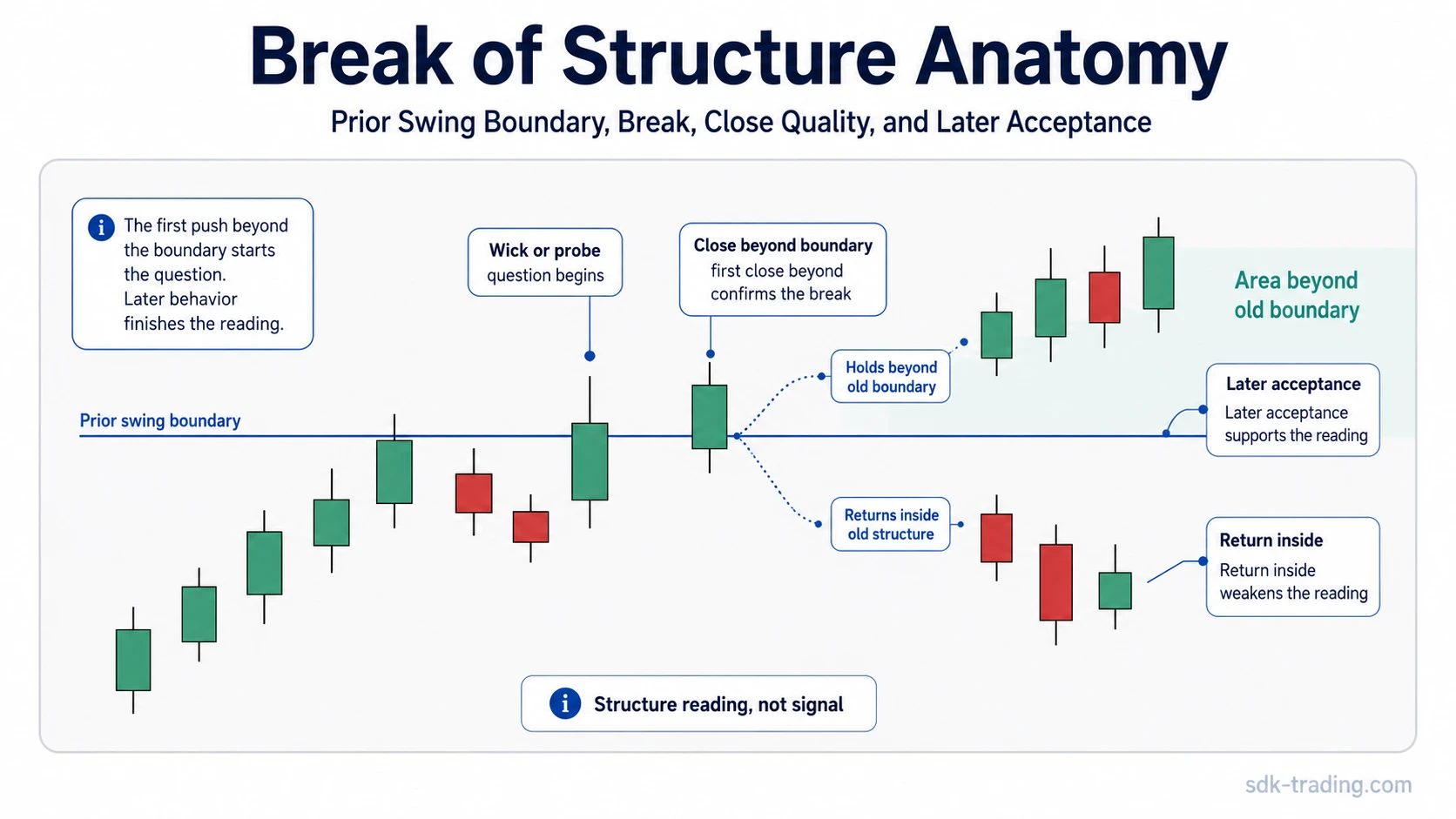
A break of structure, or BOS, occurs when price moves through a meaningful swing boundary in the active market structure. The important distinction is that not every recent high or low is structural, and different BOS frameworks can use different rules for deciding whether a wick or a candle close completes the break.
Definition: A break of structure is a break through a swing high or swing low that has a meaningful role in the current market structure. In this guide, BOS is used primarily for a break that extends the active swing sequence. A break against that sequence belongs to a different structural question.
This creates two separate decisions. First determine whether a valid structural boundary was broken under the chosen BOS rule. Then judge the quality of that break from the way price moved through the level and from the structure that developed afterward.
What Makes a Swing Boundary Structural?
BOS depends on the swing that is being broken. A minor local high or low inside ordinary price noise does not carry the same structural role as a swing that helped define the active directional sequence.
| Boundary feature | More structurally relevant | Less structurally relevant |
|---|---|---|
| Role in the sequence | The swing forms part of the visible progression of highs and lows. | The level is a small fluctuation inside one larger swing. |
| Visibility | The turning point is distinct from nearby price action. | Several nearby highs or lows compete for the same reference. |
| Structural consequence | Moving through the swing extends or materially changes the active sequence. | Crossing the level leaves the larger swing sequence unchanged. |
In an established bullish sequence, the continuation-side boundary is normally a prior swing high within a sequence of higher highs and higher lows.
In an established bearish sequence, the continuation-side boundary is normally a prior swing low within a sequence of lower highs and lower lows.
BOS Event vs BOS Quality
The existence of a boundary break and the quality of that break are related but different questions.
| Question | What to evaluate |
|---|---|
| Was there a BOS event? | Was a meaningful structural swing crossed under the break rule being used? |
| How strong was the break? | How clearly price moved through the boundary, including body size, displacement, and close location. |
| Did the break remain structurally useful? | Whether price held beyond the old boundary and developed a coherent continuation sequence. |
Key boundary: later price behavior grades the quality and persistence of a BOS. It should not replace the initial question of whether a meaningful structural swing was actually broken.
Does a Wick Count as a Break of Structure?
There is no single universal BOS convention for wick versus close. A wick-based rule records the break as soon as price trades beyond the structural level. A close-based rule waits for a candle body to finish beyond that level.
| Break rule | Advantage | Trade-off |
|---|---|---|
| Wick-based | Recognizes the boundary cross earlier. | More wick probes and failed excursions can be classified as breaks. |
| Close-based | Filters many brief trades beyond the level that close back inside. | The BOS is recognized later and some valid fast breaks are recorded only after the candle closes. |
The important requirement is consistency. A chart, indicator, or backtest should define the break rule before BOS labels are evaluated. Switching between wick and close rules after seeing the outcome makes the structural classification unstable.
Close location can still help grade a wick-based break. A candle that trades beyond the swing and closes back inside the old structure describes a different event from one that finishes clearly beyond the boundary.
Bullish and Bearish Break of Structure
| BOS type | Active structure | Continuation-side boundary |
|---|---|---|
| Bullish BOS | Upward swing sequence | A meaningful prior swing high is broken. |
| Bearish BOS | Downward swing sequence | A meaningful prior swing low is broken. |
The direction of the broken level by itself is not enough. The break should be interpreted relative to the sequence that existed before it. A move above a local high inside an established downtrend does not automatically become a bullish continuation BOS simply because an upside level was crossed.
Strong, Weak, and Failed BOS Readings
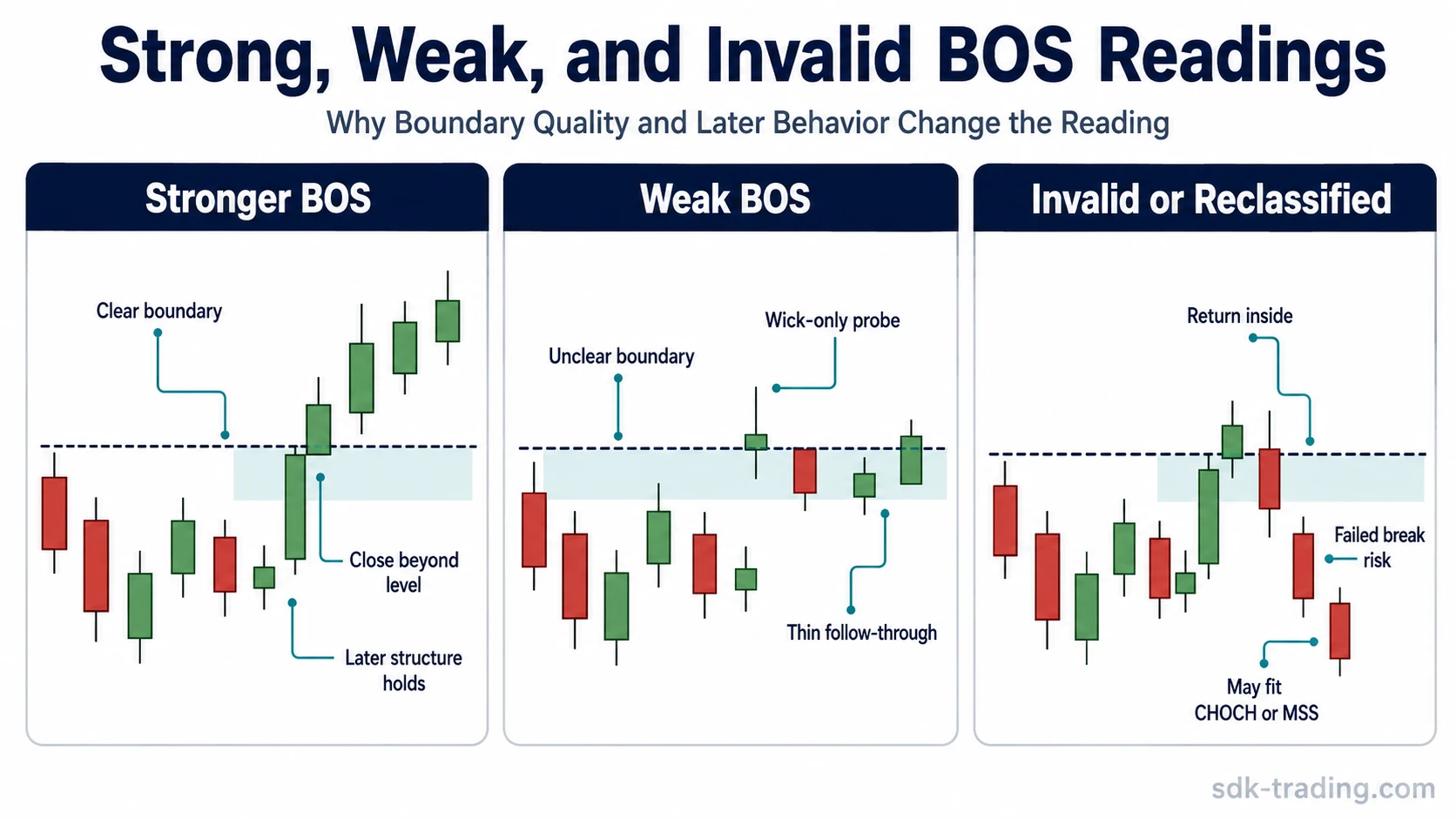
Once the structural boundary and break convention are fixed, the break can be graded separately.
| Reading | Observed structure |
|---|---|
| Stronger BOS | A clear structural swing is broken decisively and the next price sequence remains beyond the old boundary. |
| Weak BOS | The structural swing is valid, but the move through it is shallow, overlapping, or quickly stalls near the boundary. |
| Failed break | Price moves through the boundary but rapidly returns to the prior structure and cannot sustain the continuation sequence. |
| Wrong structural label | The broken level was not a meaningful swing in the active sequence, so the event should not have been classified as BOS in the first place. |
BOS vs CHOCH and Market Structure Shift
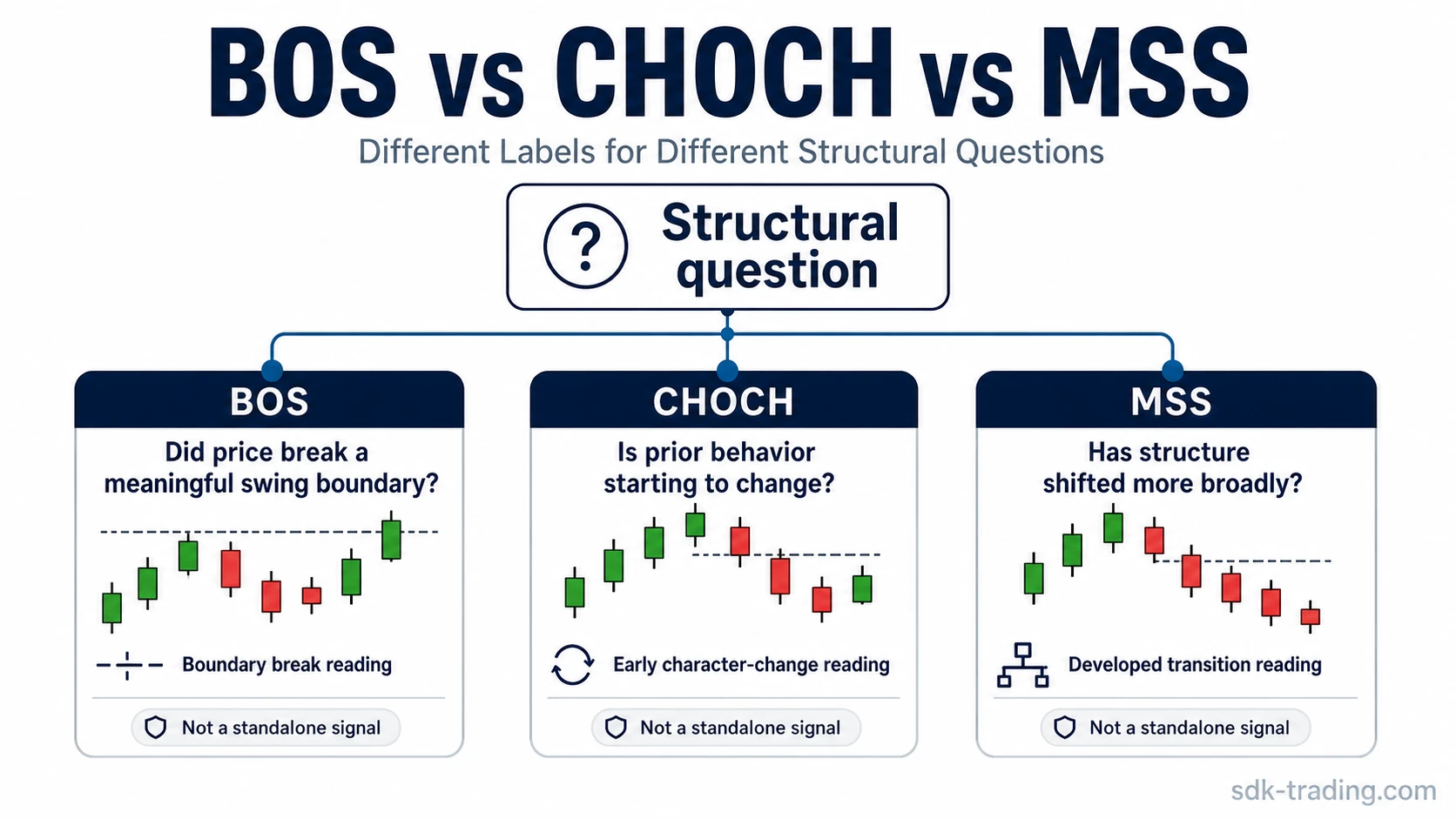
The labels are easiest to separate by the structural question they answer. A BOS is primarily a continuation-side break in the active sequence. A change of character focuses on an early break or behavior change against the prior sequence.
A market structure shift describes a broader transition in the swing logic rather than simply another continuation break.
| Concept | Main structural question |
|---|---|
| BOS | Has the active swing sequence extended through its continuation-side structural boundary? |
| CHOCH | Has price broken against the prior sequence in a way that challenges its previous behavior? |
| MSS | Has enough of the prior swing logic changed to classify a broader structural transition? |
The dedicated BOS vs CHOCH comparison handles the boundary between continuation and early structural change in more detail.
What a Break of Structure Indicator Actually Detects
A BOS indicator cannot label structure without first converting subjective chart features into mechanical rules. At minimum, the script must decide what counts as a swing, which timeframe or swing scale is being measured, and what kind of boundary crossing completes the BOS.
| Indicator setting | Why it changes BOS labels |
|---|---|
| Swing or pivot length | A shorter rule identifies more local highs and lows, while a longer rule selects fewer and larger structural swings. |
| Wick vs close condition | The same candle can qualify under a wick-based rule and fail to qualify under a close-based rule. |
| Internal vs larger swing structure | A lower-scale BOS can occur while the larger structural sequence remains unchanged. |
| Confirmation delay | Pivot-based indicators may need later candles before a swing itself is confirmed. |
This is why two BOS indicators can mark different breaks on the same chart without either script necessarily being broken. They may simply be measuring different swing scales or using different break conventions.
Break of Structure Example
Bullish example: Price forms a clear higher-high and higher-low sequence. The most recent structural high becomes the continuation-side boundary. Price then trades above that swing. Under a wick-based rule, the boundary cross can already register as BOS. Under a close-based rule, the candle must finish beyond the high. If the next swings remain above the old boundary and continue the upward sequence, the BOS also grades as structurally stronger.
If price immediately returns below the old high, the original boundary event still occurred under a wick-based rule, but its continuation quality is poor. Under a close-based rule, the same movement may never have qualified as BOS at all.
Common BOS Classification Errors
| Error | More precise approach |
|---|---|
| Calling every local high or low break a BOS | First establish whether the swing has a meaningful role in the active sequence. |
| Changing between wick and close rules after the break | Define the BOS convention before evaluating the chart. |
| Using post-break failure to claim that no boundary break occurred | Separate the existence of the break under the selected rule from the later quality of that break. |
| Calling a counter-sequence break a continuation BOS | Check whether CHOCH or MSS better describes the structural question. |
| Treating a BOS label as a complete trade decision | Use BOS as a structural classification rather than as an entry, stop, target, or outcome model. |