A market structure shift becomes visible when price stops respecting the swing sequence that had been controlling the market and breaks a meaningful swing point against that prior structure. In stricter ICT and SMC usage, the break is usually expected to show decisive movement or displacement rather than a small wick through the level.
Market structure shift (MSS): a break against the prior directional structure through a meaningful swing high or swing low, typically with enough body movement or displacement to show that the old sequence has been interrupted.
The structural break identifies the shift event. What happens afterward helps judge its quality. Price may hold on the new side, hesitate around the broken swing, or quickly restore the previous sequence.
MSS belongs inside market structure analysis because the label depends on the relationship between swings. A random high or low has little structural value unless it played a meaningful role in the sequence that preceded the break.
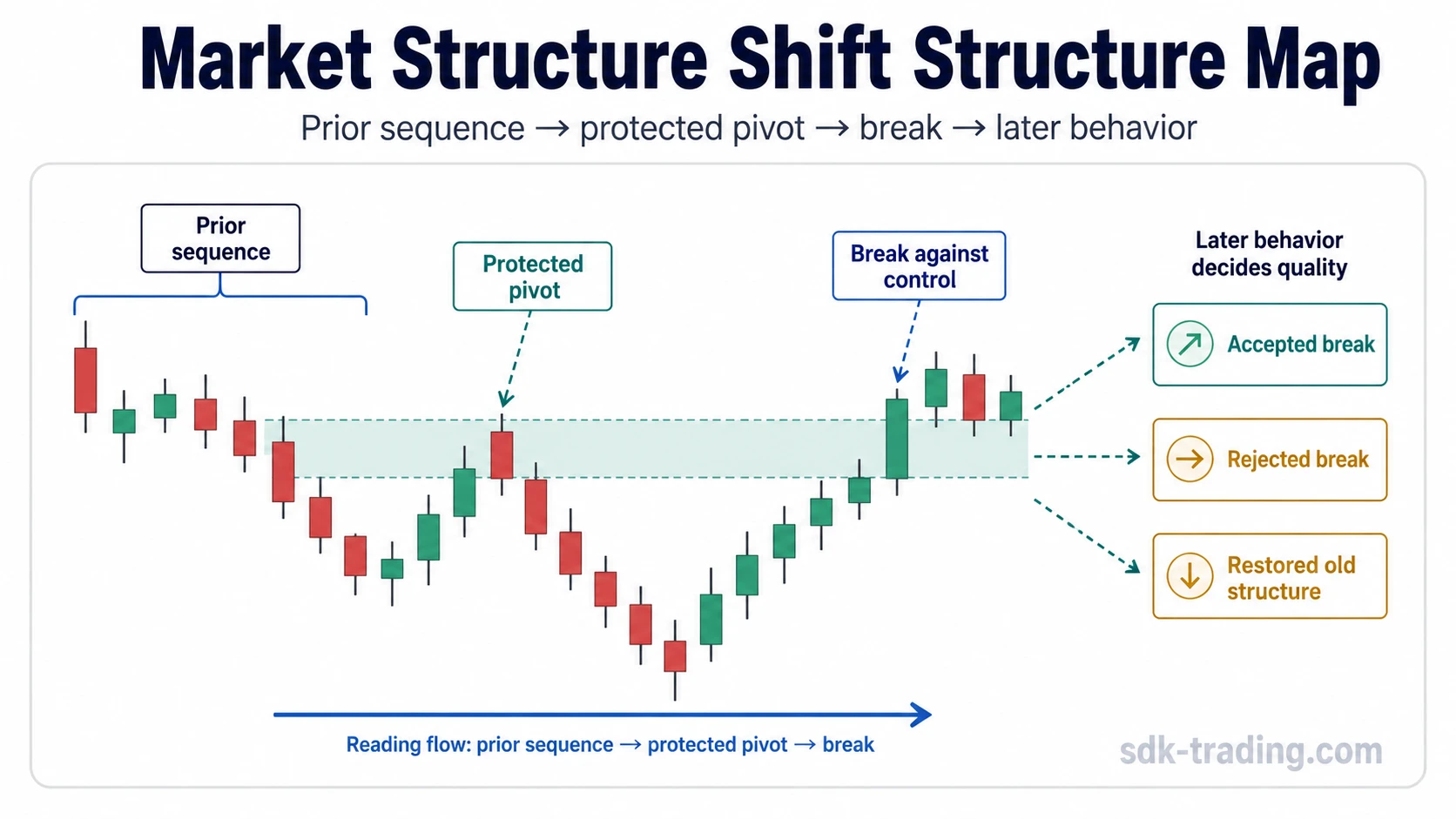
What You Can Observe on the Chart
An MSS reading should begin with chart evidence that can be identified directly. The interpretation comes after those observations are separated.
| Observable feature | What to look for | Why it matters |
|---|---|---|
| Prior swing sequence | Higher highs and higher lows, or lower highs and lower lows. | There must be an existing structure before it can shift. |
| Meaningful swing point | A swing that helped preserve the prior directional sequence. | Breaking a minor intrabar point does not carry the same structural weight. |
| Direction of the break | Price moves against the swing that had been protecting the prior structure. | A break in the same direction as the active sequence is closer to continuation behavior. |
| Break quality | Body close, range expansion, displacement, or other decisive movement through the swing. | A small wick and a forceful structural break are not equivalent observations. |
| Immediate response | Price holds beyond the broken swing, stalls around it, or quickly reclaims the old side. | This helps classify the strength or failure of the shift after the event occurs. |
How to Identify a Market Structure Shift
- Define the existing structure: identify the swing sequence that price has been respecting.
- Mark the structural swing: find the high or low whose failure would interrupt that sequence rather than simply extend it.
- Watch for a break against the sequence: the relevant break moves through the structural swing on the opposite side of prior control.
- Evaluate the break itself: distinguish a wick or shallow breach from a decisive body close or displacement through the level.
- Evaluate the response separately: after the shift, observe whether price holds the new side, becomes unresolved, or restores the previous structure.
Important distinction: the structural break and the later response answer different questions. The break identifies the shift event. Follow-through helps evaluate whether that shift is holding or failing.
Bullish and Bearish Market Structure Shift
A bullish MSS occurs against a prior bearish sequence. Price has been forming lower highs and lower lows, then breaks a meaningful lower high that had been helping preserve the bearish structure. A decisive move through that swing provides stronger structural evidence than a small temporary probe.
A bearish MSS is the opposite case. Price has been forming higher highs and higher lows, then breaks a meaningful higher low that had been supporting the bullish sequence.
| MSS direction | Prior structure | Structural event |
|---|---|---|
| Bullish MSS | Lower highs and lower lows | A meaningful lower high is broken to the upside. |
| Bearish MSS | Higher highs and higher lows | A meaningful higher low is broken to the downside. |
The bullish or bearish label describes the direction of the structural interruption. It does not guarantee that a complete trend reversal will follow.
MSS vs BOS vs CHOCH
MSS, BOS, and CHOCH all describe changes around swing structure, but the terminology is not completely standardized across ICT, SMC, and broader price-action usage.
| Concept | Common structural use | Main distinction |
|---|---|---|
| Market structure shift | A meaningful break against the prior directional structure, often with displacement in stricter usage. | Focuses on interruption of the structure that had been controlling price. |
| Break of structure | A structural break that commonly extends the active directional sequence. | Often used for continuation rather than the first break against prior control. |
| Change of character | An early change or counter-structure break that warns the prior behavior may be changing. | Some frameworks distinguish CHOCH from MSS by displacement or structural significance; others use the terms more loosely. |
A break of structure is therefore easier to separate from MSS when the direction of the break is considered first. A continuation break extends the current sequence. An MSS challenges it.
Terminology limitation: MSS and CHOCH do not have one universally enforced definition across all trading frameworks. The visible swing sequence, the swing being broken, the direction of that break, and the quality of the move are more useful than relying on the label alone.
Wick Break vs Decisive MSS Break
A wick through a swing point shows that price traded beyond the level. It does not show the same structural commitment as a decisive move through the level.
| Observed event | Structural reading |
|---|---|
| Wick beyond the swing followed by an immediate return | The level was probed, but structural acceptance beyond it is weak. |
| Small body close just beyond the swing | The boundary has been crossed, but the quality of the shift may still be weak. |
| Decisive body movement or displacement through the swing | The prior structural boundary has been broken with stronger observable evidence. |
| Break followed by immediate restoration of the old sequence | The shift event occurred, but the new structure failed to persist. |
How to Judge MSS Quality After the Break
The break itself can be evaluated separately from what happens afterward. This avoids making future behavior part of the original definition while still allowing the chart reading to change as new information appears.
| Reading | Observable behavior | Interpretation |
|---|---|---|
| Cleaner shift | Clear prior structure, meaningful swing, decisive break, and price remains on the new side. | The interruption has stronger structural support. |
| Weak shift | The correct structural swing is crossed, but the break is shallow or lacks displacement. | The structural event exists, but its quality is weaker. |
| Unresolved shift | Price trades repeatedly around the broken swing without developing a clear new sequence. | The old structure has been challenged, but control remains unclear. |
| Failed shift | Price breaks the structural swing and then quickly restores the prior directional sequence. | The interruption did not develop into a durable structural change. |
| Ordinary noise | No clear prior sequence or meaningful structural swing existed before the break. | The MSS label has little structural basis. |
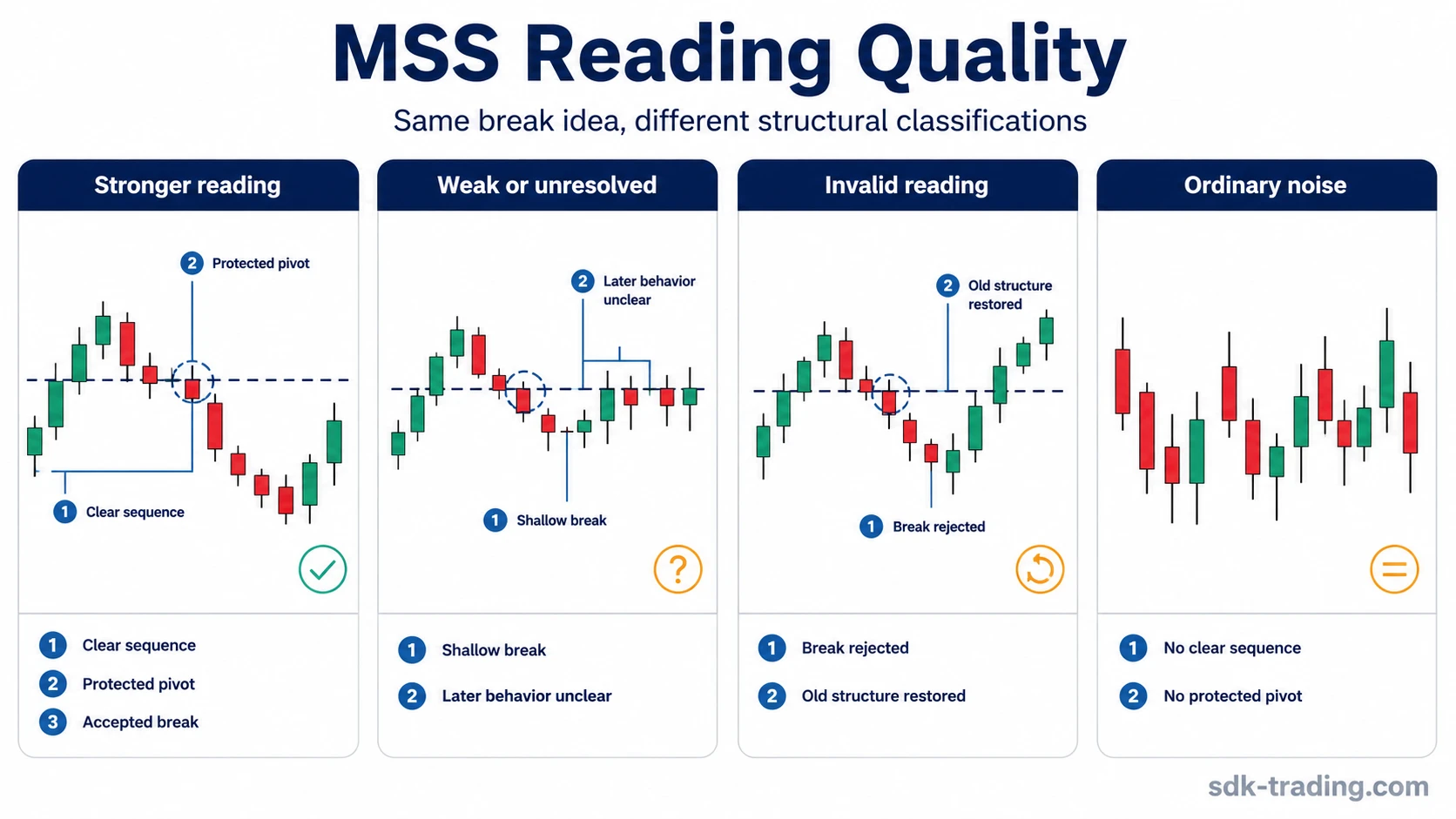
Practical MSS Scenario
Price has been forming lower highs and lower lows. One lower high becomes structurally important because subsequent selling continues from below it. Price later rallies through that lower high with a strong body move rather than a brief wick.
The observable change is now clear: a swing that had been preserving the bearish sequence has been broken against that sequence. That is the structural event behind the bullish MSS reading.
If price then remains above the broken swing and starts building higher structure, the shift develops more cleanly. If price quickly falls back below the swing and resumes lower highs and lower lows, the MSS has failed to produce a durable structural transition.
When the distinction between continuation and interruption is still unclear, examples of structure breaks help show how the same type of swing break can play different roles inside different sequences.
What MSS Does Not Establish
A market structure shift identifies a structural interruption. It does not by itself establish a completed reversal, an entry price, a stop location, a target, or the probability that the next swing will continue in the new direction.
The reading is also timeframe-dependent. A meaningful MSS on a lower timeframe can remain a minor internal movement inside a larger higher-timeframe trend. The swing sequence being analyzed must therefore remain explicit whenever the MSS label is used.