Diamonds and Wolfe waves group three related chart-pattern paths: upper diamond reversal structures, lower diamond reversal structures, and five-point Wolfe Wave structures. The useful first step is classification, because these patterns can look similar before their structure is clear.
Diamond Top, Diamond Bottom, and Wolfe Wave readings all depend on structure rather than a single candle, breakout, or line touch. A sound interpretation starts with the shape of the swing sequence, then checks whether later price action accepts or rejects the area being tested.
Definition: Diamonds and Wolfe waves are a chart-pattern group used to separate diamond-shaped reversal structures from Wolfe Wave swing structures. Diamond patterns focus on expansion and contraction around an upper or lower area, while Wolfe Wave analysis focuses on a five-point relationship between swings.
Key Points
- Diamond Top and Diamond Bottom are separate diamond-shaped reversal contexts.
- Wolfe Wave is a separate five-point swing structure, not a diamond pattern.
- The group is most useful as a classification filter before detailed pattern study.
- No single breakout, wick, or reversal candle confirms the full structure by itself.
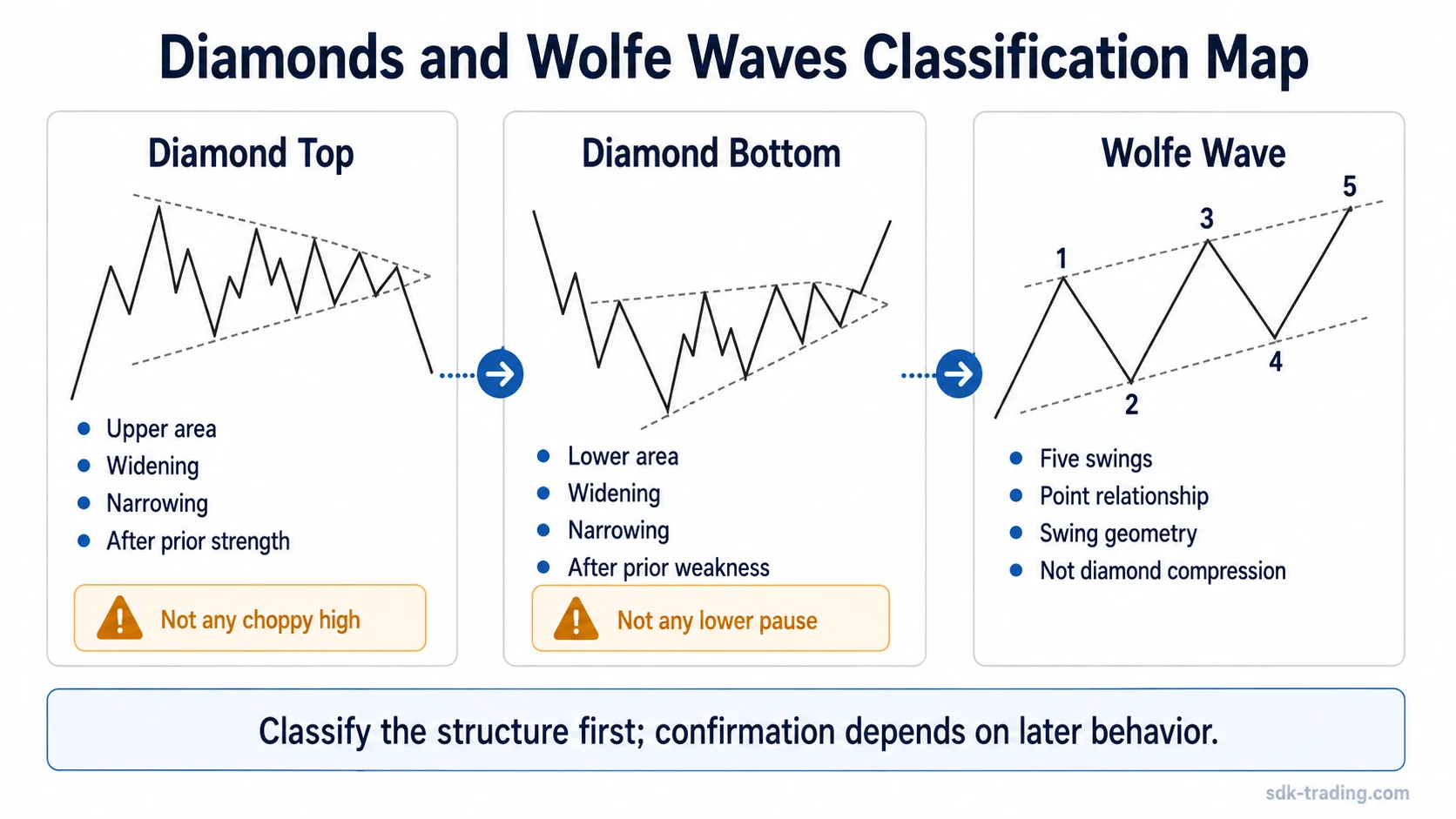
Which Pattern Fits the Structure?
Diamond patterns are shape-based, while Wolfe Wave analysis is swing-sequence based. The fastest way to separate this group is to start with the structure being formed, not with the desired directional reading.
| Pattern | Best structural clue | Common misread risk | Chart question it answers |
|---|---|---|---|
| Diamond Top | Broadening then contracting price action near an upper area after an advance. | Calling any choppy high a diamond before the expansion and contraction are visible. | Whether an upper diamond-shaped reversal structure is forming after prior strength. |
| Diamond Bottom | Broadening then contracting price action near a lower area after a decline or prolonged weakness. | Reading a lower pause as a diamond bottom before failed lower acceptance appears. | Whether a lower diamond-shaped reversal structure is forming after prior weakness. |
| Wolfe Wave | A five-point swing sequence where the relationship between points matters more than a diamond shape. | Forcing symmetry or channel structure where the five-point relationship is weak. | Whether the chart question is about swing geometry instead of diamond compression. |
Diamond Top vs Diamond Bottom vs Wolfe Wave
Diamond Top belongs near an upper area where price has already advanced and the structure begins to widen, then narrow. The shape matters because the pattern is not just a failed breakout or a single rejection candle.
Diamond Bottom belongs near a lower area where price has already weakened and the market begins to reject lower acceptance. The interpretation remains incomplete if price only pauses without showing a recognizable expansion-to-contraction structure.
Wolfe Wave belongs to a different pattern family. The focus is the five-point swing relationship, not a diamond-shaped compression. The reading weakens when the points are forced onto the chart after the fact.
Common Misreads in This Pattern Group
The main error is naming the pattern before the structure has earned the label. A volatile area can look like a diamond too early. A channel-like movement can look like a Wolfe Wave only after the five-point relationship is forced. A clean label does not make the reading stronger if the surrounding behavior does not support it.
Common mistake: Treating the first breakout, breakdown, or swing touch as confirmation. In this group, later acceptance, rejection, and structural clarity matter more than the first visible pattern clue.
Diamond readings become more defensible when the broadening and narrowing phases can be separated. Wolfe Wave readings become more defensible when the five points relate coherently to the surrounding swing path. If those conditions are missing, the structure remains unresolved.
Choosing the Correct Pattern Family
Use Diamond Top analysis for a possible upper reversal diamond after an advance. Use Diamond Bottom analysis for a possible lower reversal diamond after weakness. Use Wolfe Wave analysis for a five-swing structure rather than a diamond-shaped reversal.
| Chart question | Best-fit pattern | Why the fit is different |
|---|---|---|
| Is the upper area forming a widening then narrowing reversal structure? | Diamond Top | The question is about an upper diamond-shaped formation after prior strength. |
| Is the lower area rejecting acceptance after a widening then narrowing structure? | Diamond Bottom | The question is about a lower diamond-shaped formation after prior weakness. |
| Do the swings form a five-point relationship rather than a diamond? | Wolfe Wave | The question is about swing geometry and point relationships, not diamond compression. |
Classification Scenario
Price can advance into a prior upper area, widen into uneven swings, and then begin to contract. That structure points toward Diamond Top analysis only if the expansion and contraction are visible enough to separate from ordinary chop. The lower version belongs with Diamond Bottom analysis when failed lower acceptance is part of the structure. A coherent five-swing sequence belongs with Wolfe Wave analysis instead.
Limitation: Classification does not confirm a trade. The label only helps choose the correct pattern framework. The reading still depends on structure quality, acceptance, rejection, and later confirmation.
FAQ
Are diamonds and Wolfe waves the same pattern?
No. Diamond patterns use a broadening-then-contracting structure, while Wolfe Wave analysis uses a five-point swing relationship. They can appear in similar chart areas, but they are not the same structure.
Is Diamond Top the bearish version and Diamond Bottom the bullish version?
Diamond Top usually refers to an upper diamond-shaped reversal context, while Diamond Bottom usually refers to a lower diamond-shaped reversal context. The label still depends on structure and later confirmation, not direction alone.
When should Wolfe Wave be studied instead of a diamond pattern?
Wolfe Wave is the better fit when the chart question is about a five-point swing relationship rather than a diamond-shaped expansion and contraction. Forcing a Wolfe Wave onto weak swing geometry can create a misleading reading.