A diamond top pattern is a bearish reversal chart pattern that can form after a mature upward move, when price first expands into wider swings and then contracts into a narrowing structure.
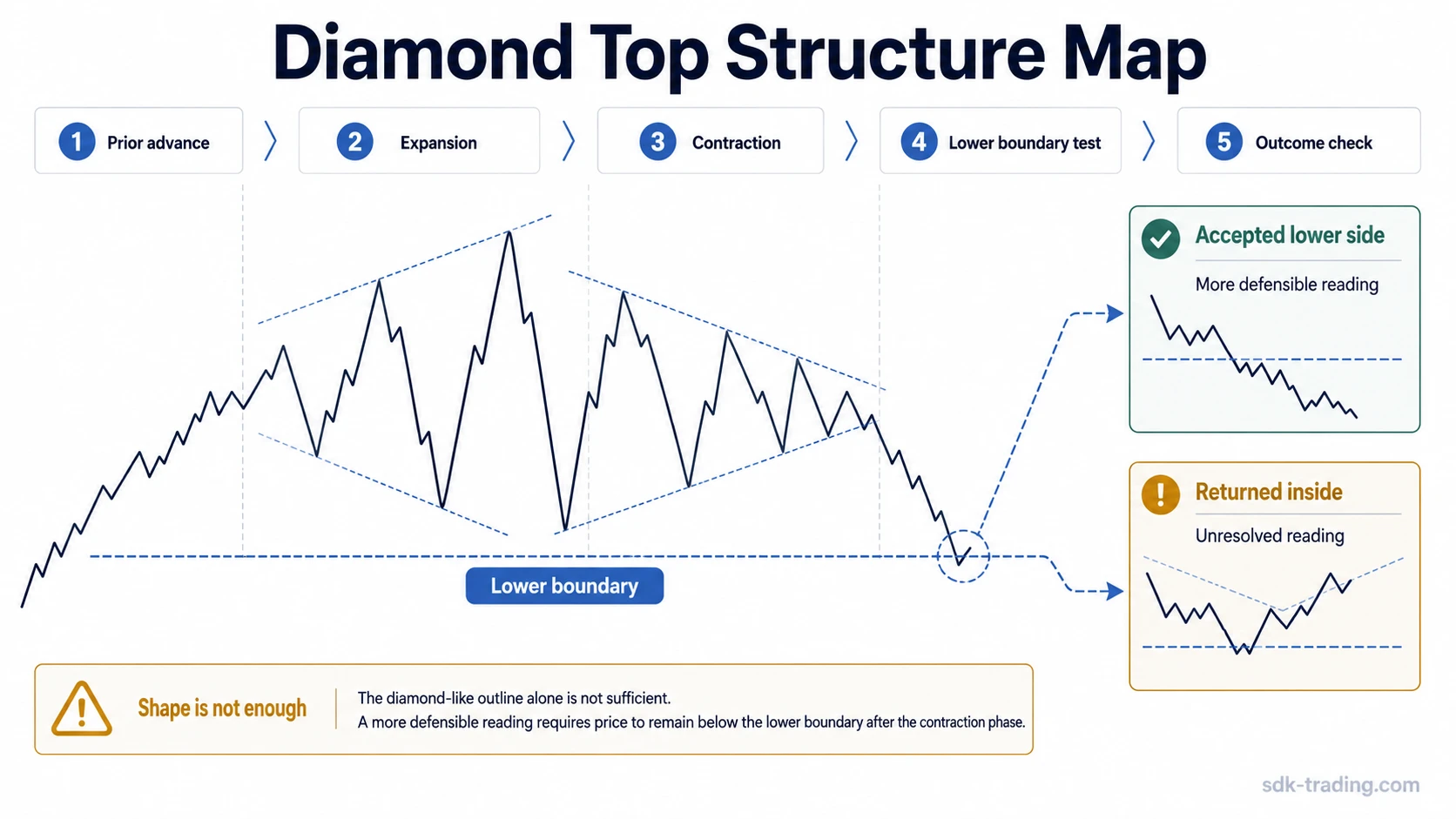
The outline alone is not enough. A stronger reading needs an upward context, a visible expansion phase, a visible contraction phase, and later behavior that holds below the lower side instead of quickly returning inside the structure.
Definition: A diamond top pattern is a top-side reversal structure built from widening volatility followed by compression. The interpretation becomes more defensible when the lower side of the structure is accepted after the contraction phase.
Key Points
- A diamond top pattern forms after a prior advance, not in any random sideways range.
- The structure widens first, then narrows as swings compress.
- A lower-boundary move needs acceptance before the bearish reversal reading becomes more defensible.
- The label remains premature if price returns inside the structure or if the outline lacks coherent expansion and contraction.
- It should be separated from diamond bottom structures, Wolfe Wave logic, head and shoulders patterns, and broadening-only formations.
What a Diamond Top Pattern Is
A diamond top is a chart-pattern label for a market that has already advanced, becomes unstable through wider swings, and then compresses into a narrower range near the top of that move. The name comes from the outline created by expansion on the left side and contraction on the right side.
The bearish interpretation is conditional. A diamond top can warn that the prior advance is losing clean control, but it does not prove a reversal by itself. The structure gains meaning when later price behavior shows that the lower side of the pattern is being accepted, not merely tested by a single wick.
Many markets create diamond-like outlines during ordinary volatility. Without a prior upward move, a readable expansion-to-contraction sequence, and a boundary test, the label can become a visual guess rather than a useful structural reading.
How to Identify a Diamond Top Pattern
The clearest diamond top readings start with observable structure rather than prediction. The pattern should begin after a sustained upward move or mature advance. Then price starts making wider swings, often with higher highs and lower lows. After that expansion, the swings compress into lower highs and higher lows.
The lower boundary becomes important only after the contraction phase has formed. A brief move through that boundary is not enough on its own. Stronger evidence appears when price holds below the broken lower side, recovery attempts fail to reclaim it, or the market stops treating the prior range as accepted value.
| Observation | What It Suggests | What Still Needs Confirmation |
|---|---|---|
| Prior upward move | The structure is forming in a top-side context. | The advance must be mature enough for reversal interpretation to be relevant. |
| Wider swings with higher highs and lower lows | Volatility is expanding instead of trending cleanly. | The expansion should be visible enough to separate the pattern from a normal pause. |
| Lower highs and higher lows after the expansion | The structure is compressing after instability. | The contraction should not be a random cluster of overlapping candles. |
| Move below the lower boundary | The market is testing the bearish completion area. | Holding below the broken lower side is needed before the reading strengthens. |
Diamond Top Structure: Expansion, Contraction, and Lower Boundary
The diamond top structure has three practical parts: expansion, contraction, and lower-side behavior. The expansion phase shows that the prior advance is no longer moving through clean trend control. The contraction phase shows that volatility is compressing after that unstable widening. The lower-side test decides whether the market accepts the break or rejects it and returns inside the structure.
Volume can support the reading, but it should stay secondary. Higher activity during the unstable expansion phase and weaker activity during late compression can add context. Still, volume alone does not complete the pattern. Structure, lower-side behavior, and later acceptance carry more weight than a single volume spike.
A practical way to read the pattern is to separate shape from behavior. Shape asks whether the outline is actually diamond-like. Behavior asks whether the market has held the lower side after that shape forms. A clean outline without that behavior remains incomplete.
Clean, Weak, and Invalid Diamond Top Readings
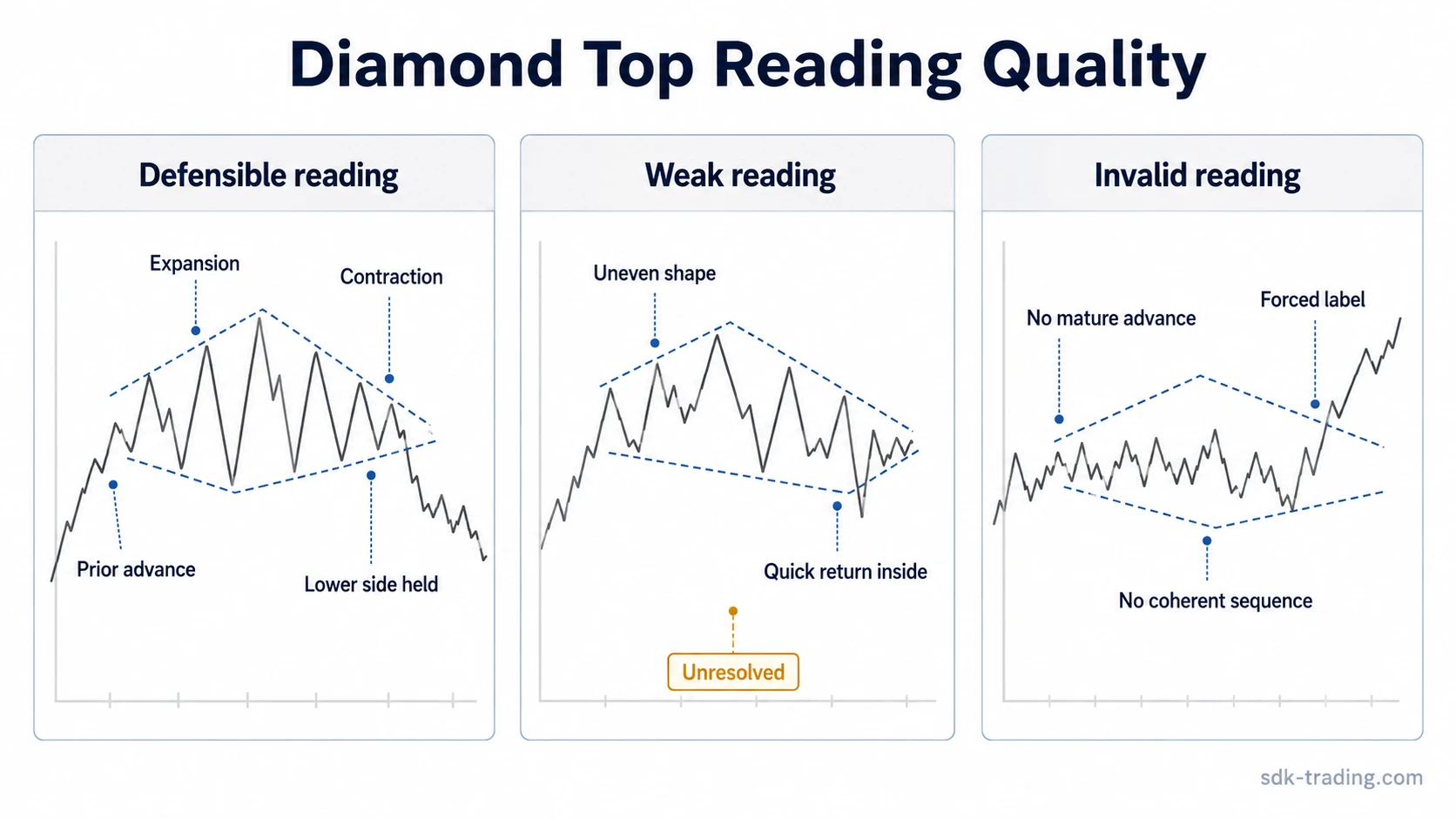
The Diamond Top Classification Test separates a defensible reading from a forced label. The purpose is not to turn the pattern into a trading instruction. The purpose is to judge whether the structure has enough observable evidence to deserve the diamond top label.
| Reading Quality | Structure | Lower-Side Behavior | Interpretation |
|---|---|---|---|
| Clean | Prior advance, clear expansion, then clear contraction. | Price holds below the lower boundary and struggles to reclaim it. | The bearish reversal interpretation is more defensible, while still conditional. |
| Weak | The outline is visible, but expansion or contraction is uneven. | Price briefly moves below the boundary but quickly returns inside. | The structure stays unresolved and should not be treated as completed. |
| Invalid | No mature advance, no coherent widening-to-narrowing sequence, or only a noisy range. | The lower boundary never gains acceptance or the structure breaks upward instead. | The diamond top label is likely forced or premature. |
Limitation: A diamond-like outline is not enough. The structure becomes useful only when the market shows a coherent sequence and then confirms or rejects the lower side through later behavior.
Diamond Top Example in Context
Price advances into a prior resistance area and begins making wider swings. A later high extends above the previous high, but the next decline also reaches lower than the prior pullback. After that widening phase, the next rallies stall earlier and the pullbacks become less aggressive, creating a narrowing right side.
The diamond top label becomes more defensible if price holds below the lower boundary and later recovery attempts fail to reclaim the broken area. If the move is quickly rejected and price returns inside the structure, the pattern remains unresolved. If the expansion-to-contraction sequence was never clear, the better classification is often a noisy range rather than a diamond top.
Diamond Top vs Diamond Bottom vs Wolfe Wave
A diamond top is a top-side structure. A Diamond Bottom belongs to the opposite context because it forms around a potential bottom-side reversal structure rather than a mature advance.
The pattern also differs from Wolfe Wave pattern logic, which depends on a wave-based sequence and projected component relationships rather than a diamond-shaped expansion-to-contraction consolidation.
| Concept | Main Context | Core Structure | Main Confusion Risk |
|---|---|---|---|
| Diamond top | After a prior advance. | Expansion first, contraction second, lower-boundary test later. | Calling any noisy top range a diamond top. |
| Diamond bottom | After a prior decline or bottoming phase. | Expansion and contraction around a possible base. | Using top-side logic in the wrong directional context. |
| Wolfe Wave | Wave-pattern structure. | Defined by component points and wave relationships. | Confusing wave sequencing with diamond consolidation. |
Common Mistakes When Reading a Diamond Top
The first common mistake is labeling the pattern too early. The left-side expansion may look convincing, but the diamond top reading is incomplete if the right-side contraction has not formed.
The second mistake is treating a wick below the lower boundary as enough evidence. A wick can test an area without proving that price has accepted the lower side. Later behavior needs to show whether price can remain outside the structure or whether the move was rejected.
The third mistake is ignoring the prior trend. A diamond top belongs in a top-side context after an advance. A diamond-like range in the middle of directionless price action may be only consolidation.
The fourth mistake is turning the structure into a prediction. A diamond top can frame a possible bearish reversal reading, but the interpretation still depends on confirmation, failed acceptance, broader market context, and the quality of the structure itself.
When the Diamond Top Pattern Loses Diagnostic Value
The label remains premature when price moves back inside the structure after testing the lower boundary. It also loses diagnostic value when the contraction phase is unclear, when the pattern forms without a prior advance, or when the supposed diamond is only a broad sideways range with irregular swings.
Failed lower acceptance is the main diagnostic problem. A lower-boundary move may appear convincing at first, but if the market quickly reclaims the broken area, the structure has not behaved like a completed diamond top. The interpretation remains unresolved until later price behavior gives a clearer answer.
FAQ
What is a diamond top pattern?
A diamond top pattern is a bearish reversal chart pattern that can form after a prior upward move, when price first expands into wider swings and then contracts into a narrowing structure.
How do you identify a diamond top pattern?
Look for a prior advance, a widening phase with broader swings, a narrowing phase with compression, and later price behavior that holds below the lower boundary.
Does a diamond top pattern always mean price will reverse?
No. A diamond top is a conditional structure, not a guarantee. The interpretation weakens if price returns inside the structure or if the lower boundary move is rejected.
What makes a diamond top reading weak?
The reading is weak when the pattern lacks a prior advance, the expansion-to-contraction sequence is unclear, or the lower boundary test is quickly rejected.