A Wolfe Wave is a five-point chart pattern in technical analysis that uses swing points, converging boundaries, point 5 behavior, and EPA/ETA reference lines to classify a possible price structure.
The pattern is useful only when the point sequence stays coherent. Points 1 through 5 need to form a readable order, the upper and lower boundaries need to make sense together, and the reaction around point 5 needs follow-through that supports the classification. A Wolfe Wave is therefore a chart-reading framework, not a standalone trading signal.
Definition: A Wolfe Wave is a five-point chart pattern in technical analysis where price forms a structured sequence between two boundaries, with point 5 acting as the late classification test and EPA/ETA serving as reference lines for interpretation.
Key Points
- A Wolfe Wave depends on five swing points, not a single candle or one isolated trendline.
- Point 5 is a boundary test; it does not confirm the pattern by itself.
- EPA and ETA are reference concepts, not guaranteed price or time outcomes.
- The classification weakens when boundaries are forced, point 5 is unclear, or later price behavior rejects the pattern logic.
What Is a Wolfe Wave?
A Wolfe Wave is a chart pattern built around a five-point sequence. The pattern usually starts with an initial swing, develops through alternating highs and lows, and then reaches a fifth point where the outline is tested near an outer boundary.
The main idea is balance between the swings. A valid reading needs more than a shape that looks like a wedge or channel. The points, boundaries, and subsequent candles must work together. When those parts do not align, the same chart may be only a loose swing sequence rather than a Wolfe Wave.
Wolfe Wave analysis belongs inside technical chart-pattern work. It can help organize price action, but it should be read with context, confirmation, and invalidation rather than treated as a mechanical forecast.
Wolfe Wave Components
The strongest Wolfe Wave readings come from a complete set of components. A missing point, a forced boundary, or an unsupported point 5 reaction can change the classification quickly.
| Component | What it does | Required for classification? | What weakens the reading? |
|---|---|---|---|
| Point 1 | Begins the reference sequence and gives the first swing anchor. | Yes | The starting point is arbitrary or only visible after forcing the pattern. |
| Point 2 | Creates the first opposite swing and helps define the early rhythm. | Yes | The move from point 1 to point 2 is too vague to anchor the pattern. |
| Point 3 | Builds the next swing and helps form one side of the boundary logic. | Yes | Point 3 does not relate cleanly to point 1 or the wider chart outline. |
| Point 4 | Completes the opposite side of the developing pattern. | Yes | Point 4 breaks the rhythm or makes the boundaries unreadable. |
| Point 5 | Tests the outer boundary and becomes the most important classification area. | Yes | Price does not behave like a boundary test or later action rejects the label. |
| 1-3 boundary | Connects the first and third points to define one side of the pattern. | Usually yes | The line requires an unnatural adjustment to touch the points. |
| 2-4 boundary | Connects the second and fourth points and helps frame the opposite side. | Usually yes | The line does not contain the pattern or fails to describe the swing rhythm. |
| EPA line | Acts as an estimated price-at-arrival reference used to read the pattern. | Useful, but not enough alone | It is treated as a guaranteed objective instead of a reference line. |
| ETA area | Acts as an estimated time-of-arrival reference for how the pattern may unfold. | Useful, but not enough alone | It is treated as a precise timing forecast instead of a structural guide. |
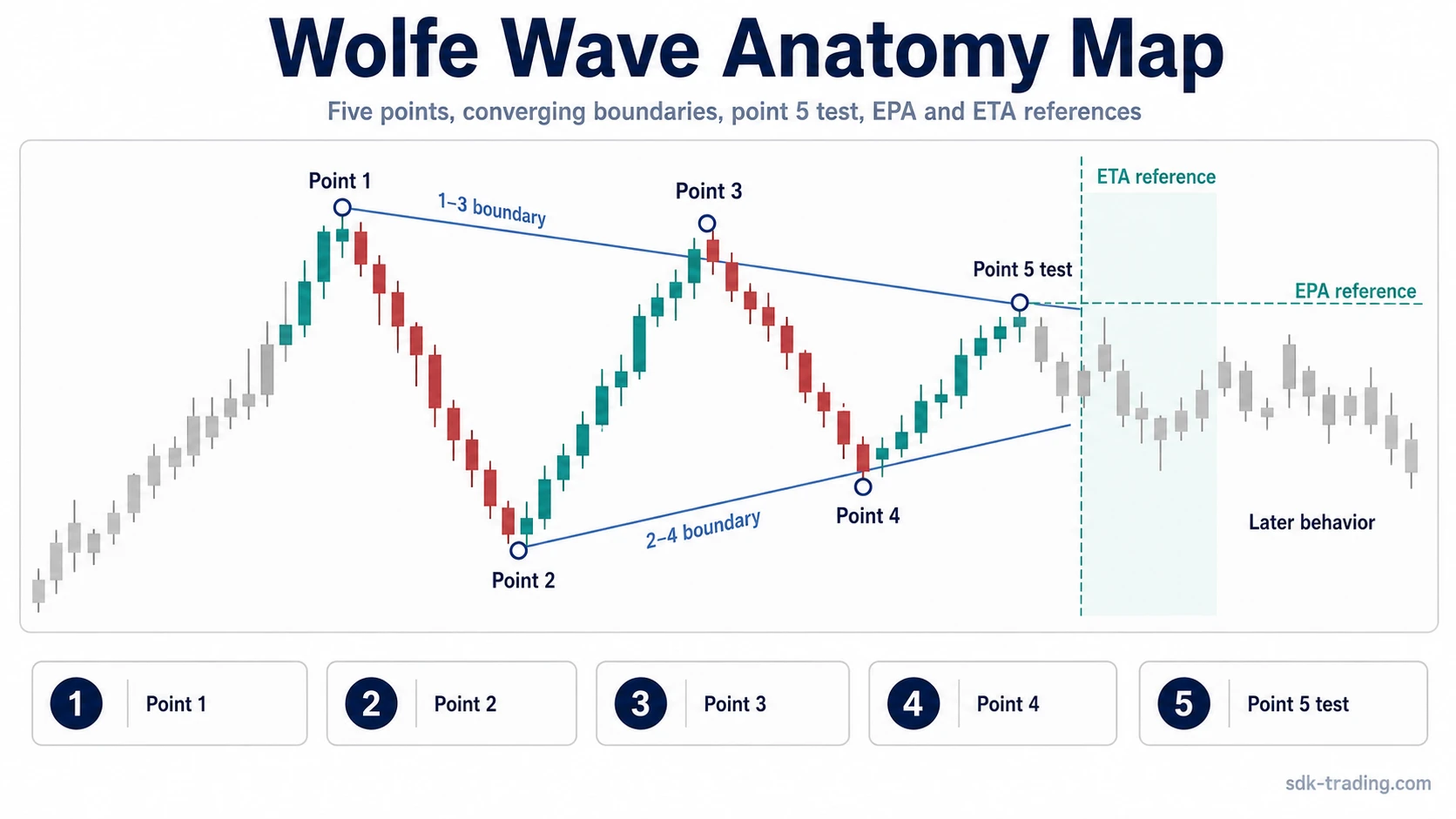
How a Wolfe Wave Forms
A Wolfe Wave forms through alternating swing points. The first four points create the visible rhythm. The fifth point tests whether the pattern is still coherent or whether the label is being forced onto ordinary price movement.
The 1-3 and 2-4 lines usually create the main boundary logic. These boundaries help separate a readable Wolfe Wave from a loose wedge, channel, or irregular swing sequence. Symmetry can make the outline easier to see, but symmetry alone is not proof.
Point 5 is often the tempting part of the pattern because it appears late and can make the whole drawing look complete. A safer reading is conditional: point 5 begins the classification test, and later price behavior decides whether the label remains useful.
Structure note: The visible outline is only the surface. The stronger reading comes from the relationship between swing points, boundaries, point 5 behavior, and later acceptance or failure.
EPA and ETA in a Wolfe Wave
EPA usually refers to Estimated Price at Arrival. ETA usually refers to Estimated Time of Arrival. In Wolfe Wave analysis, these are reference concepts used to compare the pattern idea with later behavior.
EPA should not be read as a guaranteed price objective. ETA should not be read as a precise clock. Both are reference lines, not proof that the pattern will resolve in a specific way.
If later price action breaks the point sequence or ignores the boundary logic, the EPA/ETA reference becomes less useful rather than more predictive.
Limitation: EPA and ETA can make a chart look more precise than it really is. The classification remains conditional when price fails to respect the pattern, when the boundaries are unclear, or when the later move does not support the reading.
Bullish vs Bearish Wolfe Wave
A bullish Wolfe Wave and a bearish Wolfe Wave use the same five-point logic, but the structure is mirrored. The difference is the direction of the developing swings and the way point 5 tests the outer boundary.
| Form | Structural reading | Point 5 role | What still needs confirmation? |
|---|---|---|---|
| Bullish Wolfe Wave | The pattern develops after downward or weakening price action and point 5 tests the lower boundary area. | Point 5 tests whether the lower side of the pattern is rejected or accepted. | Follow-through needs to support failed lower acceptance rather than continued breakdown. |
| Bearish Wolfe Wave | The pattern develops after upward or strengthening price action and point 5 tests the upper boundary area. | Point 5 tests whether the upper side of the pattern is rejected or accepted. | Follow-through needs to support failed upper acceptance rather than continued breakout. |
The bullish or bearish label should describe the pattern, not create an instruction. A mirrored formation can still fail if the points are not coherent or if price accepts the area that point 5 was expected to test.
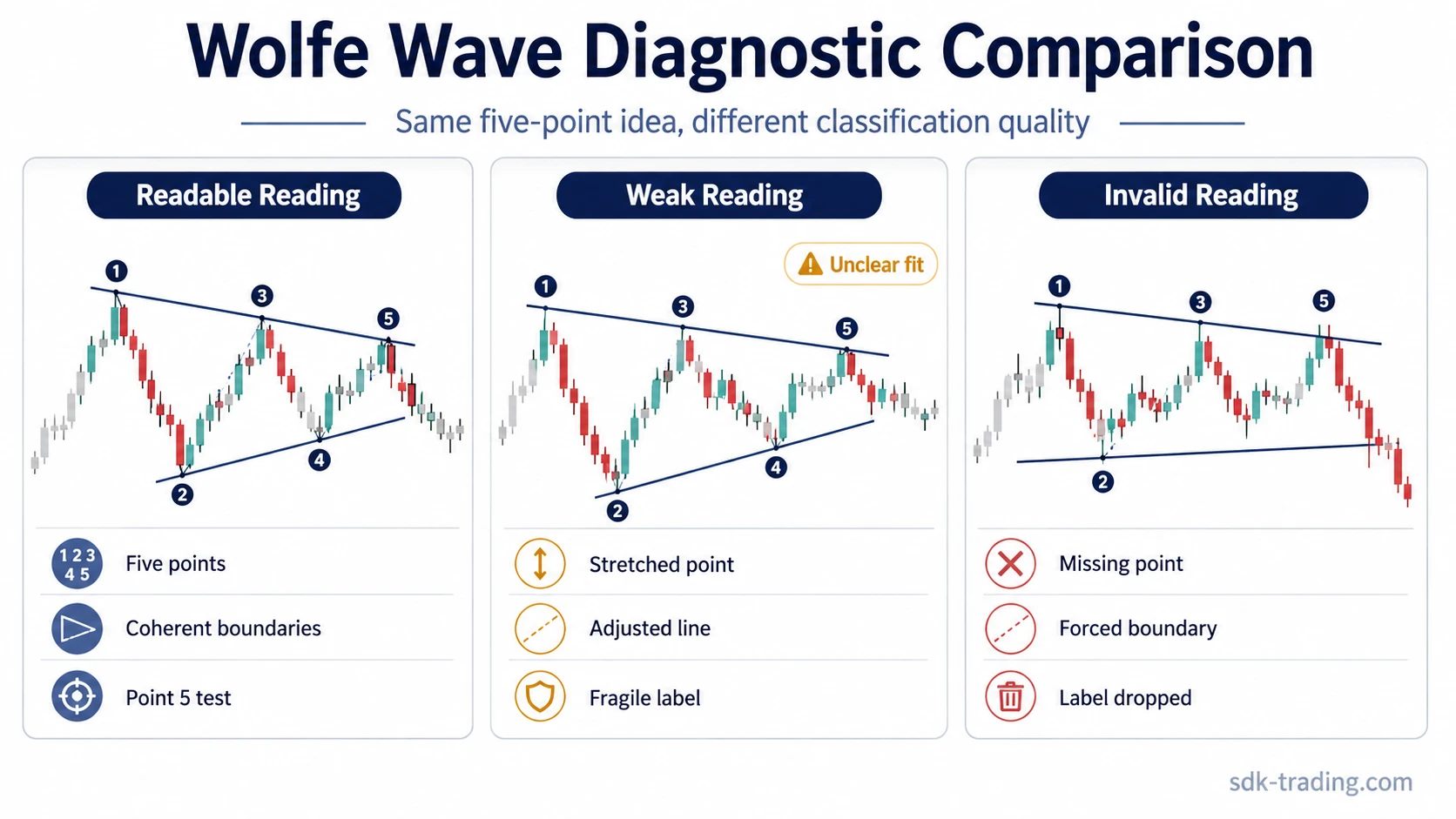
Clean, Weak, and Invalid Wolfe Wave Readings
The most useful distinction is not whether a chart looks like a Wolfe Wave at first glance. The stronger distinction is whether the pattern is clean, weak, or invalid after points, boundaries, point 5, and follow-through are compared.
| Reading | What it looks like | Why it matters | What changes the classification? |
|---|---|---|---|
| Clean Wolfe Wave | Five readable points, coherent boundaries, a meaningful point 5 test, and later behavior that respects the pattern. | The formation has enough internal agreement to be classified as a Wolfe Wave. | The reading remains conditional, but the pattern is not being forced. |
| Weak Wolfe Wave | The outline is visible, but one or more points are stretched, late, unclear, or dependent on adjusted boundaries. | The chart may still be useful for observation, but the pattern label is fragile. | The classification weakens further if later price action ignores the boundary logic. |
| Invalid Wolfe Wave | Key points are missing, the boundaries do not describe the formation, or point 5 fails to behave like a boundary test. | The chart should not be classified as a Wolfe Wave just because a rough five-swing shape exists. | The label should be dropped when later behavior rejects the pattern or accepts the tested area cleanly. |
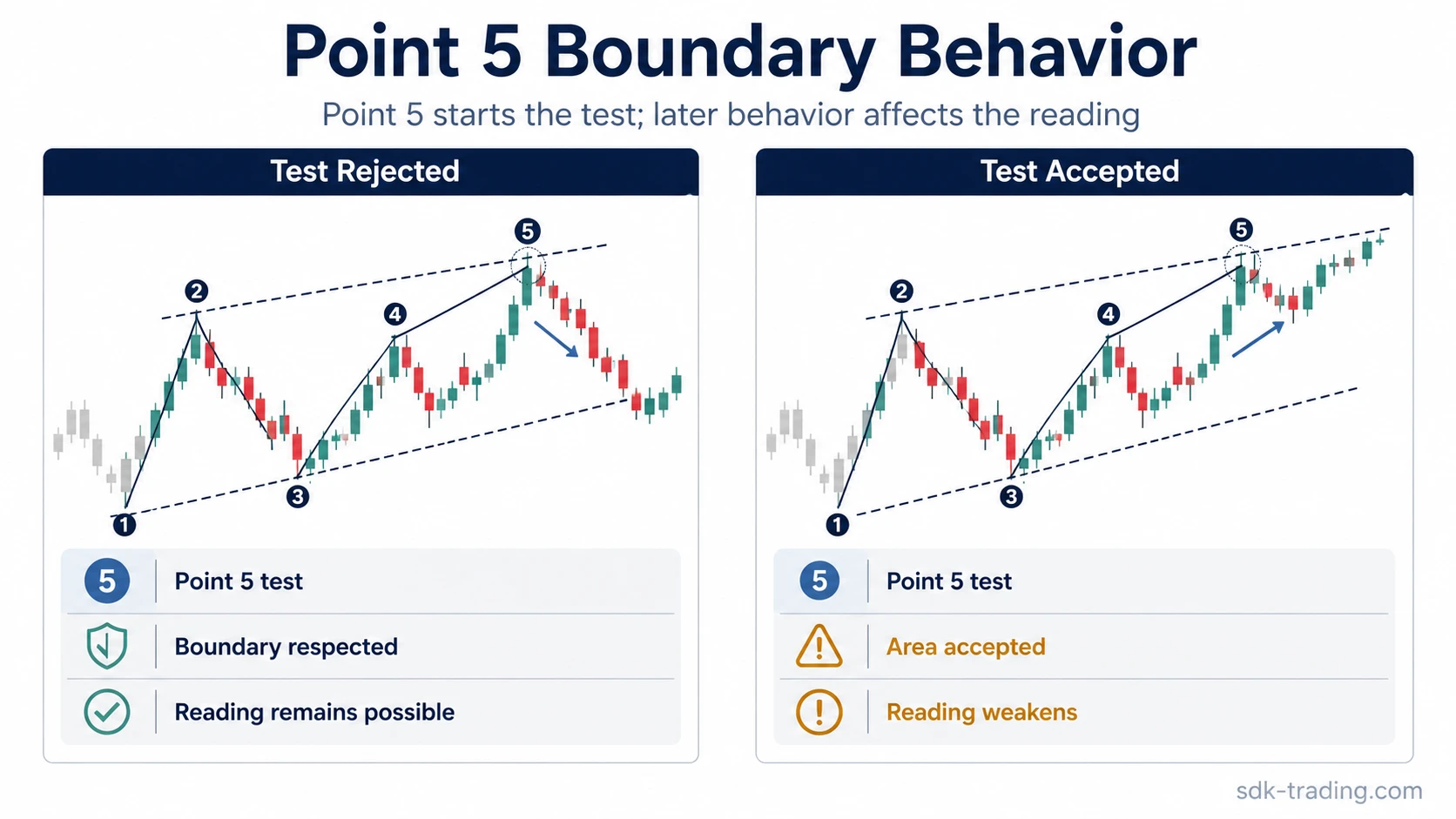
Simple Wolfe Wave Example in Context
A common chart-reading scenario starts when price makes four alternating swings that can be connected with readable 1-3 and 2-4 boundaries. The fifth swing then pushes into the outer boundary area and briefly makes the pattern look complete.
The classification is stronger if the tested area is rejected and later candles continue to respect the boundary logic. It is weaker if price accepts the tested area, stretches the line until the drawing has to be adjusted, or leaves the earlier swing points disconnected.
Classification note: Point 5 begins the test. Boundary coherence and later acceptance or rejection decide whether the Wolfe Wave label remains useful.
Common Wolfe Wave Mistakes
A common mistake is calling every wedge-like formation a Wolfe Wave. A wedge can show compression, but a Wolfe Wave needs a more specific five-point relationship and a point 5 test that fits the boundaries.
Another mistake is treating point 5 as automatic confirmation. Point 5 is late in the sequence, but late does not mean complete. The classification becomes more useful only when follow-through supports the pattern instead of rejecting it.
EPA and ETA can also be misread. They are reference tools for structure, not proof that price must reach a level or arrive by a certain time. The same caution applies to overly symmetrical drawings: a clean drawing can still describe a weak market reading if the underlying behavior does not support it.
Common mistake: A chart can have five visible swings and still fail as a Wolfe Wave if the boundaries are forced or the fifth point does not function as a real boundary test.
Wolfe Wave vs Diamond Top and Diamond Bottom
A Wolfe Wave is a five-point wave pattern. A diamond top is a different chart pattern built around a diamond-shaped expansion and contraction sequence near a potential topping area.
Bottoming diamond structures can also expand and contract before later behavior clarifies the reading. That is why diamond-shaped reversal patterns near lows should be separated from Wolfe Wave analysis instead of blended into one pattern label.
The practical distinction is structural. Wolfe Wave classification depends on five named points, boundary relationships, point 5 behavior, and EPA/ETA reference logic. Diamond patterns depend more on the wider expansion-contraction outline and how price behaves after that outline resolves.
FAQ
What is a Wolfe Wave?
A Wolfe Wave is a five-point chart pattern that uses swing points, boundary lines, point 5 behavior, and EPA/ETA references to classify a possible price structure.
How do you identify a Wolfe Wave?
Identification starts with five readable swing points, coherent 1-3 and 2-4 boundary logic, a meaningful point 5 test, and later price behavior that supports the structure.
What is point 5 in a Wolfe Wave?
Point 5 is the late structural test near the outer boundary. It is important because the pattern is weakest when point 5 is forced, unclear, or rejected by later price behavior.
What do EPA and ETA mean in a Wolfe Wave?
EPA usually means Estimated Price at Arrival, and ETA usually means Estimated Time of Arrival. In Wolfe Wave analysis, both work better as structural references than as guaranteed outcomes.
Can a Wolfe Wave fail?
Yes. A Wolfe Wave reading can fail when the points are unclear, the boundaries are forced, point 5 does not behave like a structural test, or later price action rejects the pattern logic.