Chart patterns are repeated multi-swing price structures, but the visible structure must come before the label. The useful part of a chart pattern is not the name itself; it is whether price has formed boundaries, swing relationships, touch points, compression, or repeated reaction behavior that supports that name.
A pattern label becomes weaker when a line is forced through unclear swings, when price does not react to the drawn boundary, or when contradictory structure is ignored. Identification describes what is visible on the chart. Confirmation is later behavior. Neither one turns the pattern into a prediction by itself.
Key Points
- A chart pattern label should describe visible structure, not replace it.
- Boundaries, swing points, touch points, and repeated reactions matter more than the pattern name.
- A forced label is weak when the structure needs too much interpretation to make it fit.
- Reversal, continuation, and bilateral labels are classification families, not trade instructions.
- Identification and confirmation should remain separate.
What a Chart Pattern Label Should Describe
A chart pattern label should describe a visible arrangement of price movement across more than one swing. The label is most useful when it summarizes how highs, lows, boundaries, and reactions relate to each other.
That makes chart patterns different from single-candle observations. A single candle can show a short moment of pressure or rejection. A chart pattern usually needs a sequence: several swings, repeated reactions, and enough spacing between points to make the structure readable.
The label is only a shorthand. A triangle, channel, range, wedge, or reversal structure is not meaningful because the name sounds familiar. It is meaningful only if the chart has shown behavior that supports that classification.
Structure First: Boundaries, Swings, and Touch Points
Structure-first identification begins with the visible evidence on the chart. The main question is not “Which pattern name fits?” The main question is “What has price actually formed?”
Useful structure clues:
- Repeated swing interaction: price has formed more than one meaningful high or low in a related area.
- Boundary behavior: price reacts around a line, zone, or edge instead of ignoring it.
- Touch-point quality: the boundary connects meaningful reactions, not random points chosen after the fact.
- Compression: swings become tighter, narrower, or more constrained as the structure develops.
- Clarity of highs and lows: the swing sequence can be described without forcing the chart to fit a name.
- Contradiction check: the label does not ignore price behavior that argues against it.
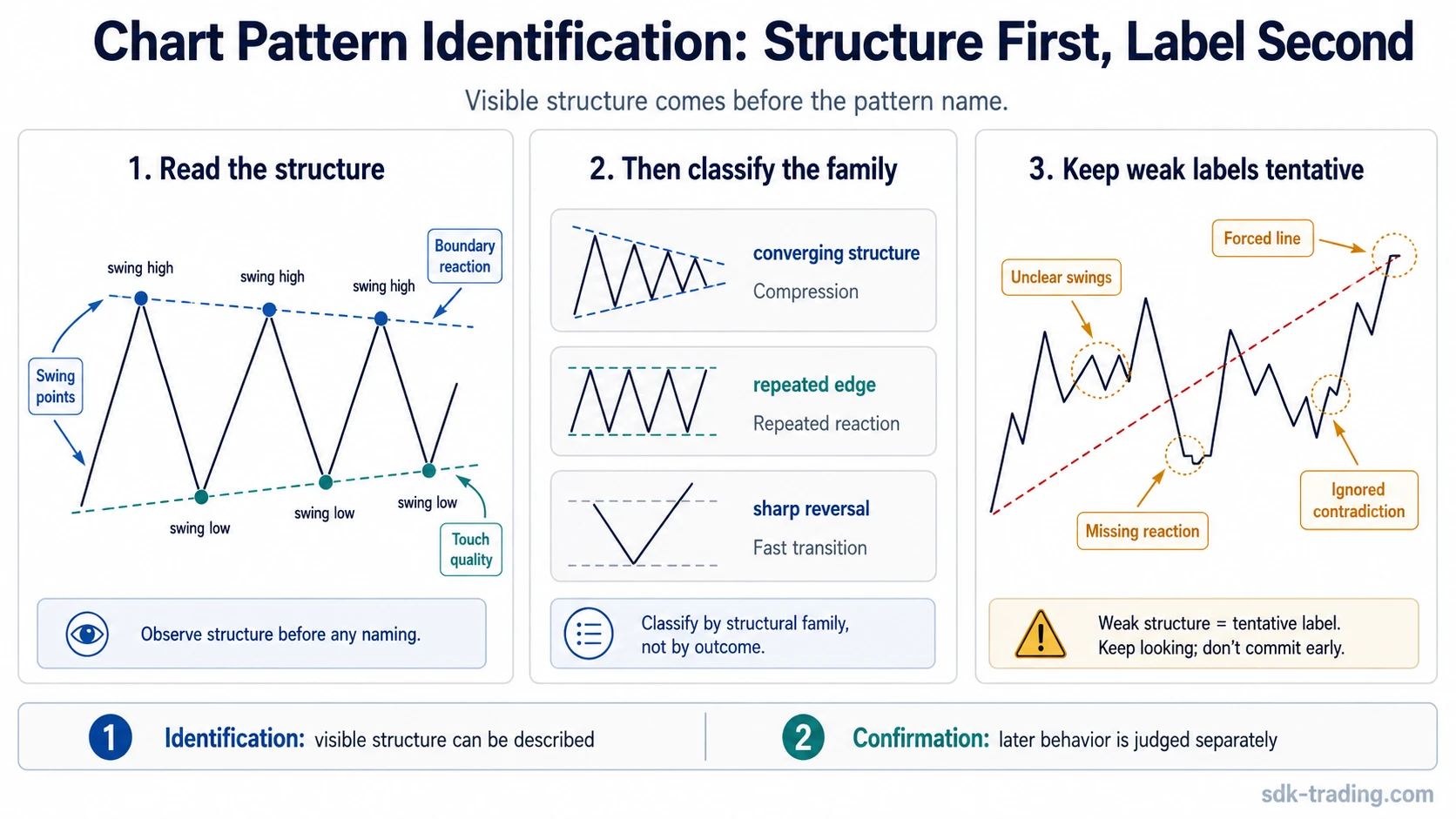
A clean structure does not need perfect symmetry. Markets often form uneven highs, imperfect reactions, and noisy swings. The issue is whether the structure is still visible without drawing lines that only work after being adjusted around every contradiction.
When a Chart Pattern Label Becomes Forced
A chart pattern label becomes forced when the name starts controlling the drawing instead of the structure controlling the name. The most common problem is selecting only the points that support the label and ignoring the reactions that do not.
| Identification element | Stronger reading | Weaker reading |
|---|---|---|
| Boundary | Several swing points interact with a similar boundary. | One line is stretched through unrelated highs or lows. |
| Swing points | The highs and lows form a readable sequence. | The swings are too scattered to show a stable relationship. |
| Touch points | Price reactions near the boundary are visible. | Price moves through the boundary with little reaction. |
| Compression | The structure becomes narrower or more constrained. | The movement stays random or expands without a clear relationship. |
| Repeated support or resistance | Price returns to a similar area and reacts more than once. | Only one isolated reaction is used to justify the label. |
| Contradictory structure | Conflicting behavior is considered before applying the label. | Contradictory behavior is ignored because the label looks familiar. |
| Confirmation boundary | The structure is identified first, then later behavior is judged separately. | The label is treated as if it already confirms direction. |
A weak label can still describe a possible structure, but it should be treated as uncertain. The weaker the boundary reaction and swing clarity, the less useful the label becomes.
A Practical Scenario: One Real Boundary, One Forced Boundary
Price has been rising unevenly, then starts pressing into the same upper area several times. Each push into that area stalls, so the upper boundary is easy to see. Two later pullbacks also form higher swing lows, which makes a triangle-like interpretation tempting.
The problem appears when the lower boundary is drawn through lows that do not share the same behavior. One low is a sharp intraday probe, another is a slow drift, and a third does not react near the proposed line. The upper boundary has repeated reactions, but the lower boundary exists mainly because the label needs it.
In that situation, the chart may show repeated resistance and some compression, but the full pattern label remains weak. A more careful reading would describe the visible parts first: repeated upper reaction, rising lows in part of the sequence, and an uncertain lower edge.
The label becomes more defensible only if later swings continue to respect both sides of the structure. If price keeps ignoring one boundary, the pattern name should stay secondary to the evidence.
Pattern Families Without Turning Labels Into Signals
Chart patterns are often grouped into reversal, continuation, and bilateral or neutral families. These families are useful for classification, but they should not be treated as automatic outcomes.
| Pattern family | What the label describes | What it does not prove |
|---|---|---|
| Reversal | A possible shift away from the prior directional structure. | It does not prove that a new trend has already started. |
| Continuation | A pause, compression, or consolidation inside a broader move. | It does not prove that the prior move must resume. |
| Bilateral / neutral | A structure where pressure is compressed but direction remains unresolved. | It does not prove which side will control the next move. |
Sharp reversal structures need the same caution. A V-bottom pattern can describe a fast downside-to-upside transition, but the name is still only a structural label.
A V-top pattern can describe a fast upside-to-downside transition, but the label should still be judged against the visible swing and reaction behavior.
Identification Is Not Confirmation
Identification means that a visible structure can be described and classified. Confirmation means later price behavior supports the interpretation. These are related, but they are not the same step.
A structure can be identifiable before it is confirmed. For example, a narrowing range may be visible before price has shown whether buyers or sellers can control the next move. Calling the structure a triangle may describe the compression, but it does not confirm direction.
The separation matters because pattern names can create false certainty. Once a familiar label appears, it is easy to treat the label as evidence by itself. A safer process keeps the questions separate: first identify the structure, then observe whether later behavior supports or weakens the interpretation.
Boundary note:
Chart patterns describe structure and classification uncertainty. They do not predict price, create trade signals, or replace risk and context decisions.
Common Weak-Reading Boundaries
Weak readings usually appear when a familiar pattern name is applied before the chart has earned it. The issue is rarely the label alone. The issue is the missing structure behind the label.
| Weak-reading boundary | Why it weakens the label | Safer interpretation |
|---|---|---|
| Forced line | The boundary only works after awkward adjustment. | Describe the nearest real reactions instead of naming the full pattern. |
| Unclear swings | The highs and lows do not form a readable sequence. | Keep the label broad until the swing relationship becomes clearer. |
| Missing boundary reaction | Price does not respond to the line or edge being drawn. | Wait for repeated interaction before treating the boundary as meaningful. |
| One-sided structure | One edge is visible, but the other side exists only to complete the name. | Name the visible side first and keep the full pattern label tentative. |
| Ignored contradiction | Opposing behavior is removed from the interpretation. | Let contradictory reactions weaken or cancel the label. |
| Noisy timeframe | The pattern appears only after zooming or compressing the chart heavily. | Check whether the structure remains visible at a readable scale. |
How to Use a Chart Pattern Label Safely
A chart pattern label is safest when it works as a summary, not as a conclusion. The structure should be readable before the name is added.
- Describe the swings first. Identify the highs, lows, boundaries, and repeated reactions before choosing a pattern family.
- Check whether the boundary is real. Look for repeated reaction, not just a line that can be drawn.
- Separate visible structure from later behavior. A readable structure can still fail to confirm.
- Look for contradictions. If price ignores one side of the pattern, the label weakens.
- Keep the family label broad when evidence is incomplete. A possible reversal, continuation, or compression reading may be more honest than a precise pattern name.
The pattern name should reduce confusion, not add certainty. When the structure is clean, the label can summarize what the chart has formed. When the structure is weak, the label should remain tentative.
FAQ
Can two traders label the same structure differently?
Yes. Chart pattern labels can be subjective when boundaries are imperfect, swings are uneven, or one timeframe shows clearer structure than another. The more important question is whether each label is supported by visible behavior.
Do chart patterns predict price?
No. Chart patterns classify visible price structure. They can help organize interpretation, but they do not guarantee direction, timing, or outcome.