Elliott Wave is a technical-analysis framework for classifying price movement into motive and corrective phases. A visible five-wave or three-wave shape starts the analysis, but a defensible count also needs subdivision, location, wave degree, rule compliance, and a clear condition for reclassification.
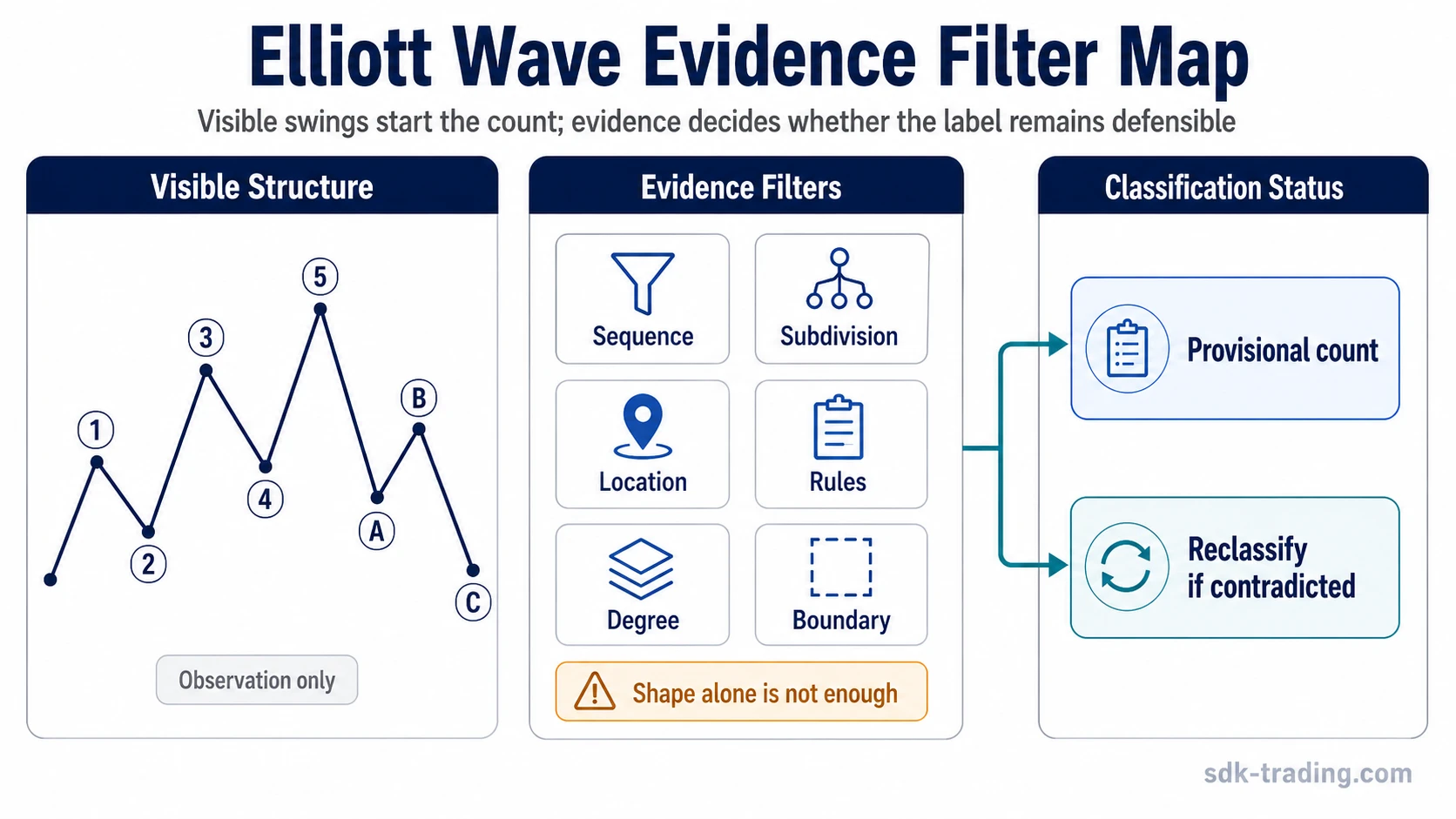
The framework is most useful when wave labels remain conditional. A count can organize a possible market phase, but it should change when later price behavior contradicts the structure that supported it.
Key Points
- Elliott Wave separates directional motive phases from corrective phases.
- A five-swing movement is not automatically a valid impulse.
- A three-swing movement is not automatically a completed correction.
- Wave 2 and Wave 4 are corrective phases inside a standard five-wave impulse structure.
- Wave labels need subdivision, degree, location, rules, and a reclassification boundary.
- Fundamental or business-cycle context can support a scenario, but it cannot prove the Elliott Wave count.
See Wave 2 and a Potential Wave 3 Setup on a Real Chart
This short example discusses a possible Wave 2 correction followed by a potential Wave 3 expansion and adds improving company profitability as a secondary contextual clue.
Important context: a company becoming profitable does not establish that price is in Wave 2, Wave 3, or any other Elliott Wave phase. Business improvement can support a broader scenario, but the wave location still has to be justified by the price structure itself.
Motive Waves vs Corrective Waves
The first useful Elliott Wave distinction is whether price is progressing with the larger directional phase or moving against, pausing, or reorganizing that phase.
| Structure | Main Role | Typical Simplified Form | Main Caution |
|---|---|---|---|
| Motive phase | Moves price in the direction of the larger wave structure. | Often represented as Waves 1-2-3-4-5. | Five visible swings do not prove a valid impulse by themselves. |
| Corrective phase | Retraces, interrupts, or reorganizes the larger directional movement. | Often represented through A-B-C or more complex corrective structures. | Three visible swings do not prove that the correction is complete. |
The broader Elliott Wave impulse framework covers directional five-wave structure, while Elliott Wave correction covers the corrective family in more detail.
How the Five-Wave Motive Sequence Works
In a simplified impulse model, Waves 1, 3, and 5 move in the direction of the larger motive phase, while Waves 2 and 4 interrupt that movement with corrections.
| Wave | Structural Role | What the Label Does Not Prove |
|---|---|---|
| Wave 1 | Begins the proposed motive sequence. | An early directional move does not yet prove that a new five-wave impulse has started. |
| Wave 2 | Corrects part of Wave 1 while the proposed impulse remains structurally possible. | A deep retracement does not automatically mean the count has failed unless the relevant rule is broken. |
| Wave 3 | Continues the motive direction and can become the dominant expansion phase. | Strong momentum alone does not prove that the move is Wave 3. |
| Wave 4 | Corrects or consolidates after Wave 3. | Sideways movement alone does not prove that the market is in Wave 4. |
| Wave 5 | Completes the final actionary segment of the proposed motive sequence. | A fifth-wave label does not guarantee exhaustion or an immediate reversal. |
Wave 2 vs Wave 4
Wave 2 and Wave 4 are both corrective phases inside a standard impulse, but their position in the larger sequence is different. That difference matters more than trying to identify them only from the visual shape of the correction.
| Feature | Wave 2 | Wave 4 |
|---|---|---|
| Position | Follows the proposed first motive wave. | Follows the proposed third motive wave. |
| Larger sequence | The motive structure is still at an early stage. | A substantial part of the motive sequence has already developed. |
| Corrective behavior | Can retrace a meaningful part of Wave 1 while remaining above the impulse origin in a standard bullish count. | Often interrupts an already developed directional move and must remain compatible with the relevant impulse rules. |
| Main classification risk | Calling an ordinary decline Wave 2 before a valid Wave 1 has been established. | Calling any late sideways structure Wave 4 simply because the trend has already advanced. |
What Evidence an Elliott Wave Count Needs
A wave label becomes more defensible when several structural tests support the same interpretation. Shape by itself is only the first filter.
| Evidence | What It Checks | Why It Matters |
|---|---|---|
| Sequence | Whether the visible swings form a coherent order. | A count that needs skipped or forced swings is weaker. |
| Subdivision | Whether the larger waves contain compatible smaller structures. | The outer shape can look correct while the internal movement disagrees. |
| Location | Where the proposed wave sits inside the larger count. | The same price shape can mean different things in Wave 2, Wave 4, or another corrective structure. |
| Rule compliance | Whether the count remains inside required Elliott Wave boundaries. | A hard rule break can require the structure to be relabeled. |
| Wave degree | Whether local and larger wave labels use a consistent scale. | A clean local count can still be misleading if it belongs to a smaller part of another structure. |
| Reclassification boundary | What price behavior would make the current interpretation no longer defensible. | A count without a failure condition can adapt endlessly to new price action. |
Elliott Wave Rules vs Contextual Evidence
Not every useful observation has the same status. Elliott Wave rules define structural boundaries. Other information, including Fibonacci relationships, momentum, volume, macro conditions, or company fundamentals, can provide context without becoming a wave rule.
| Evidence Type | How to Use It | What It Cannot Do |
|---|---|---|
| Elliott Wave rules | Test whether the proposed structural label remains valid. | A valid count still does not guarantee the future outcome. |
| Fibonacci relationships | Compare retracement and extension proportions inside a working count. | A Fibonacci level cannot prove the wave location or exact turning point. |
| Volume and momentum | Add evidence about participation and strength during different phases. | Strong momentum alone cannot identify Wave 3. |
| Business or fundamental context | Test whether the broader company stage is compatible with the working market scenario. | Profitability, earnings growth, or business maturity cannot assign an Elliott Wave number to price. |
Context rule: fundamentals can support or challenge a market scenario, but Elliott Wave location must still be established from price structure.
Why Visible Five-Wave and Three-Wave Shapes Are Not Enough
| What Is Visible | Possible First Hypothesis | What Still Needs Checking |
|---|---|---|
| Five swings | Possible motive structure | Subdivision, impulse rules, degree, and larger-count location. |
| Three swings | Possible corrective structure | Whether the correction is complete or only one part of a larger pattern. |
| Strong directional movement | Possible motive or third-wave behavior | Where the move began, its subdivision, and the surrounding count. |
| Deep pullback | Possible Wave 2 or another correction | Whether a valid prior Wave 1 exists and whether the relevant invalidation holds. |
| Sideways correction after a strong move | Possible Wave 4 | Whether the preceding structure actually supports Waves 1-2-3 at the same degree. |
How to Build an Elliott Wave Count
- Start from a defensible prior structure. Avoid beginning the count from the most convenient visible high or low.
- Classify motive vs corrective behavior first. Do not assign detailed wave numbers before deciding what type of movement the chart appears to contain.
- Check subdivision. Make sure the internal swings support the proposed larger label.
- Check wave degree. Compare the local structure with the larger chart so a smaller wave is not mistaken for the whole sequence.
- Apply the relevant Elliott Wave rules. A hard rule break should change the count rather than be explained away.
- Keep an alternate scenario when the structure is unresolved. Two possible counts can coexist while the market has not produced enough evidence to separate them.
- Define what would reclassify the preferred count. The analysis should specify what evidence would make the current interpretation weaker or invalid.
The dedicated How to Count Elliott Waves guide covers the counting workflow in greater detail.
Related Elliott Wave Structures
The broader family of Elliott Wave patterns provides the taxonomy for motive and corrective structures. The pattern name should follow the evidence rather than replace the counting process.
A three-wave correction may develop as an Elliott Wave zigzag, while a more sideways or overlapping structure may fit an Elliott Wave flat. Neither label is confirmed by outer shape alone; subdivision, location, degree, and later price behavior still need to support the classification.
Common Elliott Wave Mistakes
| Common Mistake | Why It Weakens the Count | Better Check |
|---|---|---|
| Counting every five swings as an impulse | The visible shape can exist inside a correction or at another wave degree. | Check subdivision, rules, and larger-count location. |
| Calling every three swings a completed correction | The sequence may be only part of a larger corrective pattern. | Keep the count provisional until the larger correction structure is clearer. |
| Calling a deep decline Wave 2 because a strong Wave 3 is expected | The desired future label begins determining the current count. | Establish a valid prior Wave 1 and structural invalidation first. |
| Calling every strong expansion Wave 3 | Momentum describes strength but not wave location. | Check what came before the move and whether the complete sequence supports the label. |
| Using company fundamentals to assign wave numbers | Business conditions and price-wave structure are different forms of evidence. | Use fundamentals only as a secondary context layer. |
| Ignoring alternate counts | Incomplete structures can support several defensible interpretations. | Maintain an alternate until later evidence separates the scenarios. |
| Keeping the count after contradiction | The labels begin defending the hypothesis rather than describing price. | Reclassify when the structural evidence changes. |
Limitations of Elliott Wave Analysis
Elliott Wave interpretation contains judgment. Starting points, subdivisions, wave degree, and incomplete corrective structures can allow more than one plausible count at the same time.
The framework is also easier to apply after a movement has developed than while the market is still forming the internal waves. A structure that initially looks like Wave 2 can become part of a larger correction, while an apparent Wave 3 can later require a different degree or count.
Elliott Wave is therefore best used as a conditional structure map. It can organize motive and corrective phases and define what would change the interpretation, but it does not guarantee direction, timing, price targets, or trading outcomes.