An Elliott Wave zigzag is an A-B-C corrective structure whose classification depends on 5-3-5 internal subdivision, not just a visible zigzag-shaped move.
Definition: An Elliott Wave zigzag is a corrective pattern made of three legs: Wave A, Wave B, and Wave C. The usual internal structure is 5-3-5, meaning Wave A subdivides into five waves, Wave B subdivides into three waves, and Wave C subdivides into five waves.
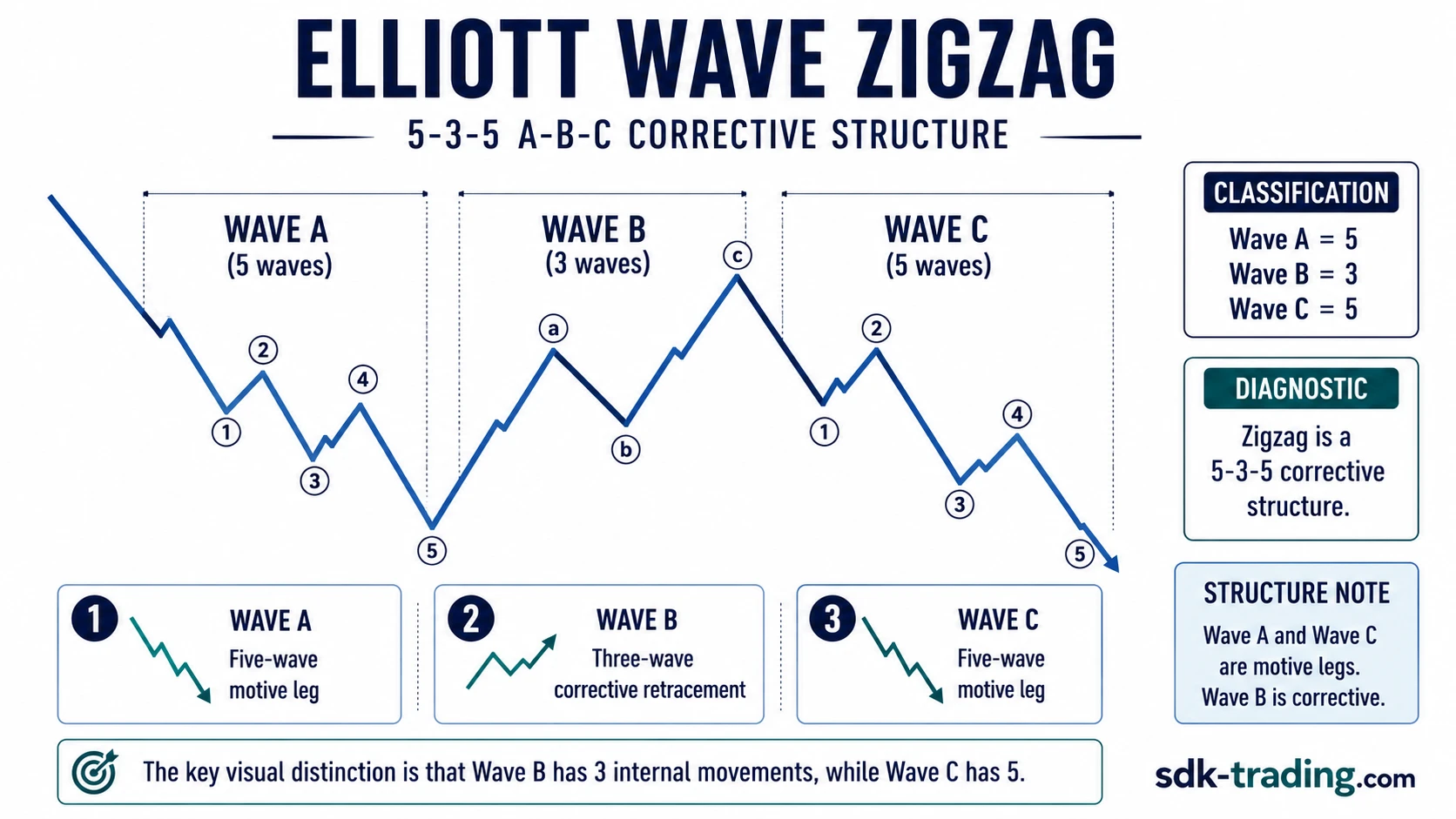
The visible path often looks sharp because Wave A and Wave C usually move with stronger directional force than Wave B. The label still depends on subdivision quality. A chart can draw a zigzag shape without meeting the Elliott Wave boundary for a valid zigzag correction.
Key Points
- An Elliott Wave zigzag is a corrective A-B-C structure.
- The standard internal subdivision is 5-3-5.
- Wave A and Wave C should behave as motive or diagonal-compatible legs.
- Wave B is corrective and normally retraces only part of Wave A.
- The main classification risk is mistaking any sharp three-leg move for a valid zigzag.
What Is an Elliott Wave Zigzag?
An Elliott Wave zigzag is one form of Elliott Wave correction. It usually appears as a sharp counter-move against the larger trend or as one corrective segment inside a broader Elliott Wave structure.
The core idea is simple: price moves in Wave A, retraces in Wave B, and then moves again in Wave C. The harder part is classification. The analyst must separate the visible path from the internal wave count.
Classification boundary: The shape alone starts the question. The internal subdivision decides whether the label is defensible.
Elliott Wave Zigzag Structure: A-B-C and 5-3-5
The standard zigzag sequence is written as A-B-C. Wave A begins the correction, Wave B retraces part of Wave A, and Wave C completes the second directional leg. In a clean count, the internal sequence is 5-3-5.
| Leg | Expected role | Subdivision test | Classification note |
|---|---|---|---|
| Wave A | First directional leg of the correction | Usually five waves or diagonal-compatible | If Wave A is clearly corrective, the zigzag label weakens. |
| Wave B | Corrective retracement against Wave A | Usually three waves | Wave B should not become the dominant directional leg. |
| Wave C | Second directional leg of the correction | Usually five waves or diagonal-compatible | If Wave C does not support a motive-style subdivision, reassess the count. |
The 5-3-5 boundary is the reason a zigzag is not only a drawing pattern. It is a subdivision-based classification. A sharp A-B-C move with weak internal evidence may remain only a possible zigzag until the count is checked against the structure.
How to Identify a Zigzag Correction
A useful identification process starts with what can be seen, then moves into what must be counted. The visible move may show three legs, but the internal structure decides whether the Elliott Wave zigzag label is appropriate.
| Diagnostic question | What supports a zigzag reading | What weakens the reading |
|---|---|---|
| Does the move form A-B-C? | Three clear legs with Wave B acting as a retracement | Overlapping movement that does not separate into a clear A-B-C sequence |
| Does Wave A subdivide properly? | Five-wave or diagonal-compatible behavior | A Wave A that looks clearly corrective rather than motive-like |
| Does Wave B stay corrective? | A three-wave retracement that does not erase the structure | A Wave B that changes the pattern into a flat-like reading |
| Does Wave C support the count? | Five-wave or diagonal-compatible behavior in the final leg | A Wave C that subdivides into three, stalls early, or belongs to another structure |
| Is the pattern part of something larger? | The zigzag can stand as a simple correction or a segment inside a larger corrective structure | The move is better classified as part of a combination or another correction family |
Illustrative scenario: A market falls in a clear first leg, retraces only part of that decline, and then falls again in a second directional leg. That visible A-B-C path may look like a zigzag. The label becomes stronger only if the first and final legs can be counted as five-wave or diagonal-compatible segments while the middle leg remains corrective.
Visible Zigzag Shape vs Valid Elliott Wave Subdivision
The most common mistake is treating the outline as proof. A price swing can move down, up, and down again, or up, down, and up again, while still failing the internal test for an Elliott Wave zigzag.
Boundary: A visible zigzag-shaped path is only chart-level evidence. A valid Elliott Wave zigzag needs a defensible A-B-C label and a 5-3-5 subdivision. If the subdivisions do not support the label, the structure should be treated as unresolved or reclassified.
A broader Elliott Wave explained framework covers the full method. Zigzag classification is narrower: it depends on whether the A-B-C path supports a 5-3-5 count.
Elliott Wave Zigzag vs Flat Correction
A zigzag and a flat are both A-B-C corrections, but they do not use the same internal structure. The compact distinction is that a zigzag is normally 5-3-5, while a flat is normally 3-3-5.
| Correction type | Typical subdivision | Usual reading | Main classification risk |
|---|---|---|---|
| Zigzag | 5-3-5 | Sharper corrective structure with motive-style A and C legs | Calling any sharp A-B-C path a zigzag without checking subdivision |
| Flat | 3-3-5 | More sideways corrective structure where Wave A is corrective | Forcing a zigzag label when Wave A is better counted as three waves |
The difference matters because the first leg changes the classification. If Wave A is three-wave rather than five-wave or diagonal-compatible, the structure may fit a flat correction better than a zigzag.
Simple Zigzag, Double Zigzag, and Combination Boundary
A simple zigzag is one A-B-C sequence. A double zigzag or triple zigzag links more than one corrective sequence through connecting waves, often labeled with W-X-Y or W-X-Y-X-Z notation. That belongs to the broader Elliott Wave patterns family and should not be collapsed into a single simple zigzag label.
Simple boundary: If the move requires multiple connected corrective structures to make sense, it may no longer be a single simple zigzag. The analyst should check whether the sequence is better treated as a double zigzag, triple zigzag, or larger combination.
This is also where C-wave interpretation can become difficult. A projected Wave C may extend or fail to subdivide cleanly. If the final leg no longer supports the expected five-wave or diagonal-compatible structure, the label should be reassessed rather than forced.
When a Zigzag Count Should Be Reassessed
A zigzag count should be reassessed when the internal structure stops supporting the label. The issue is not whether the chart still looks sharp. The issue is whether the A-B-C structure still satisfies the 5-3-5 boundary.
| Reassessment trigger | Why it matters | Safer interpretation |
|---|---|---|
| Wave A is not five-wave or diagonal-compatible | The first leg may not fit the zigzag structure. | Check whether a flat or another corrective pattern fits better. |
| Wave B becomes too deep or structurally dominant | The correction may no longer preserve a clean zigzag relationship. | Review whether the structure has shifted into a flat-like or complex correction. |
| Wave C subdivides into three | A three-wave C leg weakens the 5-3-5 reading. | Recheck the full corrective count instead of preserving the label. |
| The move belongs to a larger W-X-Y sequence | A simple zigzag label may be too narrow. | Classify the larger corrective structure first. |
Reassessment is not a failure of the method. It is part of the method. Elliott Wave labeling is strongest when the analyst allows the count to change when the structure changes.
Fibonacci Guidelines in Zigzag Corrections
Fibonacci relationships are often used as guidelines when reviewing zigzag corrections, especially around the relative size of Wave C compared with Wave A. They should not override the subdivision test.
Guideline boundary: Fibonacci proportions can support a working scenario, but they do not validate a zigzag by themselves. The A-B-C label still needs structural evidence.
This distinction also applies when Wave C extends. Extension behavior may change the visible size of the final leg, but the count still needs to remain compatible with the underlying correction. A broader Elliott Wave extension discussion covers extension behavior separately.
FAQ
What is an Elliott Wave zigzag?
An Elliott Wave zigzag is an A-B-C corrective pattern that normally has a 5-3-5 internal subdivision. Wave A and Wave C usually behave as motive-style legs, while Wave B is corrective.
Is every zigzag-shaped move an Elliott Wave zigzag?
No. A visible zigzag-shaped path is not enough. The internal subdivision must support a valid A-B-C and 5-3-5 structure.
What does 5-3-5 mean in a zigzag?
5-3-5 means Wave A subdivides into five waves, Wave B subdivides into three waves, and Wave C subdivides into five waves.
How is a zigzag different from a flat?
A zigzag is normally 5-3-5, while a flat is normally 3-3-5. The key difference is the internal structure of Wave A.
Can a zigzag be part of a larger combination?
Yes. A zigzag can appear as one segment inside a double zigzag, triple zigzag, or broader corrective combination. In that case, the larger structure should be classified separately.
Does a zigzag predict the next move?
No. A zigzag is a structural classification, not a forecast. It describes how a correction is counted, and the count should change if the internal structure no longer supports it.