An Elliott Wave extension is an elongated motive-wave segment where one actionary wave, normally evaluated as wave 1, wave 3, or wave 5 in a motive count, becomes longer or more visibly subdivided than the surrounding waves while still needing to satisfy impulse-count rules.
The label describes structure and subdivision, not a trade signal, price target, or proof that the count is correct. In Elliott Wave analysis, an extension can help classify a motive move, but the reading stays conditional until the broader structure supports it.
Definition: An Elliott Wave extension is a stretched actionary wave inside a motive sequence. It stands out because its length, internal subdivision, or both are larger than the surrounding actionary waves.
Key Points About Elliott Wave Extensions
- An Elliott Wave extension belongs to motive-wave structure, not corrective structure.
- One actionary wave becomes longer, more visibly subdivided, or both.
- The extension label still depends on valid impulse structure.
- Fibonacci projections can add proportional context to a scenario, but they do not prove the count.
- An extension does not confirm a trade, forecast, continuation, or reversal.
What Is an Elliott Wave Extension?
An Elliott Wave extension occurs when one actionary wave inside a motive structure expands more than the nearby actionary waves. In Elliott Wave discussions, extensions are normally evaluated in wave 1, wave 3, or wave 5 because those waves move in the direction of the larger motive sequence.
The important distinction is that extension is a structural label. A normal impulse may contain waves of different sizes, but an extension becomes notable when one actionary wave dominates the sequence through visible length, subdivision, or proportional imbalance.
The wider Elliott Wave explained model covers full count logic; an extension is narrower because it identifies a stretched motive segment inside that model.
How to Identify an Elliott Wave Extension
The first question is which actionary wave appears extended. A proposed extension should not be labeled only because price moved strongly. The wave also needs to fit the surrounding motive sequence and preserve the basic structure expected from an impulse-style count.
| Diagnostic check | What to look for | Why it matters |
|---|---|---|
| Relative length | One actionary wave travels materially farther than the neighboring actionary waves. | Length helps separate an extension from an ordinary uneven impulse. |
| Internal subdivision | The proposed extended wave shows clearer lower-degree movement than the surrounding waves. | Subdivision gives the label more structure than a simple “long wave” reading. |
| Neighbor comparison | Wave 1, wave 3, and wave 5 are compared against one another. | The extension is a relative classification inside the same motive sequence. |
| Impulse constraints | The proposed count still needs to respect impulse-count boundaries. | If the count violates the structure, the extension label weakens. |
| Timing of the label | The structure has enough visible development before the extension is named. | Labeling too early can turn a scenario into false certainty. |
Diagnostic note: Some extensions create a nine-wave appearance because the extended wave subdivides visibly. That appearance can support the reading, but it is not a standalone rule that validates every count.
Wave 1, Wave 3, and Wave 5 Extensions
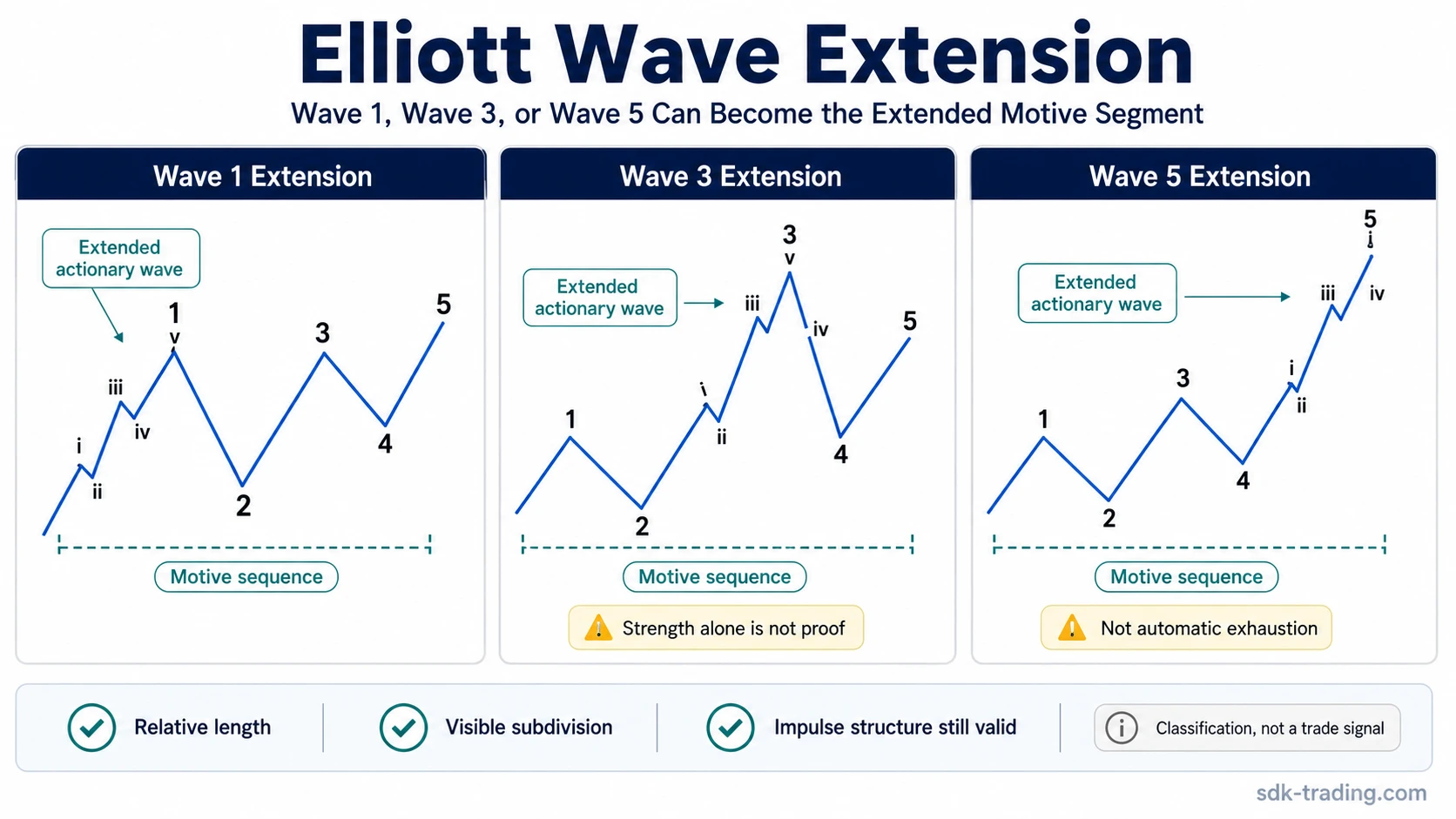
Elliott Wave extensions are normally classified by the actionary wave that expands. The label describes which part of the motive sequence dominates the structure.
| Extension label | What it means | Main diagnostic caution |
|---|---|---|
| Wave 1 extension | The first actionary wave stretches relative to later motive waves. | Later structure must still support a valid motive count. |
| Wave 3 extension | The third wave becomes the dominant motive segment. | Strength alone does not prove that wave 3 is extended. |
| Wave 5 extension | The fifth wave extends beyond a more normal-looking completion area. | Extension does not automatically prove exhaustion or reversal. |
Wave 3 extension is often discussed because the third wave is commonly associated with strong directional movement in classical Elliott Wave interpretation. That observation should stay descriptive. It does not make every strong middle move a confirmed third-wave extension.
Observable Criteria and False Positives
The safest reading starts with observable structure before interpretation. A long move can look convincing while still failing the conditions needed for a clean Elliott Wave extension label.
False-positive filter: A wave is not automatically extended because it is long, emotional, or fast. The label becomes more defensible only when relative length, internal subdivision, and impulse-count structure support the same reading.
- Relative length: Compare the proposed extended wave with the other actionary waves in the same motive sequence.
- Subdivision quality: Look for visible lower-degree movement inside the proposed extended segment.
- Structural fit: Check whether the proposed wave still belongs inside a valid motive count.
- Alternative counts: Keep the count scenario-based if another structure still fits the evidence.
- Fibonacci context: Fibonacci projections can act as a coherence check, but they do not confirm the extension by themselves.
Elliott Wave Extension vs a Long Wave
A long wave describes distance. An Elliott Wave extension describes distance plus structural context. The difference matters because a large price swing can occur inside several different wave interpretations.
| Reading | What it says | What it does not prove |
|---|---|---|
| Long wave | One segment traveled farther than nearby movement. | It does not prove motive subdivision or count validity. |
| Elliott Wave extension | One actionary wave appears longer or more subdivided inside a motive sequence. | It does not prove forecast direction, target quality, or trade timing. |
This boundary also separates extension from an Elliott wave correction, where the structure is corrective rather than motive.
Simple Elliott Wave Extension Example
A generic five-wave advance may look uneven if the third wave travels much farther than waves 1 and 5 and contains visible lower-degree subdivisions. That can make a wave 3 extension label more plausible, but the count weakens if the internal movement later breaks impulse rules or if another count explains the structure more cleanly.
The scenario is diagnostic rather than predictive. The extension label helps describe what may be happening inside the structure. It does not convert the count into a trade plan.
What an Elliott Wave Extension Does Not Confirm
An Elliott Wave extension can make a motive-wave count more specific, but it should not be treated as a standalone decision tool.
Core limitation: Extension labeling does not confirm direction, entry, stop placement, target distance, continuation, reversal, win rate, or outcome quality.
- It does not prove that the next move must continue in the same direction.
- It does not prove that a reversal is near.
- It does not replace broader wave-count validation.
- It does not make Fibonacci projections into confirmed price targets.
- It can be revised if the larger structure changes.
Related Elliott Wave Concepts
Extensions are easier to classify when they are separated from nearby Elliott Wave ideas. Elliott wave patterns describe the broader pattern family, while extension focuses on a stretched motive segment inside that family.
An Elliott wave flat belongs to corrective structure, so it should not be confused with a motive-wave extension. The overlap is conceptual only: both require structure, context, and count discipline before the label becomes useful.
Elliott Wave Extension FAQ
What is an Elliott Wave extension?
An Elliott Wave extension is an elongated motive-wave segment where one actionary wave becomes longer, more visibly subdivided, or both, compared with the surrounding actionary waves.
Which wave usually extends in Elliott Wave?
In Elliott Wave discussions, extensions are normally evaluated in wave 1, wave 3, or wave 5. Wave 3 extension is commonly referenced, but the label still depends on the full structure rather than strength alone.
Is an Elliott Wave extension a trading signal?
No. An extension is a structural classification. It does not confirm an entry, stop, target, forecast, continuation, reversal, or trade outcome.
Can Fibonacci levels confirm an Elliott Wave extension?
No. Fibonacci levels can add proportional context to a scenario, but they do not prove that an Elliott Wave extension is valid by themselves.