An Elliott Wave flat is an A-B-C corrective structure with a 3-3-5 subdivision. Wave A and Wave B subdivide as corrective threes, while Wave C subdivides as a five-wave move. The flat label depends on subdivision, B-wave behavior, C-wave behavior, location, and degree inside the broader Elliott Wave count.
Definition: An Elliott Wave flat is a corrective pattern made of three main swings: A, B, and C. Its basic subdivision is 3-3-5, which means Wave A has three internal waves, Wave B has three internal waves, and Wave C has five internal waves.
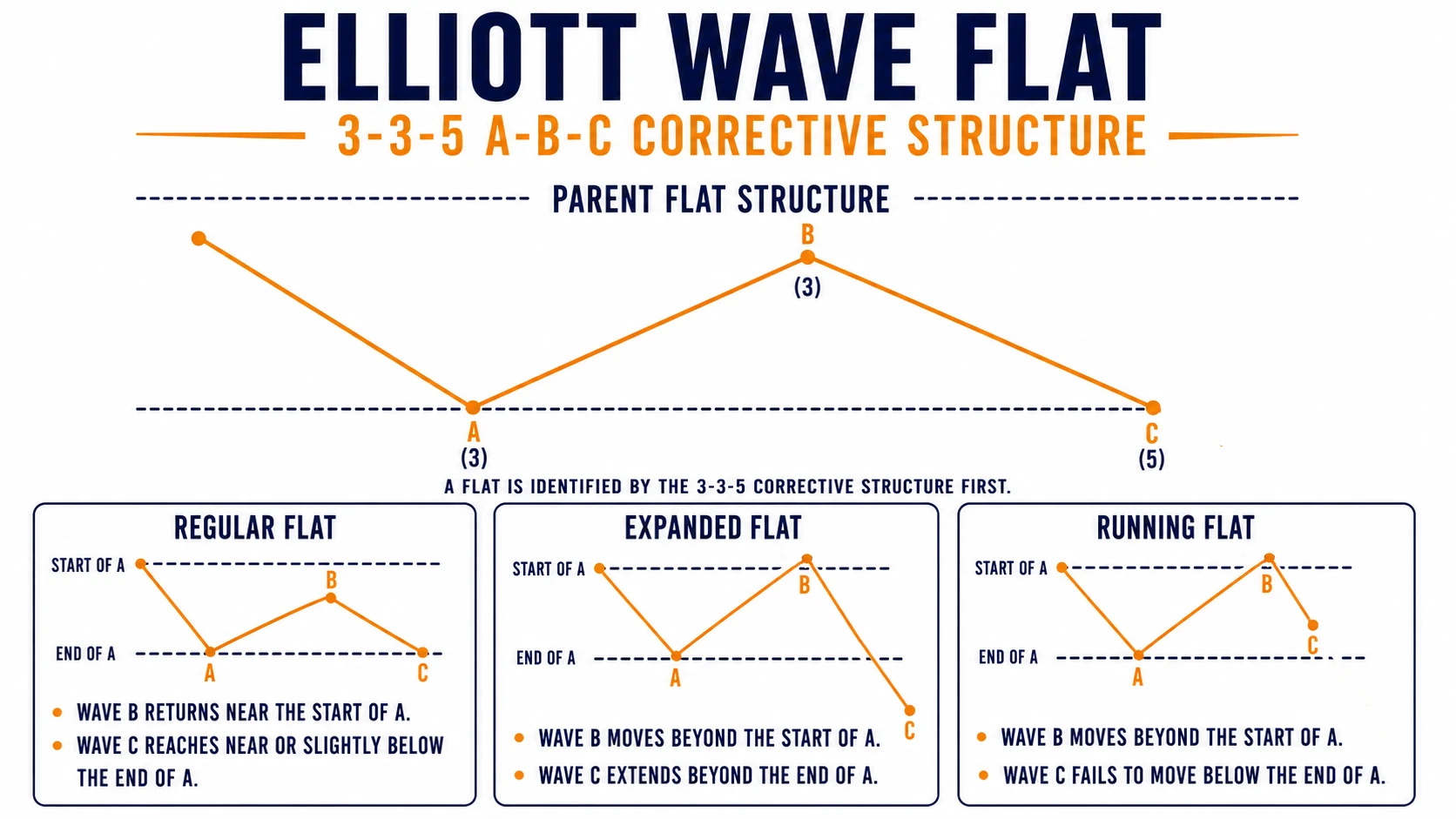
A flat is a structural classification first, not a variant label first. The pattern should be established as a flat before it is separated into regular, expanded, or running form. A visible A-B-C outline or a sideways-looking correction is not enough by itself unless the internal structure and the larger count support the label.
In the example above, the correction is drawn as Wave A down, Wave B up, and Wave C down. In the opposite market direction, the same flat logic can be mirrored while the 3-3-5 relationship remains the same.
Key Points
- An Elliott Wave flat is an A-B-C correction, not a trading signal.
- The core subdivision is 3-3-5: Wave A and Wave B are corrective threes, while Wave C is a five-wave structure.
- Regular, expanded, and running flats are variants of the same parent flat family.
- The first useful separation is often flat versus zigzag, especially through the internal structure of Wave A.
- A flat becomes more defensible when subdivision, variant behavior, and the larger wave degree all point to the same reading.
What Is an Elliott Wave Flat?
An Elliott Wave flat is a corrective structure that usually appears inside a larger wave sequence. It is built from three labeled swings: A, B, and C. The defining feature is not only that the pattern has three visible parts, but that those parts subdivide in a specific way.
In a flat, Wave A is corrective, Wave B is corrective, and Wave C is motive in form. That creates the 3-3-5 structure. This is the parent flat condition. Only after that structure is established does it make sense to decide whether the correction is regular, expanded, or running.
Classification boundary: A flat is best treated as a structural label. It describes how a correction is organized after enough subdivision evidence exists. It does not guarantee that the correction is complete or that the next larger wave must begin immediately.
The flat count becomes more useful when it explains a specific corrective phase without forcing the broader Elliott Wave count. If the larger count, the internal subdivisions, or the degree relationship do not fit, the same visible swings may need a different label.
Elliott Wave Flat Structure: A-B-C and 3-3-5
The basic Elliott Wave flat structure is A-B-C. Each part has a different structural job.
- Wave A: The first corrective leg. In a flat, Wave A should subdivide as a three-wave structure rather than a clean five-wave impulse.
- Wave B: The retracement leg. It also subdivides as a corrective three and often retraces deeply toward the start of Wave A, or beyond it in some variants.
- Wave C: The final leg of the flat. It should subdivide as five waves, commonly as an impulse or a diagonal, depending on the context.
The 3-3-5 sequence is the core diagnostic requirement. A pattern that only looks sideways but does not show the correct internal structure is not a defensible flat count.
Illustrative structure: A correction may show a three-wave move into A, a three-wave recovery into B, and then a five-wave move into C. If those subdivisions remain consistent at the same degree, the structure can support a flat interpretation. If A subdivides as five waves instead, the same visible outline may point toward another corrective form.
Wave C is especially important because it tests whether the pattern has the final five-wave component required by the flat structure. Without that five-wave C, the count may still be developing, or it may belong to a different correction type.
Regular, Expanded, and Running Flats
Regular, expanded, and running flats are variants of the same basic A-B-C corrective family. The main difference is how far Wave B retraces and where Wave C finishes relative to Wave A.
| Flat type | What Wave B does | What Wave C does | Classification caution |
|---|---|---|---|
| Regular flat | Retraces near the start of Wave A without meaningfully exceeding it. | Often returns toward or slightly beyond the end of Wave A. | The count still needs 3-3-5 subdivision. A balanced sideways shape is not enough. |
| Expanded flat | Moves beyond the start of Wave A. | Usually travels beyond the end of Wave A. | The B-wave extension must fit the larger count. A false break alone does not confirm the variant. |
| Running flat | Moves beyond the start of Wave A. | Fails to move beyond the end of Wave A. | This label is easy to overuse because an incomplete C wave can look like a running flat too early. |
The variant label should come after the core flat structure is established. Regular, expanded, and running flats are different ways the same 3-3-5 correction can express itself inside a larger wave count.
Important limitation: A running flat should be used conservatively. If Wave C has not clearly completed its five-wave structure, labeling the pattern as running too early can turn an unfinished correction into a premature conclusion.
How to Identify a Flat Without Over-Labeling
A flat count becomes more defensible when several conditions line up at the same time. The strongest evidence is not the outline of the pattern, but the relationship between subdivision, location, and degree.
- Start with the visible A-B-C sequence: A flat needs three main swings, but three swings alone do not prove the structure.
- Check the A-wave subdivision: Wave A should behave as a corrective three. A clear five-wave A usually weakens the flat interpretation.
- Check the B-wave subdivision: Wave B should also subdivide as a corrective three, even if it retraces deeply.
- Check the C-wave subdivision: Wave C should form five waves. Without that five-wave structure, the flat label remains incomplete or uncertain.
- Only then choose the variant: After the flat family is established, decide whether the correction is regular, expanded, or running.
- Compare the pattern with the larger count: The correction should fit the degree and location expected in the broader Elliott Wave structure.
The label weakens when the count depends on forcing every swing into a preferred pattern. A flat should explain the correction more cleanly than nearby alternatives, not simply preserve a larger forecast.
Practical reading: A defensible flat count usually answers five questions at once: Does A subdivide as three? Does B subdivide as three? Does C subdivide as five? Which flat variant fits best? Does the whole correction fit the larger degree?
Flat vs Nearby Elliott Wave Structures
A flat often gets confused with nearby corrective structures because several Elliott Wave corrections can look sideways or overlapping before the internal count is complete.
| Structure | Main distinction | Misreading risk |
|---|---|---|
| Flat vs zigzag | A flat is usually 3-3-5. A zigzag is usually 5-3-5. | A deep or sharp C wave can make a flat look like a zigzag unless Wave A is counted correctly. |
| Flat inside a combination | A flat can be one component inside a larger combination. | The flat component may be mistaken for the entire correction. |
| Flat vs generic sideways correction | A flat requires specific subdivision, not just sideways movement. | Any choppy A-B-C structure may be labeled as a flat before the internal waves support it. |
| Flat vs broader Elliott Wave pattern family | A flat is one corrective structure within the broader Elliott Wave patterns family. | Broad pattern context can distract from the flat-specific 3-3-5 test. |
The most important comparison is with the zigzag. If Wave A is a clear five-wave move, the flat interpretation becomes weaker. If Wave A and Wave B both subdivide as threes and Wave C develops in five, the flat interpretation becomes more structurally coherent.
Diagnostic Boundary: What Confirms or Reclassifies the Count
The diagnostic boundary for a flat is the point where the structure stops behaving like a valid 3-3-5 correction. That boundary can come from subdivision, B-wave behavior, C-wave behavior, degree mismatch, or the larger count.
| Observation | Supports flat label if… | Weakens flat label if… | Reclassification risk |
|---|---|---|---|
| A-B-C shape is visible | The internal waves match 3-3-5 and the correction fits the larger count. | The label depends only on three visible swings. | Generic correction, combination segment, or unfinished structure. |
| Wave A develops | Wave A subdivides as a corrective three. | Wave A subdivides as a clear five-wave impulse. | Zigzag, impulse-related count, or different corrective structure. |
| Wave B retraces strongly | Wave B subdivides as three and its retracement fits the selected flat type. | The B wave is counted only because price moved back near the origin of A. | Expanded flat over-labeling, running flat over-labeling, or combination. |
| Wave C begins | Wave C develops as five waves and fits the selected variant. | Wave C remains choppy, incomplete, or does not match the required degree. | Unfinished correction, triangle, combination, or alternate count. |
| Larger count is reviewed | The flat fits the expected corrective position and degree. | The flat label is needed only to protect a preferred larger forecast. | Wrong degree, wrong correction family, or forced count. |
A flat is not confirmed by appearance alone. A more defensible approach is to treat the label as conditional until the A wave, B wave, C wave, and larger degree all point to the same corrective reading.
Common Mistakes When Labeling Flats
| Mistake | Why it creates risk | Better diagnostic check |
|---|---|---|
| Calling every sideways A-B-C a flat | Sideways shape can appear in several corrective structures. | Check whether the internal structure is actually 3-3-5. |
| Ignoring the A-wave subdivision | A five-wave A usually points away from a standard flat interpretation. | Count Wave A before deciding between flat and zigzag. |
| Choosing the variant too early | The structure may not yet justify a regular, expanded, or running label. | Establish the flat family first, then separate the variant. |
| Labeling a running flat too early | An unfinished C wave can look like a running flat before the pattern is complete. | Assess whether C has the required five-wave form and fits the broader count. |
Why a Flat Is Not a Trading Signal
An Elliott Wave flat describes corrective structure. It does not provide an entry, exit, target, stop level, or probability estimate by itself. The pattern can help organize a wave count, but it does not confirm what the market must do next.
A completed-looking flat can still be reclassified if the next movement exposes a subdivision problem or a degree mismatch. A flat interpretation can also remain valid while price action develops more slowly or more complexly than expected.
Signal boundary: A flat can support structural interpretation, but it should not be treated as a buy signal, sell signal, continuation guarantee, reversal guarantee, or proof that a larger trend has resumed.
FAQ
Is an Elliott Wave flat always sideways?
No. A flat often has a sideways or overlapping appearance, but the label depends on subdivision and wave relationships. Expanded and running flats can distort the shape, so visible sideways movement is not enough to confirm the pattern.
What is the difference between a flat and a zigzag?
The main structural difference is subdivision. A flat usually follows a 3-3-5 structure, while a zigzag usually follows a 5-3-5 structure. That makes the internal count of Wave A one of the first checks.
What is the difference between a regular flat, expanded flat, and running flat?
All three belong to the same flat family. The difference comes after the core flat structure is established, mainly through how far Wave B retraces and where Wave C finishes relative to Wave A.
Can an Elliott Wave flat be a trading signal?
No. A flat is a corrective-structure classification. It may help organize a wave count, but it does not create an entry, exit, target, or forecast by itself.