An Elliott Wave running flat is a rare A-B-C corrective structure in which the whole correction subdivides as 3-3-5, Wave B moves beyond the start of Wave A, and Wave C fails to reach the end of Wave A.
Definition: A running flat is a flat-family correction where Wave A is a corrective three, Wave B is a corrective three that extends beyond the origin of Wave A, and Wave C is a five-wave move that falls short of Wave A’s endpoint.
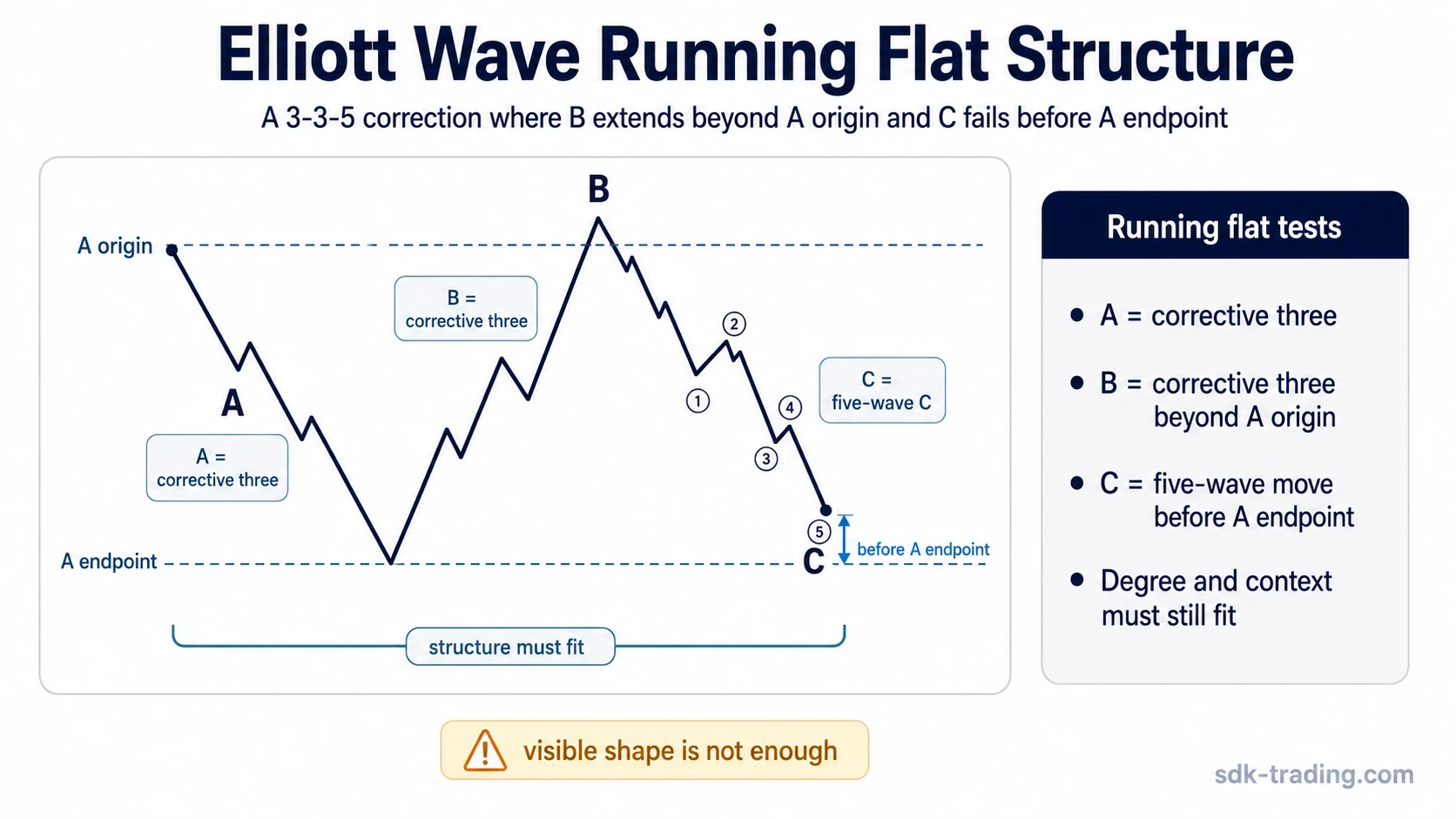
The running-flat distinction is the C-wave endpoint. It shares the B-wave overshoot with an expanded flat, but Wave C does not reach the end of Wave A. That makes the label more fragile than a normal flat reading, because a short or unfinished C wave can be mislabeled too early.
The label remains defensible only while the subdivision, endpoint behavior, degree, and surrounding corrective context all support the same classification. A visible A-B-C shape is not enough by itself, and the pattern should not be treated as a prediction, continuation signal, or trading signal.
Key Points
- A running flat is a corrective Elliott Wave structure, not a motive pattern.
- The required internal subdivision is 3-3-5: Wave A subdivides as three, Wave B subdivides as three, and Wave C subdivides as five.
- Wave B must move beyond the start of Wave A, which separates the structure from a regular flat.
- Wave C must fail to reach the end of Wave A, which separates the structure from an expanded flat.
- The count is fragile because an incomplete C wave can look like a running flat before the structure is complete.
What Is an Elliott Wave Running Flat?
An Elliott Wave running flat is a subtype of an Elliott Wave flat. It belongs to the corrective side of Elliott Wave classification and is normally read as an A-B-C structure inside a larger wave count.
The defining feature is not only that the correction has three visible swings. The defining feature is the relationship between those swings: Wave B moves beyond the start of Wave A, while Wave C fails to travel far enough to reach the end of Wave A.
Classification note: A running flat is usually treated as a rare label. The more unusual the endpoint behavior becomes, the more important subdivision, degree, and context become before the count holds.
Running Flat Structure: A-B-C and 3-3-5
The running flat uses the same broad A-B-C corrective framework as other flat corrections, but its endpoint behavior is different. The internal structure should be checked before the label is accepted.
| Wave | Expected subdivision | Diagnostic behavior | Classification role |
|---|---|---|---|
| Wave A | Corrective three | Starts the correction but does not form a clean five-wave motive sequence. | Begins the flat-family structure. |
| Wave B | Corrective three | Moves beyond the start of Wave A. | Creates the running-flat B-wave boundary condition. |
| Wave C | Five-wave move, usually an impulse or ending diagonal | Fails to reach the end of Wave A. | Separates the running flat from an expanded flat. |
The key test is the full relationship, not one isolated feature. A strong B wave alone does not create a running flat. A short C wave alone does not create a running flat. The structure needs both features while still preserving the 3-3-5 corrective subdivision.
How to Identify a Running Flat
A running flat can be assessed through a diagnostic sequence. The sequence starts with the visible A-B-C shape, but the label should remain provisional until the structure passes subdivision, endpoint, and degree checks.
- Start with the visible correction: Identify the proposed A-B-C movement inside a broader Elliott Wave count.
- Check Wave A: Wave A should subdivide as a corrective three, not as a clear five-wave motive move.
- Check Wave B: Wave B should also subdivide as a corrective three and move beyond the start of Wave A.
- Check Wave C: Wave C should unfold as a five-wave move but fail to reach Wave A’s endpoint.
- Check degree consistency: The proposed A, B, and C waves should belong to the same corrective degree rather than mixing unrelated swings.
- Check surrounding context: The broader count should support a flat-family correction rather than a motive wave, triangle, combination, or unrelated truncation.
Boundary: If the supposed B wave subdivides as a clean five, the structure may belong to a higher-degree motive sequence rather than a running flat. If the supposed C wave also subdivides as three, the structure may be closer to a triangle, combination, or unfinished correction.
Diagnostic Boundary for a Running Flat
The strongest way to read a running flat is as a conditional classification. The count remains supported only while the qualifying conditions remain intact.
| Diagnostic area | Qualifies the label | Weakens or disqualifies the label | Classification response |
|---|---|---|---|
| Subdivision | The structure holds as 3-3-5. | The sequence reads as 5-3-5, 3-3-3, or another incompatible subdivision. | Relabel the count or keep the running flat as an alternate only. |
| Wave B behavior | Wave B moves beyond the start of Wave A while still subdividing as three. | Wave B does not pass the origin of Wave A, or it subdivides more like a motive five. | Review regular flat, zigzag, or higher-degree motive alternatives. |
| Wave C endpoint | Wave C unfolds as five and fails before reaching Wave A’s endpoint. | Wave C reaches or exceeds Wave A’s endpoint. | Review expanded flat classification or another flat-family count. |
| Degree | A, B, and C behave as parts of the same corrective degree. | The swings appear to belong to different degrees or unrelated structures. | Rebuild the count from the larger structure before preserving the label. |
| Context | The surrounding wave count supports a corrective interruption. | The broader sequence supports a motive wave, triangle, or combination better. | Treat the running flat as provisional until competing counts are resolved. |
Running Flat vs Regular Flat vs Expanded Flat
The running flat is easiest to separate from other flat types by comparing Wave B behavior and Wave C termination. The parent structure remains a flat-family correction, but the subtype changes when the endpoints change.
| Flat type | Wave B behavior | Wave C behavior | Practical distinction |
|---|---|---|---|
| Regular flat | Wave B usually returns near the start of Wave A but does not create the same extension beyond it. | Wave C usually returns toward the end of Wave A. | The correction appears more balanced and less displaced. |
| Expanded flat | Wave B moves beyond the start of Wave A. | Wave C reaches beyond the end of Wave A. | The C-wave extension is the main separation from a running flat. |
| Running flat | Wave B moves beyond the start of Wave A. | Wave C fails before reaching the end of Wave A. | The structure is displaced because B exceeds A’s origin, but C does not retrace far enough to complete a normal or expanded endpoint. |
The distinction from an expanded flat depends mainly on the C-wave endpoint. Both structures can have Wave B beyond the start of Wave A. If Wave C reaches or exceeds the end of Wave A, the running-flat label no longer describes the structure.
Common False Positives
Running flats are easy to overlabel because the visible shape can look persuasive before the internal structure is checked. The table below separates common lookalikes from a structurally supported running-flat interpretation.
| False positive | Why it can look similar | What to check | Safer interpretation |
|---|---|---|---|
| Higher-degree motive wave | The supposed B wave may be strong enough to look like a breakout beyond the start of A. | Check whether the supposed B wave subdivides as five rather than three. | If B is a clean five, the count may belong to a larger motive sequence. |
| Triangle or combination | A compressed or overlapping correction may resemble an unusual flat. | Check whether the structure is closer to 3-3-3 than 3-3-5. | If C is not a five-wave move, the running-flat label weakens. |
| Expanded flat | Both structures can have a B wave that moves beyond the start of A. | Check whether C reaches or exceeds the end of A. | If C passes A’s endpoint, the structure is better treated as expanded rather than running. |
| Generic truncation | A short final swing can make C look incomplete or weak. | Check the full A-B-C subdivision and the flat-family context. | A short C wave is not enough unless the whole structure supports the running-flat subtype. |
| Premature label | The structure may look like a running flat before Wave C is complete. | Check whether C has actually finished as a five-wave move. | Before completion, the count is better treated as provisional or alternate. |
What Invalidates or Weakens the Label?
A running flat should be relabeled when the core structure no longer matches the subtype. The most important invalidation points are structural, not predictive.
- The structure is not 3-3-5: A running flat requires corrective A, corrective B, and five-wave C behavior.
- Wave B does not move beyond the start of Wave A: Without that B-wave extension, the running-flat boundary is missing.
- Wave C reaches or exceeds the end of Wave A: That behavior shifts the reading toward an expanded-flat classification.
- The supposed B wave subdivides as five: A five-wave B can point toward a higher-degree motive structure rather than a corrective B wave.
- The degree is inconsistent: If the A, B, and C labels do not belong to the same corrective degree, the count should be rebuilt from the larger structure.
- The broader context does not support a correction: A flat subtype should not be forced into a sequence that is better explained by another Elliott Wave pattern.
Relabel logic: The running-flat label should remain a classification, not a commitment. When a required condition fails, the safer response is to relabel the structure or hold it as an alternate count until the subdivision becomes clearer.
Short Structural Example
Example scenario: Price moves down in a corrective three-wave Wave A. It then rallies above the starting point of A in another corrective three-wave Wave B. After that, Wave C declines in five waves but stops before reaching the end of A. That endpoint relationship can support a running-flat label if the degree and surrounding corrective context also fit.
The same visible path would weaken if Wave B unfolded as a clear five, if Wave C subdivided as three, or if Wave C moved through the end of Wave A. In those cases, the structure may still be corrective, but the running-flat subtype becomes less defensible.
Related Elliott Wave Concepts
Running flats sit inside the flat-correction family. The main subtype contrast is the expanded-flat structure, where Wave C travels beyond the end of Wave A rather than failing before it.
For broader pattern classification, Elliott Wave patterns help separate corrective families from motive structures without turning one subtype into a complete theory guide.
FAQ
Is a running flat the same as an expanded flat?
No. Both can have a B wave that moves beyond the start of Wave A, but the C-wave endpoint is different. In an expanded flat, C reaches or exceeds the end of A. In a running flat, C fails to reach the end of A.
Why is a running flat considered rare?
It requires a specific combination: a corrective A, a corrective B that extends beyond A’s origin, and a five-wave C that still fails to reach A’s endpoint. Because nearby structures can look similar, the label is usually treated as provisional until subdivision and degree are checked.
Can a running flat be labeled before Wave C completes?
It can be tracked as a provisional scenario, but the label is not structurally defensible until Wave C can be evaluated as a completed five-wave move that fails before reaching the end of Wave A.
What makes a running flat invalid?
The label weakens or fails if the structure is not 3-3-5, if B does not move beyond the start of A, if C reaches or exceeds the end of A, or if the surrounding degree does not support a flat-family correction.