An Elliott Wave expanded flat is a 3-3-5 A-B-C corrective structure where Wave B moves beyond the origin of Wave A and Wave C extends beyond the end of Wave A.
Definition: An Elliott Wave expanded flat is an A-B-C correction in which Wave A forms a three-wave move, Wave B retraces beyond the start of Wave A, and Wave C forms a five-wave move that travels beyond the end of Wave A.
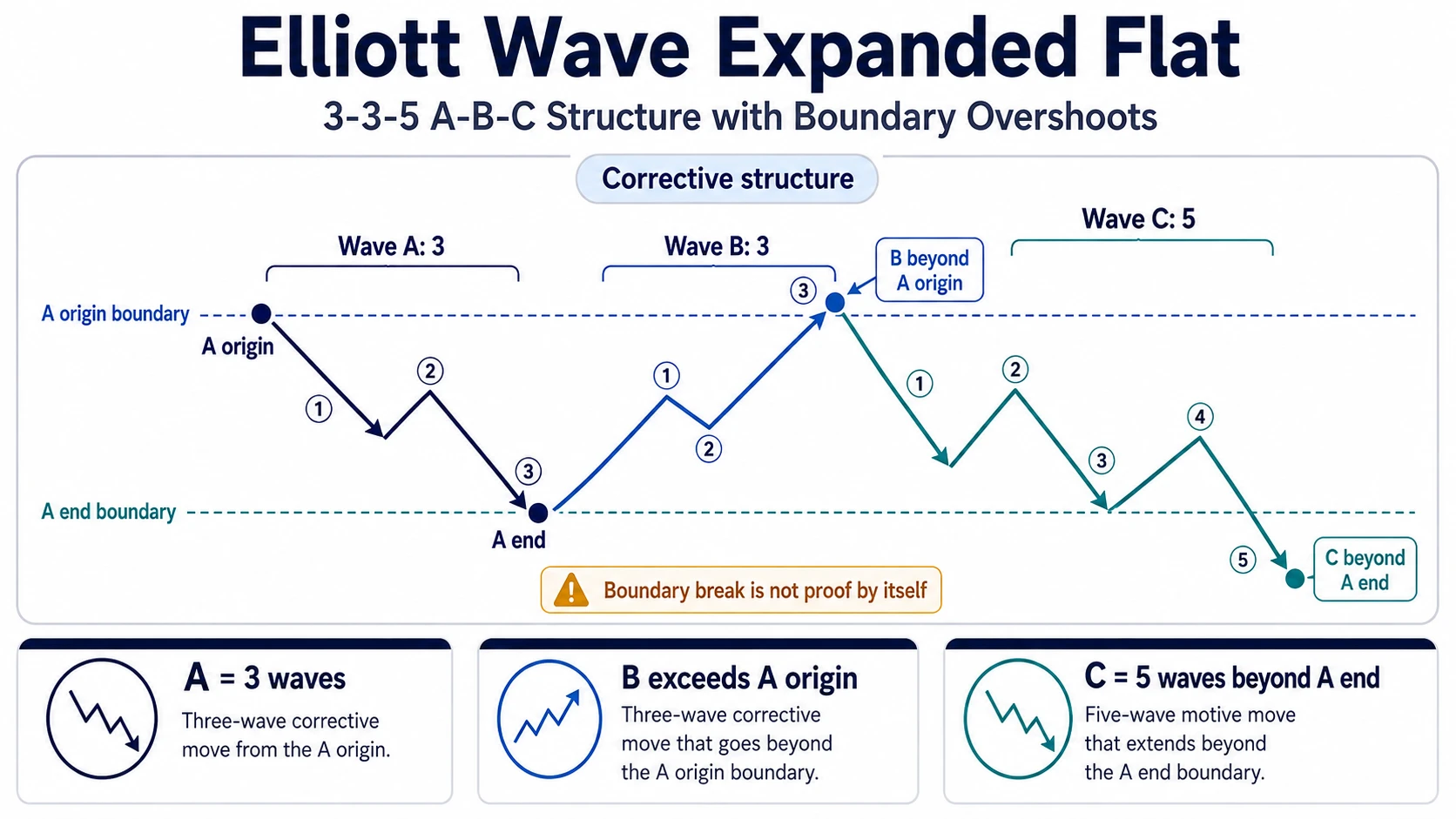
The expanded flat is a subtype of a flat correction. Its defining feature is not only that price moves beyond both sides of the prior corrective range, but that the internal wave structure also fits the expected sequence: three waves in A, three waves in B, and five waves in C.
The example above is drawn as Wave A down, Wave B up, and Wave C down. In the opposite market direction, the same boundary logic can be mirrored: Wave B still exceeds the origin of Wave A, and Wave C still moves beyond the end of Wave A.
Key Points
- An expanded flat is a 3-3-5 A-B-C corrective structure.
- Wave A and Wave B are corrective three-wave moves.
- Wave B moves beyond the start of Wave A.
- Wave C is a five-wave motive move that extends beyond the end of Wave A.
- The label becomes weak when either the subdivisions or the boundary relationships do not fit.
How an Elliott Wave Expanded Flat Is Structured
The expanded flat belongs to the broader Elliott Wave flat family. A flat correction normally uses an A-B-C sequence, but the expanded version stretches both sides of the structure: Wave B goes beyond the origin of Wave A, and Wave C then moves beyond Wave A’s termination.
The usual internal subdivision is 3-3-5. That means Wave A is corrective, Wave B is also corrective, and Wave C is motive. The boundary overshoot alone is not enough. A move that only breaks beyond the A origin without the right internal structure may be a different correction, an alternate count, or an incomplete interpretation.
| Wave | Expected structure | Boundary behavior | Diagnostic role |
|---|---|---|---|
| Wave A | Three-wave corrective move | Creates the first side of the correction | Establishes the range that Wave B and Wave C later test |
| Wave B | Three-wave corrective move | Moves beyond the origin of Wave A | Creates the expanded-flat overshoot that can be misread as continuation beyond the correction |
| Wave C | Five-wave motive move | Extends beyond the termination of Wave A | Completes the opposite-side expansion if the full structure fits |
Diagnostic Boundary for an Expanded Flat
The diagnostic test has two parts: geometry and subdivision. Geometry asks whether Wave B and Wave C exceed the relevant A-wave boundaries. Subdivision asks whether the internal wave count supports the 3-3-5 corrective form.
| Requirement | What must be visible | What it rules out | What can still go wrong |
|---|---|---|---|
| Wave A is corrective | A three-wave structure rather than a clean five-wave impulse | A simple impulse label for the first leg | Lower-degree subdivisions may be unclear or still developing |
| Wave B exceeds A origin | A B-wave move beyond the start of Wave A | A regular flat where B only returns near the start of A | The overshoot can look like a breakout before the correction is complete |
| Wave C is motive | A five-wave impulse or ending diagonal form | A weak C-wave label based only on direction | A choppy C wave may be hard to separate from another corrective structure |
| Wave C exceeds A end | A C-wave move beyond the termination of Wave A | A running flat where C fails to exceed the end of A | The count can remain provisional until the C-wave structure is clear |
Expanded Flat vs Regular Flat vs Running Flat
The expanded flat is easiest to separate from nearby flat types by focusing on where Wave B and Wave C finish relative to Wave A. These labels are closely related, but they do not describe the same corrective geometry.
| Flat type | Wave B behavior | Wave C behavior | Main distinction |
|---|---|---|---|
| Regular flat | Usually returns near the start of Wave A | Usually moves near or beyond the end of Wave A | The structure is flatter and less stretched than an expanded flat |
| Expanded flat | Moves beyond the start of Wave A | Extends beyond the end of Wave A | Both sides of the corrective range are exceeded |
| Running flat | Moves beyond the start of Wave A | Fails to travel beyond the end of Wave A | The B-wave overshoot appears, but Wave C does not complete the opposite-side expansion |
The distinction matters because an Elliott Wave running flat can share the B-wave overshoot but lacks the same C-wave extension. The broader set of Elliott Wave patterns also includes corrections that may look similar before their internal subdivisions are complete.
Why Wave B Can Be Misread
Wave B is the part of an expanded flat that often creates confusion. Because it moves beyond the origin of Wave A, it can appear to challenge the correction count and continue the prior movement. That reading is incomplete unless the later structure shows whether the A-B-C sequence is still developing.
A B-wave overshoot is only one condition. The expanded-flat label still depends on whether Wave B subdivides as a corrective three-wave move and whether Wave C later forms a motive move beyond the end of Wave A.
Illustrative scenario: Price begins a correction with a three-wave decline, then rallies above the level where that decline started. That rally may look like a clean continuation move, but in an expanded flat it can be Wave B. The label remains only a structural possibility until the following C wave develops as a five-wave move beyond the end of Wave A.
Wave C Length and Proportional Guidelines
Wave C in an expanded flat is usually the leg that completes the visible expansion. It should be read as a motive structure, commonly an impulse and sometimes an ending diagonal, rather than as a simple directional move.
Fibonacci proportions are sometimes used as guideline references for the relationship between Wave C and Wave A. Levels such as 123.6% or 161.8% can help describe proportional extension, but they do not validate the pattern by themselves and do not create a guaranteed completion zone.
Note: Proportion can support a count, but the count still depends on structure. A Fibonacci extension without the 3-3-5 sequence and the required A-wave boundary relationships is not enough to support an expanded flat label.
When the Expanded Flat Label Becomes Weak
The expanded-flat label becomes less reliable when price behavior matches only part of the pattern. The most common problem is treating any B-wave overshoot as enough evidence. Another problem is forcing a five-wave C label onto a move that still behaves like a corrective structure.
Limitation: An expanded flat is weak or invalid if Wave A and Wave B do not subdivide as corrective three-wave moves, if Wave B does not exceed the origin of Wave A, if Wave C does not form a motive structure, or if Wave C does not extend beyond the end of Wave A.
Degree selection can also change the interpretation. A move that appears to be an expanded flat at one degree may become part of a larger or smaller correction after more price structure develops. This is why Elliott Wave analysis usually treats counts as scenarios rather than fixed outcomes.
What an Expanded Flat Does Not Resolve
An expanded flat classifies a corrective structure after the necessary subdivisions and boundary conditions are visible. It does not resolve direction, timing, trade quality, reversal strength, or a specific target by itself.
The practical reading should stay structural: first check the 3-3-5 sequence, then check the A-wave boundaries, then compare the label against nearby alternatives such as regular flat, running flat, zigzag, triangle, or an unfinished correction.
FAQ
What makes an Elliott Wave flat expanded?
An Elliott Wave flat is expanded when Wave B moves beyond the origin of Wave A and Wave C extends beyond the end of Wave A, while the internal structure still fits a 3-3-5 A-B-C correction.
Does Wave C need to be five waves?
Yes. In the standard expanded-flat structure, Wave C should be a five-wave motive move, usually an impulse or sometimes an ending diagonal.
How is an expanded flat different from a running flat?
Both can have Wave B move beyond the start of Wave A, but an expanded flat has Wave C extend beyond the end of Wave A. In a running flat, Wave C does not travel beyond the end of Wave A.
Can an expanded flat be used as a trading signal?
No. An expanded flat is a corrective-pattern label. It does not create a buy signal, sell signal, timing signal, or guarantee of price movement by itself.