An Elliott Wave correction is the part of a wave count where price stops advancing the larger sequence and starts retracing, overlapping, or moving sideways. It can move against the prior move, but it can also move upward inside a bearish sequence or move sideways inside a larger structure. The label only makes sense relative to the broader count.
Definition: An Elliott Wave correction is a non-motive phase that interrupts or reorganizes a larger wave sequence. Its form can be simple or complex, and the specific label depends on position, subdivision, and how the move relates to the count around it.
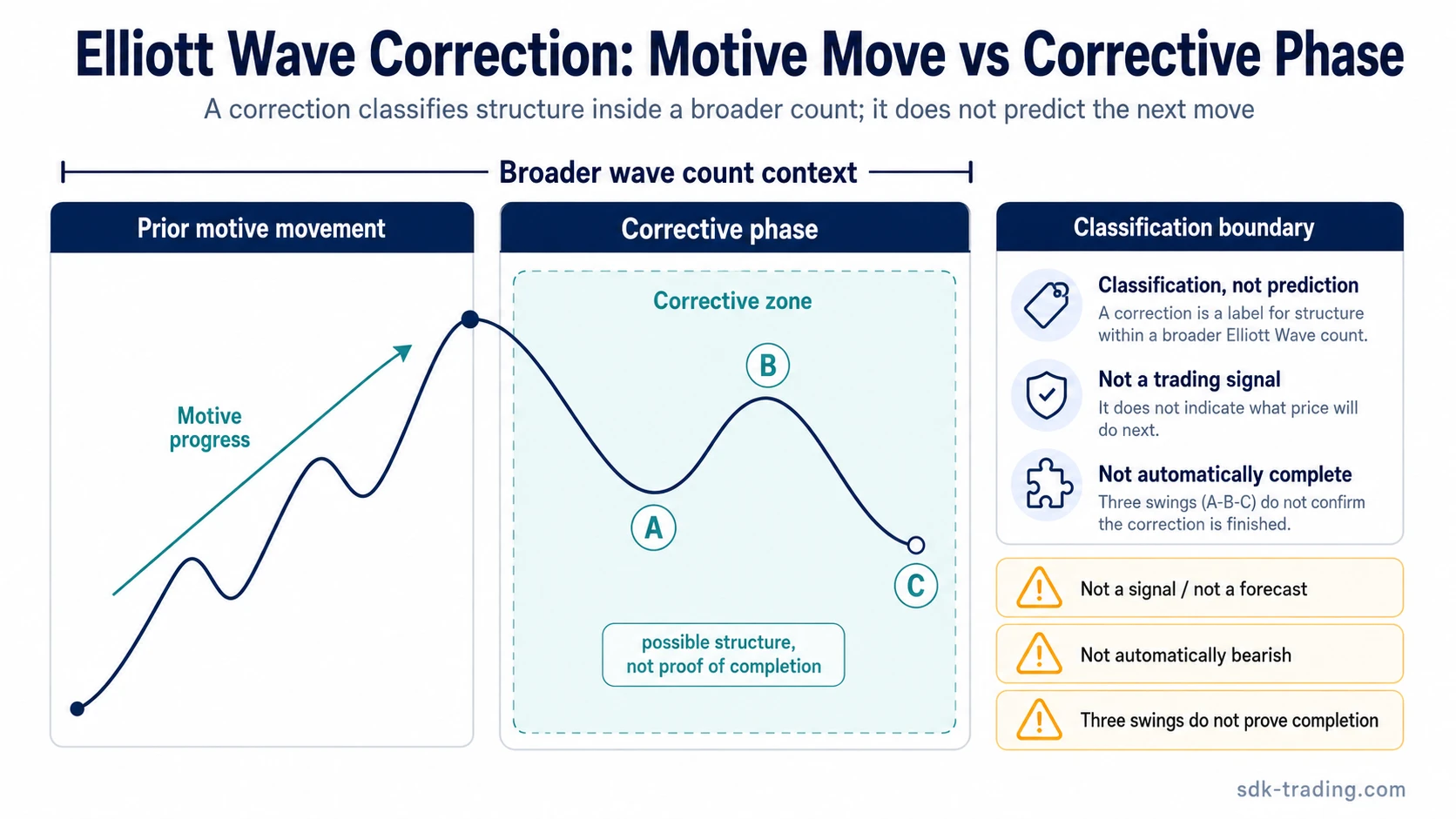
The first check is the role of the move inside the larger count. A falling move can be motive in a bearish sequence, while an upward move can be corrective inside that same structure. Once the role is clear, the next step is to examine the corrective form and internal subdivision.
Key Points
- An Elliott Wave correction is judged relative to the higher-degree count, not by direction alone.
- A correction can move down, up, or sideways depending on the larger structure.
- Wave 2 and Wave 4 are corrective positions inside a standard five-wave impulse.
- Common corrective forms include zigzags, flats, triangles, and complex combinations.
- Three visible swings are not enough to say that a correction is finished.
- The corrective label helps organize the count, but it should not be converted into an entry, exit, target, or guaranteed continuation scenario.
See a Fourth-Wave Range on a Real Chart
This short example shows a fourth-wave scenario developing inside a range. The useful part is the process: after a strong move, price starts moving sideways, and the prior fourth subwave area becomes one structural reference.
Important context: the video shows one range-based fourth-wave scenario. Wave 4 does not have to form a simple range, and the prior fourth subwave area is a guideline rather than a guaranteed destination.
The range-trading idea mentioned in the video is separate from Elliott Wave classification. A developing fourth wave can break the range, expand into another corrective form, or force the count to be revised. Execution and risk decisions need their own confirmation and invalidation rules.
Correction vs Motive Movement
Elliott Wave analysis first separates movement that advances the larger sequence from movement that interrupts it. That distinction matters because the same chart movement can mean different things at a different wave degree.
| Feature | Motive Movement | Corrective Movement |
|---|---|---|
| Main role | Advances the larger directional sequence. | Retraces, pauses, overlaps, or reorganizes the sequence. |
| Typical appearance | More directional progress. | Countertrend movement, overlap, sideways movement, or several linked corrective legs. |
| Main question | Is the directional phase still expanding? | Is the correction complete, still developing, or changing form? |
| Main mistake | Calling a directional move complete before enough structure has formed. | Calling a correction complete just because a familiar shape appears. |
The dedicated Elliott Wave impulse page covers motive five-wave structure in more detail.
Where Corrections Appear in an Elliott Wave Count
Corrective behavior can appear in several places. The label should come from the position in the count, not from the shape alone.
| Corrective Position | Structural Role | Main Caution |
|---|---|---|
| Wave 2 | Corrects the proposed first motive wave. | A decline cannot be called Wave 2 unless the preceding Wave 1 is itself defensible. |
| Wave 4 | Corrects or consolidates after Wave 3 before the proposed final motive segment. | Wave 4 can take several forms. A sideways range is common, but it is not required. |
| Wave B | Forms an internal corrective leg inside a larger A-B-C or related correction. | Wave B can retrace deeply and make it look as if the prior trend has resumed. |
| Wave X | Connects corrective structures inside a more complex correction. | A correction that looked finished can become only the first part of a larger sequence. |
Wave 2 vs Wave 4 Corrections
Wave 2 and Wave 4 are both corrective positions inside a standard impulse, but they are not interchangeable. Wave 2 appears early, before the larger impulse has proved much. Wave 4 appears after a stronger sequence has already developed.
| Feature | Wave 2 | Wave 4 |
|---|---|---|
| Position | Follows Wave 1. | Follows Wave 3. |
| Stage of motive sequence | Early. | Later, after three proposed motive/corrective segments have already developed. |
| Possible behavior | Can retrace a meaningful part of Wave 1. | Can retrace, overlap internally, compress, or develop sideways. |
| Structural boundary | In a standard impulse, Wave 2 cannot retrace beyond the origin of Wave 1. | In a standard non-diagonal impulse, Wave 4 must not overlap Wave 1 territory. |
| Common mistake | Calling any early decline Wave 2 because a strong Wave 3 is expected next. | Calling any later range Wave 4 because the previous move was strong. |
Hard count boundaries belong to the Elliott Wave rules framework. Corrective shape, alternation, and range behavior help the reading, but they do not replace those rules.
Main Types of Elliott Wave Corrections
Corrections do not all travel through the same path. A sharp A-B-C move, a sideways flat, a contracting triangle, and a W-X-Y combination can all be corrective, but they are different structures with different internal requirements.
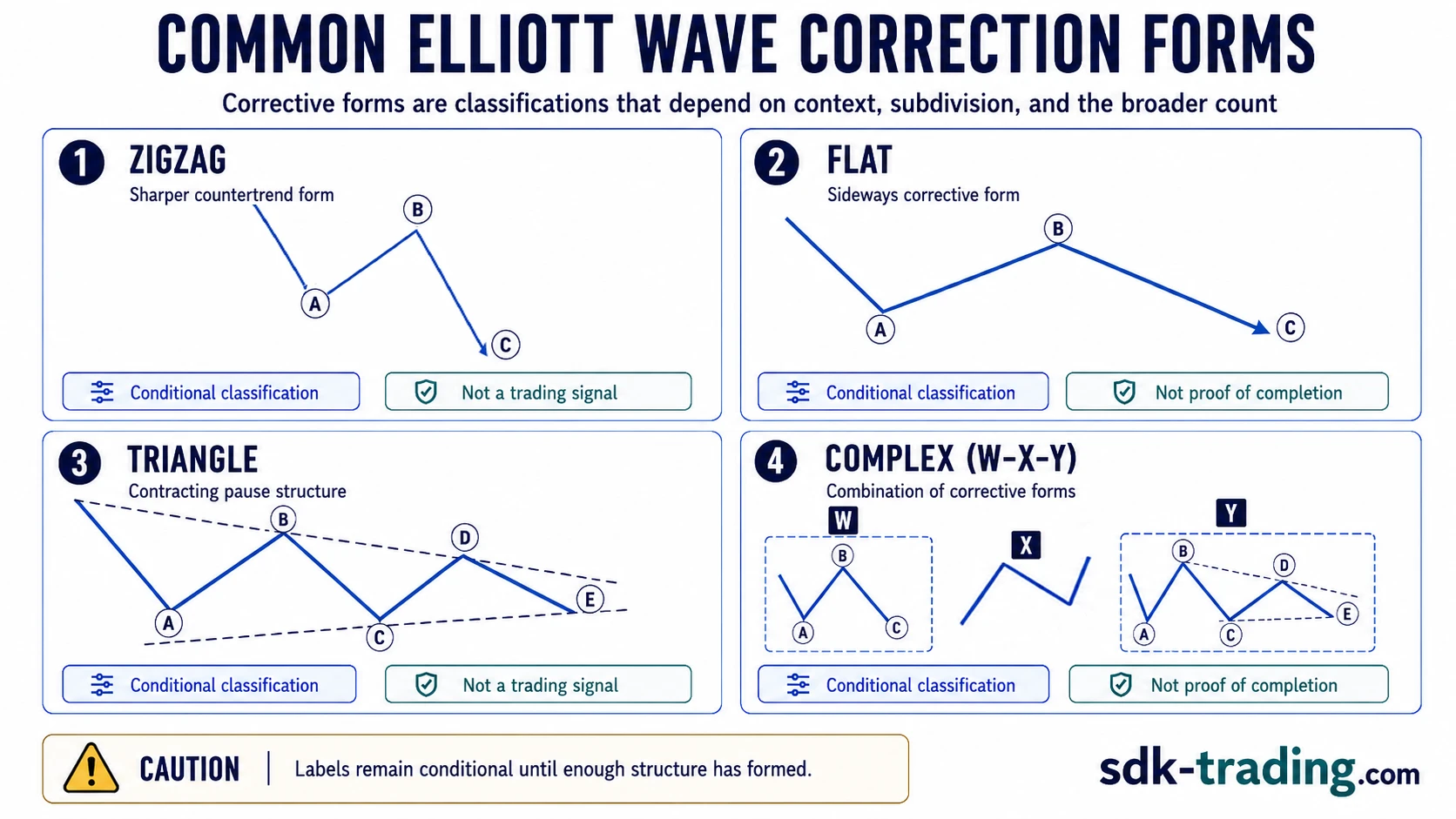
| Correction Type | Typical Structure | Main Classification Risk |
|---|---|---|
| Zigzag | A sharper A-B-C correction, normally associated with 5-3-5 subdivision. | Calling any sharp three-leg movement a zigzag without checking subdivision. |
| Flat | A more sideways A-B-C correction, normally associated with 3-3-5 structure. | Assuming every broad sideways A-B-C is a completed flat. |
| Triangle | An overlapping A-B-C-D-E corrective structure organized around boundaries. | Calling any narrowing range a triangle before five corrective legs are defensible. |
| Complex correction | Two or more corrective structures connected into a larger sequence, often through W-X-Y or related notation. | Assuming the first completed structure ended the whole correction. |
How to Read a Fourth-Wave Range
A fourth wave can become a sideways problem rather than a clean directional move. The exact path may still change as more structure develops. It can become a flat, a triangle, a running flat, or a more complex correction.
A fourth-wave range should not be labeled as a triangle too early. First check whether the larger count supports a Wave 4 position, whether the range remains compatible with the relevant impulse rules, and whether the developing structure still behaves as a correction rather than a new motive move.
| Observation | What It Can Suggest | What It Does Not Prove |
|---|---|---|
| Sideways movement after a strong directional phase | A corrective or consolidating phase may be developing. | That the structure is automatically Wave 4. |
| Repeated reactions near upper and lower range boundaries | The correction is temporarily organizing around visible containment. | That the range will continue indefinitely. |
| Return toward the prior fourth subwave area of Wave 3 | A commonly watched structural reference may be coming into play. | That price must stop or reverse at that area. |
| Break of the range | The current corrective phase may be changing or ending. | That the breakout automatically confirms Wave 5. |
How to Classify an Elliott Wave Correction
- Start with the higher-degree structure. First determine what movement came before the proposed correction. Without that context, the correction label is mostly guesswork.
- Identify the role of the current move. Ask whether price is advancing the larger sequence or interrupting it through retracement, overlap, or sideways movement.
- Check the internal subdivision. A visible A-B-C or range only starts the question. The internal structure decides whether a more specific corrective label is defensible.
- Check the wave position. Wave 2, Wave 4, Wave B, and Wave X do not play the same role inside the larger count.
- Apply the relevant structural rules. A corrective interpretation should remain compatible with the hard boundaries of the proposed count.
- Keep the label provisional while the structure is incomplete. A simple correction can still develop into a flat, triangle, combination, or another larger corrective sequence.
- Define what would require reclassification. The useful part of the label is knowing what would weaken it. If the structure changes, the count should change with it.
Simple vs Complex Corrections
A simple correction contains one primary corrective structure. A complex correction develops differently because one completed correction can become only the first piece of a larger corrective sequence.
| Feature | Simple Correction | Complex Correction |
|---|---|---|
| Basic organization | One primary corrective structure. | Several corrective structures linked together, often through W-X-Y style combination logic. |
| Visual clarity | The main legs may be easier to separate. | More overlap and extra connecting movements can make the count less obvious. |
| Completion risk | The structure can still be called complete too early. | An apparent completion can become only the first part of a larger correction. |
| Best check | Confirm that the internal form supports the proposed subtype. | Keep alternatives open until later structure reduces the ambiguity. |
Related Elliott Wave Structures
Motive movement can become more complex when a wave extends. The Elliott Wave extension concept belongs to the motive side of the framework rather than to basic corrective classification.
Zigzags, flats, triangles, and combinations sit inside the broader family of Elliott Wave patterns. Each subtype has its own internal requirements. The correction label is the broader category.
For the wider theory, Elliott Wave explained connects corrective phases with motive phases, degree, subdivision, rules, and reclassification boundaries.
Common Elliott Wave Correction Mistakes
| Common Mistake | Why It Weakens the Reading | Better Check |
|---|---|---|
| Assuming a correction must move down | Correction is defined relative to the larger wave direction, not by bearish price movement. | Start with the higher-degree context. |
| Calling three swings a completed correction | A simple A-B-C can become part of a larger corrective structure. | Check subdivision and later price behavior before fixing the label. |
| Calling every sideways range Wave 4 | A range can appear in many different corrective or non-Elliott contexts. | Confirm that the preceding same-degree count supports the Wave 4 position. |
| Assuming Wave 4 must remain a range | Fourth waves can develop through different corrective forms. | Keep zigzag, flat, triangle, and complex alternatives available when the structure supports them. |
| Treating the prior fourth subwave area as a mandatory target | The area is a guideline reference, not a hard destination rule. | Use it as context and judge the actual response. |
| Trading every fourth-wave range mechanically | The range can break, expand, change corrective form, or invalidate the assumed count. | Separate wave classification from execution, confirmation, and risk management. |
| Assuming a range breakout confirms Wave 5 | The breakout can fail or belong to a different corrective structure. | Check the larger count and later acceptance before upgrading the scenario. |
| Forcing a preferred correction after structure changes | The label starts defending the expectation instead of describing the market. | Reclassify when subdivision, boundaries, or hard rules no longer support the count. |
Limitations of Elliott Wave Correction Analysis
Corrections are often harder to classify while they are forming than after they are complete. Overlap, changing subdivisions, alternate counts, and combinations can keep several interpretations open at the same time.
A correction can also change form. A move that starts as a simple A-B-C can extend into a flat, triangle, or complex combination. A sideways range can also stop behaving like the expected fourth-wave structure.
The most useful way to treat correction analysis is conditionally. It helps organize retracement, overlap, consolidation, and alternative paths, while the actual count remains open to revision as new structure develops.