Elliott wave degrees classify the relative scale of waves inside larger and smaller Elliott Wave structures. They help separate a broad swing from the smaller waves inside that swing, so the same chart movement is not discussed as if every wave belongs to the same layer. Degree labels organize analysis, but they do not settle count correctness, timing, direction, or trade quality.
Definition: Elliott wave degrees are scale labels used to describe where a wave sits inside a larger or smaller Elliott Wave structure.
A degree label answers a scale question. It does not answer whether the count is valid, whether a correction is finished, or whether a market is ready to continue. The useful distinction is simple: one wave can be part of a larger structure while also containing smaller waves inside it.
Key Points
- Elliott wave degrees classify wave scale, not trade quality.
- Nested waves can belong to different degrees on the same chart.
- Timeframe labels are approximate because markets do not move at fixed speeds.
- Degree labels help reduce count confusion, but the count still depends on separate structural evidence.
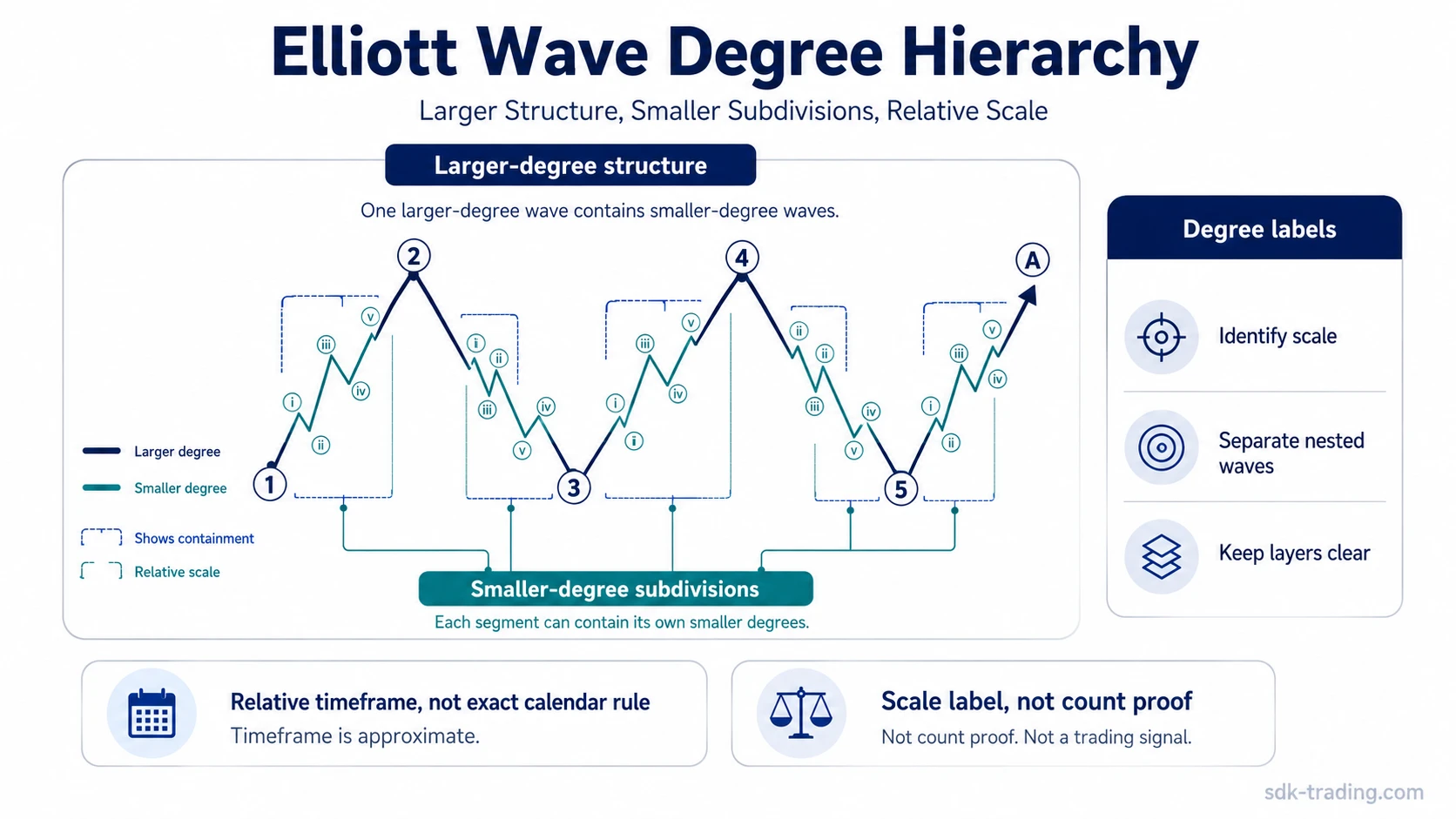
What Elliott Wave Degrees Mean
An Elliott Wave count can contain several layers of structure. A large advance may be labeled as one wave at a higher degree, while the movement inside that advance may divide into smaller waves at lower degrees. Degree labels make that difference explicit.
The core idea is hierarchy. A wave is not only a line between two price points. It may be a component of a larger pattern and, at the same time, a container for smaller internal movement. Without degree labels, the analysis can become unclear because the same number or letter may refer to different structural layers.
Degree labels are usually shown with different notation styles, such as different number formats, letter formats, or capitalization. The notation is less important than the relationship it communicates: larger degree first, smaller degree inside it.
Larger-Degree vs Smaller-Degree Waves
A larger-degree wave describes the broader swing or structure being analyzed. A smaller-degree wave describes the internal movement inside that broader swing. The smaller structure can support the larger interpretation, but it cannot validate the larger interpretation by itself.
For example, a broad upward movement may be labeled as Wave 1 at one degree. Inside that same movement, an analyst may label five smaller waves. Those lower-degree labels describe internal structure. The internal labels describe the subdivision; they do not settle the higher-degree count by themselves.
| Label type | What it describes | Common misuse |
|---|---|---|
| Larger-degree label | The broader wave or pattern layer under discussion. | Treating the broad label as proof that the whole count is confirmed. |
| Smaller-degree label | The internal subdivision inside a larger wave. | Assuming internal subdivisions automatically validate the larger structure. |
| Same-chart degree contrast | Two or more scale layers visible on one chart. | Mixing labels from different degrees as if they refer to the same structural level. |
This is why degree labels are closely connected to Elliott Wave patterns. The pattern describes the structural form, while the degree label describes the scale layer being discussed.
How Degree Labels Relate to Timeframes
Elliott wave degrees are often associated with broad time horizons, but they are not exact timeframe rules. A higher-degree wave normally covers a larger structure than a lower-degree wave, yet the actual time taken by that structure depends on market speed, volatility, and the shape of the movement.
This means a degree label should not be read as a calendar promise. A lower-degree structure can stretch longer than expected, and a larger-degree wave can develop faster than a textbook example suggests. The label is a relative scale marker, not a fixed time measurement.
Timeframe note: Degree labels can help organize multi-timeframe analysis, but the timeframe itself does not validate the label. The structure must still be evaluated through the count and surrounding context.
Condition, Implication, and Limitation
The safest way to use degree labels is to separate what the label organizes from what it cannot prove. The label can clarify the layer of structure being discussed, but it cannot replace the count logic.
| Condition | Implication | Limitation |
|---|---|---|
| A large swing contains visible internal subdivisions. | The move may be discussed as a larger-degree wave with lower-degree waves inside it. | The internal labels do not automatically prove that the larger-degree count is correct. |
| Two analysts use different labels on the same chart. | They may be discussing different structural layers rather than completely different observations. | The difference still needs count logic, not only label preference. |
| A chart shows many possible nested waves. | Degree labels can reduce confusion by separating broad and internal movement. | Trying to force every possible degree onto one chart can make the count harder to read. |
| A lower-degree five-wave move appears inside a larger structure. | The internal structure may support a motive-wave reading inside that layer. | It does not create a forecast or confirm that the next larger wave must unfold. |
| A corrective structure appears inside a broader count. | The correction can be assigned to the smaller degree inside the larger movement. | The label does not decide which corrective pattern is present without separate pattern analysis. |
Common Misread: Same Chart, Different Degree
A common scenario is that one analyst labels a full upward movement as Wave 1 at a larger degree, while another analyst focuses on the five smaller waves inside that same upward movement. Both may be looking at the same chart, but they are not necessarily labeling the same structural layer.
Illustrative scenario: A broad move rises from a low to a new swing high. At the larger degree, the whole move may be labeled as one wave. At the smaller degree, the internal path may be labeled as five waves. The smaller labels describe the internal path, while the larger label describes the broader swing. The label clarifies scale, but the count still depends on separate structural evidence.
This distinction is especially useful when a lower-degree structure resembles an Elliott Wave impulse. The internal five-wave form may be relevant, but the degree label still needs to stay tied to the scale being analyzed.
Practical Degree Label Hierarchy
Elliott Wave degree lists can become long, but practical chart discussion usually works best when only the visible scale layers are labeled clearly. The goal is not to place every possible degree on one chart. The goal is to prevent a broad wave and its internal subdivisions from being confused.
| Practical layer | Question it answers | Safer interpretation |
|---|---|---|
| Broad structure | What larger wave or pattern is being discussed? | Use the label to define the main scale of analysis. |
| Internal structure | What smaller waves appear inside the broader move? | Use lower-degree labels to describe the subdivision, not to force certainty. |
| Pattern-specific structure | Does the movement resemble a specific Elliott Wave form? | Keep the pattern question separate from the degree question. |
| Corrective nesting | Is a smaller correction developing inside a larger count? | Use degree labels to separate the correction layer from the broader structure. |
This separation matters when comparing structures such as an Elliott Wave diagonal with a cleaner impulse-like subdivision. The degree label identifies the scale of discussion, while the pattern label identifies the form.
What Elliott Wave Degrees Do Not Prove
Elliott wave degrees do not establish market direction, timing, count correctness, or trade quality. They are organizational labels. They can make a wave count easier to discuss, but they cannot remove uncertainty from the count.
Limitation: A degree label is not a signal. It does not forecast the next movement, confirm that a correction is complete, validate a trade idea, or guarantee that the selected count is the only valid interpretation.
The mistake is treating a clean label as if it proves the count. A clean label only means the analyst has named the scale layer. The separate question is whether the surrounding structure, alternation, subdivision, and invalidation logic support that count.
How Degrees Fit With Corrective Structures
Degree labels also help separate broad corrective structures from smaller internal corrections. A larger correction may contain smaller corrective waves, and those smaller movements can be labeled at lower degrees without changing the broader corrective reading.
This matters when a structure is being compared with an Elliott Wave flat or another corrective pattern. The degree label does not decide the pattern. It only identifies the scale at which that pattern is being discussed.
Keeping degree and pattern separate prevents a common error: assuming that a smaller correction invalidates the broader structure simply because it uses a different letter or number sequence.
How to Use Degree Labels Safely
Use degree labels as a clarity tool. Start with the broad structure being analyzed, then label only the internal layers that are useful for the count. If the chart becomes crowded with competing degree labels, the label system is no longer improving interpretation.
- Start with scale: Decide which wave or pattern layer is the main subject.
- Separate internal movement: Use lower-degree labels only for the subdivisions that help explain the count.
- Avoid label overload: Do not force every theoretical degree onto one chart.
- Check structure separately: Treat the label as organization, not proof.
The final test is whether the label makes the count easier to understand. If the labels make the chart harder to read, the analysis may be over-specified.
Related Elliott Wave Concepts
Elliott wave degrees are easiest to understand when they are separated from the structures they label. A broad Elliott Wave flat can contain smaller internal waves, but the flat label describes the corrective form while degree labels describe scale.
The same separation applies across Elliott Wave analysis: degree labels identify the level of structure, while pattern labels identify the shape of the structure. Keeping those two questions apart reduces confusion between nested waves, corrective forms, motive forms, and alternate counts.
FAQ
Are Elliott wave degrees the same as timeframes?
No. Elliott wave degrees are relative scale labels, while timeframes are chart intervals or broad time horizons. A degree may often correspond to a larger or smaller timeframe, but the label is not an exact calendar rule.
Do wave degrees prove that a wave count is correct?
No. Wave degrees organize the scale of a count. They do not prove that the count is correct, that timing is reliable, or that the next movement must follow one path.
Why can two Elliott Wave analysts label the same chart differently?
They may be focusing on different structural layers. One label may describe a larger wave, while another label describes the smaller waves inside it. The difference should be resolved through count logic, not label preference alone.
Do traders need to use all nine Elliott wave degrees?
No. Elliott Wave degree lists can become long, but practical chart discussion usually works best when only the visible scale layers are labeled clearly. Forcing every possible degree onto one chart can add confusion instead of improving the analysis.