An Elliott Wave diagonal is a motive-wave structure that can move with the larger trend but does not behave like a standard impulse. Its label depends on overlap, wedge-like boundary lines, internal subdivision, and where it appears in the broader count.
Definition: An Elliott Wave diagonal is a five-wave motive structure in which the waves often compress or expand inside converging or diverging boundary lines, and wave 4 commonly overlaps the price territory of wave 1. The diagonal label is a structural classification, not a forecast, signal, or confirmation that the next move must happen.
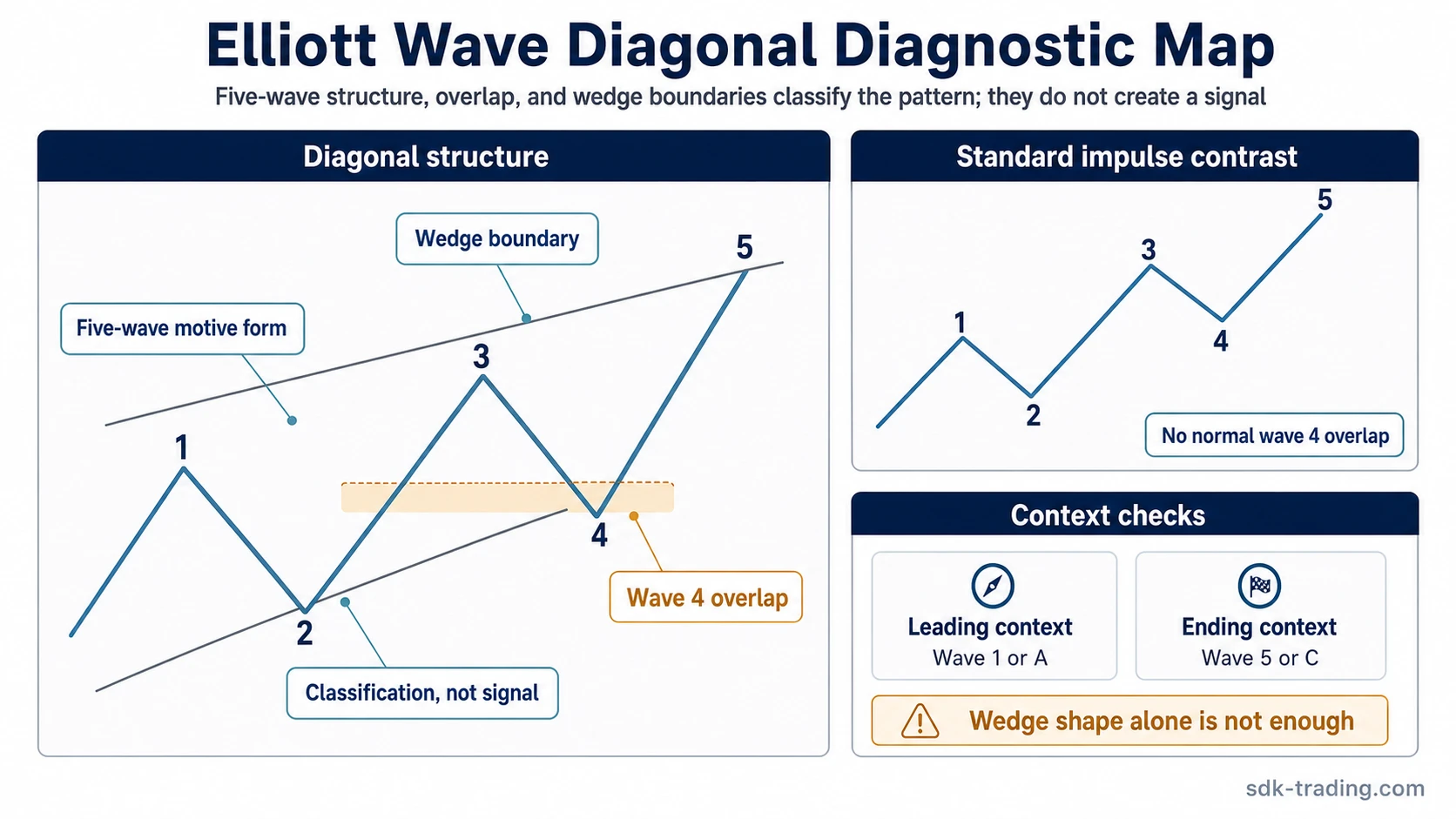
A diagonal separates a weaker or more compressed motive structure from a cleaner impulse. In a standard impulse, the structure is expected to show stronger separation between waves and no wave 4 overlap with wave 1. In a diagonal, that overlap can support the classification, but only when the broader count, subdivision, and location also fit.
The strongest reading comes from the full relationship between location, subdivision, overlap, and boundary behavior. A wedge shape alone is not enough. The same visual compression can also belong to a triangle, a correction, a weak impulse count, or a generic chart pattern if the internal wave logic does not fit.
Key Points
- An Elliott Wave diagonal is a motive-wave classification, not a trading signal.
- Leading diagonals usually appear in wave 1 or wave A positions; ending diagonals usually appear in wave 5 or wave C positions.
- Wave 4 overlap with wave 1 is central to the diagonal reading, but it must be judged with subdivision and location.
- Contracting boundary lines are common, while expanding diagonals are usually treated as a narrower caveat.
- Invalidation matters more than visual resemblance: a wedge-like shape does not automatically confirm a diagonal.
What Is an Elliott Wave Diagonal?
An Elliott Wave diagonal is a five-wave structure that belongs to the motive side of Elliott Wave analysis, but it differs from a normal impulse because its internal waves can overlap and its boundaries often form a wedge-like shape. It can appear when directional movement is still present, but the structure is less clean than a standard impulse.
The diagonal is usually labeled with five waves, often written as 1-2-3-4-5. The label becomes more defensible when the structure has a clear place in the broader count, the internal waves subdivide in an acceptable way, and the overlap does not violate the diagonal rules being applied.
That distinction is important when comparing a diagonal with a broader set of Elliott wave patterns. A diagonal is not just any wedge. It is a count-dependent structure that must fit the surrounding wave sequence.
Why a Diagonal Is Not a Standard Impulse
A standard impulse and a diagonal can both move in the direction of the larger count, but they are not the same structure. The main boundary is overlap. In a typical impulse, wave 4 should not overlap the price territory of wave 1. In a diagonal, that overlap is usually part of the diagnostic picture.
The difference is not only visual. A strong impulse usually shows clearer directional separation and stronger internal expansion. A diagonal often shows compression, weaker progression, or a wedge-like path. That is why a diagonal should be treated as a specific structural label rather than a looser name for any rising or falling wedge.
| Feature | Standard impulse | Elliott Wave diagonal |
|---|---|---|
| Wave overlap | Wave 4 overlap with wave 1 is normally not allowed. | Wave 4 overlap with wave 1 is commonly part of the structure. |
| Boundary behavior | Movement often looks more directional and less compressed. | Movement often forms contracting or occasionally expanding boundary lines. |
| Subdivision | Usually follows cleaner motive subdivision. | May use 5-3-5-3-5 or 3-3-3-3-3 depending on diagonal type and interpretation. |
| Interpretation risk | Risk comes from forcing a trend count where internal rules fail. | Risk comes from calling any wedge a diagonal without count support. |
An Elliott wave extension can make an impulse look visually stretched or uneven, but extension and diagonal are different ideas. Extension describes expansion inside a motive sequence; diagonal classification depends more on overlap, wedge behavior, subdivision, and position in the larger count.
Leading vs Ending Diagonal
The two main diagonal categories are leading diagonal and ending diagonal. The distinction depends mostly on where the structure appears in the count. A leading diagonal appears near the start of a motive sequence or corrective movement. An ending diagonal appears near the final part of a larger sequence.
| Type | Common location | Structural idea | Main caution |
|---|---|---|---|
| Leading diagonal | Wave 1 or wave A | A motive structure that begins a new sequence but does not form a clean standard impulse. | It should not be treated as confirmed just because early movement is choppy or overlapping. |
| Ending diagonal | Wave 5 or wave C | A motive structure that appears late in a broader count, often with compression or loss of clean impulse behavior. | It does not guarantee reversal, exhaustion, or immediate completion. |
A leading diagonal is usually interpreted as an early motive structure. It can appear when a new directional sequence is forming but has not developed clean impulse behavior. Because early structures can be messy, the label needs confirmation from the broader count, not only from overlap.
An ending diagonal is usually interpreted as a late-stage motive structure. It can appear in a wave 5 or wave C position, where the count is still moving directionally but the internal structure is more compressed. The label can be useful, but it should not become a reversal prediction by itself.
The wave C location connects diagonals with some corrective contexts, but a diagonal is not the same thing as a full Elliott wave correction. A correction describes the broader counter-move structure; a diagonal describes a specific five-wave form that may appear inside certain count positions.
Internal Subdivision: 5-3-5-3-5 and 3-3-3-3-3
Subdivision is one of the main checks behind the diagonal label. A diagonal is not validated only by drawing two boundary lines around price. The internal waves must also make sense as a count.
Classical interpretations often distinguish between 5-3-5-3-5 and 3-3-3-3-3 subdivisions. A leading diagonal is often discussed with 5-3-5-3-5 subdivision, while an ending diagonal is often discussed with 3-3-3-3-3 subdivision. In real chart interpretation, the exact reading can be debated, so the safer approach is to treat subdivision as evidence that supports or weakens the label rather than as a visual shortcut.
Subdivision note: The internal count should support the diagonal classification. If the visible structure looks like a wedge but the subdivisions do not fit, the diagonal label becomes weaker.
Contracting and Expanding Diagonals
Most diagonal discussions focus on contracting diagonals. In a contracting diagonal, the boundary lines move toward each other as the structure develops. This can create the familiar wedge-like shape, with each swing making less net progress than a clean impulse.
An expanding diagonal is the less common caveat. In that form, the boundary lines move away from each other rather than narrowing. The important point is that expansion or contraction does not replace the count. The boundary shape can support the label, but it cannot carry the label alone.
| Form | Boundary behavior | Interpretation | Risk of misread |
|---|---|---|---|
| Contracting diagonal | Boundary lines converge. | The structure compresses as the five-wave sequence develops. | A generic wedge may be mislabeled as a diagonal without subdivision support. |
| Expanding diagonal | Boundary lines diverge. | The structure broadens while still being treated as a diagonal candidate. | The expanding label can dominate the analysis even when the broader count is weak. |
Rules, Guidelines, and Invalidation
A diagonal count needs both rules and guidelines. Rules define conditions that should not be violated under the chosen count. Guidelines describe tendencies that can support the reading but do not prove it by themselves.
| Check | Classification | How it affects the diagonal label |
|---|---|---|
| Five-wave structure | Hard rule | The structure should be countable as five waves. If it is only a three-wave correction or sideways pattern, the diagonal label should be removed. |
| Wave 3 not shortest | Hard rule | If wave 3 is the shortest among waves 1, 3, and 5, the motive count becomes invalid under standard Elliott Wave rules. |
| Wave 4 overlap with wave 1 | Supports the diagonal label | Overlap can support a diagonal reading, but only when the structure and location also fit. |
| Wedge-like boundary lines | Guideline | Converging or diverging lines can support the label, but the shape alone is not enough. |
| Correct count location | Hard rule / context | A leading diagonal should fit wave 1 or A context; an ending diagonal should fit wave 5 or C context. A conflicting location weakens or invalidates the label. |
| Poor subdivision fit | Weakens the diagonal label | If the visible wedge does not subdivide in a way that fits the diagonal type being considered, the label becomes less defensible. |
| Clean completion assumption | Invalidates the shortcut, not the market | Seeing five swings does not prove the diagonal is complete or that the next move is known. |
Invalidation boundary: A diagonal interpretation weakens when the structure cannot be counted as five waves, when the supposed subdivisions do not fit, when the location conflicts with the broader count, or when the label depends only on a wedge outline. The label should be removed or downgraded when the count requires exceptions that the structure cannot support.
How to Identify an Elliott Wave Diagonal
Identification starts with the count, not the drawing tool. The first question is whether the structure has a valid five-wave sequence in a location where a diagonal can appear. The second question is whether overlap, subdivision, and boundary behavior support that count.
- Check the location: Decide whether the structure is appearing in a wave 1, wave A, wave 5, or wave C position.
- Count the internal waves: Look for a five-wave structure and test whether the subdivisions fit the diagonal type being considered.
- Inspect overlap: Wave 4 overlap with wave 1 can support a diagonal reading, unlike a standard impulse.
- Draw the boundaries: Contracting or expanding boundary lines can support the structure, but they should not replace the count.
- Test invalidation: Remove the diagonal label if the structure requires too many exceptions or if the broader count no longer supports the location.
Practical reading: A diagonal label is strongest when several pieces agree: count location, five-wave structure, acceptable subdivision, overlap behavior, and boundary shape. One feature alone is not enough.
Diagnostic Boundary: Diagonal vs Nearby Structures
Many diagonal mistakes come from naming the outer shape instead of reading the internal structure. A wedge outline can appear in several different Elliott Wave contexts, so the label needs a diagnostic boundary.
| Possible label | What can look similar | Safer distinction |
|---|---|---|
| Diagonal | Five swings inside a contracting or expanding shape. | The structure needs diagonal-appropriate location, overlap behavior, and subdivision. |
| Impulse | A directional five-wave move. | A standard impulse normally should not have wave 4 overlapping wave 1. |
| Triangle | Overlapping swings inside converging boundaries. | A triangle is corrective and usually behaves as a sideways or countertrend consolidation, not a motive five-wave diagonal. |
| Zigzag | A sharp three-part corrective movement. | A zigzag is corrective, so the first boundary is whether the broader structure is motive or corrective before assigning a diagonal or zigzag reading. |
| Truncation | A final wave that fails to travel beyond a prior extreme. | Truncation describes failure to extend beyond a prior level; diagonal describes the internal five-wave structure. |
| Generic wedge | Two boundary lines around compressed price action. | A wedge is a visual shape; a diagonal is a count-based Elliott Wave classification. |
Common Mislabels and Limits
The most common error is treating the diagonal as a visual pattern first. A wedge can start the question, but the count answers it. If the label depends only on two sloping lines, the analysis is too thin.
| Mislabel | Why it happens | Cleaner interpretation |
|---|---|---|
| Calling every wedge a diagonal | The outer boundary looks compressed. | Require location, five-wave structure, subdivision, and overlap support. |
| Treating an ending diagonal as a guaranteed reversal | Ending diagonals often appear late in a count. | Late-stage location can matter, but it does not guarantee immediate reversal or completion. |
| Ignoring subdivision | The outer shape appears convincing. | The internal count should support the label before the diagonal reading is used. |
| Confusing a diagonal with a correction | Both may contain overlapping movement. | Overlap alone does not decide the label; motive or corrective context must be resolved first. |
| Forcing diagonal labels after invalidation | The visual idea remains attractive after the count weakens. | The label should change when the structure no longer supports the rules being applied. |
Classification limit: A diagonal can organize a difficult count, but it should not be used to rescue every messy structure. When the count becomes too dependent on exceptions, the better reading may be a different Elliott Wave pattern or no clean label at all.
Illustrative Scenario
Imagine a five-wave advance that begins strongly, then starts to compress. Wave 2 retraces part of wave 1. Wave 3 advances again but does not create the clean separation expected from a strong impulse. Wave 4 then overlaps part of wave 1, while the outer boundary lines begin to narrow. Wave 5 makes another push inside the same narrowing structure.
That sequence may support a diagonal reading if the broader count places it in a valid leading or ending location and the internal subdivisions fit. It would remain only a candidate if the structure is just a wedge outline without a coherent wave count.
Related Elliott Wave Concepts
Diagonal interpretation becomes clearer when it is compared with the surrounding Elliott Wave structure rather than isolated as a standalone shape.
- Corrections: Elliott wave corrections help separate overlapping countertrend movement from motive diagonal movement.
- Extensions: Elliott wave extensions can look stretched or uneven without becoming diagonals.
- Pattern families: Elliott wave patterns help distinguish diagonals from triangles, zigzags, impulses, and truncations.
- Core Elliott Wave rules: Core Elliott Wave rules help separate motive and corrective labels before assigning a diagonal, zigzag, triangle, or truncation reading.
FAQ
Is an Elliott Wave diagonal a reversal signal?
No. A diagonal is a structural classification. An ending diagonal may appear late in a count, but that does not guarantee reversal, completion, or a specific next move.
Can wave 4 overlap wave 1 in a diagonal?
Yes. Wave 4 overlap with wave 1 is one of the features that separates a diagonal from a standard impulse. The overlap still needs to fit the broader count and subdivision.
Is every wedge an Elliott Wave diagonal?
No. A wedge is a visual shape. A diagonal requires a count-based structure, acceptable subdivision, valid location, and rule support.