An Elliott Wave impulse is a five-wave motive structure that moves in the larger-degree direction. Waves 1, 3, and 5 advance the structure, while waves 2 and 4 act as corrective retracements. A strong price move is not automatically an impulse; the count must satisfy wave-role, rule, and subdivision criteria.
Definition: An Elliott Wave impulse is a five-wave motive pattern labeled 1-2-3-4-5, where the actionary waves move with the larger trend and the corrective waves retrace part of that movement.
The useful boundary is structural, not emotional. A move can look forceful, fast, or extended and still fail as an impulse if its internal waves do not divide correctly, if a core rule is broken, or if a cleaner corrective count explains the same price action.
Key Points
- An impulse is a five-wave motive structure, not just a strong directional move.
- Waves 1, 3, and 5 are actionary segments; waves 2 and 4 are corrective retracements.
- The standard impulse rules check Wave 2 depth, Wave 3 length, and Wave 4 overlap.
- The internal subdivision is normally 5-3-5-3-5.
- Impulse classification remains a structural reading, not a standalone trading signal.
What Is an Elliott Wave Impulse?
An Elliott Wave impulse is the basic motive structure used to label directional movement in Elliott Wave analysis. It contains five waves: three actionary waves that move the structure forward and two corrective waves that interrupt that movement.
The label is valid only when the proposed count behaves like a motive sequence. Direction alone is not enough. A sharp rally or selloff may still be corrective if the movement subdivides poorly, breaks a rule, or fits a corrective pattern more cleanly.
Classification boundary: The impulse label describes structure. It does not prove future direction, create a trade setup, confirm trend continuation, or remove the need for broader market context.
Elliott Wave Impulse Structure
The standard impulse count is labeled from Wave 1 through Wave 5. The structure has an alternating rhythm: actionary movement, corrective retracement, actionary movement, corrective retracement, and final actionary movement.
| Wave | Role | What it does | Diagnostic note |
|---|---|---|---|
| Wave 1 | Actionary / motive | Begins the directional sequence. | Must be followed by a corrective Wave 2 that does not fully erase it. |
| Wave 2 | Corrective | Retraces part of Wave 1. | Cannot retrace beyond the origin of Wave 1 in a valid impulse. |
| Wave 3 | Actionary / motive | Moves the structure forward again. | Cannot be the shortest of Waves 1, 3, and 5. |
| Wave 4 | Corrective | Retraces part of Wave 3. | Should not overlap Wave 1 territory in a standard impulse. |
| Wave 5 | Actionary / motive | Completes the five-wave motive sequence. | May be strong, extended, ordinary, or sometimes truncated, depending on the broader count. |
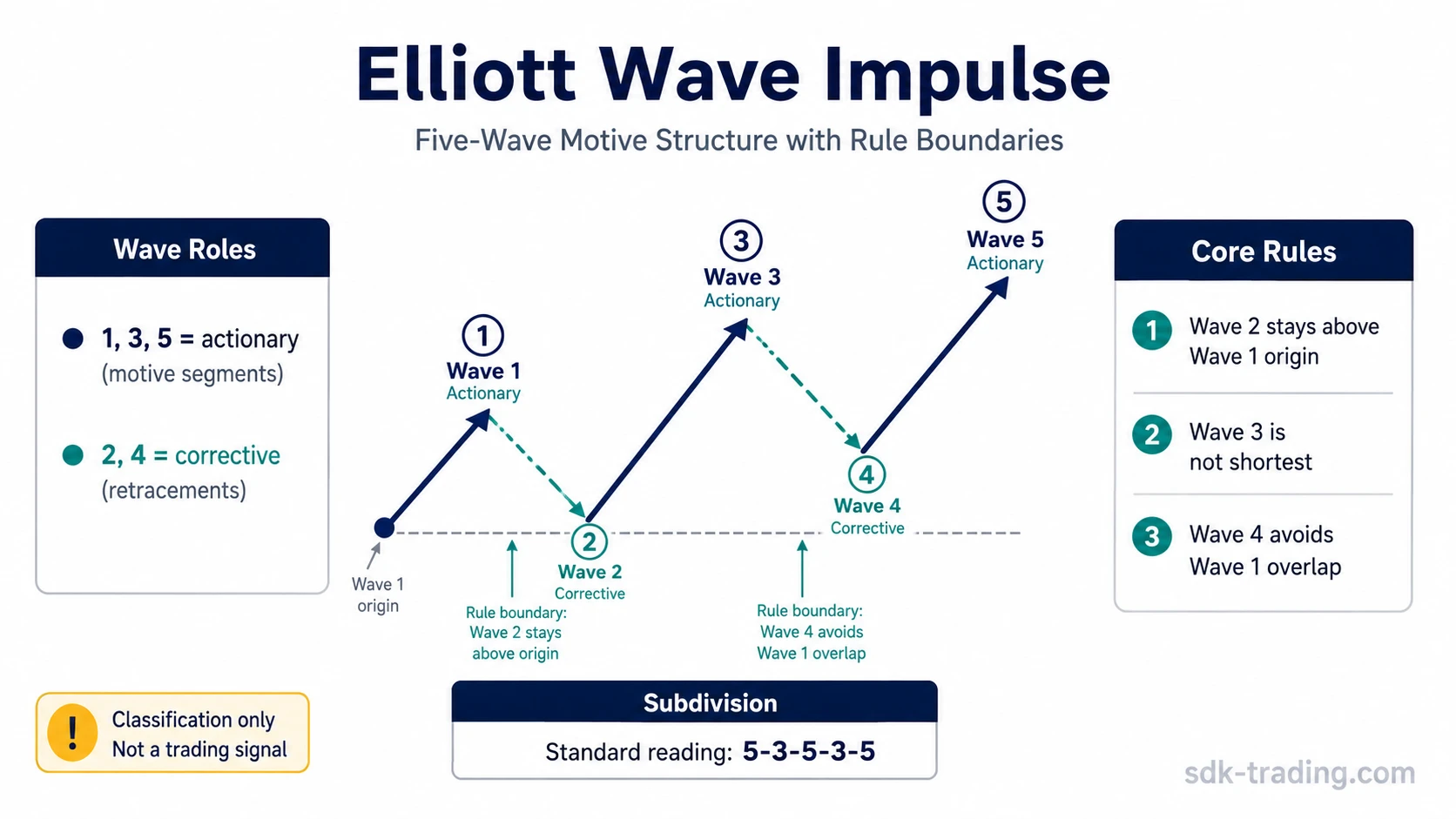
The wave roles matter because they stop the label from becoming a generic trend description. If every segment is treated as directional movement, the count loses the corrective pauses that define the structure.
Core Elliott Wave Impulse Rules
The standard impulse count is checked against three core rules. These rules do not make the count predictive, but they help reject structures that do not qualify as a normal impulse.
- Wave 2 cannot retrace beyond the origin of Wave 1. If the proposed Wave 2 fully breaks the start of Wave 1, the impulse count is invalid.
- Wave 3 cannot be the shortest of Waves 1, 3, and 5. Wave 3 does not always have to be the longest, but it cannot be the smallest actionary wave among the three.
- Wave 4 should not overlap Wave 1 territory in a standard impulse. Meaningful overlap usually forces a review of the count, unless a specific diagonal structure is being analyzed separately.
Rule boundary: Rule compliance is necessary, but it is not enough by itself. A count can obey the three basic rules and still be weak if subdivision, proportion, context, or alternate corrective structures do not support the reading.
Internal Subdivision: 5-3-5-3-5
A standard Elliott Wave impulse normally subdivides as 5-3-5-3-5. That means Waves 1, 3, and 5 each subdivide into smaller motive structures, while Waves 2 and 4 subdivide into corrective structures.
| Segment | Expected subdivision | Why it matters |
|---|---|---|
| Wave 1 | 5 waves | Supports the idea that the first segment is motive, not merely corrective noise. |
| Wave 2 | 3 waves | Shows retracement behavior rather than a new motive sequence against Wave 1. |
| Wave 3 | 5 waves | Reinforces the motive character of the central actionary segment. |
| Wave 4 | 3 waves | Maintains the corrective pause before the final actionary wave. |
| Wave 5 | 5 waves | Completes the motive sequence without requiring a prediction about what follows. |
Subdivision is often where weak impulse counts fail. A move may look like five visible swings at one scale, but the internal structure can still point to a correction, diagonal, or alternate count.
Impulse Diagnostic Boundary
A compact diagnostic test is safer than relying on visual force or directional confidence. Each condition narrows the count before the impulse label is accepted.
| Criterion | Required reading | Misread to avoid |
|---|---|---|
| Five-wave form | The proposed structure can be labeled 1-2-3-4-5. | Calling any large move an impulse because it traveled far. |
| Wave roles | Waves 1, 3, and 5 move the structure forward; Waves 2 and 4 retrace. | Ignoring corrective waves and treating every swing as trend confirmation. |
| Rule compliance | Wave 2, Wave 3, and Wave 4 behavior remains inside standard impulse rules. | Keeping an attractive count after an invalidating rule break. |
| Internal subdivision | The structure supports a 5-3-5-3-5 reading. | Counting only the outer swings while ignoring smaller-degree structure. |
| Correction contrast | Corrective alternatives are checked before the impulse label is accepted. | Assuming the first plausible five-wave label is the best count. |
Elliott Wave Impulse vs Correction
An impulse is motive. It moves in the larger-degree direction and is normally counted as 1-2-3-4-5. An Elliott Wave correction moves against or pauses the larger-degree movement and usually uses corrective structures such as A-B-C forms.
The distinction is not based only on direction. A correction can be sharp and directional, while an impulse can contain deep retracements. The cleaner question is whether the structure satisfies motive rules, subdivision, and wave-role behavior.
Useful distinction: Impulse labels classify motive structure. Correction labels classify retracement, pause, or counter-move structure. Neither label is a complete trading plan by itself.
False Impulse Readings
False impulse readings usually come from forcing a directional story onto incomplete structure. The most common mistake is treating movement strength as proof that the count is motive.
| False reading | Why it fails | Safer classification habit |
|---|---|---|
| Calling a strong move an impulse immediately | Size does not prove 5-3-5-3-5 subdivision. | Check internal structure before accepting the label. |
| Ignoring Wave 2 invalidation | A full retracement beyond Wave 1 origin breaks the proposed impulse. | Treat the level as a structural boundary, not a flexible preference. |
| Keeping a short Wave 3 count | Wave 3 cannot be the shortest among Waves 1, 3, and 5. | Compare the three actionary waves before finalizing the count. |
| Explaining away Wave 4 overlap | Overlap can invalidate a standard impulse reading. | Review whether a diagonal or corrective alternative fits better. |
| Skipping alternate counts | One visible five-part swing can still belong to a larger correction. | Compare the impulse reading against nearby corrective structures. |
Practical Classification Scenario
Example: A market advances in several visible swings, pauses twice, and then pushes to a new high. The movement may look like an impulse at first. The impulse reading becomes stronger only when the advancing waves subdivide as motive segments, the pauses behave as corrective waves, Wave 2 stays above the origin of Wave 1, Wave 3 is not the shortest actionary wave, and Wave 4 avoids standard impulse overlap with Wave 1 territory.
If one of those checks fails, the safer reading is not to force the impulse label. The movement may still be directional, but the Elliott Wave classification remains unresolved until a cleaner count appears.
Extensions, Truncation, and Related Impulse Concepts
Some impulse structures contain an Elliott Wave extension, where Wave 1, Wave 3, or Wave 5 becomes longer or more visibly subdivided than the surrounding actionary waves. Extension does not remove the need for the standard impulse checks.
A truncation can occur when the fifth wave fails to move beyond the end of the third wave. That condition belongs to a more specific count review and should not be used to excuse a weak structure without broader confirmation.
Impulse waves also sit inside the wider family of Elliott Wave patterns. The broader Elliott Wave explained framework gives the surrounding theory, but the impulse count itself remains a specific five-wave motive classification.
Limitations of Elliott Wave Impulse Counts
Impulse counts are useful for organizing structure, but they are not mechanically objective. Different analysts may label the same movement differently, especially before the full structure is visible.
Limitations: Elliott Wave impulse analysis can be affected by subjectivity, hindsight bias, changing degree labels, incomplete data, and alternate corrective counts. Fibonacci proportions may help compare wave relationships, but they are guidelines rather than rules.
The safest use of an impulse label is diagnostic. It can describe whether a movement fits a motive structure, but it does not guarantee continuation, timing, target distance, or trade quality.
FAQ
What is an Elliott Wave impulse?
An Elliott Wave impulse is a five-wave motive structure labeled 1-2-3-4-5. Waves 1, 3, and 5 move the structure forward, while Waves 2 and 4 retrace part of that movement.
Is every strong price move an impulse wave?
No. A strong price move is not automatically an impulse. The structure must satisfy wave-role behavior, core impulse rules, and the expected 5-3-5-3-5 subdivision.
What invalidates a standard Elliott Wave impulse count?
A standard impulse count is invalid if Wave 2 retraces beyond the origin of Wave 1, if Wave 3 is the shortest of Waves 1, 3, and 5, or if Wave 4 overlaps Wave 1 territory in a normal impulse structure.
Does an impulse wave create a trading signal?
No. An impulse wave is a structure classification. It does not create a standalone entry, exit, target, probability, or trading recommendation.