Elliott Wave limitations come from subjective wave counts, alternate interpretations, uncertain timing, and the difference between a count that is merely weak and one that has become structurally invalid. The method can organize price into conditional scenarios, but it cannot prove that the market has only one valid path.
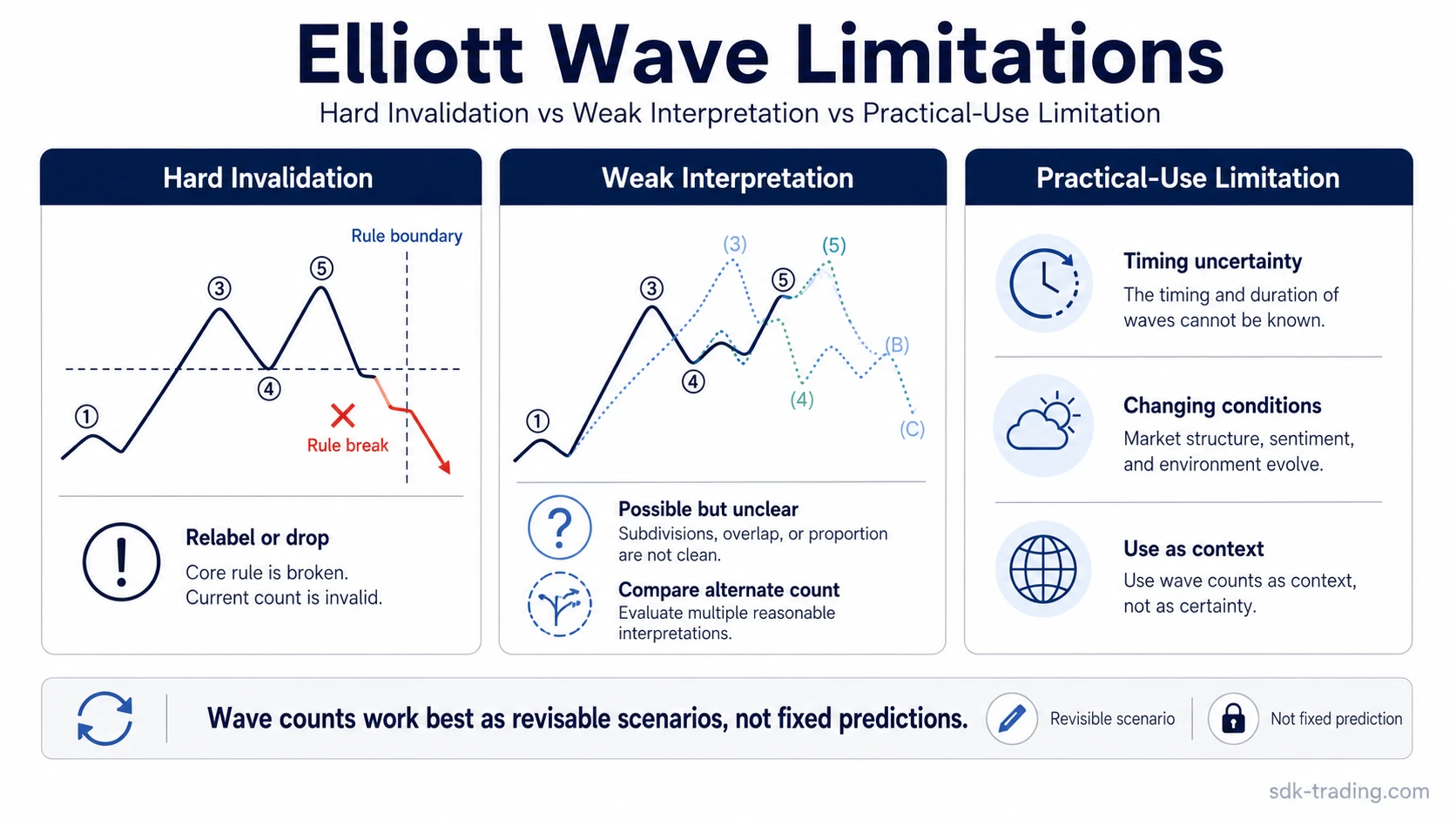
The key discipline is to keep the count conditional. A technically possible interpretation can lose quality before it becomes invalid, while a direct rule break requires the count to be changed rather than defended.
Key Points
- Elliott Wave counts can remain subjective while a structure is still developing.
- A hard invalidation is different from a count that is technically possible but increasingly weak.
- Wave degree, subdivision, overlap, and corrective complexity can support more than one reasonable interpretation.
- Fibonacci relationships can help compare proportions but do not prove that a count is correct.
- A preferred count should be revised when the structural condition it depends on no longer holds.
- Elliott Wave works best as a scenario framework, not as a fixed prediction or standalone trading signal.
See an Elliott Wave Count Fail on a Real Chart
This TLT example shows the difference between a deep correction that still fits a working hypothesis and a structural break that forces the interpretation to change.
In the example, the original wave interpretation remains possible while its critical structural level holds. Once price crosses the level required by that count, keeping the old labels would mean defending the hypothesis instead of responding to new price evidence.
Three Types of Elliott Wave Limitations
Not every problem with a wave count has the same consequence. Separating the type of limitation helps determine whether the count should be dropped, downgraded, or simply treated with more caution.
| Limitation | What It Means | Appropriate Response |
|---|---|---|
| Hard invalidation | The proposed count violates a structural condition or rule required by the interpretation. | Drop or rebuild the count rather than forcing the existing labels to remain. |
| Weak interpretation | The count remains possible, but subdivision, proportion, overlap, degree, or competing alternatives make it less convincing. | Reduce confidence and compare the preferred count with cleaner alternatives. |
| Practical-use limitation | The structure may remain coherent, but timing, volatility, changing market conditions, or incomplete price action limit its usefulness. | Use the count as context rather than as a precise timing or execution tool. |
Hard Invalidation vs a Weak Count
This distinction is central to Elliott Wave analysis. A weak count can remain technically possible. An invalid count no longer satisfies a condition required by the proposed structure.
| Question | Weak Interpretation | Hard Invalidation |
|---|---|---|
| Has a required structural rule been broken? | No. | Yes. |
| Can the current label remain possible? | Yes, but with lower confidence. | No, not in its current form. |
| Typical problem | Unclear subdivision, poor proportion, unexpected overlap, or a strong alternate count. | Price crosses a boundary or creates a relationship that the proposed count requires not to occur. |
| Best response | Compare alternatives and downgrade confidence. | Relabel or rebuild the structure. |
Important distinction: A count can become less convincing before it becomes invalid. Low confidence and structural invalidation are not the same state.
Why Elliott Wave Counts Can Be Subjective
Subjectivity usually enters through several decisions: where the count begins, which swings belong to the same degree, how the internal subdivisions are classified, and whether an incomplete movement is motive or corrective.
Corrective structures create additional ambiguity because overlapping price action can support several interpretations while the correction is still developing. An Elliott Wave flat and an Elliott Wave triangle can both keep the larger count unresolved for longer than a clean directional impulse.
Subjectivity does not mean that every count is equally useful. A stronger interpretation still needs coherent subdivision, degree consistency, rule compliance, and fewer forced assumptions than the competing alternatives.
When Should an Elliott Wave Count Be Revised?
A count should change because the evidence changes, not simply because price moves against the preferred expectation.
- Identify what the current count requires. Define the structural relationship or boundary that must remain intact.
- Separate discomfort from invalidation. A deep retracement or slow wave can look wrong without necessarily breaking the count.
- Check subdivision and degree. New price action may reveal that a move previously treated as complete is still developing or belongs to another degree.
- Compare the alternate count. If another interpretation now explains the same movement with fewer conflicts, the preferred count should lose confidence even before a hard rule break.
- Drop the old count when its required condition fails. Once the structure becomes incompatible with the hypothesis, keeping the old labels no longer improves the analysis.
Timing and Hindsight Limitations
Elliott Wave structures often look cleaner after they are complete than they did while they were forming. Real-time analysis has to deal with unfinished subdivisions, overlapping swings, extensions, alternate counts, and waves whose final length is still unknown.
A count may identify a possible stage of a larger structure without determining exactly when the next segment will begin or how long it will last. This is one reason structural classification and market timing should remain separate questions.
The broader Elliott Wave patterns framework is useful for classifying motive and corrective structures, but the pattern label remains conditional while the sequence is incomplete.
Why Fibonacci Ratios Do Not Confirm a Count
Fibonacci relationships can help evaluate whether wave lengths and retracements are proportionally plausible. They can support a structural hypothesis or identify an area where a wave relationship is worth watching.
They cannot make an otherwise weak count correct. Price reaching a Fibonacci ratio does not repair inconsistent degree labels, unclear subdivisions, a broken structural rule, or a cleaner alternate interpretation.
The useful order is structure first, proportion second. Fibonacci relationships can refine a count that already makes structural sense, but they should not be used as proof that one preferred scenario must occur.
How Elliott Wave Remains Useful Without False Precision
| Useful Application | Avoid Using It For |
|---|---|
| Organizing price into motive and corrective scenarios | Claiming certainty about the next price path |
| Defining what would weaken or invalidate a count | Defending the preferred count after its structural condition fails |
| Comparing a primary count with alternate interpretations | Assuming only one valid interpretation can exist in real time |
| Evaluating wave proportion and structural maturity | Using Fibonacci ratios as proof of the count |
| Providing context for broader technical analysis | Mechanical entries, exits, targets, or guaranteed reversal timing |
Common Elliott Wave Analysis Mistakes
| Common Mistake | Why It Weakens the Analysis | Better Check |
|---|---|---|
| Treating one preferred count as confirmed | Incomplete structures can support more than one interpretation. | Keep at least one reasonable alternate while the structure remains unresolved. |
| Changing the count after every small move | Normal price variation becomes confused with structural invalidation. | Define the condition that would materially change the count before price reaches it. |
| Refusing to change an invalid count | The labels begin defending a market opinion instead of describing price structure. | Relabel once the required structural condition has failed. |
| Ignoring wave degree | A locally correct count can conflict with the scale of the larger structure. | Check whether the labels remain consistent with the surrounding count. |
| Using Fibonacci levels as confirmation | Proportion alone cannot validate a structurally weak count. | Check subdivision, degree, and rule compliance first. |
| Calling every failed fifth-wave expectation a truncation | A short or weak fifth wave does not automatically meet truncation requirements. | Use the specific Elliott Wave truncation criteria before applying the label. |
| Using the count as a standalone trading signal | A structural label does not determine entry, risk, timing, or outcome by itself. | Keep Elliott Wave inside a broader evidence and risk framework. |
The Practical Boundary of Elliott Wave Analysis
Elliott Wave is most useful when it makes uncertainty explicit. A good count identifies the structure currently supported by price, keeps reasonable alternatives available, and defines what would cause the interpretation to weaken or fail.
Its limitation is the same feature that makes scenario analysis necessary: the future structure is incomplete. Wave labels can organize the evidence available now, but they cannot remove uncertainty about how the next segment will develop.