An Elliott Wave triangle is a corrective A-B-C-D-E structure where overlapping corrective legs compress between boundary lines before the count is complete.
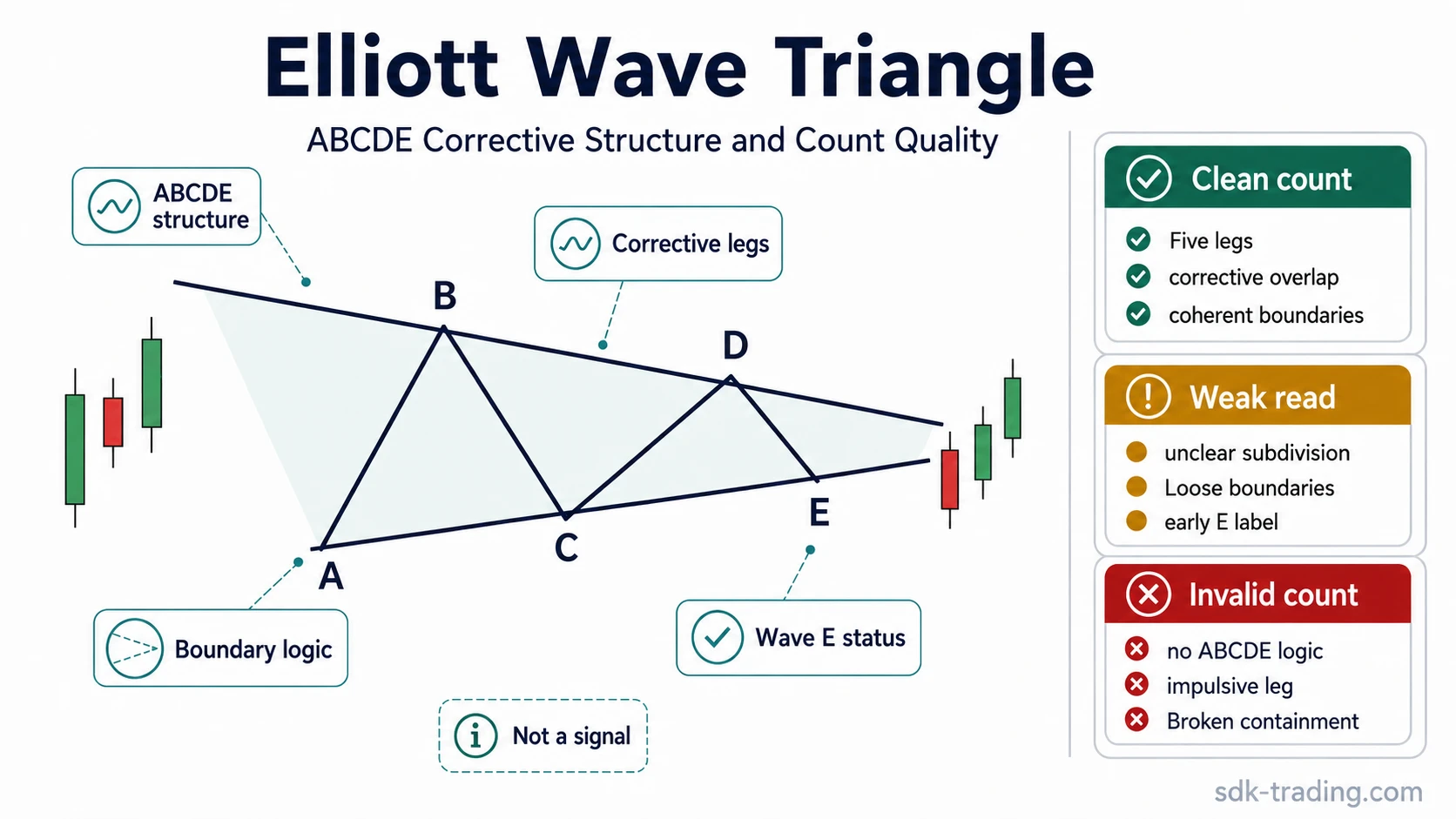
In Elliott Wave analysis, a triangle belongs to the corrective family rather than the motive family. Its role is structural: it organizes sideways or narrowing price action into five corrective swings, labeled A, B, C, D, and E. The count is not complete simply because price moves sideways. The structure needs leg sequence, corrective subdivision, overlap, boundary behavior, and a defensible wave E.
Definition: An Elliott Wave triangle is a five-leg corrective pattern in which A, B, C, D, and E each behave as corrective swings, commonly described as a 3-3-3-3-3 structure, while price action develops between recognizable boundary lines.
Key Points
- An Elliott Wave triangle is a corrective pattern, not an impulse wave.
- The structure uses five labeled swings: A, B, C, D, and E.
- The legs are normally corrective, often summarized as 3-3-3-3-3 subdivision.
- Boundary quality matters because the count depends on compression, barrier behavior, or expansion logic.
- A triangle count can be clean, weak, or invalid depending on leg structure, boundary behavior, and wave E status.
How an Elliott Wave Triangle Forms
An Elliott Wave triangle forms when a correction develops through repeated overlap instead of a direct impulse-style advance or decline. Each leg moves against or across the prior leg enough to create a sideways structure, while the full pattern remains organized around five corrective segments.
The boundary lines usually connect alternating swing points, often A-C and B-D in a simplified structure. In a contracting triangle, those lines narrow toward an apex. In a barrier triangle, one side may remain almost horizontal while the other side compresses toward it. In an expanding triangle, the swings widen instead of narrowing, which usually makes the count harder to defend.
The triangle is part of the broader Elliott Wave correction family because its internal logic is corrective. It should not be treated as an impulse unless the internal legs and boundary behavior stop supporting the corrective count.
Observable Signals in an Elliott Wave Triangle
The strongest triangle readings come from observable structure rather than from a label placed on unfinished price action. The count should be tested against leg count, subdivision, overlap, boundary quality, and wave E behavior.
| Observable | What to check | Why it matters |
|---|---|---|
| Leg count | A, B, C, D, and E can be identified without forcing extra swings into the count. | The triangle identity depends on five corrective legs, not only sideways movement. |
| Subdivision | Each leg behaves more like a correction than a clear five-wave impulse. | A dominant impulsive leg can weaken or break the triangle interpretation. |
| Boundary quality | Alternating swing points create coherent converging, barrier, or expanding boundaries. | Random overlap without boundary logic is not enough for a strong triangle count. |
| Compression or containment | Price action remains organized between the boundary lines until wave E is assessed. | Containment behavior separates a developing triangle from a loose corrective drift. |
| Wave E status | Wave E is present, defensible, and not assumed too early. | Premature wave E labeling is one of the main causes of weak triangle counts. |
Elliott Wave Triangle Types
Triangle labels describe the boundary behavior of the corrective structure. The type does not create a trade instruction. It only clarifies how the A-B-C-D-E legs are being organized.
| Triangle type | Boundary behavior | Diagnostic note |
|---|---|---|
| Contracting triangle | Both boundary lines move toward each other. | Often the cleanest form when the legs are corrective and the compression is visible. |
| Barrier triangle | One boundary is relatively flat while the other side compresses toward it. | The flat boundary should still behave as a meaningful containment area. |
| Expanding triangle | Successive swings widen instead of narrowing. | Usually harder to validate because widening swings can blur the corrective structure. |
| Running triangle | The structure remains corrective while one side shows unusual displacement. | The count needs extra caution because the shape can be confused with other corrections. |
Clean, Weak, and Invalid Triangle Counts
A triangle label should remain conditional until the structure supports it. The practical distinction is not only whether a triangle is present, but whether the count is clean, weak, or invalid.
| Classification | What it means | Typical evidence |
|---|---|---|
| Clean triangle count | The A-B-C-D-E structure is coherent and the legs behave as corrective swings. | Five legs, visible overlap, defensible boundary lines, and a wave E that fits the structure. |
| Weak triangle read | The idea is possible, but the evidence is not strong enough to treat the label as stable. | Unclear subdivision, premature E labeling, loose boundaries, or uneven compression. |
| Invalid triangle count | The structure no longer supports triangle logic. | No defensible ABCDE sequence, an impulsive leg dominates, or the boundary logic breaks down. |
Boundary: A changing corrective path is not always the same as a failed broader correction. A developing triangle can weaken and shift toward a flat or zigzag interpretation. The triangle count fails when its ABCDE sequence, corrective subdivision, or containment framework no longer holds.
Wave E and False Break Risk
Wave E is the final leg of the triangle count, but it is also one of the easiest places to mislabel the structure. A shallow E can undershoot the boundary, while a sharp E can briefly overshoot it. Either behavior requires context from the full A-B-C-D-E structure.
An overshoot does not automatically validate or invalidate the pattern by itself. The more important question is whether the move still fits the triangle’s corrective sequence or whether the count should shift toward another corrective interpretation.
Clarification: Wave E should be read as a structural completion question, not as a breakout instruction. A triangle count remains diagnostic until later price behavior clarifies whether the structure was accepted, revised, or invalidated.
Elliott Wave Triangle vs Nearby Structures
Triangles often sit near other Elliott Wave structures in the same corrective family. A precise label matters because a triangle, flat, zigzag, impulse, and extension do not describe the same internal behavior.
| Nearby structure | Main difference from an Elliott Wave triangle | Common confusion |
|---|---|---|
| Flat correction | A flat correction is not organized as a five-leg ABCDE triangle. | Sideways movement can look triangular before the full corrective path is clear. |
| Zigzag correction | A zigzag is more directional and does not rely on five overlapping triangle legs. | A sharp corrective leg can make an unfinished triangle idea look like a different correction. |
| Impulse | An impulse is motive structure, while a triangle is corrective structure. | A strong internal leg can make the triangle count weak if it behaves impulsively. |
| Extension | An extension expands part of a wave sequence rather than defining boundary compression. | Extended wave structures can create visual complexity, but they do not replace triangle boundary logic. |
Broader Elliott Wave patterns organize motive and corrective structures into separate families. The broader Elliott Wave framework gives the larger rule context, while the triangle count stays focused on one corrective formation.
Elliott Wave Triangle Example in Context
Price moves sideways after a larger directional swing and begins forming overlapping corrective legs. The first three swings can be labeled A, B, and C, but the structure remains incomplete because D and E are not yet defensible. Calling the pattern complete at that stage would rely on expectation rather than structure.
The triangle case becomes cleaner if price later forms a D leg that respects the opposite boundary and an E leg that completes the corrective sequence without breaking the overall boundary framework. The read remains weak if the final legs are unclear, if the boundaries need constant redrawing, or if one leg behaves like a dominant impulse rather than a corrective swing.
Scenario: A sideways correction compresses between two visible boundaries, but wave E is still developing. The safer reading is to treat the triangle as provisional until the A-B-C-D-E structure, corrective subdivision, and containment behavior remain coherent together.
Common Mistakes and Limitations
Triangle analysis is most useful when it separates structure from expectation. The label becomes risky when it is applied before the evidence is visible.
| Mistake | Safer interpretation |
|---|---|
| Calling any sideways compression a triangle | Compression starts the question, but a triangle still needs A-B-C-D-E structure and corrective legs. |
| Labeling wave E too early | Wave E should be defensible inside the full structure, not assumed because the pattern looks nearly complete. |
| Assuming a later thrust or breakout | The count describes structure. It does not guarantee a later market outcome. |
| Ignoring a changed corrective path | A triangle idea can weaken into another correction before the broader corrective phase is invalidated. |
| Using a triangle label to ignore invalidation | If ABCDE logic, corrective subdivision, or boundary behavior fails, the triangle count should be revised or rejected. |
Limitation: Elliott Wave triangles are interpretive structures. They can organize corrective movement, but they do not remove uncertainty, create a trade signal, or prove what price must do next.
FAQ
How many waves are in an Elliott Wave triangle?
An Elliott Wave triangle has five corrective legs labeled A, B, C, D, and E. Each leg is normally corrective, which is why the structure is often summarized as 3-3-3-3-3.
Where does an Elliott Wave triangle usually appear?
An Elliott Wave triangle appears as a corrective structure where the broader Elliott Wave count allows sideways correction, commonly in wave 4, wave B, or final X positions. The exact placement still depends on the surrounding count.
Can wave E overshoot a triangle boundary?
Wave E can sometimes undershoot or overshoot a boundary. The overshoot matters only in relation to the full ABCDE structure, corrective subdivision, and boundary logic.
When is an Elliott Wave triangle count invalid?
A triangle count is invalid when the structure no longer supports ABCDE logic, the legs stop behaving as corrective swings, or the boundary framework no longer organizes the movement.