Elliott Wave truncation, also called a truncated fifth wave, occurs when a completed wave 5 fails to move beyond the same-degree wave 3 extreme. A short or weak fifth wave alone is not enough: the surrounding count, wave degree, internal structure, and later price behavior must still support completion.
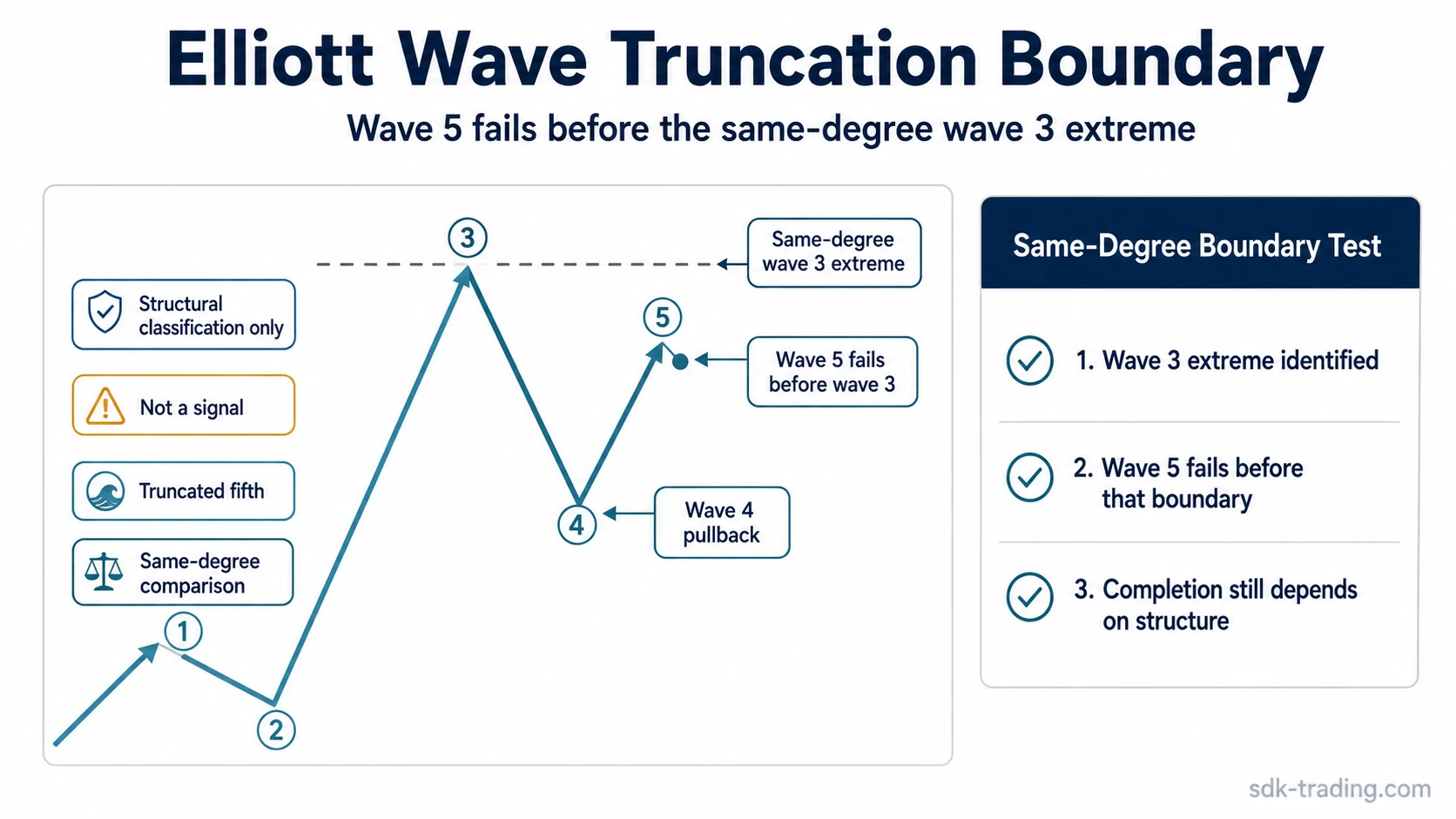
Truncation is therefore a completed-wave classification, not simply a description of weak momentum. In an upward motive sequence, wave 5 ends below the wave 3 high. In a downward motive sequence, wave 5 ends above the wave 3 low.
Key Points
- Wave 5 must fail against the wave 3 extreme of the same Elliott Wave degree.
- A weak, short, or hesitant fifth wave is not automatically a truncation.
- The proposed wave 5 still needs a defensible completed internal structure.
- The preceding motive count must remain coherent under Elliott Wave rules.
- An apparent truncation can remain unresolved in real time if wave 5 may still extend.
- Truncation classifies structure; it does not guarantee an immediate reversal or future price target.
See a Weak Fifth Wave on a Real Chart
This Vital Farms example shows an important distinction: a fifth wave can look weak or short without qualifying as a completed Elliott Wave truncation. The question is whether the move has actually completed before the same-degree wave 3 extreme or is still developing.
The example is useful precisely because the first visual impression is not enough. A weak fifth-wave move should remain provisional until its internal structure and later price behavior support a completed count.
What Must Be True for Elliott Wave Truncation?
The failed wave 5 endpoint is only one part of the classification. A defensible truncation combines the correct boundary with a coherent motive count and enough evidence that the fifth wave has actually ended.
| Criterion | Supports Truncation | Weakens the Reading |
|---|---|---|
| Wave 3 boundary | Wave 5 fails to exceed the wave 3 extreme of the same degree. | The comparison is made with an unrelated swing, wick, or resistance area. |
| Prior motive count | Waves 1 through 4 remain coherent and the proposed sequence still fits a motive structure. | The earlier count already requires forced relabeling or violates the intended structure. |
| Wave 5 internal form | The fifth wave contains enough internal structure to support completion. | The proposed fifth wave remains too incomplete or ambiguous to call finished. |
| Wave degree | Wave 3 and wave 5 are being compared at the same degree. | A smaller-degree subdivision is compared with a larger-degree wave endpoint. |
| Later behavior | Subsequent movement remains consistent with the motive sequence having ended. | Price continues building or extending the proposed fifth wave. |
Why a Weak Fifth Wave Is Not Automatically Truncation
Wave 5 can be shorter, slower, more overlapping, or less forceful than wave 3 and still continue later. Weakness describes how the wave looks; truncation makes the stronger claim that the fifth wave has completed without exceeding the same-degree third-wave extreme.
This distinction matters most in real time. A failed push can pause below wave 3, subdivide again, and later extend beyond the apparent endpoint. Labeling that first hesitation as truncation converts an unresolved count into a completed count too early.
Structure-first rule: Shortness starts the truncation question. Completion, wave degree, and the wave 3 boundary decide whether the label is defensible.
Truncation vs Incomplete Fifth Wave
This is the main diagnostic distinction on the page. Both structures can initially show wave 5 failing to move beyond wave 3, but they imply different states of the count.
| Question | Completed Truncation | Incomplete Fifth Wave |
|---|---|---|
| Has wave 5 exceeded wave 3? | No. | Not yet, but the fifth wave may still extend. |
| Is wave 5 structurally complete? | The internal form supports a completed fifth wave. | The internal structure remains unfinished or ambiguous. |
| How should the failed endpoint be treated? | As part of a conditional completed-fifth classification. | As a provisional endpoint inside an active wave 5. |
| What can later price action do? | Support the idea that the motive sequence ended at the failed fifth. | Extend the fifth wave and invalidate the earlier truncation assumption. |
| Real-time confidence | Higher only after completion evidence develops. | Remain unresolved until more internal structure appears. |
How to Identify a Truncated Fifth Wave
- Establish the larger motive count first. The proposed structure should already support waves 1 through 4 before wave 5 is classified.
- Confirm the relevant wave degree. The wave 3 and wave 5 endpoints must belong to the same degree. See Elliott Wave degrees for the degree framework.
- Mark the same-degree wave 3 extreme. This is the boundary wave 5 must fail to exceed for a truncation to remain possible.
- Examine wave 5 internally. A short swing is not enough. The internal form must reasonably support a finished fifth wave.
- Check the earlier count against the rules. A truncation should not be used to rescue an already weak motive count. The underlying Elliott Wave rules still apply.
- Keep the incomplete-fifth alternate open. If wave 5 can still subdivide or extend, the truncation label should remain provisional.
- Use later behavior as additional evidence. Subsequent price action can support completion or reopen the possibility that wave 5 was still developing.
Why Truncation Often Appears After a Strong Third Wave
Truncation is often discussed after a strong or extended wave 3 because much of the motive movement may already have occurred before the final fifth wave begins. That context can make a weaker final push structurally plausible.
It is still only context. A powerful wave 3 does not automatically cause truncation, and a weak wave 5 after an extended third wave still needs the same endpoint, degree, and completion checks.
The broader Elliott Wave impulse structure remains important because truncation is a special fifth-wave condition inside a motive count rather than a standalone chart formation.
Truncation in Impulses and Diagonals
| Structure | How Truncation Is Evaluated | Main Caution |
|---|---|---|
| Impulse | Wave 5 fails before the same-degree wave 3 extreme while the motive count still supports completion. | A failed push is not enough if wave 5 still appears internally incomplete. |
| Diagonal | A fifth-wave failure can be evaluated inside a valid diagonal structure using the same degree and completion logic. | Wedge shape by itself does not establish either a diagonal or a truncation. |
Common Elliott Wave Truncation Mistakes
| Common Mistake | Why It Fails | Better Check |
|---|---|---|
| Calling every short fifth wave a truncation | Wave length alone does not establish completion. | Check the same-degree boundary and internal wave 5 structure. |
| Using nearby resistance as the boundary | Truncation is defined against wave 3 at the same degree, not an arbitrary chart level. | Identify the correct wave 3 endpoint before evaluating wave 5. |
| Mixing wave degrees | A smaller-degree failed push can look truncated inside a larger unfinished fifth wave. | Keep the degree labels consistent across wave 3 and wave 5. |
| Calling truncation before wave 5 is complete | The market can pause and later continue the same fifth wave. | Keep an incomplete-fifth alternate until the internal form supports completion. |
| Using truncation to rescue a weak count | A failed endpoint cannot repair earlier rule or subdivision problems. | Validate the motive count before evaluating the final wave. |
| Treating truncation as an immediate reversal signal | The label classifies the completed wave structure but does not determine the next move. | Separate Elliott Wave classification from later price confirmation. |
Limitations of Elliott Wave Truncation
Truncation is difficult to classify in real time because wave completion itself can be uncertain. The same movement can initially look like a failed fifth and later become another subdivision inside an extended wave 5.
Wave degree introduces another source of judgment. A failed move that appears meaningful on one chart scale may belong to a smaller-degree structure when the larger count is reviewed.
The safest use of the truncation label is therefore diagnostic. It describes a specific fifth-wave failure condition when the broader structure supports completion; it does not create a guaranteed reversal, price target, or standalone trade signal.