Elliott Wave rules are strict count boundaries used to decide whether a proposed wave structure remains valid. In a standard impulse, Wave 2 cannot retrace beyond the start of Wave 1, Wave 3 cannot be the shortest of Waves 1, 3, and 5, and Wave 4 must not overlap Wave 1 territory in a standard non-diagonal impulse.
A rule break does not forecast what the market must do next. It means the current count no longer fits that rule set and should be questioned or relabeled. A guideline issue is different: it may weaken a count, but it does not automatically invalidate it.
Definition: Elliott Wave rules are the non-negotiable structural conditions that separate a valid wave count from a count that has broken its own classification logic.
Key Points
- Elliott Wave rules control count validity, not future price direction.
- The three cardinal impulse rules focus on Wave 2 retracement, Wave 3 length, and Wave 4 overlap.
- Rules are stricter than guidelines. Fibonacci relationships, alternation, and proportion are flexible context, not automatic invalidation.
- When a hard rule breaks, the preferred count should be relabeled instead of defended.
- Corrective structures can follow different rules, so impulse rules should not be applied mechanically to every A-B-C or triangle formation.
What Elliott Wave Rules Actually Control
Elliott Wave rules control the internal logic of a wave count. They help separate a possible structure from a structure that no longer fits the chosen label. That makes them classification rules, not trade rules.
A preferred count remains a scenario until price structure supports it. The count can become cleaner if the waves respect the required boundaries, but rule compliance still does not guarantee continuation, reversal, or timing. It only keeps that interpretation structurally possible.
Rule, guideline, and preferred count: A rule defines a hard boundary. A guideline describes a common tendency. A preferred count is the current interpretation, and it can change when the structure no longer supports it.
The Three Cardinal Elliott Wave Rules
The most widely used Elliott Wave rules apply to standard impulse counts. They help decide whether a five-wave motive structure can still be treated as a valid impulse.
| Rule | Applies to | What invalidates the count | Common misread |
|---|---|---|---|
| Wave 2 cannot retrace beyond the origin of Wave 1. | Standard impulse structure. | Wave 2 moves past the starting point of Wave 1. | Keeping the impulse label after the supposed second wave has already erased the first wave. |
| Wave 3 cannot be the shortest of Waves 1, 3, and 5. | The three actionary waves inside an impulse. | Wave 3 is shorter than both Wave 1 and Wave 5. | Calling a weak middle leg Wave 3 simply because it sits in the middle of the count. |
| Wave 4 must not overlap Wave 1 territory in a standard non-diagonal impulse. | Standard non-diagonal impulse counts. | Wave 4 enters Wave 1 territory while the structure is still being labeled as a standard non-diagonal impulse. | Treating every overlap as harmless without checking whether a different structure is more appropriate. |
Boundary: These rules describe count validity. They do not turn a valid count into a trading signal, and they do not remove the need to consider structure, context, and alternative labels.
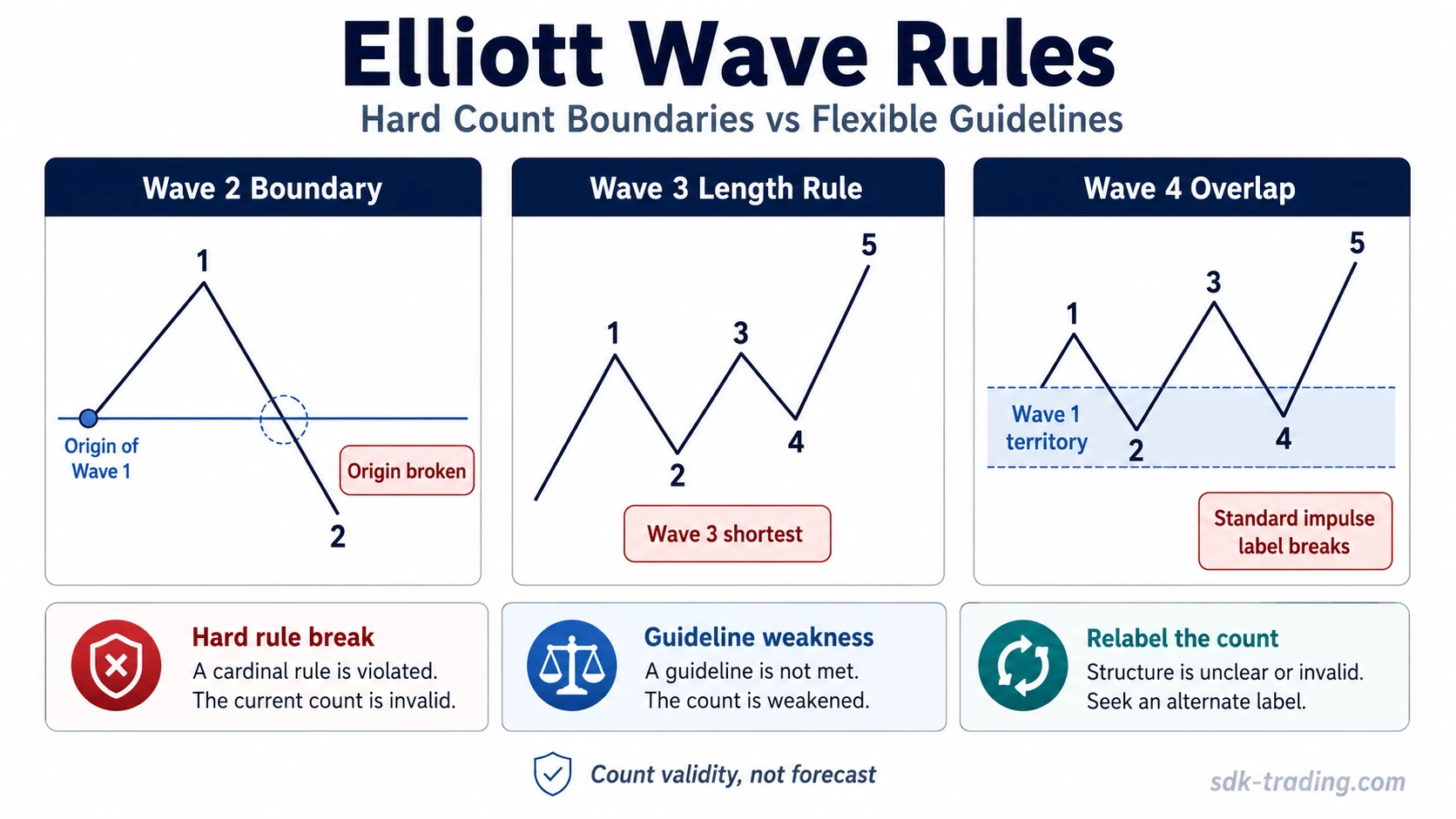
Elliott Wave Rules vs Guidelines
Rules are hard boundaries. Guidelines are flexible tendencies that may help assess count quality but do not always decide validity by themselves.
Fibonacci relationships, alternation between corrective waves, channel behavior, proportion, and wave personality are usually treated as guideline context. They can make a count look cleaner or weaker, but they should not be confused with the three cardinal impulse rules.
| Item | How to treat it | Safer interpretation |
|---|---|---|
| Wave 2 retraces beyond Wave 1 origin | Hard rule break | The impulse count should be relabeled. |
| Wave 3 is not the longest | Not automatically invalid | Wave 3 may be valid if it is not the shortest among Waves 1, 3, and 5. |
| Fibonacci ratio is not clean | Guideline issue | The count may weaken, but the rule set has not necessarily broken. |
| Alternation between Wave 2 and Wave 4 is unclear | Guideline issue | The count may need caution, but unclear alternation is not the same as hard invalidation. |
What Happens When an Elliott Wave Rule Breaks
When a hard rule breaks, the cleaner response is relabeling. The broader market idea may still be possible under another structure, but the broken count should not be forced into the same impulse label.
A weak interpretation and an invalid interpretation are different states. A weak count may need more comparison, restraint, or structural evidence. A count that breaks a cardinal rule has crossed a boundary that the label itself cannot absorb.
Hard invalidation vs weak interpretation: A hard invalidation breaks the count’s required structure. A weak interpretation remains possible but less convincing because proportions, alternation, momentum, or surrounding structure do not support it cleanly.
Relabeling also protects the analysis from confirmation bias. Instead of defending a preferred label, the structure can be reassessed as a different impulse, a corrective move, a diagonal-like structure, or a broader pattern still in development.
Common Elliott Wave Rule Mistakes
Most rule mistakes come from treating a preferred count as fixed before the structure has earned that label. The problem is usually not the existence of alternatives; it is the refusal to relabel when the evidence changes.
| Mistake | Why it creates risk | Safer interpretation |
|---|---|---|
| Forcing a preferred impulse count | The same label remains in use even after a rule boundary is broken. | Treat the count as invalid and compare alternate structures. |
| Treating every guideline issue as invalidation | A count may be discarded too early because a flexible tendency is treated like a hard rule. | Separate hard rules from guideline weakness before relabeling. |
| Calling an early count confirmed | The wave structure may still be incomplete or open to several labels. | Keep the count as a scenario until later structure supports it. |
| Applying impulse rules to every corrective structure | Corrections can follow different forms, so impulse boundaries may not answer the whole question. | Check the structure type before applying the rule set. |
Failure-Mode Example
Example: A chart begins to show a possible five-wave advance: the first leg holds as Wave 1, but the next pullback trades through the origin area instead of holding above it. At that point, the proposed impulse count has broken a hard rule. The broader market structure may still develop into another valid pattern, but the original impulse label no longer fits.
A different failure can appear around the fourth wave. If a structure is labeled as a standard impulse and the supposed Wave 4 overlaps Wave 1 territory, the count needs another check: the label may be wrong, the structure may be diagonal-like, or the move may be corrective rather than a standard impulse.
The diagnostic point is not whether the market later moves higher or lower. The point is whether the chosen count still follows its own rule set.
How Rules Connect to Elliott Wave Pattern Structure
Elliott Wave rules work best when the structure type is identified first. Elliott Wave patterns organize the larger family of motive and corrective structures, while the rule set helps test whether a specific label remains valid.
Corrective structures require extra care because they do not always follow impulse rules in the same way. An Elliott Wave flat can involve a three-wave A, a three-wave B, and a five-wave C, so the analysis must first separate correction structure from impulse structure.
An Elliott Wave triangle is another corrective structure where the internal sequence and boundary logic differ from a standard five-wave impulse. Applying impulse rules mechanically can create false invalidation.
Fifth-wave nuance also matters. Elliott Wave truncation can affect how a final wave is interpreted when the expected extension or new extreme does not appear cleanly. That does not remove the need for rule discipline; it only shows why the exact structure label matters before conclusions are drawn.
FAQ
Are Elliott Wave rules the same as guidelines?
No. Elliott Wave rules are hard structural boundaries for a valid count. Guidelines are flexible tendencies that may improve or weaken interpretation but do not automatically invalidate a count.
What happens if Wave 3 is the shortest wave?
If Wave 3 is shorter than both Wave 1 and Wave 5, the standard impulse count is invalid. The structure should be relabeled instead of forced into the same impulse interpretation.
Does Wave 4 always invalidate a count if it overlaps Wave 1?
In a standard non-diagonal impulse, Wave 4 overlap with Wave 1 territory invalidates that impulse label. The next step is to check whether the structure is mislabeled, diagonal-like, corrective, or part of a different pattern.
Do corrective patterns follow the same rules as impulses?
No. Corrective structures can have different internal rules and subdivisions. Impulse rules should be applied only after the structure is being tested as an impulse.