Counting Elliott waves means building a provisional map of price structure from a defensible starting point, then checking whether the movement behaves as motive or corrective, how it subdivides, what wave degree it belongs to, and what would invalidate or weaken the count. The goal is not to label every swing. The goal is to find the simplest structure that fits the visible price movement without forcing it.
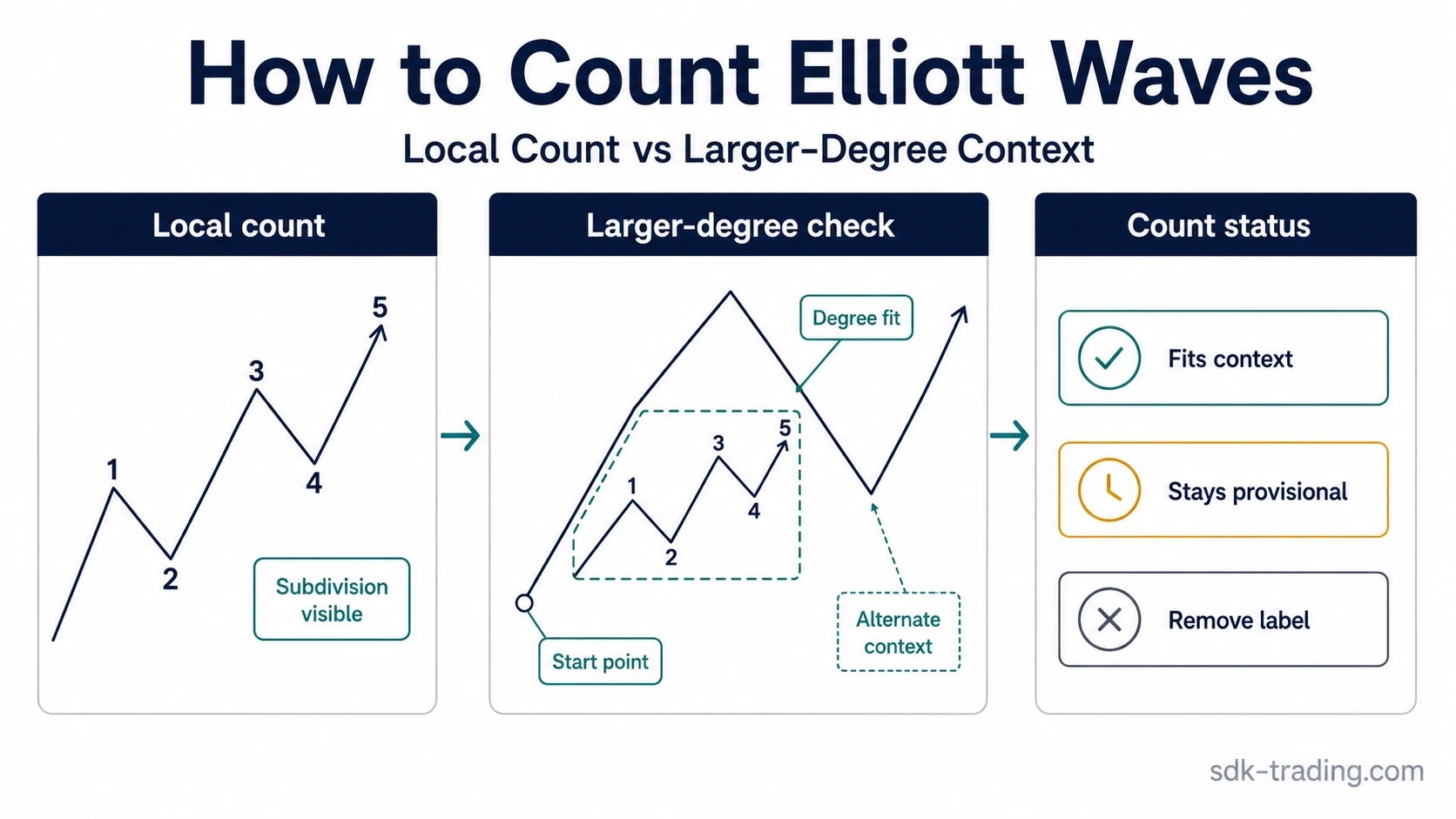
A clean-looking 1-2-3-4-5 sequence can still be misleading if it begins from the wrong place or belongs to only one smaller part of a larger correction. Counting therefore works from larger structure toward smaller labels, not from isolated swings toward a preferred forecast.
Key Points
- Start from a likely completed prior structure rather than the most convenient visible high or low.
- Decide whether the current movement behaves more like motive or corrective price action before assigning detailed labels.
- Check internal subdivision instead of relying only on the outer shape.
- Match the local count to a larger wave degree.
- Use Elliott Wave rules to remove invalid counts rather than to prove a preferred scenario.
- Keep an alternate count when the structure remains incomplete or ambiguous.
- A wave count is a scenario map. Execution, confirmation, and risk management remain separate decisions.
See a Real Elliott Wave Counting Process
This PATH case begins with a possible Wave 2 correction and then works through the evidence needed to decide whether a larger Wave 3 scenario is becoming more plausible. The useful part is not the final label. It is the sequence used to build, test, and compare the count.
From about 2:00, the example moves through a possible Wave 2 interpretation, a W-X-Y correction, the preceding Wave 1 structure, a possible new impulse, an A-B-C subdivision, alternate scenarios, support areas, and volume-profile zones.
Important context: this is a historical PATH case and the labels shown in the video are working interpretations. A completed W-X-Y or A-B-C structure can support a scenario, but it does not prove that the next move must become Wave 3. The count still needs structural confirmation and should be revised if later price action contradicts it.
Step 1: Find a Defensible Starting Point
The first question is not whether the next swing should be labeled Wave 1. The first question is whether the previous structure has enough evidence of completion for a new count to begin.
| Starting-Point Check | Stronger Evidence | Warning Sign |
|---|---|---|
| Prior structure | The previous motive or corrective sequence has a defensible completed form. | The prior structure still appears incomplete. |
| Separation | The new movement begins to behave differently from the preceding structure. | The supposed new wave remains part of the same overlap or range. |
| Visible swings | The first major swings can be labeled without ignoring obvious price movement. | Several visible swings must be compressed or skipped to make the count work. |
| Larger context | The proposed starting point fits the higher-degree structure. | The local count requires the larger count to be ignored. |
Step 2: Decide Whether the Move Is Motive or Corrective
Before assigning detailed wave numbers or letters, classify the visible behavior. Directional expansion and corrective overlap create different counting problems.
| Visible Behavior | First Structural Hypothesis | What Still Needs Checking |
|---|---|---|
| Directional movement with recognizable five-wave subdivision | Possible motive structure | Impulse rules, internal subdivision, wave degree, and larger context. |
| Three-leg countertrend movement | Possible correction | Whether the structure is complete or one component of a larger correction. |
| Repeated overlap and sideways movement | Possible corrective or consolidating structure | Whether a flat, triangle, combination, or another structure is developing. |
| Strong directional candle or short burst | Insufficient by itself | The surrounding sequence and internal subdivision. |
A standard Elliott Wave impulse uses a five-wave motive structure, while an Elliott Wave correction can develop through several different corrective forms.
Step 3: Mark the Largest Swings Before the Small Ones
Wave counting becomes harder when every small movement receives a label immediately. Start with the largest visible turns that define the structure, then move inward only when the larger path makes sense.
- Identify the major starting point. Use the prior completed structure as the anchor.
- Mark the largest directional move. Do not subdivide it yet.
- Mark the major retracement or interruption. Compare its relationship with the first move.
- Continue through the large visible sequence. Decide whether the outer movement resembles motive or corrective behavior.
- Only then inspect smaller subdivisions. The smaller count should explain the larger one rather than replace it.
Step 4: Check the Internal Subdivision
The outer shape can suggest a count, but subdivision tests whether the internal price movement supports it. A supposed motive wave should not be accepted only because five large swings can be drawn on the chart.
| Proposed Label | Internal Question | Common Failure |
|---|---|---|
| Impulse | Can the actionary and corrective segments be subdivided coherently within the five-wave structure? | The outer count looks like 1-2-3-4-5 but the internal movement is mostly corrective or forced. |
| A-B-C correction | Do the three main legs fit a recognizable corrective relationship? | The supposed completion later expands into another corrective segment. |
| W-X-Y correction | Can two corrective structures be separated by a connecting X wave? | W, X, and Y are assigned simply because a basic A-B-C interpretation stopped working. |
| Diagonal | Does the overlapping structure satisfy the requirements of a diagonal rather than a standard impulse? | Overlap is used as an excuse to preserve an otherwise weak count. |
Step 5: Check Wave Degree
Wave degree describes the scale of the count. A clean five-wave movement on a smaller scale may be only one component of a much larger structure.
This is why the same local five-wave rise can support several interpretations. It could be Wave 1 of a larger impulse, Wave A or C inside a correction, or a smaller subdivision inside another wave.
| Question | Why It Matters |
|---|---|
| What structure contains this local count? | The larger pattern determines what role the smaller sequence can play. |
| Are adjacent waves being labeled at the same scale? | Mixing degrees can make one small subdivision appear comparable with an entire larger move. |
| Does the larger chart remain coherent? | A local count loses value if it creates an impossible or highly forced higher-degree structure. |
Step 6: Apply Rules and Invalidation
Elliott Wave rules are most useful as filters. They tell you when a proposed structure can no longer keep its current label.
| Standard Impulse Check | What It Tests |
|---|---|
| Wave 2 does not retrace beyond the origin of Wave 1 | Whether the proposed first impulse segment still exists. |
| Wave 3 is not the shortest of Waves 1, 3, and 5 | Whether the actionary-wave relationship remains compatible with a standard impulse. |
| Wave 4 does not overlap Wave 1 territory in a standard non-diagonal impulse | Whether the structure still belongs to the standard impulse category. |
The dedicated Elliott Wave Rules page separates these hard boundaries from guidelines such as Fibonacci relationships, alternation, and proportion. A rule break requires the count to be reviewed or relabeled, but rule compliance alone does not prove that the count is correct. :contentReference[oaicite:2]{index=2}
Step 7: Build an Alternate Count
An alternate count is useful when two structures explain the same unfinished price movement without breaking hard rules. The purpose is not to produce endless possibilities. It is to identify the nearest meaningful fork in interpretation.
| Situation | Primary Count | Useful Alternate |
|---|---|---|
| Possible Wave 2 appears complete | A new Wave 3 may be beginning. | The correction may still be extending into a larger A-B-C or W-X-Y structure. |
| Five local waves appear complete | A motive segment may have ended. | The five waves may be one smaller component inside a larger structure. |
| Sideways overlap develops | A particular corrective pattern may be forming. | The structure may remain an unresolved range until more legs develop. |
Alternate-count rule: prefer the interpretation that explains the visible structure with fewer exceptions. If the primary count repeatedly needs special justification, the alternate deserves more weight.
What the PATH Example Adds to the Counting Process
The PATH tutorial is useful because several evidence layers appear in one continuous case rather than in isolation.
| Video Section | Counting Function | What to Learn From It |
|---|---|---|
| Possible Wave 2 | Establishes the working location inside a larger count. | The Wave 2 label depends on a defensible prior Wave 1. |
| W-X-Y correction | Tests whether the pullback may be a complex correction rather than a simple one. | Corrective structures can expand while they develop. |
| Wave 1 structure | Checks the segment that must exist before Wave 2 and Wave 3 can be proposed. | A future Wave 3 thesis cannot repair a weak Wave 1 count. |
| Possible new impulse | Looks for a change from corrective behavior toward directional expansion. | Early directional movement begins the question but does not settle the new wave label. |
| A-B-C structure | Examines smaller corrective subdivision inside the broader scenario. | Outer and inner wave structures should remain compatible. |
| Alternative scenarios | Prevents one unfinished interpretation from becoming fixed too early. | A count should remain revisable while several paths remain structurally possible. |
| Support and volume zones | Adds non-wave context to the structural scenario. | Confluence can help rank scenarios, but it does not rewrite Elliott Wave rules. |
Clean, Weak, and Invalid Elliott Wave Counts
| Count Quality | Typical Characteristics | How to Treat It |
|---|---|---|
| Clean count | Starting point, subdivision, degree, rules, and larger structure fit without forced labels. | Use it as the primary working scenario while continuing to monitor the alternate. |
| Weak count | The structure remains possible, but one or more relationships require interpretation or stronger evidence. | Keep it provisional and compare it with a cleaner alternate. |
| Invalid count | A hard rule breaks or the proposed degree and visible structure can no longer coexist. | Remove the label and rebuild from the last defensible structure. |
Related Structures That Can Change the Count
The broader family of Elliott Wave patterns provides the taxonomy around the local count. A counting workflow should still begin with the immediate structure rather than choosing a pattern label first.
Some motive structures allow overlap that would not fit a standard impulse. An Elliott Wave diagonal is one example, so overlap should be tested against the rules of the proposed structure rather than rejected automatically.
Degree context also matters because a clean local five-wave move can appear inside a broader correction. An Elliott Wave flat can contain directional subdivisions that look motive locally while remaining part of a larger corrective structure.
Common Elliott Wave Counting Mistakes
| Common Mistake | Why It Weakens the Count | Better Check |
|---|---|---|
| Starting from a convenient swing | The supposed new count may still belong to the unfinished prior structure. | Establish why the preceding structure is likely complete. |
| Labeling small swings before the larger structure | Detail can create the appearance of precision while the main market phase remains unclear. | Count from larger visible swings toward smaller subdivisions. |
| Calling every five swings an impulse | A five-wave local structure can belong to a larger correction or another degree. | Check subdivision and larger context. |
| Calling every three swings a completed correction | The correction can extend into a flat, triangle, W-X-Y, or another complex form. | Keep completion provisional until later structure supports it. |
| Mixing wave degrees | Small subdivisions and larger waves begin receiving equivalent labels. | Compare each wave with neighboring movements at the same structural scale. |
| Ignoring an alternate count | Incomplete structures often allow more than one reasonable interpretation. | Keep one meaningful alternate until price separates the scenarios. |
| Using fundamentals to assign the wave number | Business improvement can strengthen a scenario without establishing whether price is in Wave 2 or Wave 3. | Build the count from price structure and use fundamentals only as contextual evidence. |
| Keeping a count after invalidation | The labels begin defending the forecast rather than describing the chart. | Relabel when a hard structural boundary breaks. |
When the Correct Answer Is Not Enough Information
Some charts simply have not developed enough structure for a high-quality count. That can happen during an unfinished correction, immediately after a turning point, or when two different degrees explain the same movement almost equally well.
In those situations, keeping the count unresolved is more useful than filling every swing with labels. The next meaningful price movement may reveal whether the current sequence is motive, corrective, complete, or only one part of a larger structure.
Counting boundary: “not enough information yet” is a valid Elliott Wave conclusion. A count becomes useful when the structure reduces uncertainty, not when every candle has a label.
Limitations of Elliott Wave Counting
Wave counting contains judgment because starting points, corrective subtypes, subdivisions, and wave degree are not always obvious while price is still developing. Two counts can remain structurally possible until a later move separates them.
Greater detail does not necessarily create greater accuracy. A highly detailed count can be weaker than a simpler one if it requires more exceptions or ignores the higher-degree structure.
The practical purpose of counting Elliott waves is therefore to organize scenarios and define what would change them. The count is strongest when it explains the visible structure clearly, respects its rules, fits the larger degree, and can be abandoned when the evidence no longer supports it.