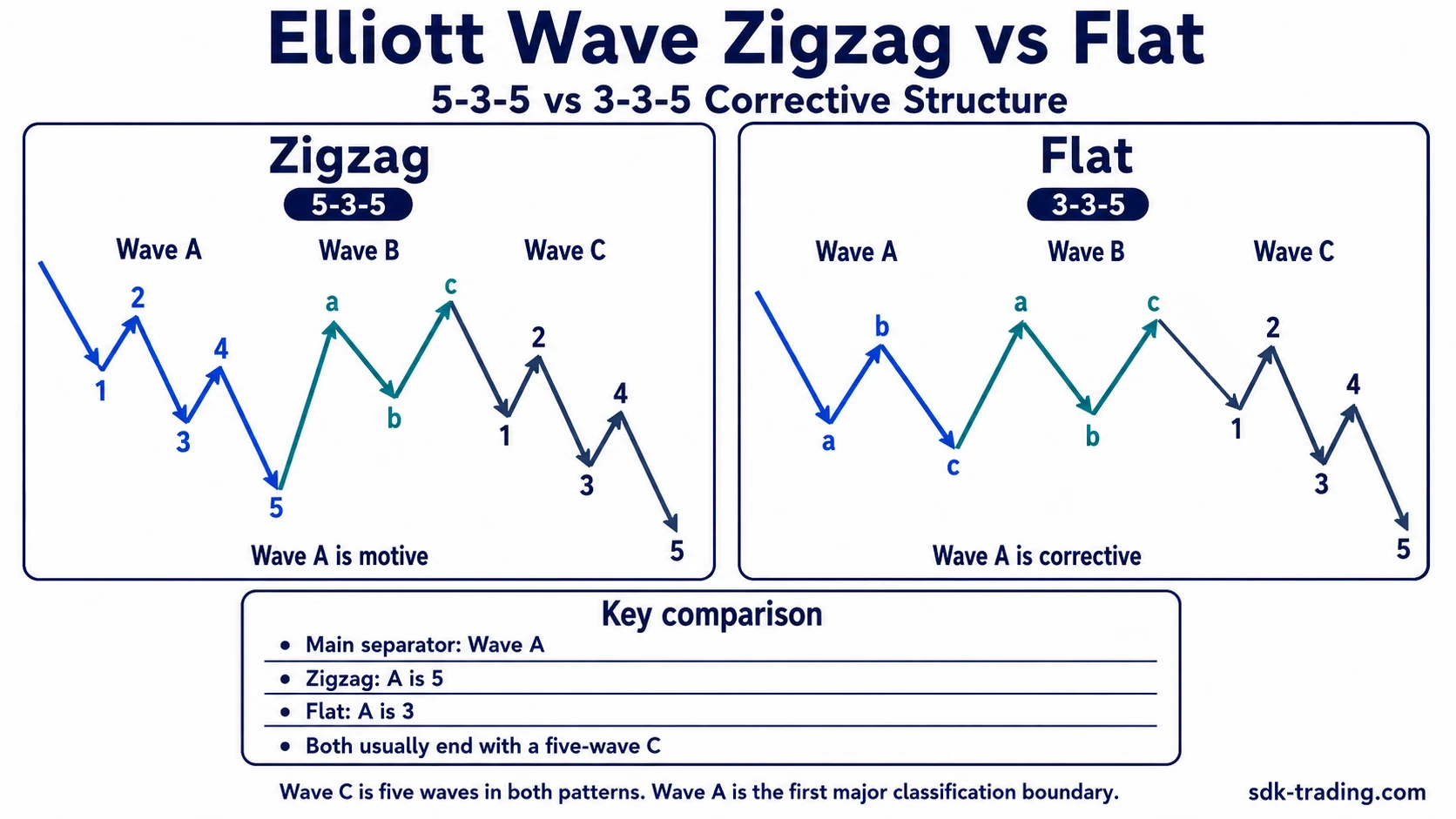
An Elliott Wave zigzag is a 5-3-5 corrective structure, while a flat is a 3-3-5 corrective structure. The first major boundary is Wave A: in a zigzag, Wave A is motive or five-wave; in a flat, Wave A is corrective or three-wave.
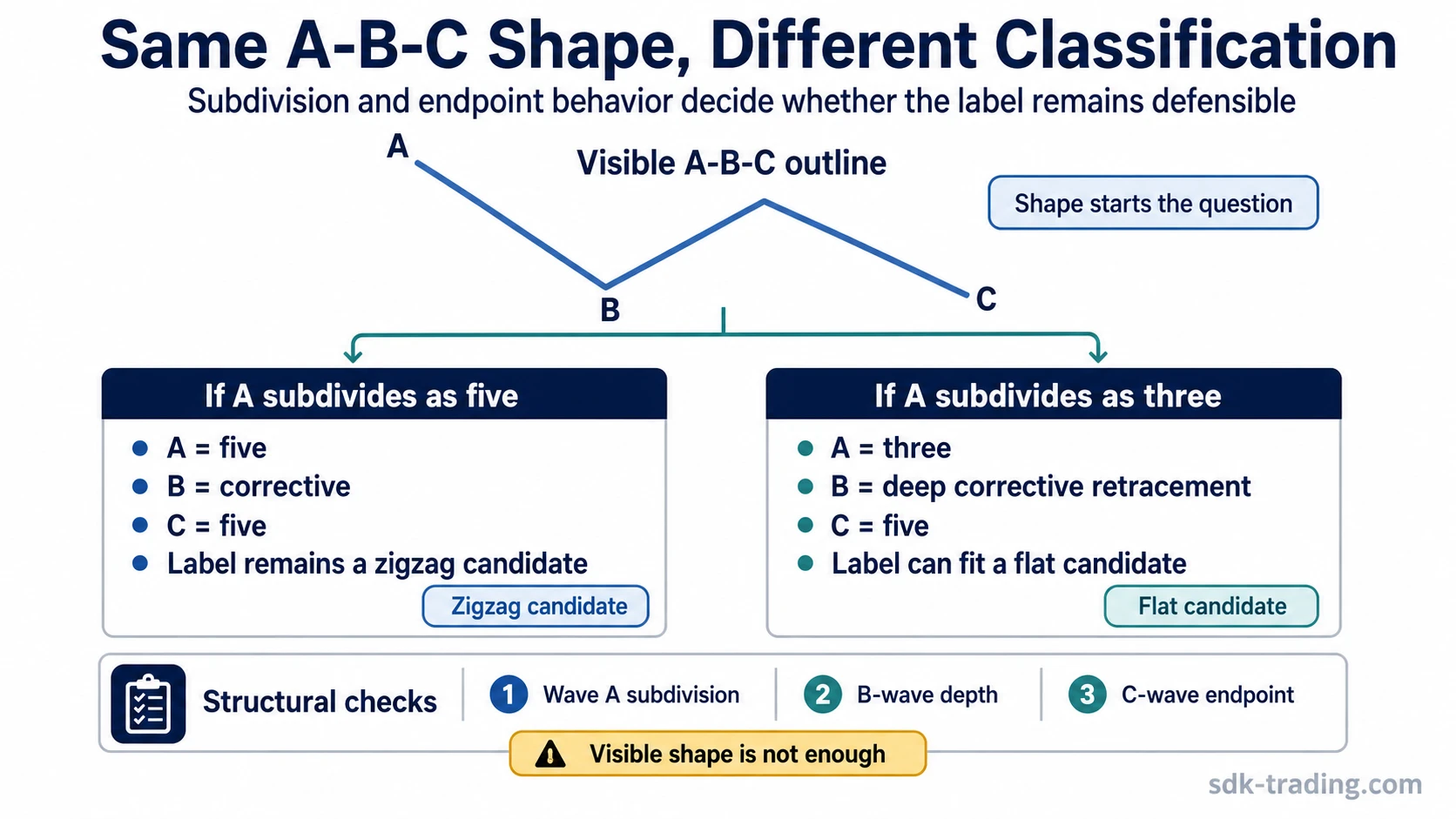
Both patterns can appear as A-B-C corrections, so visible shape alone is not enough. The label remains defensible only while subdivision, wave degree, B-wave behavior, and C-wave termination support the same reading.
Core distinction: A zigzag usually expresses a sharper corrective path because both A and C are five-wave legs. A flat usually expresses a more sideways corrective path because Wave A subdivides as three, Wave B retraces deeply, and Wave C completes the corrective structure as five.
Key Points
- A zigzag is classified as 5-3-5: five-wave A, three-wave B, five-wave C.
- A flat is classified as 3-3-5: three-wave A, three-wave B, five-wave C.
- Wave A is the first major decision boundary because it separates motive A from corrective A.
- Wave B usually retraces less in a zigzag and more deeply in a flat, often toward or beyond the origin of A.
- Wave C is five waves in both patterns, so C alone cannot separate the two without the earlier subdivision and endpoint checks.
Elliott Wave Zigzag vs Flat: The Core Difference
The difference is structural, not only visual. A zigzag stays a zigzag candidate when Wave A subdivides as a motive five-wave move, Wave B remains corrective, and Wave C also unfolds as five. A flat moves into view when Wave A subdivides as a corrective three, Wave B retraces deeply, and Wave C completes the structure as five.
The difficult part is that both patterns end with a five-wave C leg. A visible A-B-C shape can therefore be mislabeled if the earlier subdivision and endpoint behavior are not checked.
Classification note: The question is not whether the correction looks sharp or sideways at first glance. The safer question is whether the internal subdivisions and endpoint behavior still support the label.
Zigzag vs Flat Comparison Table
| Comparison point | Zigzag correction | Flat correction |
|---|---|---|
| Core subdivision | 5-3-5 | 3-3-5 |
| Wave A | Motive or five-wave structure | Corrective or three-wave structure |
| Wave B | Corrective retracement that usually does not return as deeply toward the start of A | Corrective retracement that often returns near or beyond the origin of A |
| Wave C | Five-wave move that normally continues the corrective direction from A | Five-wave move whose endpoint depends on whether the flat is regular, expanded, or running |
| Typical appearance | Often sharper and more directional | Often more sideways, overlapping, or range-like |
| Common misread | Calling any sharp A-B-C correction a zigzag without checking Wave A subdivision | Calling any sideways A-B-C correction a flat without checking whether Wave A is corrective |
| Best classification check | Confirm whether A and C both subdivide as five-wave legs while B remains corrective | Confirm whether A and B both subdivide as corrective threes while C completes as five |
How Wave A Separates a Zigzag from a Flat
Wave A is the first major diagnostic point. In a zigzag, Wave A should subdivide as a motive or five-wave leg. That is why a dedicated Elliott Wave Zigzag explanation focuses on the 5-3-5 structure rather than only the visible A-B-C outline.
In a flat, Wave A is corrective. It usually subdivides as three, which means the first leg does not carry the same motive character as a zigzag A. If the first leg is only counted from swing shape without subdivision review, a flat and a zigzag can be confused early.
Boundary: A sharp first leg does not automatically make the correction a zigzag, and a sideways first leg does not automatically make it a flat. The internal count of Wave A is the stronger classification test.
How Wave B Changes the Reading
Wave B adds the next filter. In a zigzag, B is corrective and usually retraces less deeply relative to Wave A. The structure often keeps a more directional corrective character because both A and C are five-wave legs.
In a flat, B is also corrective, but it often retraces much more deeply toward the origin of A. In expanded and running flats, B can move beyond the origin of A, which is one reason a flat can look confusing before Wave C clarifies the structure.
Diagnostic note: B-wave depth helps the reading, but it should not be used alone. Subdivision, degree, and C-wave behavior still need to agree with the label.
How Wave C Confirms or Weakens the Classification
Wave C is five waves in both zigzags and flats. That means a five-wave C does not separate the two patterns by itself. It only becomes useful when read together with Wave A subdivision and Wave B behavior.
In a zigzag, Wave C normally continues the corrective direction from Wave A and completes the 5-3-5 sequence. In a flat, Wave C also unfolds as five, but its endpoint depends on the flat variant. Regular, expanded, and running flats are separated by how B behaves and where C terminates relative to A.
Signal boundary: A completed C-wave count is still a structural classification. It does not guarantee direction, timing, reversal, or trade outcome.
Same Visible Correction, Different Classification
A market can move down in A, rebound in B, and move down again in C. From the surface, both a zigzag and a flat may look like an A-B-C correction. The classification changes when the internal structure is checked.
Illustrative scenario: Price declines from a prior swing, rebounds, and then declines again. If the first decline subdivides as five, the rebound is corrective, and the final decline also subdivides as five, the structure can remain a zigzag candidate. If the first decline subdivides as three, the rebound returns deeply toward the start of A, and the final decline unfolds as five, the same visible outline can instead fit a flat reading.
The point is not that one label is stronger because the move looks cleaner. The point is that the visible outline begins the classification, while subdivision and endpoint behavior decide whether the label remains defensible.
Flat Variants That Affect the Comparison
Flat variants matter because the C-wave endpoint is not identical across all flats. The comparison with a zigzag should therefore stay focused on structure first and variant behavior second.
| Flat variant | Structural behavior | Why it matters for zigzag vs flat classification |
|---|---|---|
| Regular flat | B returns near the origin of A, and C commonly moves toward the endpoint of A. | The deeper B-wave behavior separates it from the more directional zigzag profile. |
| Expanded flat | B moves beyond the origin of A, and C often extends beyond the endpoint of A. | The expanded variant has its own endpoint logic, so the dedicated Elliott Wave Expanded Flat explanation is the better place for the full expanded-flat breakdown. |
| Running flat | B moves beyond the origin of A, while C fails to reach the endpoint of A. | The label depends on the relationship between B and C, not on a generic sideways appearance. |
Common Mistakes When Comparing Zigzags and Flats
| Mistake | Safer interpretation |
|---|---|
| Calling any sharp A-B-C correction a zigzag | A zigzag still needs a five-wave A, corrective B, and five-wave C. |
| Calling any sideways A-B-C correction a flat | Sideways movement can start the question, but a flat still needs corrective A, corrective B, and five-wave C. |
| Using B-wave depth by itself | A deep B supports a flat reading only when subdivision and degree also support the label. |
| Ignoring wave degree | The compared A, B, and C legs must belong to the same corrective structure, not mixed degrees from nearby swings. |
| Treating the label as a trading signal | Zigzag and flat labels organize a wave count. They do not create a buy signal, sell signal, target, or forecast. |
How to Decide Between a Zigzag and a Flat
- Start with Wave A: Check whether it subdivides as five or three.
- Check Wave B: Note whether B is a shallower corrective retracement or a deep retracement toward or beyond the origin of A.
- Check Wave C: Confirm that C subdivides as five, then compare its endpoint behavior with the suspected pattern.
- Check degree consistency: Avoid mixing a smaller swing with a larger correction just because the visible shape looks similar.
- Keep the label conditional: Relabel if later subdivision or endpoint behavior stops supporting the original count.
Practical boundary: The most defensible label is the one supported by the whole structure, not the one that best matches the first visible shape.
FAQ
Can a flat look like a zigzag?
Yes. Both can appear as A-B-C corrections on the surface. The main difference is that a flat begins with a three-wave A, while a zigzag begins with a five-wave A.
Is Wave C always five waves in both patterns?
In the standard Elliott Wave classification, Wave C is five waves in both zigzags and flats. That is why Wave C alone is not enough to separate them; Wave A and B behavior must also be checked.
Is a zigzag or flat a trading signal?
No. A zigzag or flat label is a structural classification, not a buy or sell signal. The label can help organize a wave count, but it does not guarantee direction, timing, or outcome.