Williams %R is a technical-analysis oscillator that measures where the current close sits inside a recent high-low range. It uses a negative 0 to -100 scale, where readings near 0 show closes near the top of the lookback range and readings near -100 show closes near the bottom.
Definition: Williams %R, also called Williams Percent Range, is a bounded range-position oscillator. It compares the current close with the highest high and lowest low over a chosen lookback period, commonly 14 periods, then converts that position into a reading between 0 and -100.
The reading describes range position, not automatic trade action. A move near -20 or -80 can mark a stretched threshold state, but the meaning depends on whether price later accepts that area, rejects it, or keeps closing near the same edge of the range.
Key Points
- Williams %R measures the close’s position inside a recent high-low range.
- The scale runs from 0 to -100, with 0 near the top of the range and -100 near the bottom.
- The common -20 and -80 levels describe threshold zones, not automatic reversal points.
- Persistent readings near a range edge can reflect trend pressure rather than immediate exhaustion.
- The reading becomes more useful when later closes show whether the tested range edge is being accepted, rejected, or reabsorbed.
What Is the Williams %R Indicator?
Williams %R is a momentum-style oscillator built from recent range position. Instead of measuring gain-loss balance like RSI, it asks a narrower question: where did price close relative to the highest high and lowest low of the lookback window?
That makes Williams %R useful for reading whether closes are clustering near the upper or lower side of a recent range. A high reading on the scale does not mean price must reverse. It only means the close is near the upper boundary of the lookback range. A low reading means the close is near the lower boundary.
| Classification point | Williams %R reading |
|---|---|
| Indicator family | Bounded oscillator / range-position oscillator |
| Primary input | Highest high, lowest low, and current close over a lookback period |
| Scale | 0 to -100 |
| Main reading | Where the close sits inside the recent high-low range |
| Common threshold areas | Around -20 and -80 |
| Main limitation | A threshold reading does not prove reversal, continuation, or exhaustion by itself |
How Williams %R Is Calculated
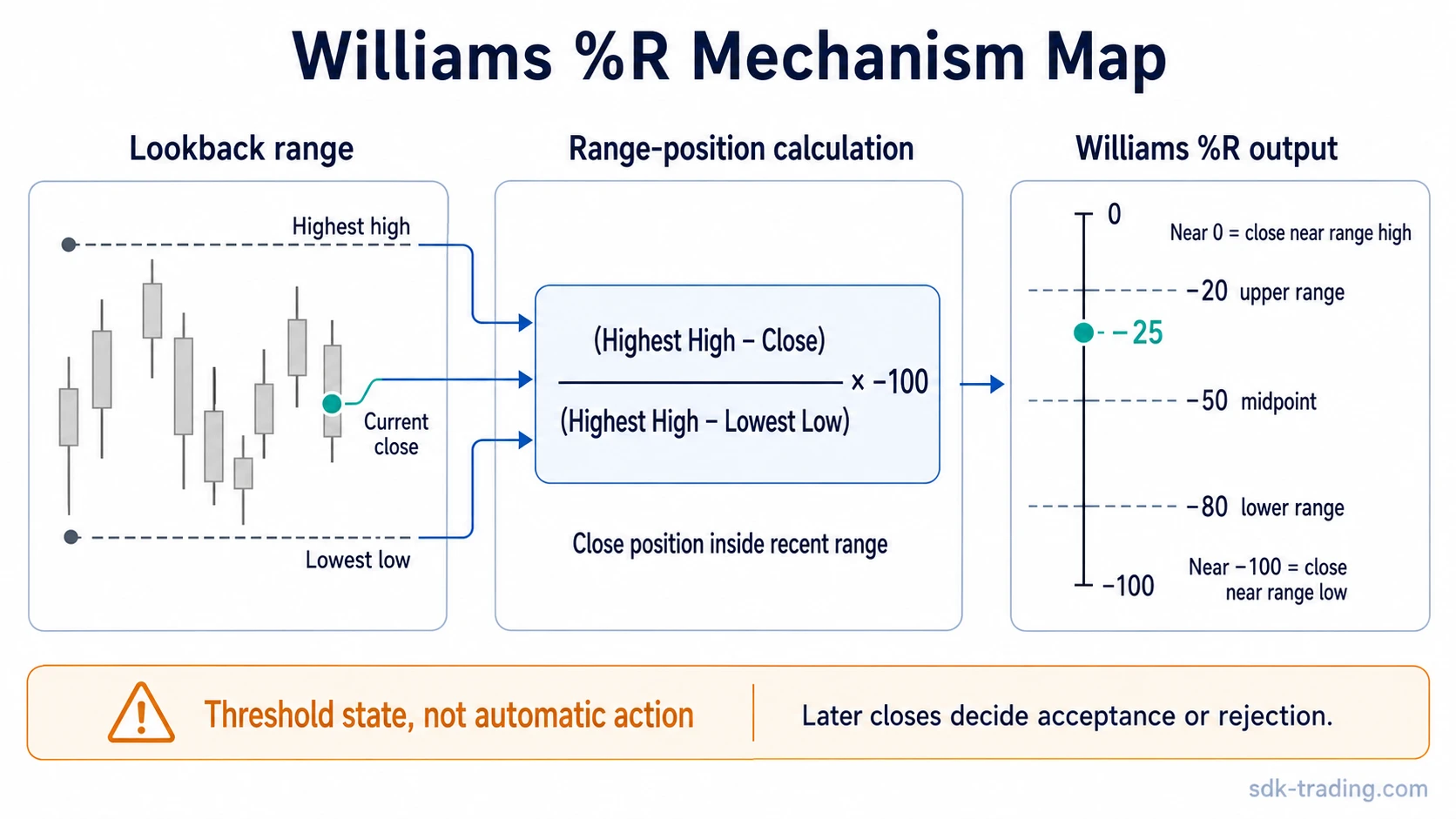
Williams %R compares the current close with the recent high-low range. The usual formula is:
Formula: Williams %R = (Highest High – Close) / (Highest High – Lowest Low) x -100
The highest high and lowest low come from the selected lookback period. A 14-period setting checks the highest high and lowest low over the most recent 14 bars. The current close is then placed inside that range and expressed on the 0 to -100 scale.
| Formula part | What it means | Why it matters |
|---|---|---|
| Highest High | The highest price reached during the lookback period | Sets the upper edge of the recent range |
| Lowest Low | The lowest price reached during the lookback period | Sets the lower edge of the recent range |
| Close | The latest closing price | Shows where the market finished relative to the range |
| Lookback period | The number of bars used to define the recent range | Controls how reactive or stable the reading becomes |
| x -100 | Converts the position into the Williams %R negative scale | Creates the familiar 0 to -100 oscillator reading |
A close near the highest high produces a reading near 0. A close near the lowest low produces a reading near -100. The negative scale can feel inverted at first, but the logic is simple: the closer the close is to the top of the recent range, the closer Williams %R moves toward 0.
How to Read the 0 to -100 Williams %R Scale
The Williams %R scale is best read as a range-position map. The most common reference zones are near -20, -50, and -80, but those levels describe where the close sits inside the lookback range rather than what price must do next.
| Williams %R area | Mathematical meaning | What it does not prove |
|---|---|---|
| 0 to around -20 | The close is near the upper side of the recent range | It does not prove that price must reverse lower |
| Around -50 | The close is near the middle of the recent range | It does not prove balance, trend change, or neutrality on its own |
| Around -80 to -100 | The close is near the lower side of the recent range | It does not prove that price must reverse higher |
The broader idea behind overbought and oversold readings is useful here, but Williams %R adds a specific mechanism: the threshold comes from the close’s location inside a recent high-low range.
What a Williams %R Reading Does Not Prove
A Williams %R reading near -20 does not prove that buying pressure is finished. It only shows that the close is near the upper part of the recent range. A reading near -80 does not prove that selling pressure is finished. It only shows that the close is near the lower part of the recent range.
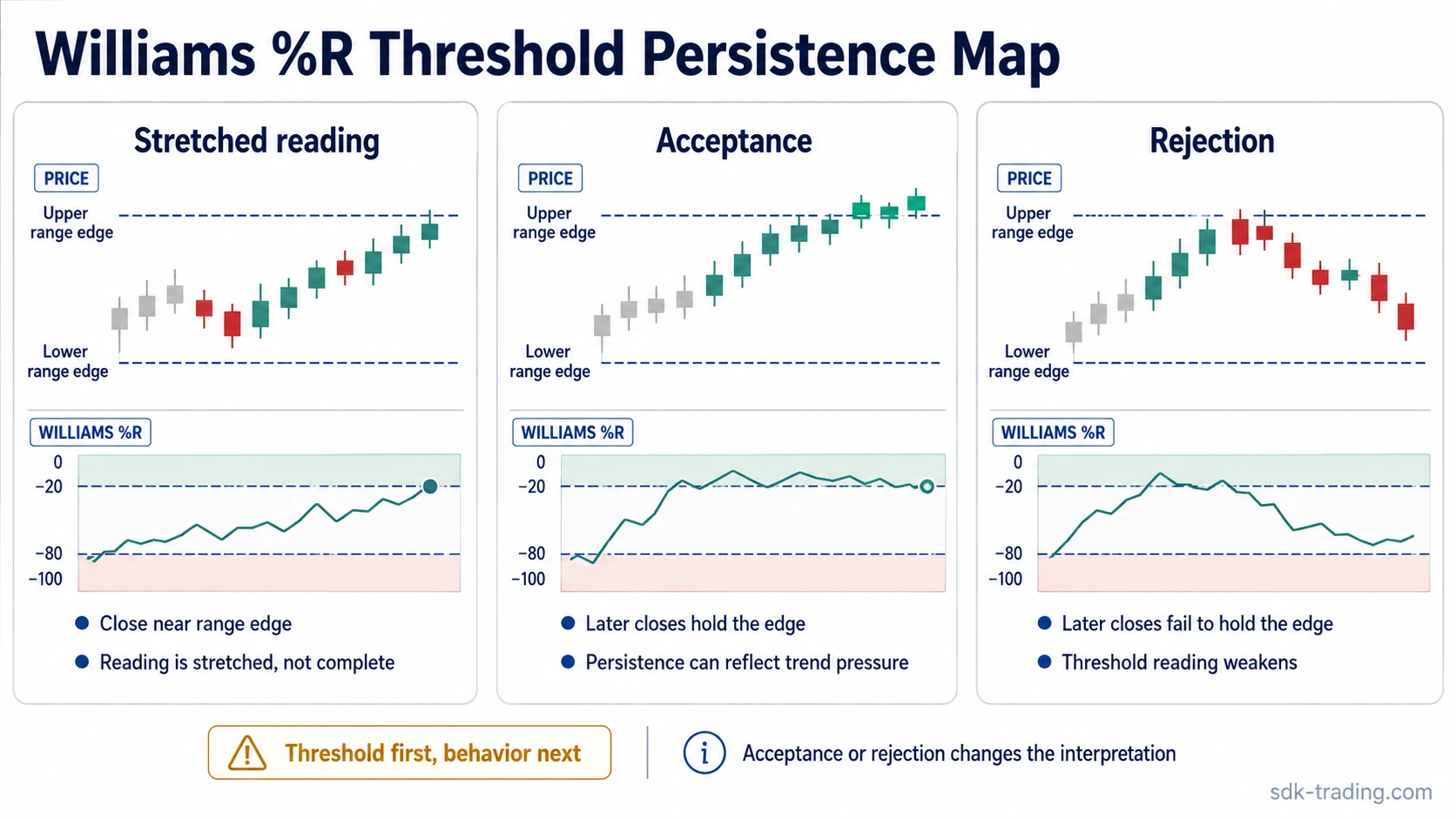
The diagnostic question is whether later closes accept, reject, or reabsorb the range edge that produced the stretched reading. If closes keep forming near the upper edge, a high Williams %R reading may reflect sustained upward pressure. If price briefly reaches that zone and then closes back inside the prior range, the continuation reading becomes less stable.
| Reading | Mathematical meaning | Stronger interpretation | Weaker or invalid reading |
|---|---|---|---|
| Near -20 | Close near the upper range edge | Later closes continue holding near or above the tested area | Price rejects the area quickly and closes back inside the prior range |
| Near -50 | Close near the range midpoint | Mid-range behavior aligns with a broader consolidation or transition | The midpoint reading is treated as meaningful without nearby structure |
| Near -80 | Close near the lower range edge | Later closes stop accepting lower levels and recover into the range | Price keeps accepting lower closes while the oscillator stays stretched |
Clean, Weak, and Invalid Williams %R Readings
The clearest Williams %R readings connect the oscillator value with price behavior around the recent range edge. The weakest readings treat the oscillator value as a complete message without checking what happened after the threshold was reached.
| Reading quality | What appears on Williams %R | Price behavior to compare | Diagnostic takeaway |
|---|---|---|---|
| Clean reading | Williams %R reaches a threshold area | Price behavior around the range edge supports the same interpretation | The oscillator and price behavior point toward the same range-position story |
| Weak reading | Williams %R touches -20 or -80 briefly | Price does not clearly accept or reject the tested area | The reading remains incomplete because the market has not resolved the edge test |
| Invalid reading | Williams %R is read as a reversal clue | Price keeps closing in the same direction and accepts the new range edge | The threshold interpretation is contradicted by later range acceptance |
Example: Price advances into a prior resistance area and Williams %R stays near -20 for several bars. The stretched reading does not automatically mark exhaustion. It may simply show that closes keep forming near the top of the lookback range. A reversal reading becomes more defensible only if later candles fail to hold the tested area and close back inside the prior range. If price continues accepting higher levels, the stretched oscillator reading is better treated as trend persistence than as a completed reversal clue.
Williams %R vs Stochastic Oscillator
Williams %R is closely related to the Stochastic Oscillator because both compare the close with a recent high-low range. The key difference is presentation. Williams %R uses a 0 to -100 scale, while the Stochastic Oscillator is usually displayed from 0 to 100.
This relationship can create confusion because both tools describe range position, but they are not the same display. Williams %R moves toward 0 when the close is near the range high, while Stochastic readings move toward 100 in a comparable upper-range condition.
The Ultimate Oscillator belongs to the oscillator family as well, but its construction is different because it blends buying-pressure readings across multiple timeframes rather than using one Williams %R range-position formula.
Common Williams %R Mistakes
Mistake 1: Treating -20 as an automatic bearish reversal area. A reading near -20 means the close is near the top of the lookback range; the next question is whether price continues accepting that upper area or rejects it.
Mistake 2: Treating -80 as an automatic bullish reversal area. A reading near -80 means the close is near the bottom of the lookback range; persistent lower closes can keep the oscillator stretched.
Mistake 3: Ignoring lookback sensitivity. A shorter lookback reacts faster to recent price changes and may create more threshold touches. A longer lookback smooths some noise but may respond more slowly when the range changes.
Mistake 4: Reading the oscillator without checking range acceptance. Williams %R becomes more useful when the threshold reading is compared with later closes, failed acceptance, or continued acceptance near the tested edge.
Williams %R Limitations
Williams %R is sensitive to the range used in the calculation. When a new high or new low enters the lookback window, the range can re-anchor, and the oscillator may shift even if the broader market interpretation has not changed much.
Trend persistence: In a strong advance, closes can stay near the upper side of the recent range, keeping Williams %R near -20. In a strong decline, closes can stay near the lower side of the range, keeping readings near -80 or below.
Parameter sensitivity: A shorter lookback can make Williams %R more reactive. A longer lookback can make it slower. Neither setting removes the need to compare the reading with price behavior around the range edge.
Volatility changes: A sudden expansion in the high-low range can change the oscillator reading quickly. The indicator may look less stable when the market is rapidly redefining its recent range.
Williams %R Origin
Williams %R is commonly attributed to trader Larry Williams. The historical origin is secondary to the calculation logic: the indicator converts the close’s position inside a recent high-low range into a negative oscillator reading.
FAQ
What does Williams %R measure?
Williams %R measures where the current close sits inside a recent high-low range. Readings near 0 show closes near the range high, while readings near -100 show closes near the range low.
What are the common Williams %R threshold levels?
The common reference areas are around -20 and -80. A reading near -20 means the close is near the upper side of the recent range, while a reading near -80 means the close is near the lower side.
Is Williams %R the same as the Stochastic Oscillator?
Williams %R is closely related to the Stochastic Oscillator because both compare the close with a recent high-low range, but Williams %R uses a 0 to -100 scale instead of the more familiar 0 to 100 display.
Can Williams %R stay overbought or oversold?
Williams %R can remain near a threshold area when price keeps closing near one edge of the lookback range. Persistent stretched readings can reflect trend pressure rather than immediate reversal.