Momentum indicators measure different characteristics of price movement over a selected lookback period. One tool may react to the balance between recent gains and losses, another to price displacement, range position, distance from an average, or price-plus-volume behavior. The same market move can therefore produce several different momentum readings without creating a contradiction.
Definition: Momentum indicators are technical indicators that measure the rate, strength, persistence, or relative position of price movement over a selected period. Their output depends on the input, formula, lookback, scale, and smoothing method used.
How Momentum Measurements Differ
- Momentum is not one calculation. Different indicators measure different properties of the same price move.
- Recent gain-loss balance, price displacement, range position, baseline distance, and volume-adjusted pressure can change at different rates.
- Two momentum indicators can disagree because their formulas are answering different questions.
- The lookback period controls which part of the move receives the most weight.
- A useful comparison starts with the measurement behind each output rather than the visual position of the oscillator line.
What Momentum Indicators Actually Measure
Consider a stock that rises from one price area to another. That movement can be measured in several ways.
One calculation can ask how much price changed from a previous close. Another can compare the size of recent gains with recent losses. A range-based oscillator can ignore much of that arithmetic and instead ask where the latest close sits inside the recent high-low range. CCI approaches the move from another angle by measuring how far typical price has moved from an average baseline.
These are related observations, but they are not interchangeable. A strong move can score highly on several measurements at once, while another move can produce a mixed momentum profile.
Five Measurement Lenses for the Same Price Move
For practical comparison, one price move can be separated into five measurement questions. This is a way to organize the outputs of existing indicators, not a separate indicator or formula.
| Measurement lens | Question being measured | Typical indicator logic |
|---|---|---|
| Gain-loss balance | How strong have recent upward changes been relative to recent downward changes? | RSI-style momentum. |
| Price displacement | How far has the current price moved from a previous price? | Rate-of-change and raw momentum calculations. |
| Range position | Where is the current close relative to the recent high-low range? | Stochastic and Williams %R style calculations. |
| Baseline distance | How far has current price behavior moved from an average reference? | CCI-style displacement measurement. |
| Price-plus-volume pressure | How does price movement look when volume-derived money flow is included? | MFI-style momentum. |
Scale Design Changes the Output
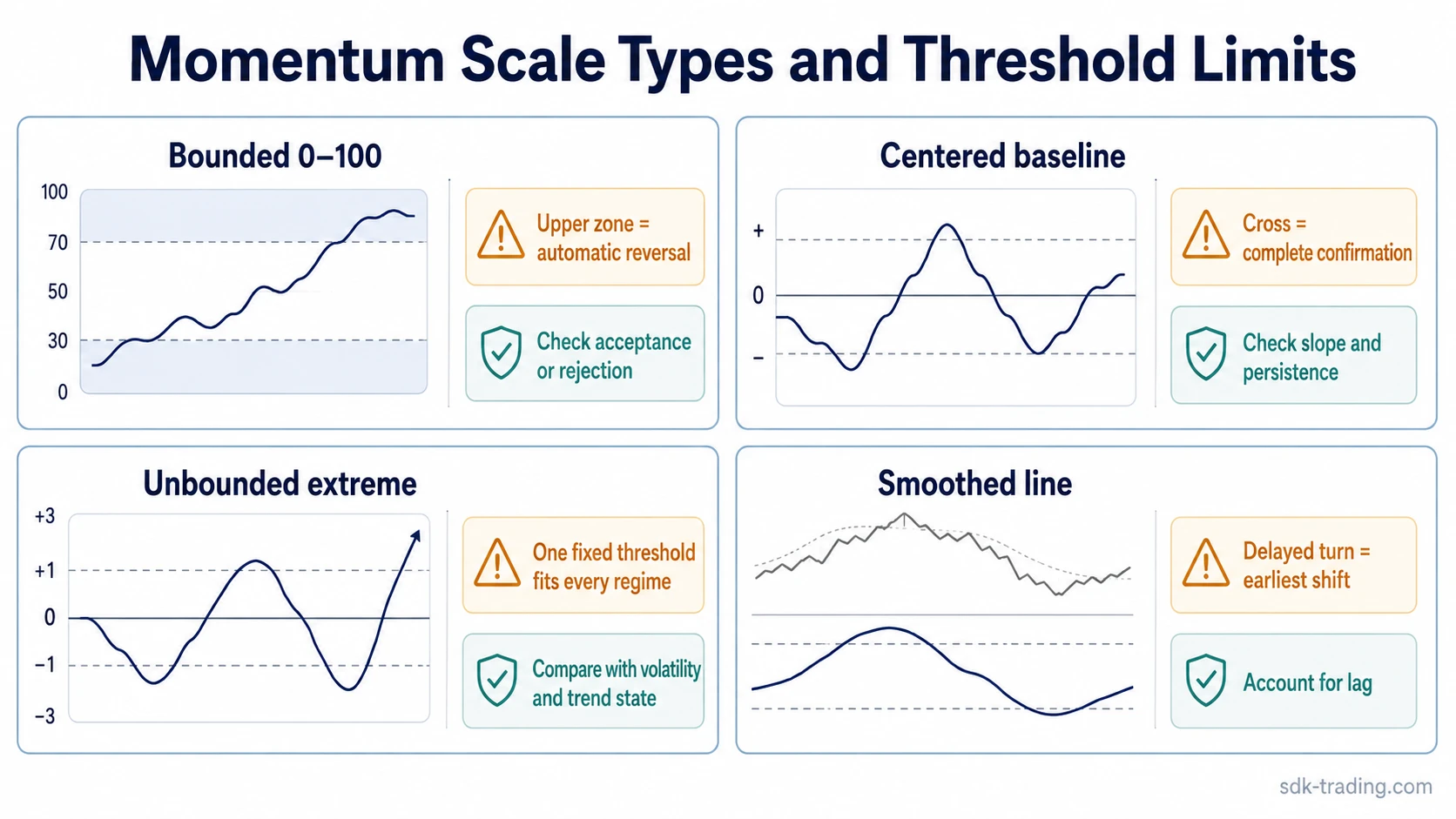
The calculation determines what is measured, while the scale determines how that measurement is displayed. Some momentum indicators remain inside fixed limits. Others move around zero or can expand well beyond commonly watched reference areas.
| Scale type | How the output behaves | Example measurement |
|---|---|---|
| Bounded scale | The indicator remains inside fixed upper and lower limits. | RSI and many range-position oscillators. |
| Centered scale | The reading moves above and below a central reference such as zero. | Price-change or moving-average-difference measurements. |
| Expandable scale | The value can travel farther from the center as displacement increases. | CCI-style distance from an average. |
| Smoothed output | Recent movement is filtered through an averaging process. | Momentum calculations built from moving averages. |
Why Momentum Indicators Can Disagree
Suppose price advances strongly for several sessions and then begins moving more slowly near the upper end of its recent range.
RSI can remain relatively high because recent gains still outweigh recent losses. A range-position oscillator can also remain high because price is still closing near the top of its lookback range. ROC may already decline because the distance between the current price and the price several periods ago is no longer expanding at the previous rate.
CCI can respond differently again if typical price moves back toward its average baseline. Money Flow Index can add another distinction because volume-derived money flow is part of its calculation.
None of those outputs needs to be treated as the correct one. Each describes a different property of the move.
One Price Move Can Have a Mixed Momentum Signature
A price advance can continue while some characteristics of momentum strengthen and others weaken.
| Observed behavior | Possible momentum reading |
|---|---|
| Price is still rising, but each new advance covers less distance. | Price displacement may be losing strength even though direction remains positive. |
| Price keeps closing near the top of its recent range. | Range-position momentum can remain strong. |
| Up bars remain larger than down bars. | Gain-loss momentum can stay elevated. |
| Typical price moves closer to its average. | Baseline displacement can contract. |
| Price advances while volume-derived money flow becomes less aggressive. | Price-plus-volume momentum can differ from price-only momentum. |
This mixed profile explains why two indicators can move in different directions during the same section of a chart. The disagreement can reveal which characteristic of the move is changing first.
RSI, CCI, MFI, and Williams %R Can Read the Same Advance Differently
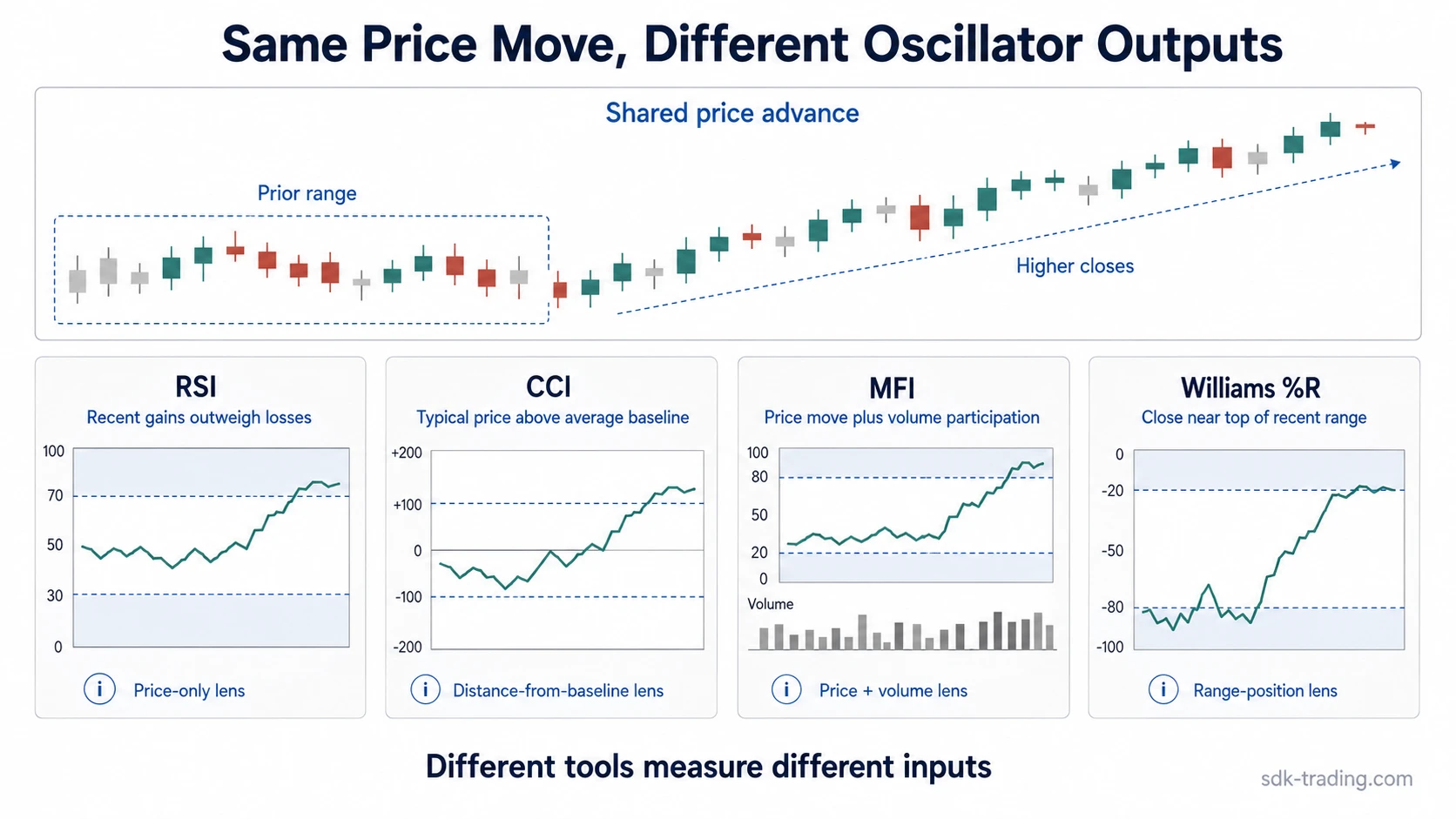
Imagine price has broken above a short consolidation and continues higher.
RSI can rise as recent gains dominate recent losses. Commodity Channel Index can rise sharply when typical price moves far above its average baseline. MFI can strengthen when the price move is accompanied by stronger volume-derived money flow.
Williams %R asks a different question. It measures where the latest close sits relative to the recent high-low range. If price continues closing close to the top of that range, Williams %R can remain near its upper extreme even when another momentum calculation begins to soften.
When Momentum Disagreement Is Informative
Disagreement is most useful when the reason for it can be identified from the calculation.
| Combination | What may be changing |
|---|---|
| Range position stays strong while displacement falls | Price is still closing near the edge of the range, but each new advance is covering less distance. |
| Gain-loss momentum stays strong while baseline distance contracts | Recent gains still dominate, although price has moved closer to its average reference. |
| Price-only momentum strengthens while volume-adjusted momentum does not | The advance is occurring without the same change in volume-derived pressure. |
| Fast momentum turns while a smoothed measure changes slowly | The newest bars are changing faster than the longer calculation can absorb them. |
The calculation explains the disagreement. Without that step, comparing several oscillator lines can create apparent confirmation or conflict without showing what has actually changed in price behavior.
Lookback Length Changes the Momentum Signature
A momentum indicator only sees the data inside its calculation window. A short lookback gives recent bars more influence and usually changes faster. A longer lookback keeps older movement inside the measurement for more time.
This can create different readings even when the formula itself is unchanged. A fast RSI can react sharply to a short pullback while a slower RSI remains elevated. A short ROC calculation can contract as soon as recent price progress slows, while a longer comparison may still include much of the earlier advance.
The lookback therefore defines the time horizon of the momentum measurement. Comparisons are cleaner when that horizon is known before the outputs are interpreted.
Momentum and Trend Describe Different Parts of the Chart
A trend describes the broader directional sequence of price. Momentum describes characteristics of movement inside that sequence.
An uptrend can continue while price displacement slows. A decline can remain structurally intact while downside momentum temporarily contracts. A sideways market can produce large short-term oscillator swings without establishing a sustained directional trend.
This distinction is useful when a momentum indicator changes before the larger price structure does. The indicator is showing that one property of the move has changed. The trend question remains separate until the price sequence itself changes.
FAQ
What do momentum indicators measure?
Momentum indicators measure characteristics of price movement over a selected lookback period. Depending on the formula, the output may reflect price change, gain-loss balance, range position, distance from an average, smoothing, or price-plus-volume behavior.
Why can two momentum indicators give different readings?
They can use different inputs, formulas, scales, and lookback periods. Two indicators can therefore describe different properties of the same price move.
Can momentum weaken while price is still rising?
Yes. Price can continue rising while displacement slows, participation changes, or another momentum measurement loses strength. Direction and momentum are related, but they are not the same measurement.
Are momentum indicators the same as trend indicators?
No. Momentum indicators measure characteristics such as speed, displacement, range position, or pressure over a lookback period. Trend analysis focuses on the broader directional structure of price.