Oscillator readings are often misread when a high or low value is treated as an automatic reversal point. The same extreme can behave very differently in a range, a persistent trend, or a breakout because each oscillator measures a specific part of price behavior through its own calculation and scale.
Definition: An oscillator reading is the current output of a technical indicator relative to its scale, centerline, or reference zone. Depending on the formula, the reading may describe momentum, range position, displacement, or volume-adjusted pressure.
How Extreme Oscillator Readings Behave
- An extreme reading can persist while price continues moving strongly in the same direction.
- A first threshold touch and several bars spent near the same extreme describe different oscillator behavior.
- Price can keep progressing while the oscillator remains stretched, or price progress can slow even though the oscillator is still near the same boundary.
- The depth of the next oscillator reset and the speed of any return to the extreme add information that one threshold value cannot show.
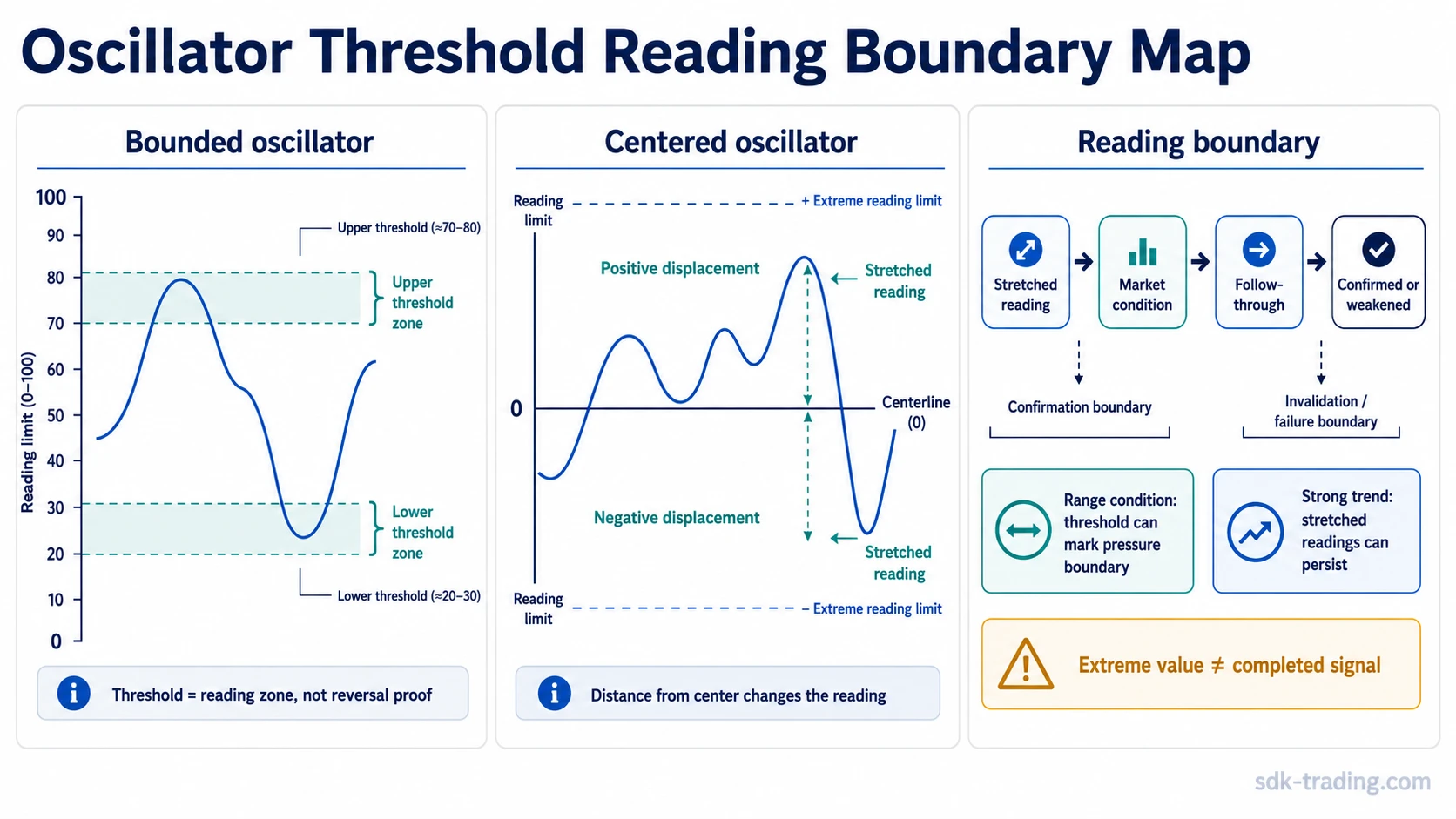
Why Extreme Oscillator Readings Can Persist
A high oscillator value does not require price to turn immediately. If the price behavior driving the calculation continues, the indicator can remain near the upper part of its scale for several bars. Sustained downside movement can keep the same type of oscillator near its lower boundary.
RSI can stay elevated while recent gains continue to outweigh recent losses. Stochastic can remain near the upper end of its scale while price keeps closing near the top of the recent high-low range. Williams %R can remain close to zero for a similar range-position reason.
The number is therefore only the current state of the calculation. The sequence that develops after the first extreme usually tells more than the first threshold touch by itself.
Range, Trend, and Breakout Conditions
The same threshold behaves differently when the price environment changes. Inside a sideways range, an oscillator may travel repeatedly between its upper and lower zones. During a strong advance, it may spend much more time near the upper boundary because the movement that created the reading continues.
| Market condition | Typical oscillator behavior | What to watch |
|---|---|---|
| Sideways range | The oscillator often rotates between upper and lower zones. | Whether price continues rejecting the range boundary or starts holding outside it. |
| Persistent uptrend | Upper-zone readings can remain elevated or return quickly after shallow resets. | Whether price continues making upside progress while the oscillator stays strong. |
| Persistent downtrend | Lower-zone readings can remain depressed while selling pressure continues. | Whether rebounds change the downside sequence or remain temporary resets. |
| Breakout or expansion | The oscillator can move rapidly toward an extreme as price leaves the previous range. | Whether price continues progressing after the initial expansion. |
| Compression | Fast settings can move between thresholds even while price makes little net progress. | Whether the oscillator is reacting to real expansion or short-term movement inside the compression. |
Reading Threshold Persistence as a Sequence
A threshold can be followed through four observable parts of the sequence: how long the oscillator stays near the extreme, what price does during that period, how far the oscillator resets, and how quickly it returns.
| Observation | What to measure | What it adds to the reading |
|---|---|---|
| Occupancy | How many bars the oscillator spends inside or repeatedly returning to the extreme zone. | Separates a brief threshold touch from persistent extreme behavior. |
| Price progress | Whether price continues making meaningful progress while the oscillator remains extreme. | Shows whether oscillator persistence is still accompanied by directional movement. |
| Reset depth | How far the oscillator moves away from the extreme during the next pullback or pause. | Shows how much of the previous oscillator pressure was given back. |
| Re-entry speed | How quickly the oscillator returns toward the same extreme after the reset. | Shows whether the previous oscillator condition rebuilds quickly or struggles to return. |
These observations sit on top of the oscillator’s existing formula. They describe how an extreme develops over time rather than changing the calculation itself.
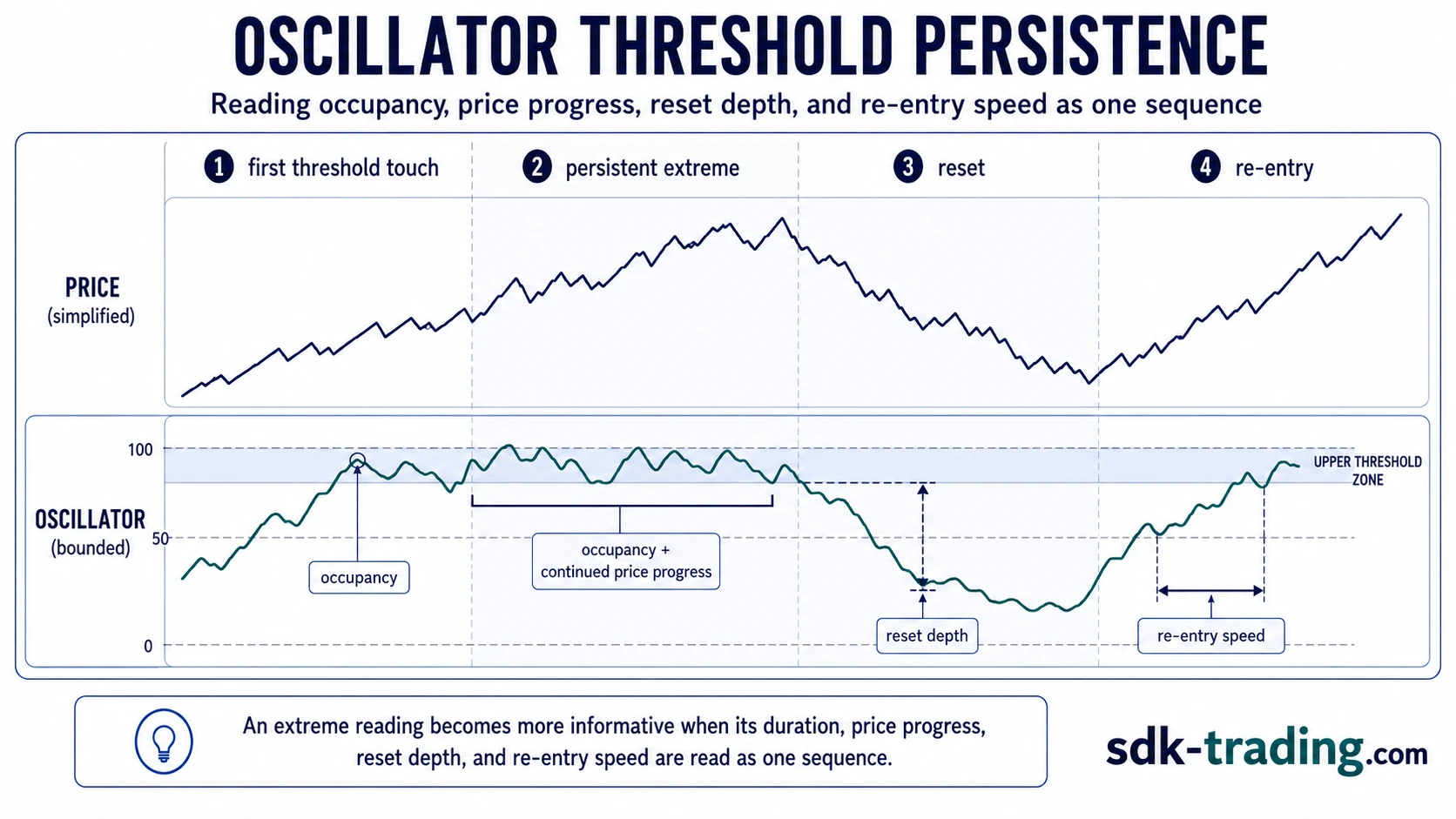
Price Progress Changes the Meaning of Persistence
Two oscillators can spend the same amount of time near an upper threshold while the price behavior behind those readings is very different.
In the first case, price keeps advancing while the oscillator remains elevated. New price progress continues to accompany the extreme reading. A shallow reset followed by a quick return to the upper zone would show that the same condition is rebuilding quickly.
In the second case, the oscillator remains high but price stops making much progress. The next reset is deeper, and the oscillator struggles to return to its previous extreme. The threshold may look similar at first, but the sequence behind it has changed.
| Oscillator sequence | Price behavior | What the combination suggests |
|---|---|---|
| Long occupancy | Price continues making progress | The extreme is occurring alongside continued directional movement. |
| Long occupancy | Price progress slows or stalls | The oscillator remains elevated while price efficiency is weakening. |
| Shallow reset and fast re-entry | Price resumes the previous move | The prior oscillator condition rebuilds quickly after the pause. |
| Deep reset and slow or weak re-entry | Price also struggles to regain previous progress | The previous relationship between price and oscillator pressure has weakened. |
Different Oscillators Reach Extremes for Different Reasons
The sequence still has to be read through the formula of the oscillator being used. A high RSI value and a high Stochastic value can appear at the same time without measuring the same thing.
| Oscillator | What can drive an extreme reading | What the extreme describes |
|---|---|---|
| RSI | Recent gains become large relative to recent losses. | Gain-loss momentum over the selected lookback. |
| Stochastic | Price repeatedly closes near the upper or lower part of its recent range. | Closing-price position inside the lookback range. |
| MFI | Price and volume-derived money flow become concentrated in one direction. | A Money Flow Index reading incorporates price and volume behavior. |
| CCI | Typical price moves far from its moving-average baseline. | A Commodity Channel Index reading describes displacement relative to that baseline. |
| Williams %R | The close remains near one edge of the recent high-low range. | Range position displayed through a negative bounded scale. |
| MACD histogram | The distance between the MACD line and its signal line expands. | The changing relationship between the MACD line and its signal line around zero. |
Settings Change the Persistence Profile
The lookback period changes how quickly an oscillator reacts. A shorter setting gives more weight to recent movement, so the indicator can enter, leave, and re-enter an extreme zone more quickly. A longer setting usually moves more slowly because more historical data remains inside the calculation.
That difference also affects occupancy, reset depth, and re-entry speed. A quick reset on a fast setting may appear as only a small change on a slower version of the same oscillator.
For that reason, threshold sequences should be compared using stable settings. Changing the lookback after seeing the result changes the behavior being evaluated.
A Practical Oscillator Reading Order
- Identify what the oscillator actually calculates.
- Locate the current reading on its scale or relative to its centerline.
- Identify the surrounding price condition: range, trend, breakout, pullback, or compression.
- Check whether the extreme is a first touch or a persistent state.
- Compare oscillator occupancy with actual price progress.
- If the oscillator resets, compare the depth of that reset with earlier resets.
- Watch how quickly the oscillator can return to the previous extreme and whether price resumes progressing at the same time.
This sequence keeps the analysis tied to observable behavior. A single overbought, oversold, or centerline reading remains one point inside a longer process.
Common Oscillator Reading Errors
Automatically fading every high reading is unreliable because strong directional movement can keep a bounded oscillator elevated. The same problem appears on the downside when a low reading is treated as an automatic bounce.
Another error is applying one threshold rule to every oscillator. Gain-loss momentum, range position, baseline displacement, and volume-adjusted pressure can produce similar-looking extremes for different reasons.
The sequence can also be distorted by changing parameters after the chart is visible. If the settings change, the timing of the threshold touch, the duration of the extreme, the reset, and the re-entry all change with them.