Crypto trading means analyzing cryptocurrency price movement, market context, and risk across digital-asset markets before focusing on any one coin, exchange, or chart setup.
Crypto markets trade continuously, liquidity is split across venues, volatility can expand quickly, and sharp wicks can appear before the broader structure is clear. That makes crypto trading easier to understand when it is separated into structure, liquidity, cycles, volatility, and risk.
Definition: Crypto trading is the analysis and participation in cryptocurrency price movement across spot, derivative, and exchange-based markets. The core task is not guessing the next coin move; it is reading market behavior, managing uncertainty, and knowing which concept explains the situation being observed.
Key Points
- Crypto trading is different from long-term holding because it focuses more on price behavior, timing context, and risk control.
- Digital-asset markets run 24/7, so volatility and fatigue can build without the same session boundaries used in many traditional markets.
- Exchange fragmentation can make liquidity, wicks, and short-lived price movement harder to interpret.
- Market cycles can provide context, but cycle labels do not guarantee direction or timing.
- A more stable learning path starts with structure, liquidity, volatility, cycles, and risk before tactical labels become useful.
What Is Crypto Trading?
Crypto trading is the process of analyzing and acting on cryptocurrency price movement. It can involve spot markets, derivatives, or other exchange-based instruments, but the instrument is secondary to the interpretation problem: price can move quickly, liquidity can shift across venues, and risk can change before a clean chart pattern appears.
A beginner often starts with the idea of choosing a coin or finding a platform. That sequence is incomplete. The more durable starting point is understanding what the chart is actually reflecting: trend behavior, failed acceptance, wick-heavy moves, liquidity pressure, volatility expansion, and the risk attached to each condition.
Crypto trading also has a different rhythm from many stock or futures markets because the market does not close for a normal overnight break. Continuous trading can create fast repricing, weekend movement, and emotional pressure to treat every candle as meaningful. A sharp move can still be noise, a wick can still be premature, and a cycle label can remain secondary until price behavior supports it.
How Crypto Trading Differs From Investing
Crypto trading and crypto investing can overlap in the same asset, but they use different decision models. Trading focuses on price behavior, market context, volatility, and risk control over a shorter or more conditional horizon. Investing or holding usually depends more on ownership, thesis, adoption assumptions, and a longer holding period.
| Lens | Crypto trading | Crypto investing or holding |
|---|---|---|
| Main question | What is price doing now, and what changes the interpretation? | Is the asset worth owning through a longer cycle? |
| Primary focus | Structure, liquidity, volatility, timing context, and risk. | Asset thesis, network assumptions, adoption, and long-term conviction. |
| Main danger | Reacting to noise, leverage, liquidations, or fast wick movement. | Holding through changing conditions without reassessing the thesis. |
The distinction matters because a trading decision cannot rely only on belief in an asset. A chart can move against a strong narrative, and a temporary rally can appear even when the longer-term thesis remains uncertain.
What Makes Crypto Markets Different
Crypto markets have several structural features that change how price movement should be read. These features do not make crypto easier or harder by default; they change the conditions under which interpretation becomes reliable.
| Feature | Why it matters | Interpretation risk |
|---|---|---|
| 24/7 trading | Price can move continuously across weekdays, weekends, and low-attention periods. | Every move can feel urgent even when the structure is still unresolved. |
| Fragmented venues | Liquidity can be distributed across multiple exchanges and products. | A wick or spike can look more meaningful than it is if venue context is ignored. |
| Fast volatility expansion | Large candles can appear before a stable trend or range is confirmed. | Movement can be mistaken for directional quality. |
| Leverage and liquidation pressure | Forced position closures can accelerate movement during stress. | A sharp move may reflect pressure mechanics rather than clean directional acceptance. |
| Cycle narratives | Crypto traders often frame movement through broad cycle phases. | A cycle label can become misleading if structure, risk, and liquidity do not confirm it. |
The practical issue is sequence. A crypto move may be visible before its meaning is clear, so structure, liquidity, volatility, and risk need to be separated before the move receives a stronger label.
Crypto Trading Concepts to Understand First
The most useful beginner question is not which crypto to trade first. A better question is which concept explains the market behavior being observed. The same price move can require a structure read, a liquidity read, a risk read, or a cycle read depending on what is actually happening.
| Concept bucket | What it helps clarify | Why it matters in crypto | Natural next concept |
|---|---|---|---|
| Price structure | Whether price is trending, ranging, breaking, reclaiming, or failing. | Fast movement can hide whether swing highs, swing lows, and acceptance are actually changing. | Structural change in price behavior helps separate movement from confirmed change. |
| Liquidity and wicks | Whether a sharp wick reflects a real shift or a failed probe beyond a visible area. | Fragmented venues and forced flows can create fast spikes that reverse before acceptance develops. | Crypto wick behavior is often easier to study through liquidity sweep behavior. |
| Volatility and risk | How quickly exposure can become unstable when movement expands. | Leverage, liquidation pressure, and continuous trading can make risk change faster than the chart first suggests. | A defined risk control process keeps the focus on uncertainty, exposure, and process. |
| Cycles and phase context | Whether the market is behaving like accumulation, expansion, distribution, or decline. | Crypto cycle narratives can be useful context, but they should not replace structure or risk checks. | Cycle and phase context can frame conditions without turning the phase label into a forecast. |
| Platform and venue context | Where price, liquidity, custody, and execution conditions may differ. | Access to a platform does not create a trading plan, and venue differences can change the quality of a price move. | Use venue context as background, not as the main decision model. |
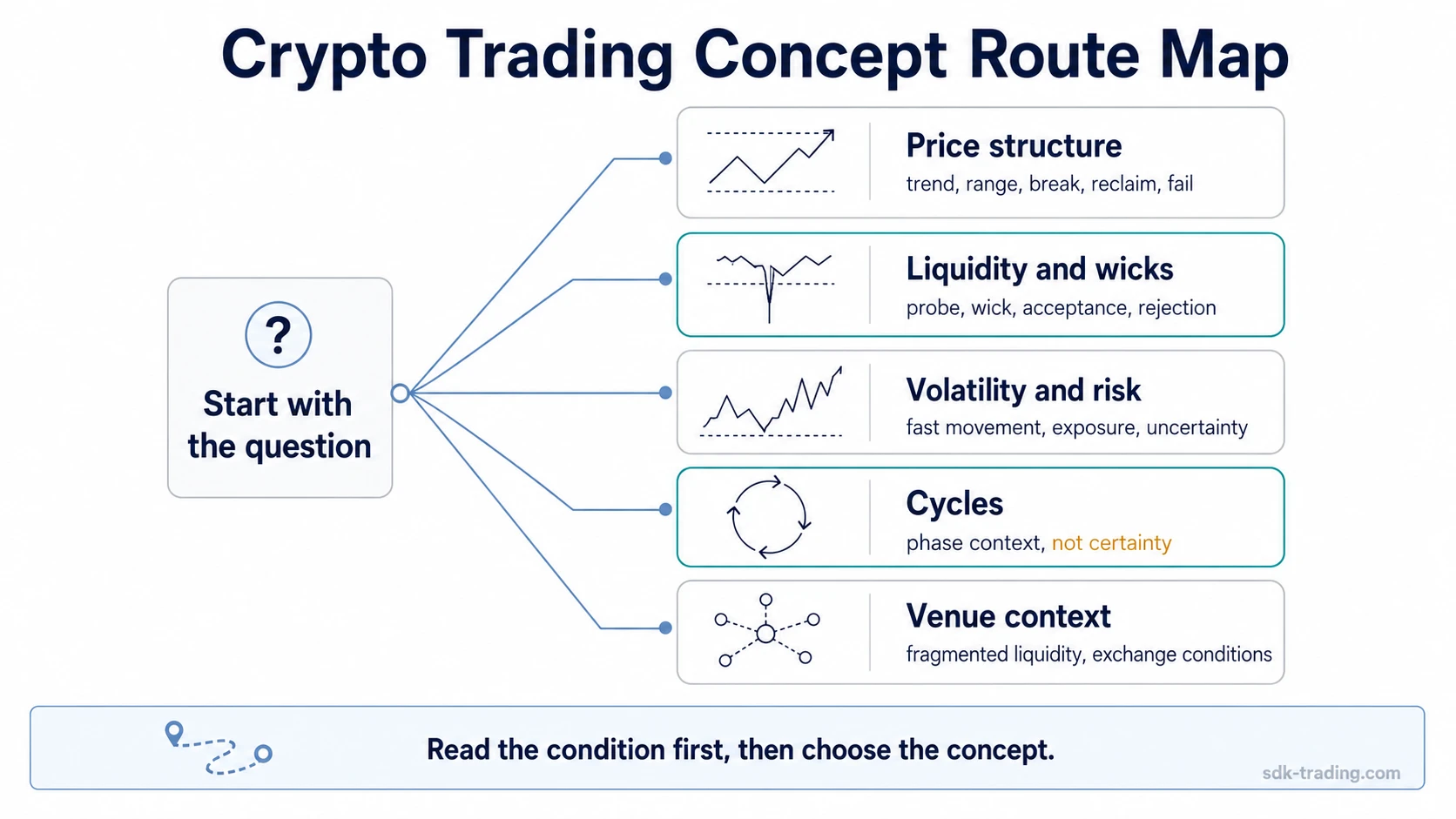
A Simple Crypto Trading Concept Path
Price pushes through a visible prior high, leaves a long upper wick, and then fails to hold above the tested area. A quick label can be misleading here: breakout, rejection, liquidity sweep, and failed acceptance can all sound plausible before the next structure is clear.
If the issue is the long wick, liquidity deserves the first look. If the issue is whether the move changed the trend, structure deserves the first look. If the issue is the speed of the move and the size of the possible damage, risk deserves the first look. If the move is being explained only by a broad cycle story, cycle context should stay secondary until price behavior supports it.
This concept path prevents a common beginner mistake: assigning one dramatic candle too much meaning before the market has shown whether the tested area was accepted, rejected, or still unresolved.
Common Mistakes in Crypto Trading
Crypto trading often feels more accessible than other markets because platforms are easy to find and charts are always moving. Accessibility can create false confidence when preparation, structure, and risk are still weak.
| Mistake | Why it happens | Safer interpretation |
|---|---|---|
| Treating platform access as a plan | An exchange account can make participation feel simple. | Access is only infrastructure. The decision process still needs structure, risk, and invalidation logic. |
| Reading every wick as a signal | Crypto charts often produce sharp probes and fast reversals. | A wick matters more when follow-up behavior clarifies whether the tested area was accepted or rejected. |
| Confusing volatility with opportunity | Large candles can make movement look more meaningful than it is. | Volatility increases both possible movement and interpretation risk. |
| Using cycle stories as certainty | Crypto markets are often discussed through broad boom-and-bust phases. | Cycle context is useful only when price structure, liquidity, and risk conditions support the interpretation. |
| Ignoring liquidation pressure | Sharp moves can be explained as normal trend continuation. | Forced flows can accelerate movement without proving durable acceptance. |
Crypto Trading Risk and Limitations
Crypto trading carries market risk, liquidity risk, venue risk, leverage risk, and interpretation risk. These risks can overlap. A fast move can occur during thin liquidity, a wick can trigger a false read, and a cycle narrative can make a trader overconfident before structure confirms the phase.
Liquidity is best treated as background pressure, not as a direct timing tool. A liquidity observation can help explain why a move occurred, but it does not define a trade, a direction, or a reliable outcome by itself.
Risk management does not remove risk. It limits how much uncertainty is allowed to damage the process. In crypto markets, that distinction matters because continuous trading, volatility bursts, and liquidation pressure can change conditions quickly.
Limitation: Crypto market behavior can remain unresolved even after a large move. A strong candle, sharp wick, or popular cycle explanation is not enough unless price behavior, structure, liquidity context, and risk conditions point to the same reading.
FAQ
What is crypto trading in simple terms?
Crypto trading is the analysis and participation in cryptocurrency price movement. The practical focus is reading price behavior, volatility, liquidity, structure, and risk rather than reacting only to coin narratives or platform access.
How is crypto trading different from crypto investing?
Crypto trading usually focuses on price behavior, timing context, and risk control over a more conditional horizon. Crypto investing or holding usually depends more on ownership, thesis, adoption assumptions, and a longer-term view.
Why do crypto charts often have sharp wicks?
Sharp wicks can appear when liquidity is fragmented, volatility expands, or forced flows move price beyond a visible area before the market accepts that area. A wick needs follow-up behavior before it becomes meaningful.
What should beginners understand before crypto trading?
Beginners should first understand structure, liquidity, volatility, cycles, and risk. Choosing an asset or platform before understanding those concepts can create false confidence.
Are crypto market cycles reliable?
Crypto market cycles can provide useful context, but they are not guarantees. A cycle label should remain secondary to price structure, liquidity conditions, risk, and confirmation or invalidation.