A liquidity sweep is a market-structure event where price clears a visible high, low, or boundary where liquidity may be clustered, then later behavior around that old level shows whether the move was accepted or failed. The sweep itself is not a prediction. The reading depends on the quality of the prior boundary, the probe through it, and whether price accepts beyond that area or returns back inside prior structure.
Key Points
- A liquidity sweep clears a visible high, low, range edge, or repeated boundary where liquidity may be clustered.
- The reading depends on later acceptance or failed acceptance, not on one wick alone.
- A clean reading needs a visible prior liquidity area, a meaningful probe, and coherent behavior after the sweep.
- A liquidity sweep is not automatically a trade signal, reversal signal, or proof of institutional intent.
What Is a Liquidity Sweep?
A liquidity sweep is a move through a visible liquidity area, such as a prior swing high, prior swing low, range edge, or repeated boundary, followed by a reaction that helps define whether the move failed or became accepted. In trading language, the swept area is usually a zone where resting orders may exist because many participants can see the same level.
Liquidity sweep definition: a liquidity sweep happens when price moves through a visible liquidity area and then must be judged by the next behavior around that old boundary. If price fails to accept outside the level and returns back inside the prior structure, the sweep reading becomes stronger. If price accepts beyond the level and continues to develop there, the failed-sweep reading weakens or becomes invalid.
The crossing creates the sweep condition, but the later treatment of the old boundary decides whether the reading is clean, weak, or invalid.
A visible liquidity cluster can help explain where a sweep may occur, but it does not predict reversal by itself. The area only gives context. The later behavior supplies the more important evidence.
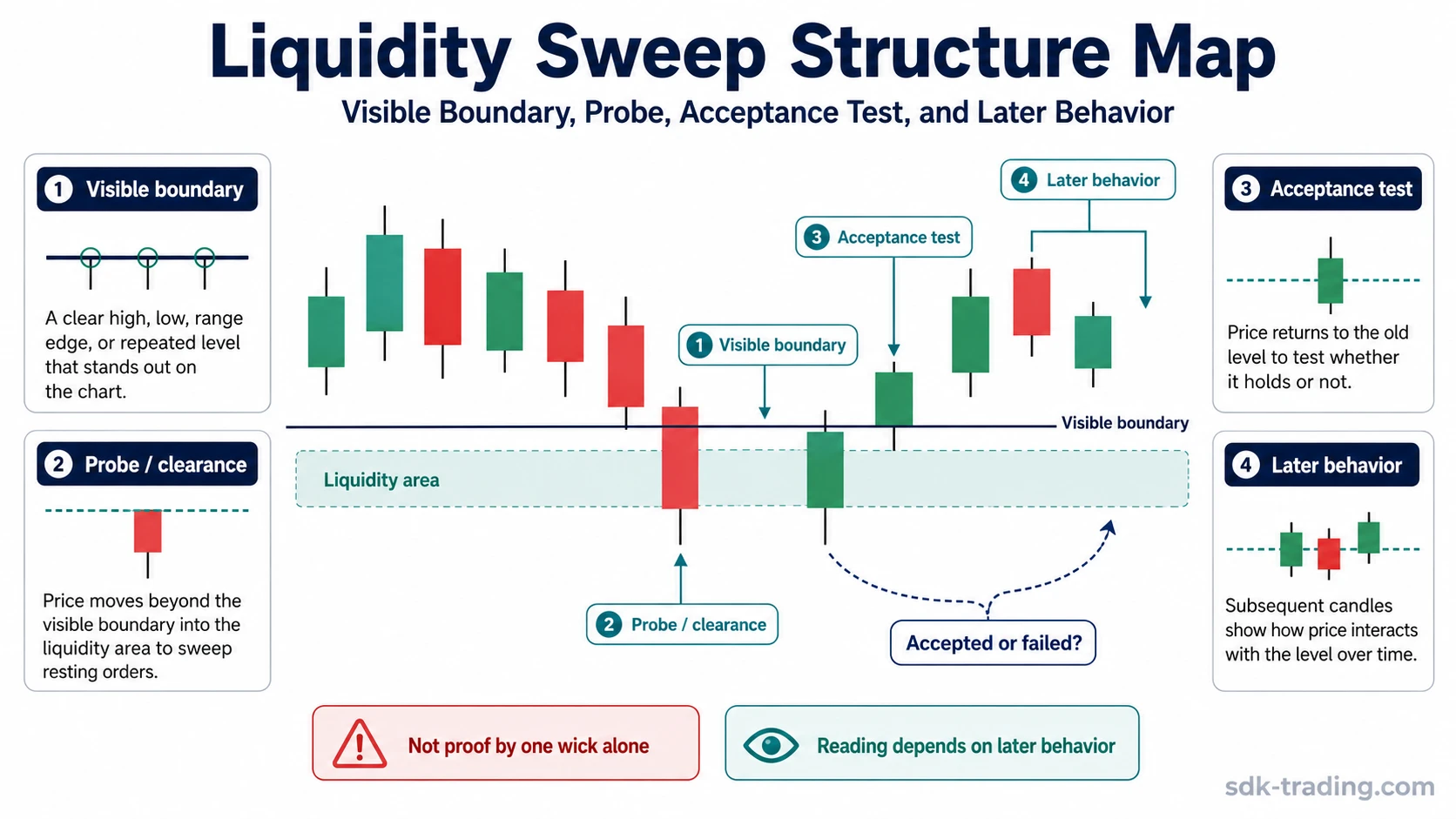
How a Liquidity Sweep Forms Around Highs and Lows
A liquidity sweep usually begins with a level that many traders can identify. That level may be a recent swing high, recent swing low, equal highs, equal lows, a range boundary, or a support and resistance area that has already produced a visible reaction. The more obvious the boundary, the easier it is for orders to cluster around it.
When price pushes above a visible high, the move may interact with buy-side liquidity because orders often accumulate above prior highs. When price pushes below a visible low, the same logic applies in the opposite direction, with sell-side liquidity often discussed below prior lows.
The basic sequence is simple:
| Stage | What happens | Why it matters |
|---|---|---|
| Visible boundary | Price reacts near a high, low, or range edge that other traders can also see. | The boundary gives the sweep a meaningful reference point. |
| Probe or clearance | Price moves beyond the old level and clears the nearby liquidity area. | The move creates the sweep condition, but not the final interpretation. |
| Acceptance test | Price either holds beyond the old boundary or fails and returns through it. | This is where the reading becomes stronger, weaker, or invalid. |
| Later structure | Price either develops outside the level or re-enters the prior structure. | Later behavior separates failed acceptance from accepted continuation. |
A common scenario is a market repeatedly reacting near a visible high. Price later moves above that area, clears the visible liquidity zone, and then either holds above the old boundary or falls back below it. The reading depends on that later behavior, not on the wick alone.
How to Identify a Liquidity Sweep
A liquidity sweep is easier to identify when the chart shows a clear boundary before the sweep occurs. Without a visible prior level, the move may be ordinary volatility rather than a meaningful sweep. The level does not need to be exact to the tick, but it should be clear enough that other participants could reasonably recognize it.
1. Start With a Visible Boundary: The first condition is a visible high, low, range edge, or repeated reaction area. A random wick in open space is not enough. The sweep needs a reference area that was already meaningful before price moved through it.
2. Check Whether Price Actually Clears the Area: The second condition is a real probe beyond the boundary. This may appear as a wick, a fast push, or a short expansion through the old level. The important detail is that price reaches beyond the area where visible liquidity may have been resting.
3. Watch the Acceptance Test: The third condition is later behavior. A liquidity sweep reading strengthens when price fails to accept beyond the old level and returns back through it. The reading weakens when price stays beyond the boundary, builds structure there, and treats the old level as accepted territory.
4. Separate the Event From the Interpretation: The event is the clearance through the liquidity area. The interpretation comes after the event. Calling the sweep too early often creates false positives because a valid breakout and a failed liquidity sweep can look similar at the first moment of the probe.
Diagnostic note: a wick through a level may be evidence, but it is not enough by itself. The reading becomes more useful when the prior boundary is visible, the sweep is meaningful, and later price behavior either rejects or accepts the old level.
Liquidity Sweep Example
A simple liquidity sweep example starts with price reacting several times near the same visible high. Price then pushes above that high, clears the area where buy-side liquidity may be resting, and later either accepts above the old boundary or returns back below it. If price returns back inside the prior structure after failing to hold above the level, the failed-acceptance reading becomes stronger. If price holds above the old boundary and continues to develop there, the move behaves more like accepted development than a failed sweep.
Clean, Weak, and Invalid Liquidity Sweep Readings
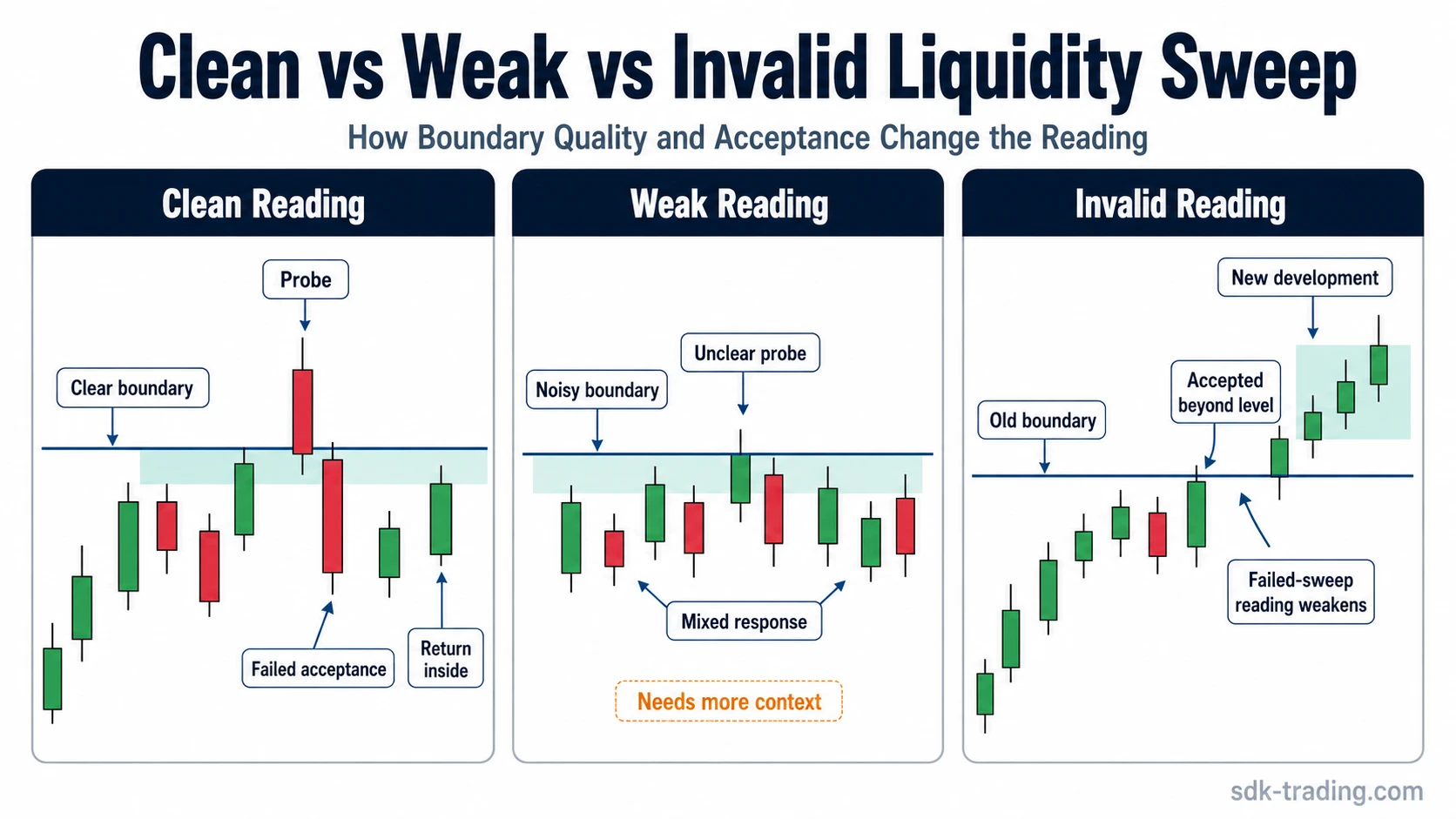
The strongest way to read a liquidity sweep is to judge the full boundary sequence rather than the candle shape alone. A clean reading, a weak reading, and an invalid reading can all begin with price moving beyond a visible level. The difference is what happens next.
| Reading quality | What price does | What supports the interpretation | What weakens or invalidates it | Common mistake |
|---|---|---|---|---|
| Clean liquidity sweep | Price clears a visible high, low, or boundary, then fails to accept outside it and returns back inside prior structure. | The prior boundary was clear, the probe was meaningful, and later behavior shows failed acceptance. | The reading weakens if the boundary was unclear or the return back inside structure is not coherent. | Assuming the wick alone is the full confirmation. |
| Weak liquidity sweep | Price moves beyond a possible level, but the boundary is noisy, the reaction is unclear, or later structure gives mixed evidence. | There may be some visible liquidity context, but not enough clean structure to make the reading strong. | The reading weakens if the level was selected only after the move happened. | Using hindsight to label any sharp move as a sweep. |
| Invalid sweep reading | Price clears the old boundary and then accepts beyond it, builds structure outside it, or continues development through the level. | The original sweep event may still have occurred, but the failed-sweep interpretation no longer fits. | Accepted development beyond the old level invalidates the failed-acceptance reading. | Calling an accepted breakout a sweep because price first crossed a liquidity area. |
This distinction prevents a common error: treating every move through a prior high or low as a failed move. Some sweeps fail and return. Some probes become accepted breaks. Some moves are too noisy to classify cleanly.
Liquidity Sweep vs Liquidity Grab
Liquidity sweep and liquidity grab are closely related labels, but they are not always used the same way. A liquidity grab is often used for a shorter, more wick-like test of nearby liquidity. A liquidity sweep is usually read through the broader boundary sequence: visible liquidity area, clearance, acceptance or failed acceptance, and later structure.
| Concept | Main focus | Typical reading | Key limitation |
|---|---|---|---|
| Liquidity sweep | Price clears a visible liquidity area and is judged by acceptance or failed acceptance. | Boundary event plus later structural behavior. | Not every sweep means reversal. |
| Liquidity grab | Brief probe beyond a nearby high, low, or liquidity pocket. | Often more wick-like and localized. | Can be overused when the prior level is not meaningful. |
The overlap is real. Both terms can describe price moving beyond a level where orders may be resting. The cleaner distinction is that a liquidity sweep should be judged by the full boundary behavior, not only by the initial probe.
Liquidity Sweep vs Breakout or Break of Structure
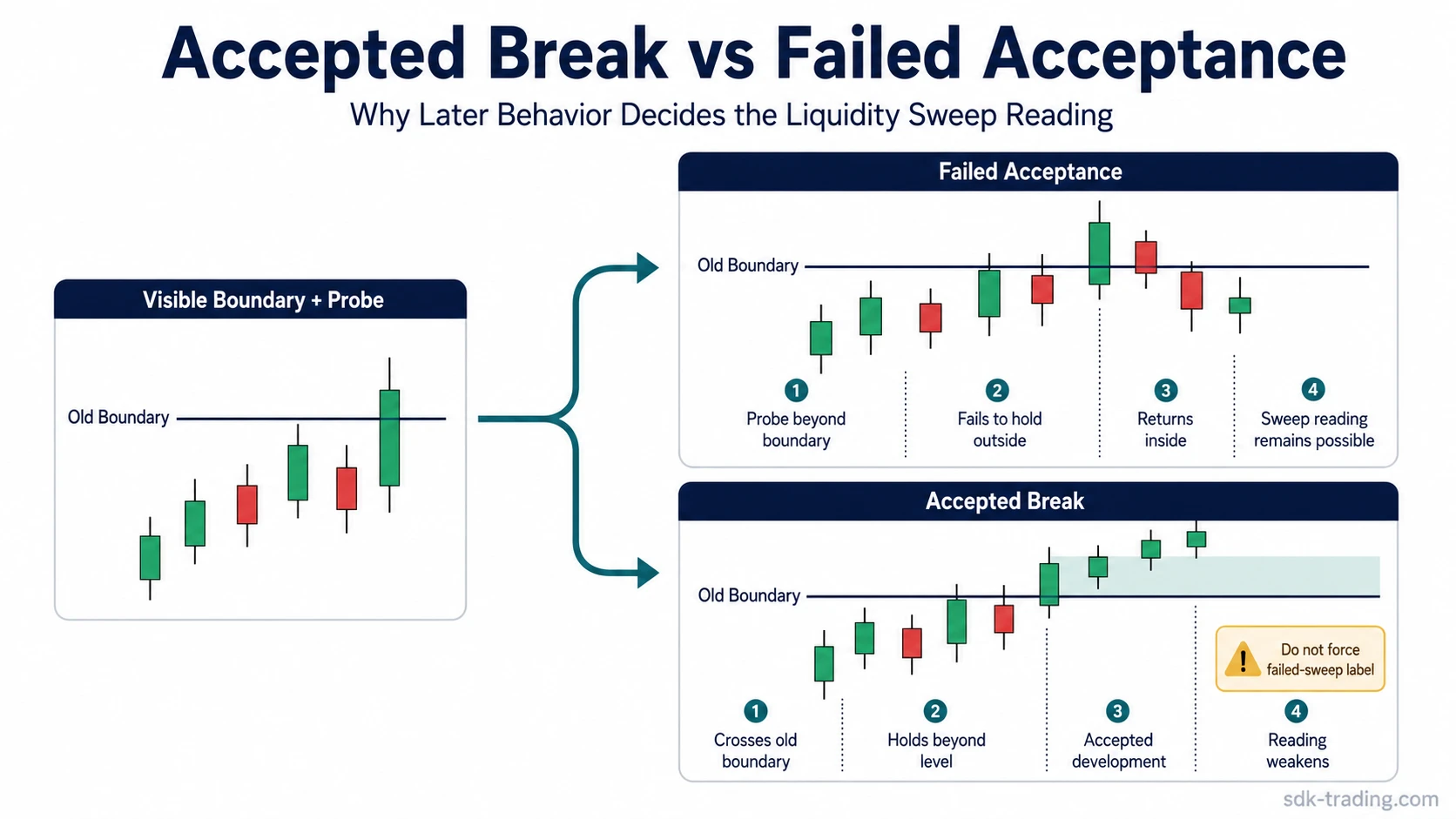
A liquidity sweep and an accepted breakout can begin with the same visible action: price moves beyond an old high, low, or range edge. The difference appears after the move through the level. Failed acceptance supports the sweep reading. Accepted development supports the breakout or break-of-structure reading.
If price pushes above an old high and quickly returns below it, the sweep reading may become stronger. If price pushes above the high, holds there, forms structure above it, and continues to treat the old level as accepted, the failed-sweep interpretation becomes weaker.
| Reading | Boundary behavior | Later evidence | Interpretation risk |
|---|---|---|---|
| Liquidity sweep | Price clears the old boundary. | Price fails to accept outside the level and returns back inside prior structure. | Calling it too early before acceptance or failure is visible. |
| Accepted breakout / BOS | Price clears the old boundary. | Price accepts beyond the level and continues to develop outside the old range. | Mislabeling a valid accepted move as a failed sweep. |
| Liquidity void | Price moves quickly through an area with little visible two-way trading. | The focus is displacement or inefficiency, not only the sweep of a boundary. | Confusing fast movement with a liquidity sweep when no clear prior boundary exists. |
This is why acceptance matters. The same initial clearance can become a failed move, an accepted break, or simply a noisy expansion depending on what price does after the old boundary is crossed.
Buy-Side and Sell-Side Liquidity Sweep
A buy-side liquidity sweep occurs when price moves above a visible high or upper boundary where buy-side orders may be clustered. This can happen around prior swing highs, equal highs, or the upper edge of a range. The later reading depends on whether price accepts above that old area or fails and returns below it.
A sell-side liquidity sweep occurs when price moves below a visible low or lower boundary where sell-side orders may be clustered. This can happen around prior swing lows, equal lows, or the lower edge of a range. The same rule applies: the sweep is not complete as an interpretation until later behavior around the old level is visible.
| Sweep type | Where it occurs | What to observe next |
|---|---|---|
| Buy-side liquidity sweep | Above a visible high, equal highs, or upper range boundary. | Whether price accepts above the old high or fails and returns below it. |
| Sell-side liquidity sweep | Below a visible low, equal lows, or lower range boundary. | Whether price accepts below the old low or fails and returns above it. |
The direction of the sweep describes which side of the visible structure was cleared. It does not automatically describe what price must do next.
Common Mistakes When Reading Liquidity Sweeps
The most common mistake is treating every wick beyond a level as a liquidity sweep. A wick can be part of the evidence, but the old boundary must matter first. If the boundary is weak, random, or selected only after the move, the sweep label becomes unreliable.
| Mistake | What goes wrong | Safer reading |
|---|---|---|
| Ignoring boundary quality | Price moves through a level that was not clearly meaningful before the move. | Start with a visible prior high, low, range edge, or repeated reaction area before using the sweep label. |
| Assuming reversal | The sweep is treated as if it automatically means price must reverse. | Wait for failed acceptance or accepted development around the old boundary before judging the move. |
| Reading motive into the chart | The move is used as proof of institutional intent or deliberate stop hunting. | Keep the reading structural: boundary, probe, acceptance or failure, and later development. |
| Treating clusters as predictions | A visible liquidity area is treated as if it predicts the next move. | Use the cluster as context only. The next behavior around the level supplies the stronger evidence. |
| Confusing sweep with displacement | Any fast price movement is labeled as a liquidity sweep, even without a clear prior boundary. | Use the sweep label only when price clears a visible liquidity area. Fast movement without a boundary may be better read as displacement or imbalance. |
When a Liquidity Sweep Reading Becomes Invalid
A liquidity sweep reading becomes invalid when the later structure no longer supports failed acceptance. If price clears the old boundary and then builds accepted structure outside it, the market is no longer behaving like it rejected the swept area.
Invalidation logic: the sweep event may still be visible historically, but the failed-sweep interpretation weakens when price accepts beyond the old boundary. Accepted development changes the reading from failed liquidity test toward breakout, continuation, or a different structure.
This matters because a sweep label can become stale. A move that initially looked like a failed probe may later become accepted. The interpretation should update with the structure instead of forcing the original label to remain active.
Liquidity Sweep FAQ
What is a liquidity sweep?
A liquidity sweep is a market-structure event where price clears a visible high, low, or boundary where liquidity may be clustered, then later behavior around the old level shows whether the move was accepted or failed.
How do you spot a liquidity sweep?
Start with a visible prior boundary, then check whether price meaningfully clears that area. The reading becomes stronger when price fails to accept outside the old level and returns back inside prior structure.
Is a liquidity sweep the same as a liquidity grab?
The terms overlap, but a liquidity grab is often used for a shorter, more wick-like probe. A liquidity sweep is better judged through the full boundary sequence: visible level, clearance, acceptance or failed acceptance, and later structure.
Does a liquidity sweep guarantee reversal?
No. A liquidity sweep does not guarantee reversal. Price can reject the swept area, accept beyond it, or remain too noisy to classify cleanly. The later structure determines how strong the reading is.
What invalidates a liquidity sweep reading?
A failed-sweep reading becomes invalid when price accepts beyond the old boundary and continues to develop there. In that case, the move behaves more like accepted development than failed acceptance.