A liquidity grab is a brief probe beyond a visible high, low, or liquidity boundary that fails to accept outside the level and returns inside the prior structure.
The term describes observable price behavior. A clean reading needs a visible reference area, a temporary move beyond it, failed acceptance outside that area, and a return that shows the former range still has relevance. The probe alone is not enough.
A liquidity grab can appear above a prior high, below a prior low, or around a repeated boundary where orders may cluster. It can precede a reversal, a pause, or a later continuation, so the label should stay tied to structure rather than prediction.
Key Points
- A liquidity grab starts with a visible high, low, or boundary that attracts attention.
- The move must probe beyond that area and then fail to accept outside it.
- A single wick does not create a clean liquidity grab by itself.
- The reading weakens when the boundary is noisy, the return is slow, or price keeps building outside the old level.
- The reading becomes invalid when price accepts beyond the old boundary and forms new structure there.
What Is a Liquidity Grab?
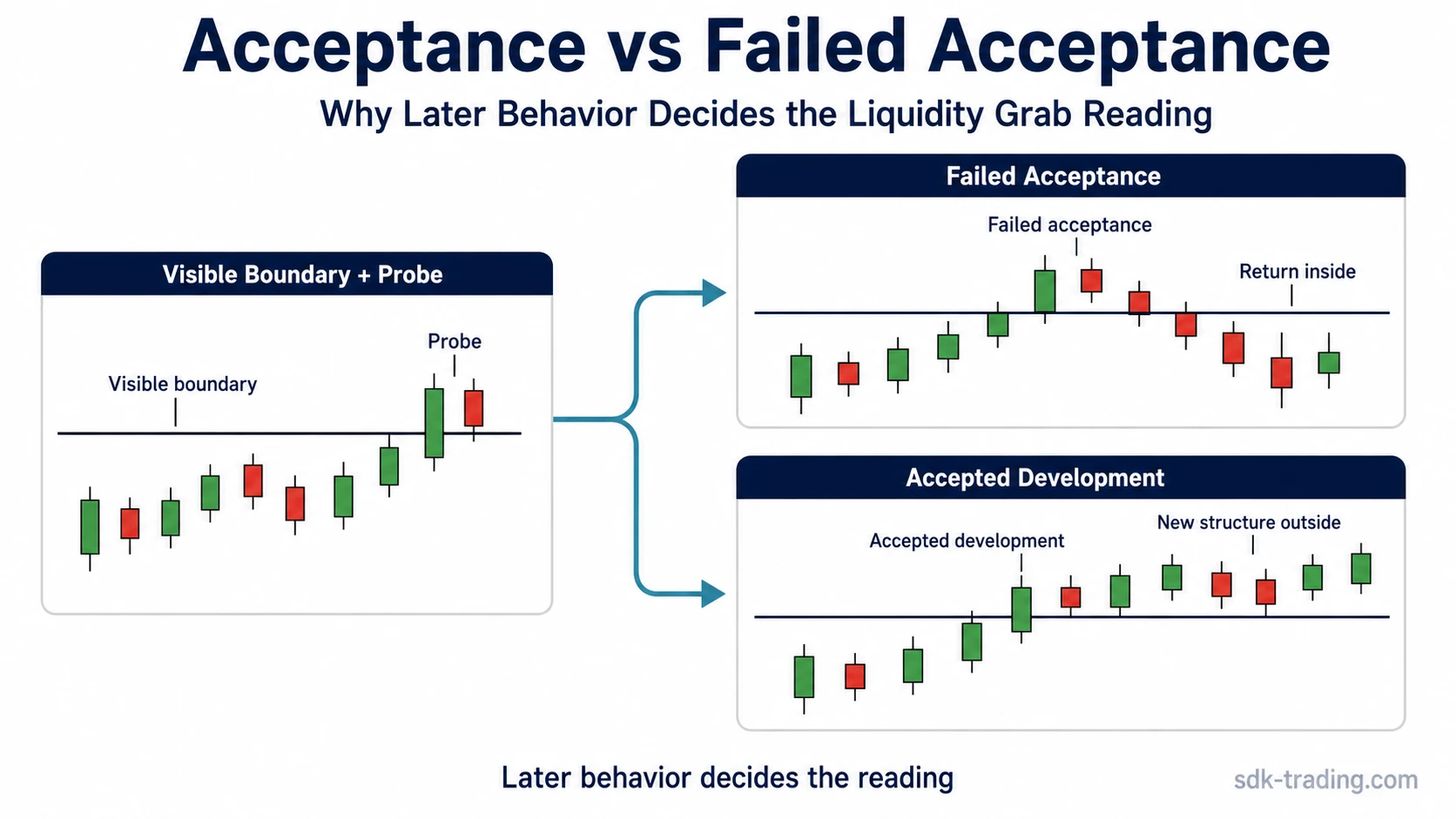
A liquidity grab is a market-structure event where price moves beyond a visible level, tests the area where liquidity may be resting, and then returns inside the prior structure. The important feature is not exact price equality. The important feature is whether price can stay accepted beyond the level after the probe.
For example, several swing highs may form around the same upper area. If price pushes above that area, fails to hold above it, and moves back below the boundary, the move may be read as a liquidity grab. The same logic can apply below visible lows when price briefly trades through the lower boundary and then returns above it.
| Diagnostic question | Liquidity grab answer |
|---|---|
| What is tested? | A visible high, low, or liquidity boundary. |
| What happens? | Price probes beyond the visible area. |
| What makes it a grab? | Failed acceptance outside the level and return inside the prior structure. |
| What is not enough? | One wick without boundary quality or return behavior. |
| What invalidates it? | Acceptance or sustained development beyond the old boundary. |
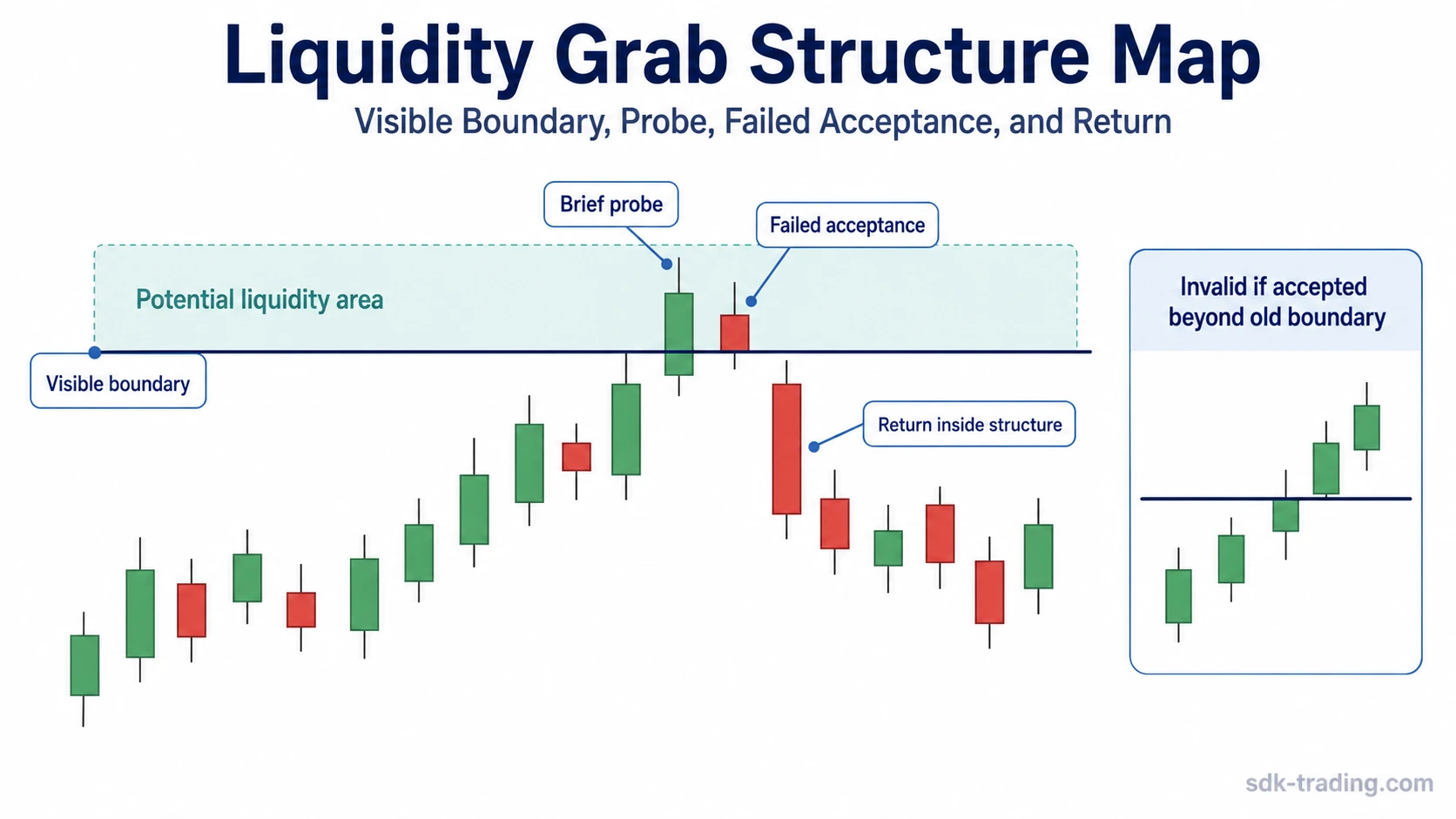
How a Liquidity Grab Forms
The sequence starts with a level that is visible enough for many traders to notice. That level can be a prior high, prior low, equal-high area, equal-low area, range edge, or another repeated boundary. The more visible the boundary, the more likely it is that orders may be positioned around it.
Above visible highs, the relevant area often overlaps with liquidity above visible highs. Below visible lows, the same logic can apply to sell-side pressure around a lower boundary. The reading stays structural only if price fails to keep building beyond the probed area.
- A visible high, low, or boundary forms.
- Orders may cluster beyond that visible area.
- Price moves through the boundary.
- The move fails to hold or develop outside the level.
- Price returns inside the prior structure.
- The reading stays clean, weakens, or becomes invalid depending on later acceptance behavior.
A fast return inside the previous range supports the liquidity grab reading. A slower return, several overlapping closes outside the level, or new structure beyond the boundary makes the reading weaker.
How to Identify a Liquidity Grab
The strongest liquidity grab readings come from a clean boundary and a clear failure to accept beyond it. A random spike in the middle of a messy range is weaker because there is no obvious reference point being tested.
| Observation | Stronger reading | Weaker reading |
|---|---|---|
| Boundary quality | Clearly visible high, low, or repeated boundary. | Random wick without an obvious reference area. |
| Probe behavior | Brief move beyond the level. | Choppy movement around the level. |
| Acceptance | Failed acceptance beyond the boundary. | Multiple closes or development outside the old area. |
| Return | Price moves back inside the prior structure. | Price remains outside or starts forming new structure. |
| Follow-through | The old boundary still affects interpretation. | The reading becomes ambiguous or invalid. |
The same price spike can carry different meaning depending on boundary quality. A wick through a well-defined range edge has more diagnostic value than a wick through an area where price has already been overlapping for many candles.
Liquidity Grab vs Liquidity Sweep
A liquidity grab is a narrower reading around a visible boundary probe, failed acceptance, and return inside prior structure. A liquidity sweep is a closely related concept that often emphasizes the clearing of resting liquidity beyond a visible high or low.
The two terms can overlap, but they should not be treated as identical in every case. A grab reading is strongest when the old boundary remains useful after the probe. A sweep reading focuses more on the liquidity-clearing action beyond a visible level, while a grab reading depends on whether price fails to stay accepted beyond the boundary.
| Feature | Liquidity grab | Liquidity sweep |
|---|---|---|
| Main focus | Boundary probe and failed acceptance. | Clearing liquidity beyond a visible area. |
| Best use | Reading whether a probe returned into prior structure. | Reading whether resting liquidity was swept around a known level. |
| Overlap | Can include a sweep-like move. | Can include a grab-like failed acceptance. |
| Main risk | Calling every wick a grab. | Calling every level break a sweep. |
Clean, Weak, and Invalid Liquidity Grab Readings
A liquidity grab is not a fixed label that remains valid after any later behavior. The reading can become cleaner, weaker, or invalid depending on how price behaves around the old boundary after the probe.
| Reading | Structure | Interpretation |
|---|---|---|
| Clean | Visible boundary, brief probe, failed acceptance, return inside range. | The liquidity grab reading is structurally coherent. |
| Weak | Noisy boundary, dispersed highs or lows, slow return, overlapping candles. | A liquidity test is possible, but the structure is not clean. |
| Invalid | Price accepts above or below the old boundary or builds structure outside it. | The prior grab reading is no longer the cleanest explanation of the move. |
The cleanest version is a brief failure outside a level that quickly returns to the old range. The weakest version is a messy break where price keeps rotating around the boundary with no clear rejection or acceptance. The invalid version is a successful acceptance beyond the old level.
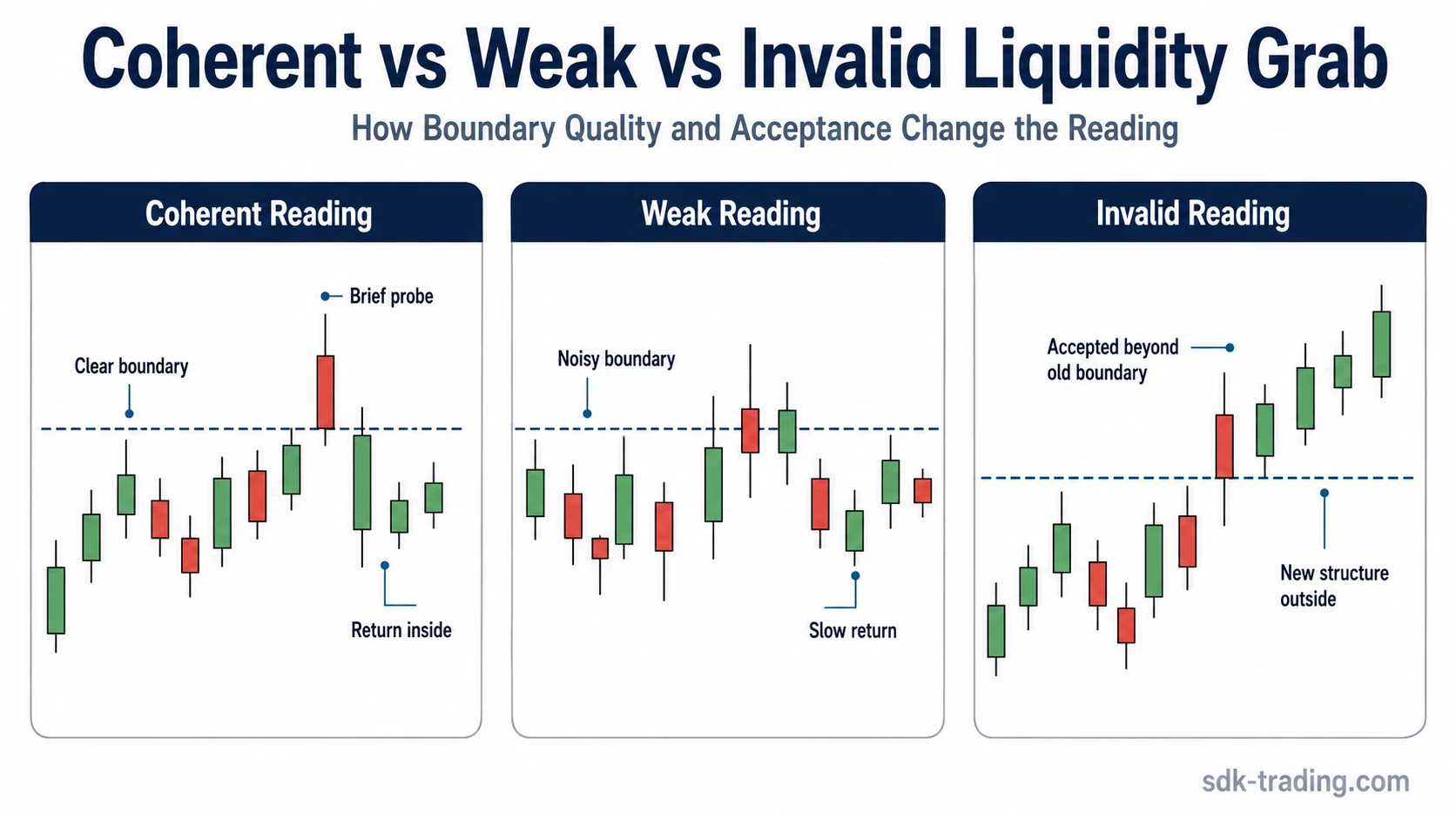
Liquidity Grab Example
Assume price has formed several highs near the same upper boundary. The area above those highs may contain resting orders because the level is easy to see. Price then pushes slightly above the boundary, trades briefly in the upper area, and returns below the old highs.
If price cannot keep closing above that upper area, the probe may be read as a liquidity grab. The reading weakens if price spends more time above the old highs, keeps accepting in the upper area, or begins forming higher structure there.
This differs from a liquidity void, where the main issue is thin movement through an area with limited two-way trading. A liquidity grab focuses on a visible boundary test and the acceptance or rejection around that boundary.
Common Misunderstandings
Most false readings come from treating the first break as the final answer. A probe is only the first part of the structure. The reading needs boundary quality and later behavior around the level.
| Misreading | Cleaner interpretation |
|---|---|
| Every wick beyond a high or low is a liquidity grab. | A wick needs a visible boundary, failed acceptance, and return behavior. |
| The highs or lows must match exactly. | The relevant area is usually a zone or boundary, not an exact tick. |
| A liquidity grab always means reversal. | A failed probe can precede reversal, consolidation, or later continuation. |
| Institutional motive can be known from the candle. | The safer reading is observable structure, not assumed motive. |
| A sustained breakout is still a grab. | Acceptance beyond the old level can invalidate the grab reading. |
| Liquidity grab and liquidity sweep are always the same thing. | They overlap, but the grab label depends on failed acceptance around a boundary. |
Related Liquidity Concepts
Liquidity grab sits near resting orders, buy-side liquidity, liquidity sweep, and liquidity void. Resting orders may cluster around visible highs and lows. Buy-side liquidity is relevant above visible highs, while a liquidity sweep focuses on liquidity-clearing beyond a visible level.
Liquidity void is different because it describes thin movement through an area rather than a boundary probe by itself. The practical distinction is that a liquidity grab is judged by the relationship between the old boundary, the probe beyond it, and the acceptance behavior that follows.
FAQ
Is a liquidity grab the same as a liquidity sweep?
No. The terms overlap, but a liquidity grab focuses on a visible boundary probe, failed acceptance, and return inside prior structure. A liquidity sweep emphasizes liquidity clearing beyond a visible high or low.
Can a liquidity grab become a real breakout?
Yes. If price accepts beyond the old boundary and starts building structure there, the old liquidity grab reading can become invalid. The move is then better read as accepted development beyond the prior level.
Does a liquidity grab always mean reversal?
No. A liquidity grab can appear before a reversal, but it can also lead to consolidation or later continuation. The label describes failed acceptance around a boundary, not a guaranteed outcome.
What invalidates a liquidity grab reading?
The reading is invalidated when price accepts beyond the old boundary, keeps closing outside it, or forms new structure above or below the level that was expected to reject the probe.