Financial markets turn willingness to buy or sell into actual transactions through orders, available liquidity, and execution rules. The important distinction is that an order, a displayed quote, and a completed trade are different stages of the process.
Core mechanism: an order reaches a market or liquidity source, interacts with available buying or selling interest, and executes when compatible prices and quantities are available. Each execution can change the remaining quotes and depth, so the next order interacts with a different market state.
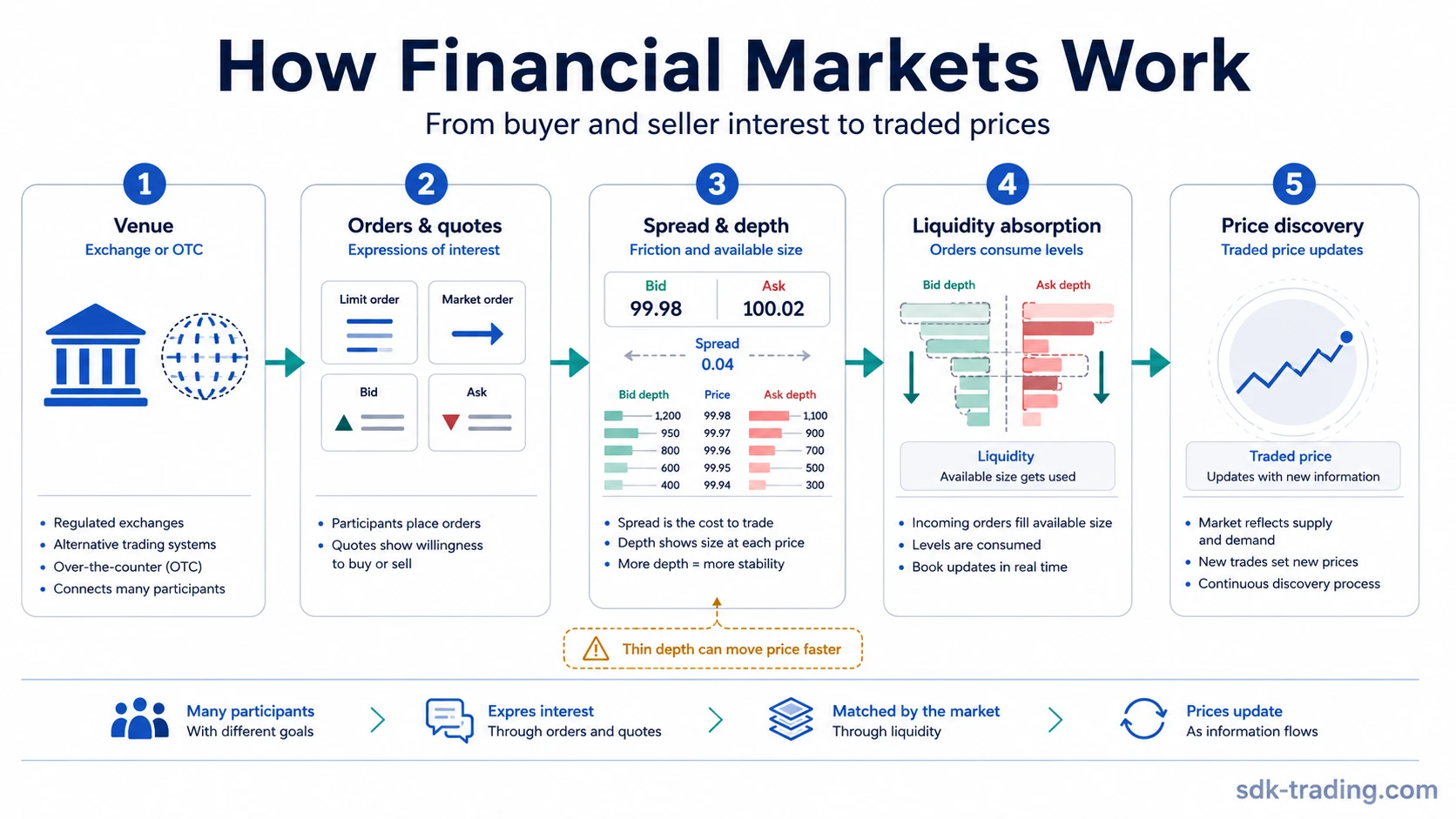
Order, Quote, Trade, and Price Are Different
Several values can appear on a trading screen at the same time, but they do not describe the same event.
| Market element | What it represents | What it does not guarantee |
|---|---|---|
| Order | An instruction to buy or sell under defined conditions. | Submission alone does not mean a trade has occurred. |
| Bid | A displayed price at which buying interest is available. | It does not mean every sell order will execute entirely at that price. |
| Ask | A displayed price at which selling interest is available. | It does not mean unlimited quantity is available there. |
| Execution | A completed transaction at a specific price and quantity. | One execution does not show all remaining liquidity. |
| Last traded price | The price of the most recent completed transaction. | It is not necessarily the same as the current bid, ask, or next execution price. |
Useful distinction: when someone says “the market price,” check whether they mean the latest trade, the current bid or ask, the midpoint, or the price available for the quantity they actually want to execute.
How an Order Becomes a Trade
The process can be reduced to a short sequence.
| Stage | What happens |
|---|---|
| 1. Order instruction | A participant specifies a side, quantity, and order conditions. |
| 2. Market access | The order is routed into the relevant exchange, dealer, broker, or other execution process. |
| 3. Liquidity check | The order encounters available opposite-side interest at one or more prices. |
| 4. Execution | Compatible buying and selling interest completes a transaction for the quantity available. |
| 5. Market update | Executed quantity is removed, new orders may arrive, existing orders may change or disappear, and the visible bid, ask, or depth can update. |
| 6. Price discovery continues | The next participant acts against the new set of available prices and quantities. |
Market Orders and Limit Orders Use Liquidity Differently
A market order prioritizes execution against available liquidity. It does not specify one guaranteed execution price, so a sufficiently large order can trade across more than one price level when the quantity available at the best quote is limited. SEC investor guidance makes the same distinction between market orders and price-controlled limit orders. :contentReference[oaicite:2]{index=2}
A limit order defines the worst price the trader is willing to accept. Depending on its price and the existing market, it may rest as available liquidity or become immediately executable against interest already available.
| Order behavior | Primary priority | Main limitation |
|---|---|---|
| Market order | Execution | The final execution price can differ from the quote seen before the order reaches the market. |
| Limit order | Price boundary | The order may remain partially filled or completely unfilled if sufficient opposite-side interest never becomes available within the limit. |
Why Depth Matters to the Execution Price
The best bid and ask show the nearest quoted prices, but they do not show unlimited liquidity. Depth describes how much buying or selling interest is available at the best price and at nearby levels. CME’s order-book methodology separately tracks bid prices, ask prices, order quantities, and multiple depth levels for this reason. :contentReference[oaicite:3]{index=3}
If an incoming order is larger than the quantity available at the best price, the remaining quantity may have to interact with the next available level. That is one reason the final average execution price can differ from the first quote visible before the order was submitted.
Simple Execution Example
Assume the sell side currently shows 200 shares at $100.05, another 300 shares at $100.06, and additional liquidity above those prices.
If an immediate buy order for 400 shares reaches that market and no other orders change first, 200 shares could execute at $100.05 and the remaining 200 at $100.06. The order was one instruction, but it produced executions at two prices because the best ask did not contain enough quantity for the entire order.
After those transactions, the old market state no longer exists. Some liquidity has been consumed, the displayed depth has changed, and another incoming order will interact with the updated book.
Common mistake: seeing an ask of $100.05 does not mean every quantity can be bought at $100.05. The displayed price and the quantity available at that price have to be read together.
Why Price Can Move Without a New Headline
New information can change buying and selling decisions, but news is not required for every short-term price change. Price can also move when available liquidity changes.
If sellers remove nearby offers while buyers remain urgent, the next executable sell prices may be higher. If bids disappear while sellers demand immediate execution, transactions may occur progressively lower. The visible movement comes from the interaction between order urgency and the liquidity available at each price.
Limitation: a fast liquidity-driven move does not by itself establish a new trend or broader market regime. Execution mechanics explain how the repricing occurred, not whether the move will persist.
Market Mechanics and Price Drivers Answer Different Questions
Market mechanics explain how a change in buying or selling pressure becomes an execution and a new traded price. Price drivers explain why participants changed their behavior in the first place.
Earnings, economic data, monetary policy, positioning, risk appetite, or unexpected events can change participant behavior. The actual repricing still has to pass through available quotes, liquidity, and executions.
Those conditions also change across market cycles, where participation, volatility, liquidity, and risk appetite may differ from one environment to another.