Trading vs investing separates how capital is used in financial markets: trading focuses on shorter-term price behavior and decision cadence, while investing focuses on longer-term ownership, value development, and portfolio context.
The same stock, ETF, currency pair, or crypto asset can be traded or invested in. The asset does not define the approach. The approach is defined by objective, holding period, evidence, risk exposure, and how often the decision is reviewed.
Core distinction: trading is a shorter-term market decision built around price movement, volatility, structure, and timing. Investing is a longer-term capital allocation decision built around ownership, business quality, valuation, income, or durable value development.
Key Points
- Trading and investing can involve the same asset, but they use different objectives.
- Trading depends more on price behavior, volatility, timing, and review cadence.
- Investing depends more on ownership thesis, valuation, business quality, and longer review periods.
- Neither approach removes risk; the risk appears through different channels.
- Using both approaches requires separated capital, objectives, horizons, and evaluation criteria.
Trading vs Investing: Key Differences
The difference between trading and investing is not only the holding period. Time horizon matters, but the deeper distinction is the decision model. A trader asks whether price behavior, volatility, structure, or market reaction creates a shorter-term opportunity. An investor asks whether ownership is justified by value, business quality, income, growth, or long-term portfolio fit.
Trading decisions are reviewed more frequently because the evidence can change quickly. Investing decisions can tolerate more short-term price movement when the longer ownership thesis remains intact. That does not make investing risk-free, and it does not make trading automatically speculative. Each approach needs evidence that matches its objective.
Market behavior can also change which approach feels more relevant. A fast repricing, earnings reaction, or volatility expansion may matter more to a trader. A longer development in business quality, valuation, cash flow, or portfolio allocation may matter more to an investor. Broader market cycles can affect both approaches, but they do not make the two decisions the same.
Trading vs Investing Comparison Table
The cleanest test is whether the decision is judged by price behavior over a defined review window or by ownership value over a longer thesis period.
| Criterion | Trading lens | Investing lens |
|---|---|---|
| Main objective | Interpret shorter-term price movement, volatility, structure, or market reaction. | Allocate capital toward longer-term ownership, value development, income, or portfolio fit. |
| Typical horizon | Shorter and more variable, from very short-term decisions to multi-week or multi-month positioning. | Longer, often built around years of ownership or a durable thesis. |
| Primary evidence | Price behavior, volume, volatility, market structure, technical context, and reaction to news. | Business quality, valuation, earnings durability, cash flow, balance sheet, income, or asset value. |
| Decision cadence | Reviewed more often because the setup can change quickly. | Reviewed when the ownership thesis, valuation, or risk profile changes. |
| Risk exposure | Timing risk, execution pressure, short-term volatility, and rapid repricing. | Drawdowns, valuation risk, business deterioration, macro changes, and thesis decay. |
| Costs and taxes | More frequent activity may increase transaction costs and can add tax complexity. | Lower turnover can reduce some activity-related costs, but tax treatment still depends on jurisdiction and account structure. |
| Monitoring burden | Higher day to day because price, liquidity, volatility, and invalidation conditions can shift quickly. | Lower day to day, but the ownership thesis still needs periodic review. |
Same Asset, Different Lens
A stock rises sharply after earnings. A trading lens may focus on the immediate price reaction, volatility expansion, gap behavior, volume, and whether buyers continue to accept higher prices after the first move. The question is not whether the company is permanently better. The question is whether the shorter-term market reaction still has structure, follow-through, or failure risk.
An investing lens looks at the same earnings event differently. The focus may shift toward revenue quality, margin durability, balance-sheet strength, valuation, management commentary, and whether the new information changes the longer-term ownership thesis. A one-day price reaction may matter, but it is not enough by itself to define the investment case.
For the investing side, the decision usually needs an investment thesis that connects business evidence, valuation context, risk boundaries, and review conditions rather than only a price reaction.
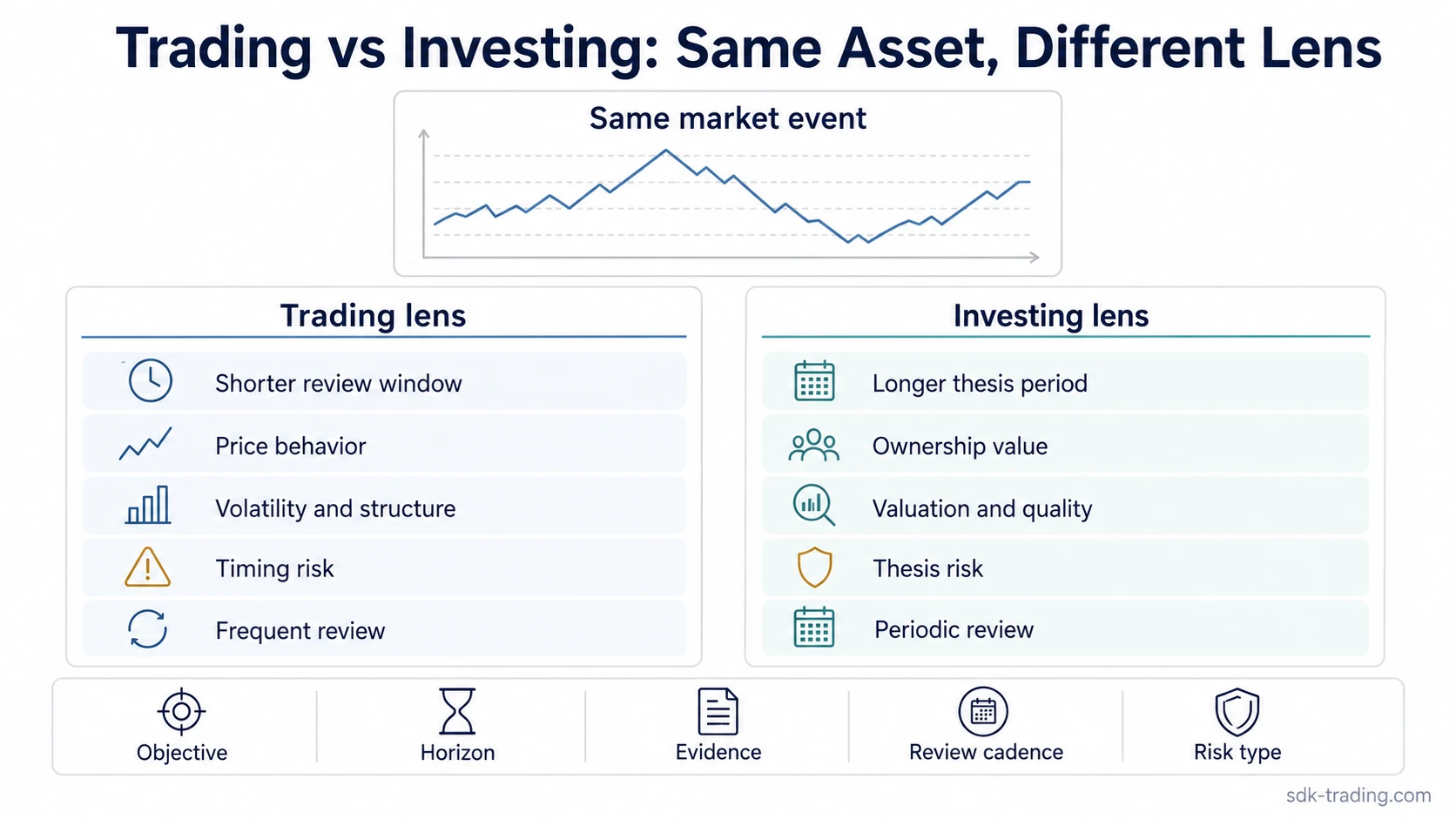
Example of a basic trading vs investing reading: price breaks higher after a strong report, then stalls near a prior resistance area. A trader may treat the stall as information about short-term acceptance or rejection. An investor may treat the same stall as secondary if the long-term thesis improved and valuation remains defensible. The same asset creates two different decisions because the evidence is judged against different time horizons.
When Trading Fits Better
A trading lens fits better when the decision depends mainly on price behavior rather than long-term ownership. This can include volatility after news, short-term market structure, changing momentum, liquidity conditions, or a defined review window. The focus is on how the market is behaving now and what would weaken the shorter-term interpretation.
Trading requires stronger attention to timing and process because small changes in price behavior can change the meaning of the setup. A move that initially looks constructive can become less useful if follow-through fails, volatility expands against the idea, or the market stops accepting the tested area.
| Use the trading lens when… | Why it matters |
|---|---|
| The decision depends on shorter-term price reaction. | The main evidence is market behavior, not long-term ownership value. |
| Volatility, momentum, or market structure is changing quickly. | The interpretation may need frequent review. |
| The holding period is limited by a defined scenario. | The decision is judged by whether that scenario remains intact. |
| Timing quality is central to the decision. | A good idea can still fail if the market reaction does not support it. |
When Investing Fits Better
An investing lens also fits when short-term volatility does not automatically invalidate the reason for holding the asset. A falling price can still matter, but it is judged against valuation, business deterioration, portfolio risk, or thesis quality rather than only against the most recent candle or price swing. For long-term investors, even decisions about continuing a SIP during market falls are usually portfolio-discipline questions rather than short-term price-timing decisions.
Investing does not mean ignoring price. Price still affects valuation, expected return, drawdown risk, and opportunity cost. The difference is that short-term movement is usually judged against the ownership thesis instead of treated as the whole decision.
| Use the investing lens when… | Why it matters |
|---|---|
| The decision depends on longer-term ownership value. | The main evidence is the durability of the asset or business thesis. |
| Valuation, cash flow, earnings quality, or income is central. | Price action alone cannot answer the ownership question. |
| The review period is longer than the latest market reaction. | Short-term volatility may be noise unless it changes the thesis. |
| Portfolio role matters more than immediate timing. | The asset may serve diversification, income, exposure, or long-term compounding goals. |
Why Trading and Investing Are Often Confused
The confusion starts because the same asset can serve both purposes. A person can trade a stock for a short-term reaction, while another person invests in the same stock because of long-term business quality. The transaction may look similar, but the decision logic is different.
Activity level also creates confusion. Frequent buying and selling does not automatically mean a decision is well-structured trading. Holding for a long time does not automatically mean a decision is sound investing. The important question is whether the evidence, horizon, risk, and review process match the stated objective.
Common mistake: switching approaches after the position moves against the original idea. A short-term trade should not become a long-term investment only because price moved unfavorably. A long-term investment should not become a short-term trade only because volatility becomes uncomfortable.
Can Trading and Investing Work Together?
Trading and investing can coexist, but only when they are separated clearly. The cleanest separation is usually by capital bucket, objective, time horizon, review cadence, and evaluation criteria. Without that separation, one approach can quietly override the other.
A market participant might hold a long-term investment position while also making shorter-term trading decisions in a separate account or with a separate allocation. Each decision needs its own evidence. The investment thesis should not be judged by every short-term fluctuation, and a trading decision should not be rescued by a long-term story that was not part of the original plan.
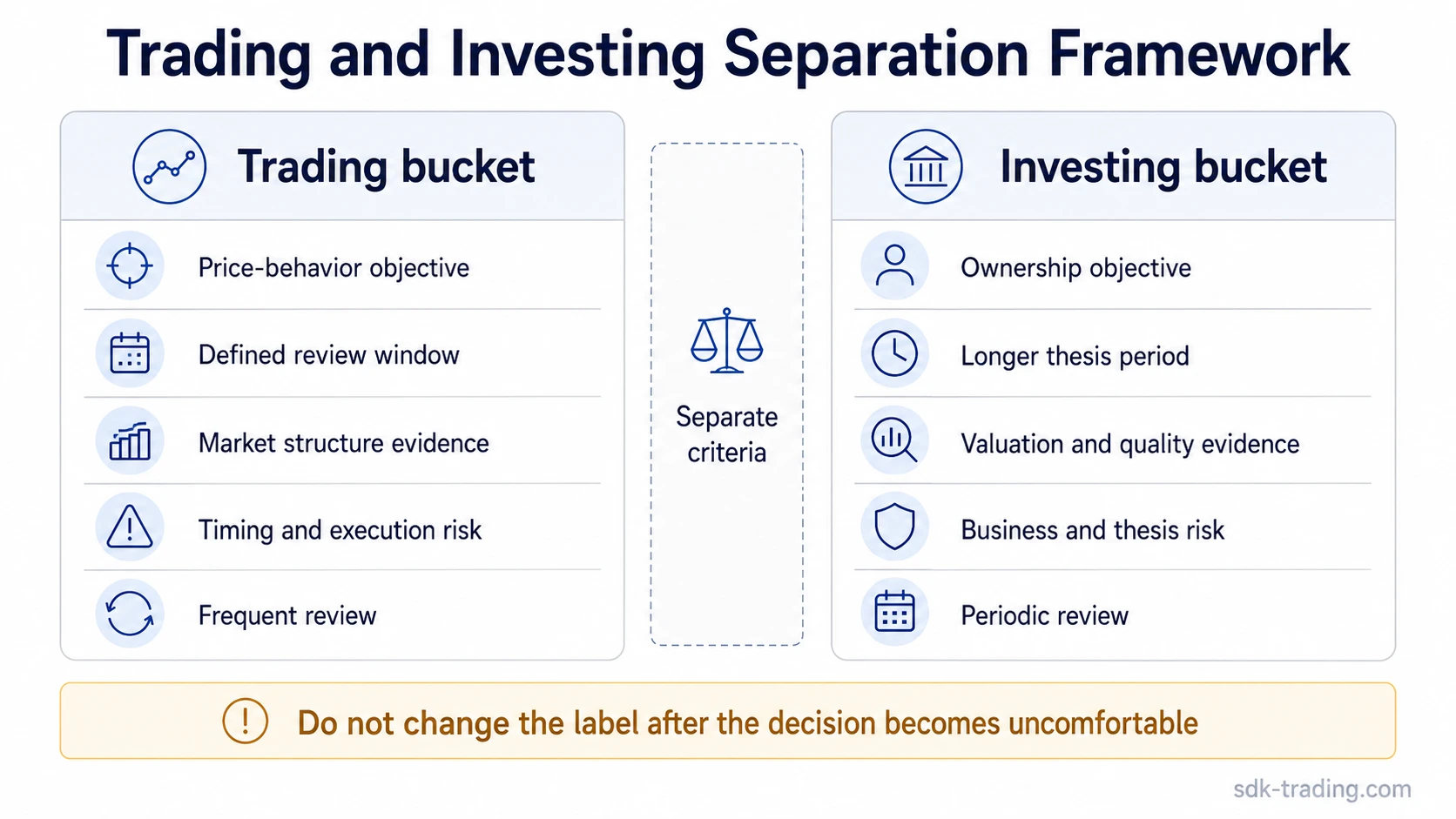
| Separation point | Why it matters |
|---|---|
| Capital bucket | Prevents a short-term decision from silently becoming a long-term allocation. |
| Objective | Clarifies whether the goal is price behavior interpretation or ownership value. |
| Time horizon | Prevents short-term noise from controlling a long-term thesis, or a long-term story from excusing a failed trade. |
| Review cadence | Keeps the decision aligned with the type of evidence that matters. |
| Risk definition | Separates timing and execution risk from business, valuation, and portfolio risk. |
Similarities Between Trading and Investing
Trading and investing both involve uncertainty, capital at risk, and incomplete information. Both require process discipline, position awareness, and a way to review whether the original idea is still valid. Neither approach becomes safe simply because the label sounds more conservative or more active.
Both approaches also depend on context. A trader still needs to understand the environment in which price is moving. An investor still needs to understand how market conditions can affect valuation, liquidity, and sentiment. The difference is not whether context matters. The difference is which context receives priority.
Risks and Limits
Trading risk often appears through timing, execution, volatility, transaction costs, leverage, liquidity, and rapid changes in market behavior. A technically sound idea can still fail if the market stops accepting the expected structure or if the review process is too loose.
Investing risk often appears through drawdowns, valuation compression, weak business results, deteriorating balance sheets, changing interest rates, inflation, sector disruption, or thesis decay. A long holding period does not protect capital if the underlying reason for ownership weakens.
Costs and taxes also matter, but they should be handled carefully. More frequent trading can increase transaction costs and tax complexity. Longer-term investing may reduce turnover, but tax treatment depends on jurisdiction, account type, holding period, and personal circumstances. Tax-specific decisions require qualified professional guidance.
Common Mistakes When Comparing Trading and Investing
| Mistake | Cleaner distinction |
|---|---|
| Assuming the asset defines the approach. | The same asset can be traded or invested in; the objective defines the lens. |
| Calling trading better because it is more active. | More activity can increase decision pressure, costs, and error frequency. |
| Calling investing safer in all cases. | Longer horizons still face valuation risk, business risk, and drawdowns. |
| Changing the label after the decision becomes uncomfortable. | The original objective, evidence, and review rules should remain visible. |
| Ignoring monitoring burden. | A trading lens usually needs more frequent review; an investing lens still needs thesis review. |
FAQ
What is the main difference between trading and investing?
The main difference is the decision lens. Trading usually focuses on shorter-term price behavior, volatility, structure, and review cadence. Investing usually focuses on longer-term ownership, value development, income, valuation, or portfolio role.
Is trading riskier than investing?
Trading often has more timing, execution, volatility, and monitoring risk. Investing still has drawdown, valuation, business, and thesis risk. The risk profile changes by approach, but neither approach removes uncertainty.
Can the same stock be both traded and invested in?
Yes. The same stock can be traded under a shorter-term price-behavior lens and invested in under a longer-term ownership lens. The two decisions should use separate objectives, evidence, horizons, and review criteria.
Is day trading the same as investing?
No. Day trading is a short-term trading style focused on intraday price behavior and fast decision review. Investing is usually based on longer-term ownership and broader value or portfolio considerations.
Which is better: trading or investing?
Neither is universally better. The cleaner question is whether the objective, time horizon, evidence type, monitoring burden, and risk profile match the approach being used.