Common trading myths are simplified beliefs that turn uncertain market behavior into false certainty. They often make trading sound more predictable, more stable, or easier to control than it really is.
Most trading myths begin with a real observation and then stretch it too far. A strategy can work in one environment, but that does not make it universal. A trader can have a high win rate, but that does not automatically mean the overall result is healthy. A chart can organize a scenario, but it does not remove uncertainty.
Definition: A common trading myth is a repeated belief about trading that simplifies risk, skill, prediction, psychology, or market behavior into a rule that sounds cleaner than real conditions allow.
The useful test is not whether a myth sounds familiar. The useful test is whether it distorts risk, payoff, strategy fit, prediction, psychology, or trading style.
Key Points
- Trading myths usually turn probability into certainty.
- A belief can sound reasonable and still create weak decisions when market conditions change.
- Win rate, prediction, strategy, and discipline are often misunderstood because they are easier to discuss than risk.
- The safer approach is to identify what each myth leaves out before treating it as useful trading knowledge.
What Common Trading Myths Get Wrong
Trading myths usually remove the uncomfortable part of market participation: outcomes vary. Prices respond to liquidity, positioning, sentiment, time horizon, and changing participation. No single belief can compress those forces into a stable rule without losing important context.
The problem is not only that a myth is false. The bigger issue is that it can point attention toward the wrong variable. A trader who focuses only on win rate may ignore loss size. A trader who searches for one perfect setup may miss that market conditions change. A trader who believes analysis creates certainty may treat a scenario as a forecast.
Common Trading Myths by Decision Area
Different myths distort different parts of the decision process. Sorting them by decision area makes the weak point easier to see.
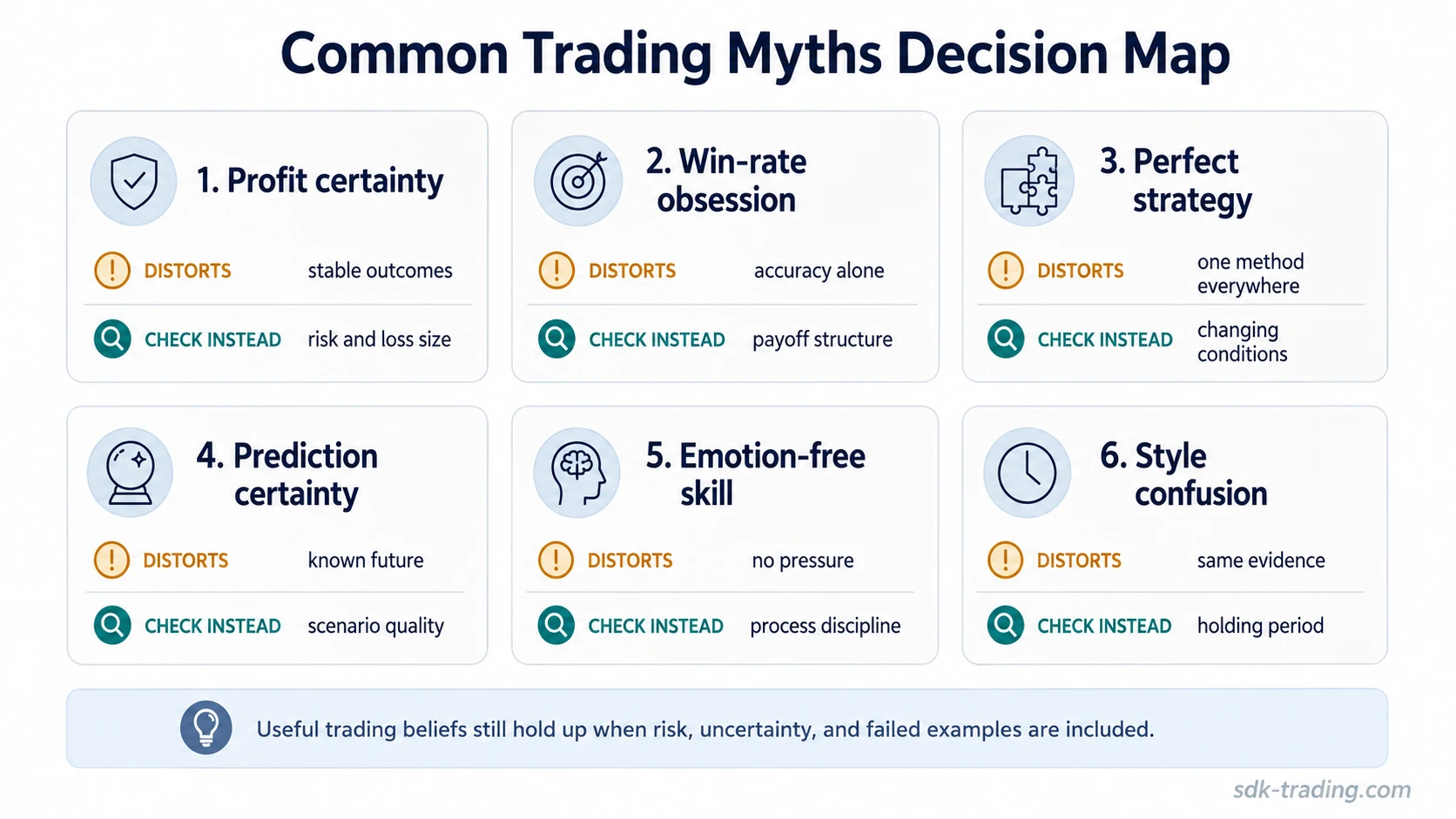
| Myth family | What it distorts | More useful interpretation | What to check instead |
|---|---|---|---|
| Profit certainty | Trading is treated like a stable income machine. | Returns can be irregular because market conditions, volatility, and decision quality vary. | Risk management in trading frames exposure, losses, and uncertainty before outcomes are known. |
| Win-rate obsession | Accuracy is treated as the same thing as a strong process. | A high win rate can still be fragile if losses are large compared with gains. | The risk-reward ratio explains why outcome size matters alongside accuracy. |
| Perfect strategy | One method is expected to work across every environment. | A setup that fits one condition may weaken when liquidity, volatility, or participation changes. | Market cycles explain why the same idea can behave differently as conditions shift. |
| Prediction certainty | Analysis is treated as a way to know the future. | Analysis can organize scenarios, but it cannot remove uncertainty from the next price movement. | Scenario quality depends on evidence, invalidation, and changing context. |
| Emotion-free skill | Experience is treated as the removal of pressure. | Skill can improve structure and discipline, but emotional pressure can still affect decisions. | Process matters because it limits impulsive reactions when outcomes are uncertain. |
| Style confusion | Different holding periods are treated as interchangeable. | A short-term trading style and a multi-day or multi-week approach require different expectations. | Swing trading clarifies how holding period changes structure, risk, and patience. |
Quick test: before trusting a trading belief, ask what it ignores. A useful belief should still make sense when risk, loss size, changing conditions, emotional pressure, and failed examples are included.
Myth 1: Trading Guarantees Consistent Profits
The belief that trading can produce smooth, repeatable income ignores the variable nature of market participation. Volatility can create opportunity, but the same movement can also create loss, drawdown, and poor execution conditions.
A stronger interpretation starts with uncertainty rather than certainty. The question is not whether every trade can be controlled. The question is whether exposure, loss size, and decision rules remain clear when the outcome is still unknown.
Common mistake: treating a profitable period as proof that the same process will behave the same way in the next market environment.
Myth 2: A High Win Rate Is Enough
Win rate is easy to understand, so it often becomes too important in beginner thinking. A strategy that wins often can still be fragile if the occasional loss is much larger than the average gain.
A better distinction separates accuracy from payoff structure. A trader may be right many times and still struggle if the larger losses dominate the smaller wins. Outcome size, risk per idea, and drawdown behavior matter alongside how often a trade works.
Example: A trader may close many small gains while conditions are calm, then give several of them back when volatility expands and one loss becomes much larger than the usual win. The weak point is not only the losing trade. The weak point is focusing on accuracy while ignoring average gain, average loss, and risk control.
Myth 3: One Perfect Strategy Works Everywhere
The idea of a perfect strategy turns market complexity into a search for the right formula. A method can look strong in one environment and weaker in another because liquidity, volatility, trend behavior, and participation change.
A strategy should be judged partly by how it behaves when conditions no longer match its best environment. A method that only explains clean winning examples may hide the moments when the same rules become less useful.
Limitation: a setup that fits a trending market may behave poorly in a choppy range, while a range-based idea may struggle when momentum expands.
Myth 4: Enough Data Makes the Market Fully Predictable
More information can improve preparation, but it does not turn trading into certainty. Markets are shaped by how participants interpret information, how they are positioned, and how quickly liquidity changes when pressure appears.
The practical value of analysis is not perfect prediction. It is the ability to separate stronger scenarios from weaker ones, define what would change the interpretation, and avoid treating a single signal as complete evidence.
Myth 5: Skilled Traders Do Not Feel Emotion
Experience does not remove emotional pressure from uncertain outcomes. It can improve preparation, reduce impulsive decisions, and create more consistent behavior, but it does not make risk feel neutral.
The useful distinction is between emotion and process. Feeling pressure is not automatically the problem. The problem appears when pressure changes position size, patience, exit behavior, or the willingness to respect invalidation.
Myth 6: Trading and Investing Are the Same Decision
Trading and investing can both involve financial markets, but they do not use the same decision structure. Trading usually gives more weight to timing, volatility, execution, and risk control over shorter holding periods. Investing usually gives more weight to long-term business, valuation, or portfolio context.
The mistake is using the wrong evidence for the chosen holding period. A short-term trade can fail even if a long-term thesis remains intact, while a long-term investment can become noisy if every short-term fluctuation is treated as a decision signal.
When a Trading Myth Becomes Risky
A trading myth becomes risky when it changes behavior before evidence is clear. It can encourage larger risk, rushed decisions, overconfidence after a short winning period, or the belief that a tool works without context.
Many weak decisions begin with a belief that sounds simple: more trades create more opportunity, more indicators create more confirmation, or stronger conviction creates better outcomes. None of those ideas is reliable unless the surrounding conditions support the interpretation.
What Each Myth Leaves Out
Profit myths leave out risk. Win-rate myths leave out payoff structure. Strategy myths leave out changing conditions. Prediction myths leave out uncertainty. Psychology myths leave out pressure. Style myths leave out the relationship between holding period and evidence.
The useful shift is from asking whether a myth is true or false to asking what variable is missing. Most trading myths leave out uncertainty, risk, adaptation, or the difference between a possible scenario and a confirmed outcome.
FAQ
What are common trading myths?
Common trading myths are simplified beliefs about trading that make markets sound more predictable, stable, or controllable than they are. They often distort risk, strategy, psychology, prediction, or trading style.
Why are trading myths risky?
Trading myths are risky because they can push attention toward the wrong variable. A trader may focus on win rate, a single setup, or prediction while ignoring loss size, changing conditions, and uncertainty.
Is a high win rate enough in trading?
A high win rate is not enough by itself. The size of gains and losses, the amount of risk taken, and the behavior of the strategy during difficult conditions can matter as much as accuracy.