A bear trap in trading is a false downside break that fails to hold below support and then reclaims prior structure, leaving bearish traders caught on the wrong side of the move.
The label depends on failed downside acceptance. A wick below support, a quick dip, or one bullish candle after a selloff is not enough. A stronger bear trap reading needs a clear prior level, a downside breach, failed acceptance below that level, and later behavior that shows the market has moved back into the prior range or structure.
Definition: A bear trap is a failed bearish breakdown. Price moves below a support area or prior low, attracts bearish expectation, then fails to remain below that area and reclaims the broken structure.
What Is a Bear Trap in Trading?
A bear trap forms when a market appears to confirm downside continuation but then rejects that lower area. The first downside break creates the trap condition, but the later reclaim is what changes the interpretation. Without that reclaim, the move may simply be a normal breakdown.
The central issue is acceptance. If price breaks below support and begins building structure beneath it, the bearish move is being accepted. If price breaks lower, cannot hold there, and returns above the broken level, the earlier bearish reading loses reliability.
A bear trap is therefore a conditional reading, not a reversal guarantee. It describes how a failed downside break can trap sellers, not what price must do next.
How a Bear Trap Forms
The sequence usually begins near a visible support area, prior low, range boundary, or cluster of lows where traders are watching downside continuation. Price then trades below that area, which can make the move look like a confirmed breakdown.
The trap develops only if the lower move fails to gain acceptance. Instead of continuing beneath the broken level, price returns above it and starts to behave as if the breakdown was rejected. Bearish traders who acted on the initial break may then be forced to reassess as the market moves back into prior structure.
| Stage | What Happens | Why It Matters |
|---|---|---|
| Prior level | Price is near a visible support area, prior low, or range boundary. | The trap needs a recognizable area where bearish expectation can form. |
| Downside break | Price trades below the watched level. | The move creates the appearance of a bearish breakdown. |
| Failed acceptance | Price cannot hold below the broken area. | The lower area begins to look rejected rather than accepted. |
| Reclaim | Price returns above the broken level or back into prior structure. | The earlier bearish reading weakens because the market has not sustained the lower move. |
| Later response | Price either accepts back above the level, overlaps without clarity, or moves lower again. | The final reading becomes clean, weak, or invalid depending on this response. |
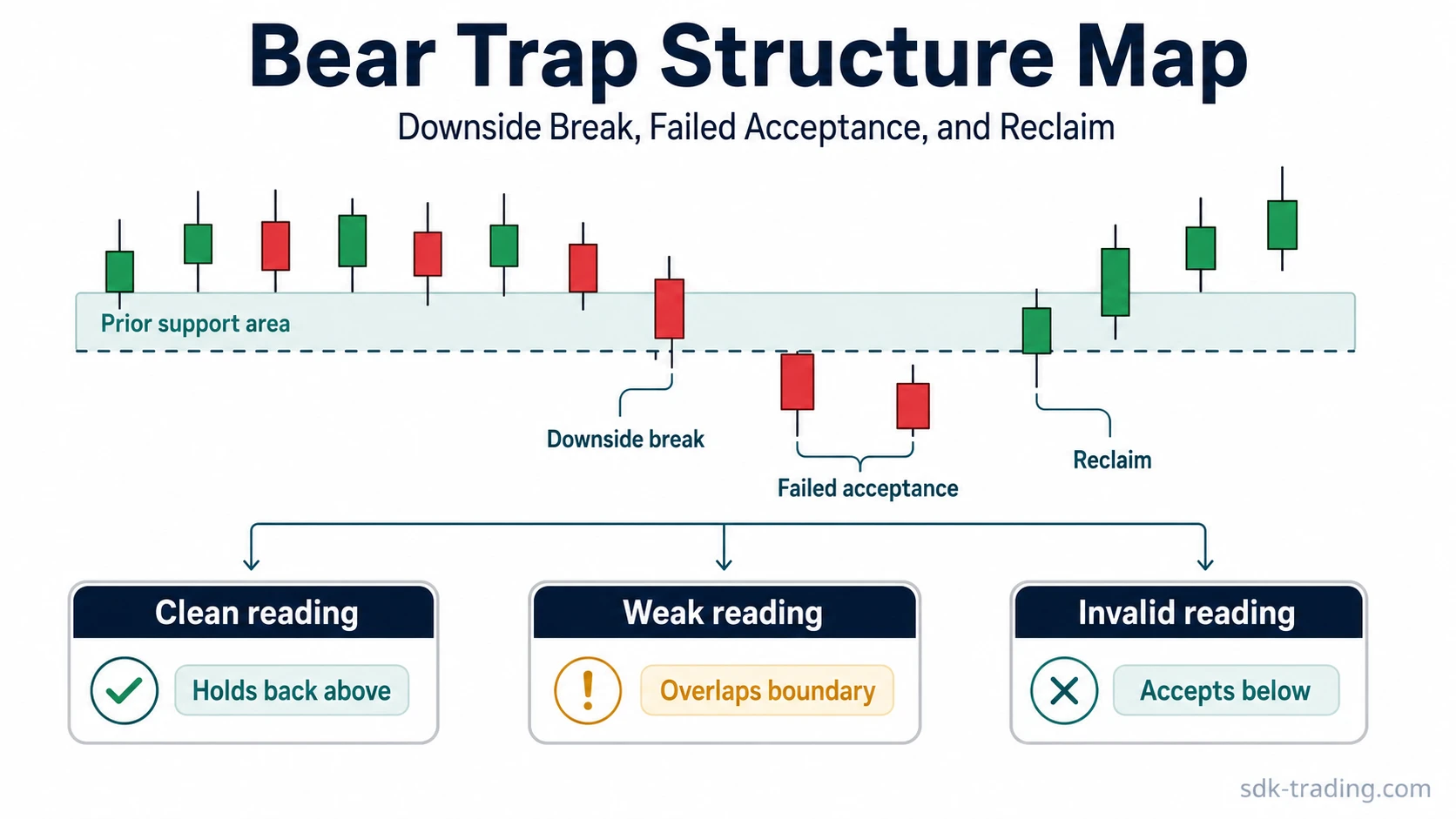
Bear Trap Classification Test
A bear trap reading becomes more useful when it is tested as a sequence instead of labeled from one candle. The questions below separate a possible trap from an ordinary dip, a messy range move, or a real breakdown.
| Question | Stronger Reading | Weaker Reading |
|---|---|---|
| Was there a visible support area or prior low? | The level was clear before the break. | The level is vague, crowded, or visible only after the fact. |
| Did price break below that area? | The break moved clearly through the watched level. | The move only touched the level or stayed inside normal noise. |
| Did bearish expectation increase? | The move looked like a breakdown that could attract sellers. | The move did not meaningfully change the market reading. |
| Did price fail to accept below the level? | Price quickly or clearly rejected the lower area. | Price continued to overlap below the level without a decisive reclaim. |
| Did price reclaim prior structure? | Price returned above the broken area and held back inside the prior structure. | Price bounced briefly but failed to regain the broken area. |
| Did later behavior support the trap reading? | The market treated the lower break as failed. | The market accepted below support or remained unresolved. |
Safe interpretation note: The first break starts the review. The later acceptance or rejection decides whether the bear trap reading remains defensible.
Clean, Weak, and Invalid Bear Trap Readings
The same downside break can produce different readings depending on what happens after the break. The trap case is strongest when the market rejects the lower area and returns to the prior structure with clear acceptance.
| Reading | Typical Structure | Interpretation |
|---|---|---|
| Clean bear trap | Clear support, decisive downside breach, failed acceptance below the level, and reclaim back above the broken area. | The downside break failed, and bearish participation is more likely to be trapped by the reclaim. |
| Weak bear trap | Messy range, unclear level, slow overlap, or a bounce that does not clearly reclaim prior structure. | The lower move may have failed, but the evidence stays unresolved unless the market clearly holds back above the broken area. |
| Invalid bear trap | Price accepts below broken support and begins building structure beneath it. | The trap label fails because the market is no longer rejecting the lower area; the breakdown reading remains more relevant. |
Bear Trap vs Bull Trap
A bear trap is a failed downside break. A bull trap is the opposite structure, where price breaks above resistance, fails to hold the upside move, and leaves bullish participation caught above the prior range or level.
The direction of the failed break is the main difference. A bear trap begins below support or below prior lows. A bull trap begins above resistance or above prior highs. Both readings depend on later failure and reclaim behavior, not the first break alone.
| Concept | Initial Move | Failed Acceptance Area | Trapped Side |
|---|---|---|---|
| Bear trap | Break below support or prior lows | Below the broken support area | Bearish participation |
| Bull trap | Break above resistance or prior highs | Above the broken resistance area | Bullish participation |
Bear Trap vs Liquidity Sweep and Liquidity Grab
A liquidity sweep or liquidity grab can appear inside a bear trap sequence, but the terms are not identical. A sweep describes price moving through a liquidity area around lows or stops. A bear trap needs the later failed downside acceptance and reclaim that changes the breakdown reading.
Equal lows can mark an area where sell-side liquidity may sit, but equal lows alone do not confirm a bear trap. The reading still depends on what happens after price trades through the area.
Common Bear Trap Mistakes
The most common mistake is labeling any dip below support as a bear trap before the market shows rejection. A break below support can be real, false, or unresolved. The difference comes from acceptance and later structure.
| Mistake | Why It Fails | Cleaner Reading |
|---|---|---|
| Calling any dip a bear trap | A dip can be normal volatility or the start of a real breakdown. | Check whether price rejects the lower area and reclaims the broken level. |
| Treating a wick below support as enough | A wick shows rejection only in a narrow candle-level sense. | Look for later structure that confirms the lower area was not accepted. |
| Ignoring acceptance below support | Building structure below the broken level weakens the bear trap reading. | Separate failed breakdown from accepted breakdown. |
| Using one bullish candle as confirmation | One candle can be a temporary reaction inside a broader bearish move. | Focus on reclaim behavior and whether the market holds back above the broken area. |
| Reading the pattern as a prediction | The label describes failed downside behavior, not a guaranteed reversal. | Treat the reading as conditional until later behavior supports or invalidates it. |
Bear Trap Example in Context
Price trades near a prior low after several failed recovery attempts. The low is visible enough that a break beneath it can attract bearish expectation. Price then moves below the low, but the lower area does not hold. Instead of building structure beneath the break, price returns above the prior low and begins trading back inside the earlier range.
The trap case is stronger if the market continues to accept back above the broken level. The evidence stays unresolved if the reclaim is brief and price keeps overlapping around the boundary. It fails if price accepts below the low and starts treating the broken support area as resistance.
Limitations of Bear Trap Readings
A bear trap is not a standalone trading signal and does not guarantee a reversal. It is a structural interpretation of a failed downside break. The reading is most useful when it is tied to a visible level, failed acceptance, reclaim behavior, and later market response.
Volume, candle shape, and speed of recovery can add context, but none of them confirms the pattern by itself. A large bullish candle after a break may still be only a reaction. A high-volume break may still become accepted below support. A quick reclaim may still fail if the market cannot remain back inside prior structure.
Limitation: The bear trap label weakens when the prior level is unclear, the downside break is only noise, the reclaim is brief, or price accepts below the broken support area.
FAQ
What is a bear trap in trading?
A bear trap in trading is a false downside break that fails to hold below support and then reclaims prior structure, leaving bearish participation caught by the failed breakdown.
How does a bear trap form?
A bear trap forms when price breaks below a visible support area or prior low, attracts bearish expectation, fails to accept below the level, and then moves back above the broken area.
Is every break below support a bear trap?
No. A break below support becomes a stronger bear trap reading only if price fails to hold below the level and later behavior supports rejection of the lower area.
What makes a bear trap reading invalid?
A bear trap reading becomes invalid when price accepts below the broken support area and starts building structure beneath it instead of reclaiming the prior level.
What is the difference between a bear trap and a bull trap?
A bear trap is a failed downside break below support, while a bull trap is a failed upside break above resistance. Both depend on failed acceptance after the initial break.