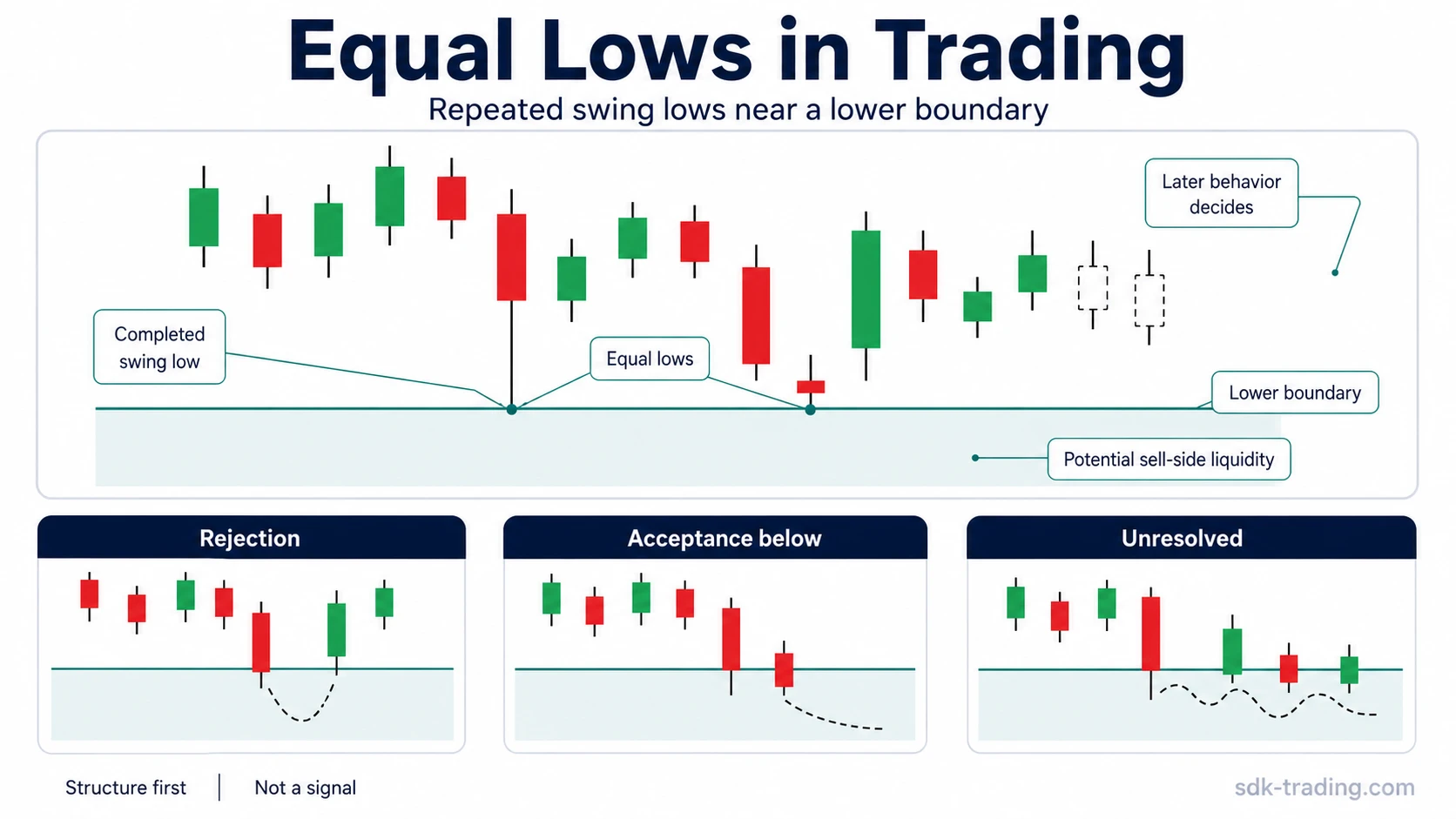
Equal lows in trading are two or more completed swing lows that form near the same lower boundary on a price chart.
The structure is usually watched because repeated lows can make the area below them visible. In liquidity-focused price action, that lower area may become a reference for potential sell-side liquidity, but the equal lows alone do not predict a sweep, reversal, continuation, or trade outcome.
- Equal lows describe a visible lower boundary made from repeated swing lows.
- The lows do not need to match at the exact same price; they need to sit close enough to form a recognizable area.
- The reading becomes weaker when the lows are incomplete, too far apart, or buried inside unresolved chop.
- Later behavior around the lower boundary decides whether the area was rejected, accepted, or left unresolved.
What Are Equal Lows in Trading?
Equal lows are repeated swing lows that appear around the same lower price area. They mark a lower boundary that price has respected more than once, creating a visible reference point for traders watching structure, liquidity, and possible future interaction with that area.
The useful detail is not mathematical equality. A market can form equal lows even when the lows are slightly different, as long as the difference is small relative to the chart’s volatility and the area is visually clear. If the lows are too scattered, too recent, or not formed from completed swings, the reading becomes less reliable.
Equal lows definition: Equal lows are two or more visible swing lows clustered near the same lower boundary, forming a repeated reference area on a trading chart.
What Qualifies as Equal Lows?
A clean equal lows reading starts with structure, not with a fixed price threshold. The lows should be visible, separated by enough price movement to count as distinct swings, and close enough to form one lower boundary rather than several unrelated reaction points.
| Criterion | Clean reading | Weak reading |
|---|---|---|
| Completed swing lows | Each low forms after price moves down, reacts, and later moves away. | The lows are still forming or appear only as minor pauses inside one move. |
| Horizontal proximity | The lows sit close enough to create one recognizable lower boundary. | The lows are too spread out to be treated as the same area. |
| Visible separation | There is enough movement between lows to show distinct tests of the area. | The lows are clustered inside tight chop without clear swing separation. |
| Chart context | The surrounding structure makes the boundary easy to see. | The area is hidden inside noisy price action or a fast-moving market. |
| Volatility-aware tolerance | Small differences between lows are reasonable for the instrument and timeframe. | The tolerance is stretched until unrelated lows are forced into one pattern. |
How Equal Lows Work
The mechanism begins when price reacts from a lower area, later returns near that same area, and reacts again. The repeated behavior creates a visible boundary. Once the boundary is visible, traders may begin treating the area below it as a place where resting orders, stops, or liquidity expectations could exist.
The first repeated low only identifies the boundary. It does not settle the interpretation. Price can later reject the area, trade below it briefly, accept below it, or keep chopping around it. Those later reactions are what separate a clean structure from a weak or invalid reading.
| Stage | What appears on the chart | What it means |
|---|---|---|
| Boundary forms | Two or more lows appear near the same lower area. | The market has created a visible lower reference. |
| Area becomes watched | The repeated lows are easy to identify without forcing the pattern. | The area below the lows may become a liquidity reference. |
| Price interacts later | Price returns to, probes, or breaks below the boundary. | Later behavior clarifies whether the boundary was rejected, accepted, or unresolved. |
Equal Lows and Liquidity
Equal lows can relate to liquidity because repeated lower-boundary lows are easy for market participants to see. When many traders recognize the same area, the space below that boundary may become associated with potential sell-side liquidity.
This does not mean price must move below the lows. It also does not mean a move below the lows must reverse. A probe below equal lows can fail, continue, or remain unresolved depending on whether price rejects the lower area, accepts below it, or keeps rotating around the boundary.
| Later behavior | Reading | What weakens the interpretation |
|---|---|---|
| Price trades below the lows and returns back above the boundary. | The lower area was probed and then rejected. | The return above the boundary is weak, brief, or immediately reversed. |
| Price trades below the lows and continues accepting below them. | The old boundary may no longer be acting as the same reference. | The move below is thin, temporary, or quickly pulled back into the prior range. |
| Price keeps rotating around the lows without a clean reaction. | The structure remains unresolved. | The lows lose clarity as the area becomes noisy and over-tested. |
Clean, Weak, and Invalid Equal Lows
The clearest equal lows readings separate a clean boundary from weak or invalid structures. A repeated low is not automatically meaningful just because two candles have similar prices. The structure needs clarity, separation, and later behavior that keeps the boundary interpretable.
| Reading type | What it looks like | Interpretation |
|---|---|---|
| Clean equal lows | Two or more completed swing lows form near one clear lower boundary, with visible separation between tests. | The boundary can be treated as a meaningful structural reference and possible liquidity area. |
| Weak equal lows | The lows are close, but the area is choppy, incomplete, too compressed, or not easy to identify. | The reading should stay conditional until later behavior makes the boundary clearer. |
| Invalid equal lows | The lows are unrelated, too far apart, formed inside random noise, or no longer respected after price accepts below the area. | The structure should not be treated as a clean equal lows reference. |
A practical scenario is a sideways market where price reacts from the same lower area twice, moves away after each test, and leaves a clean horizontal reference. That can be labeled equal lows. If price later breaks below and stays below the area, the old boundary may become less useful as an equal lows reference because the market has accepted below it instead of simply probing it.
Equal Lows vs Equal Highs
Equal lows form near a lower boundary. Equal highs form near an upper boundary. The difference is directional in the chart structure: equal lows reference repeated lows below price, while equal highs reference repeated highs above price.
| Concept | Boundary location | Liquidity context |
|---|---|---|
| Equal lows | Lower boundary | May point to potential sell-side liquidity below repeated lows. |
| Equal highs | Upper boundary | May point to potential buy-side liquidity above repeated highs. |
Equal Lows vs Support, Double Bottoms, and Liquidity Sweeps
Equal lows are often confused with nearby chart concepts because all of them can involve price reacting around a lower area. The distinction is that equal lows describe the visible boundary itself. Other concepts describe broader reaction zones, pattern interpretation, or later interaction with liquidity.
| Concept | Main focus | Key distinction |
|---|---|---|
| Equal lows | Repeated swing lows near the same lower boundary. | The concept identifies the boundary before assuming what happens next. |
| Support | A broader area where price has reacted or may react. | Support can include many types of reactions; equal lows are a specific repeated-low structure. |
| Double bottom | A pattern interpretation around two lows and a later recovery attempt. | A double bottom adds pattern logic; equal lows only name the repeated lower boundary. |
| Liquidity sweep or liquidity grab | Later movement through a watched liquidity area. | A sweep or grab describes interaction after the boundary exists, not the boundary itself. |
Common Mistakes When Reading Equal Lows
The most common mistake is treating equal lows as a complete trading message. They are a structural reference, not an instruction. Their meaning depends on whether the lows are clean, whether the surrounding market structure supports the reading, and how price behaves when it returns to the area.
| Mistake | Why it creates a weak reading | Cleaner interpretation |
|---|---|---|
| Demanding exact-price equality | Markets often create zones rather than perfect horizontal matches. | Look for a tight lower boundary relative to volatility. |
| Calling every repeated low equal lows | Minor pauses inside one move may not be completed swing lows. | Require separation, reaction, and visible structure. |
| Assuming equal lows must be swept | A visible liquidity area does not force price to trade through it. | Treat the sweep as one possible later behavior, not a guaranteed outcome. |
| Assuming a break must reverse | Price can accept below the old boundary and continue building lower structure. | Separate a brief probe from sustained acceptance below the lows. |
| Ignoring unresolved chop | Too many overlapping reactions can erase the clean boundary. | Downgrade the reading when the area becomes noisy and indistinct. |
What Invalidates Equal Lows?
Equal lows become invalid or less useful when the structure no longer behaves like a clear repeated lower boundary. That can happen when the lows are not distinct swing points, when the area becomes too noisy, or when price accepts below the boundary long enough that the old reference loses its meaning.
The reading also weakens when the surrounding structure does not support the boundary. For example, a fast one-way decline with small pauses may show similar low prints, but those prints may not form a meaningful equal lows structure if price never creates separate reactions from the area.
FAQ
What do equal lows mean in trading?
Equal lows mean that price has formed two or more completed swing lows near the same lower boundary. The structure can mark a visible price-action reference and may relate to potential liquidity below the lows.
Are equal lows bullish or bearish?
Equal lows are not automatically bullish or bearish. They identify a lower-boundary structure. Later behavior around that boundary decides whether the area is rejected, accepted, swept, or left unresolved.
Are equal lows the same as support?
No. Equal lows are a specific structure made from repeated swing lows near the same area. Support is a broader concept that can include many kinds of reactions around a price zone.
How many lows are needed for equal lows?
Two completed swing lows can be enough if they are close, visible, and separated by a meaningful reaction. More lows can make the boundary more visible, but too much chop can also weaken the reading.
What invalidates equal lows?
Equal lows are invalidated or weakened when the lows are not distinct swings, when they are too far apart, when the area becomes unresolved chop, or when price accepts below the boundary and the old level loses relevance.