Stop hunting in trading is a market-structure reading where price probes a visible level that may contain clustered stop-loss orders. The move can trigger those orders and create temporary execution flow, but a stop trigger alone does not prove intentional hunting. The stronger reading comes from what happens after the probe: price either accepts beyond the old boundary or fails to accept and returns into prior structure.
Definition: Stop hunting is the interpretation that price has moved into or through a visible stop-loss area, such as a prior high, prior low, range edge, support zone, resistance zone, or round number, where clustered stop orders may become executable liquidity.
The useful part of the concept is not the claim that a specific participant targeted a specific trader. The useful part is the observable structure: visible levels attract similar stop placement, triggered stops can add market-order flow, and later price behavior decides whether the move was only a probe or accepted development beyond the old level.
Key Points
- Stop hunting readings usually begin around visible highs, lows, range edges, support and resistance, and round numbers.
- Clustered stop-loss orders can become liquidity when triggered because many stops convert into market orders.
- A wick or brief cross through a level is not enough to confirm a clean stop hunting reading.
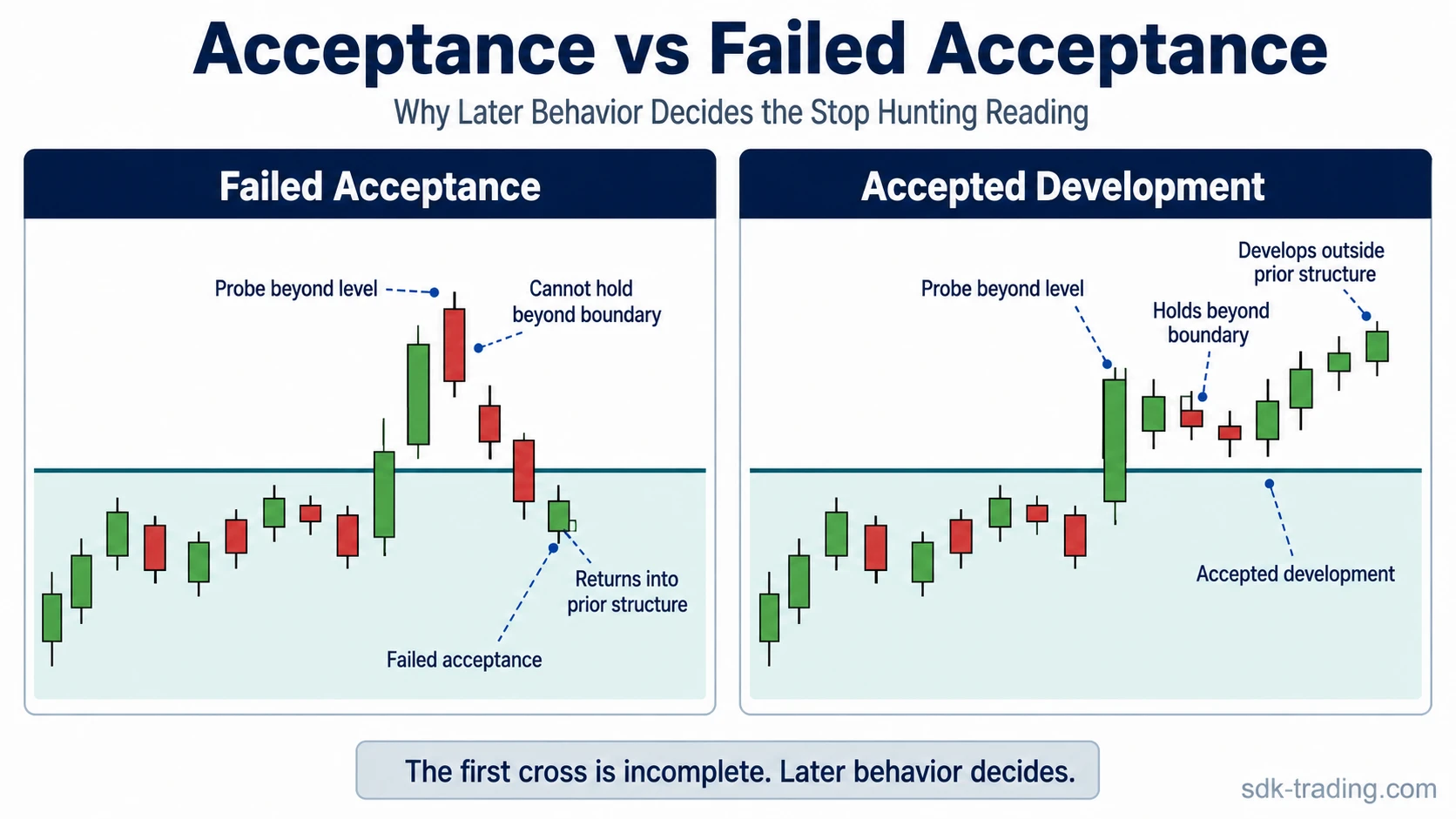
- Failed acceptance means price cannot hold beyond the old boundary and moves back into prior structure.
- Accepted development beyond the old level weakens or invalidates the stop hunting interpretation.
What Is Stop Hunting in Trading?
Stop hunting in trading describes a move into an area where many traders may have placed stop-loss orders. These areas are usually visible on the chart. A prior swing high can attract stops from traders positioned against an upside move. A prior swing low can attract stops from traders positioned against a downside move. Range edges, repeated boundaries, support and resistance, and round numbers can create the same clustering effect.
When price reaches the cluster, stop orders may trigger and become market orders. That can add short-term execution pressure because many orders are released near the same area. The move may look sharp, especially when the level was visible and liquidity was thin around the boundary.
Important limitation: a triggered stop does not prove motive. Normal volatility, news, low liquidity, poor stop placement, or ordinary breakout behavior can also push price through visible levels. Stop hunting is more defensible as a structural reading than as a claim about intention.
Where Stop Hunting Readings Usually Form
Stop hunting readings usually form where many traders can see the same reference level. The level does not need to be perfect. The point is visibility. When a boundary is clear enough, traders may cluster decisions around it.
| Location | Why stops may cluster there | Reading risk |
|---|---|---|
| Prior swing high | Stops from bearish positions may sit above the high. | A breakout may be real if price accepts above the level. |
| Prior swing low | Stops from bullish positions may sit below the low. | A downside break may be valid if price accepts below the level. |
| Range edge | Repeated reactions can make the boundary visible. | Multiple noisy probes can weaken the quality of the reading. |
| Support and resistance | Many traders may define invalidation around the same visible zone. | The level may fail because supply or demand actually changed. |
| Round numbers | Simple price references often attract clustered order placement. | The round number alone is not enough without structure. |
| Breakout or fakeout area | Stops may sit just beyond the old breakout boundary. | The first move through the level must be tested by later behavior. |
Downside stop clusters below visible lows often overlap with sell side liquidity, but the two terms should not be treated as identical. Sell side liquidity names the likely liquidity area. Stop hunting describes the interpretation of a probe into that area and the later acceptance test.
How Stop Hunting Works
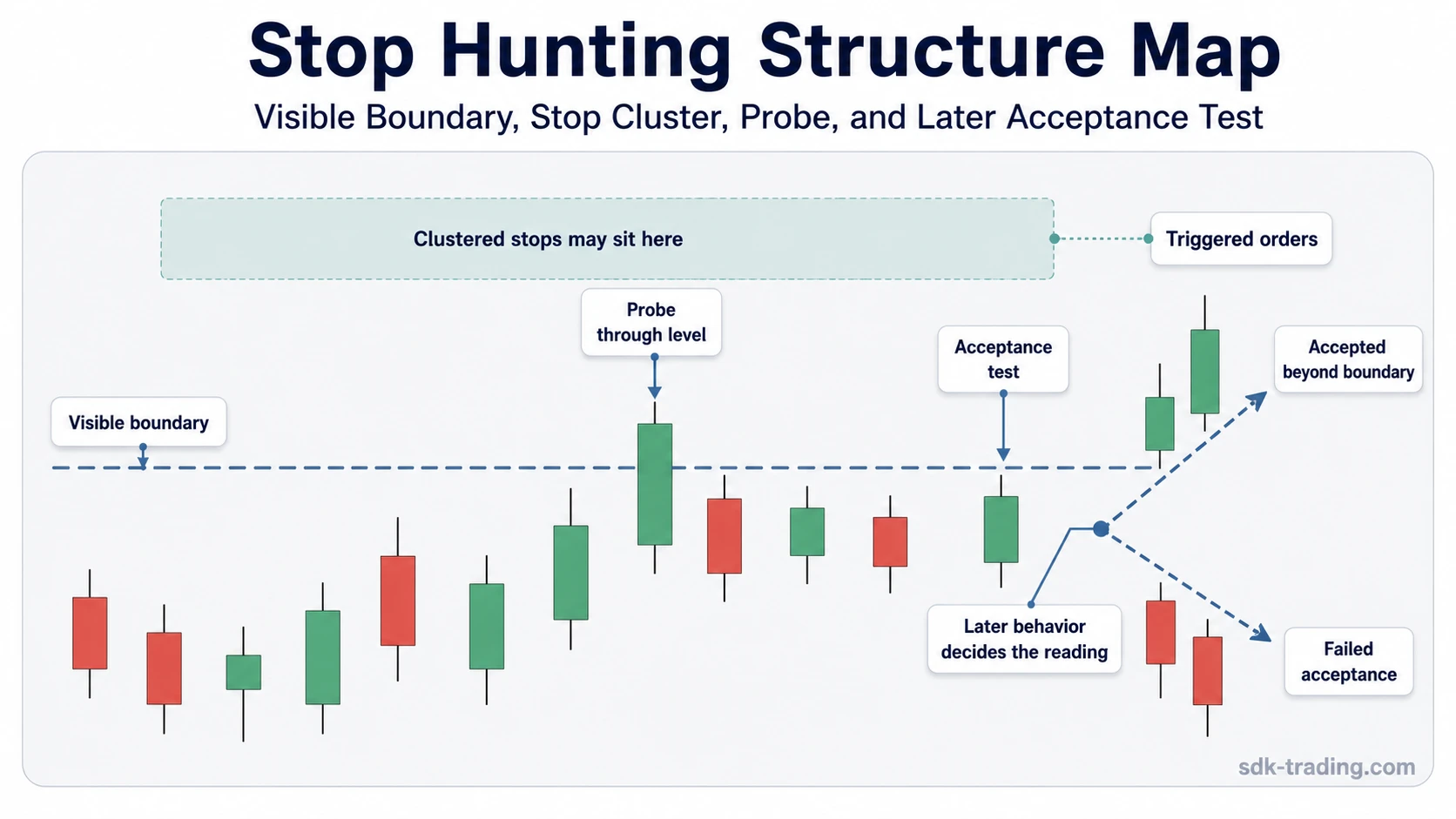
A stop hunting reading usually follows a sequence. The sequence matters because the probe itself is only the first part of the evidence.
- Traders place stops around a visible high, low, range edge, support zone, resistance zone, or round number.
- Price moves into or through that level.
- Stop-loss orders trigger and convert into market orders.
- The triggered orders can add temporary execution flow and accelerate price beyond the level.
- Later behavior decides the reading: price either accepts beyond the old boundary or fails to accept and returns into prior structure.
Acceptance test: if price holds beyond the old boundary and starts building structure there, the move looks more like accepted development. If price cannot hold beyond the level and returns inside the prior structure, the move can support a failed-acceptance reading.
Clean, Weak, and Invalid Stop Hunting Readings
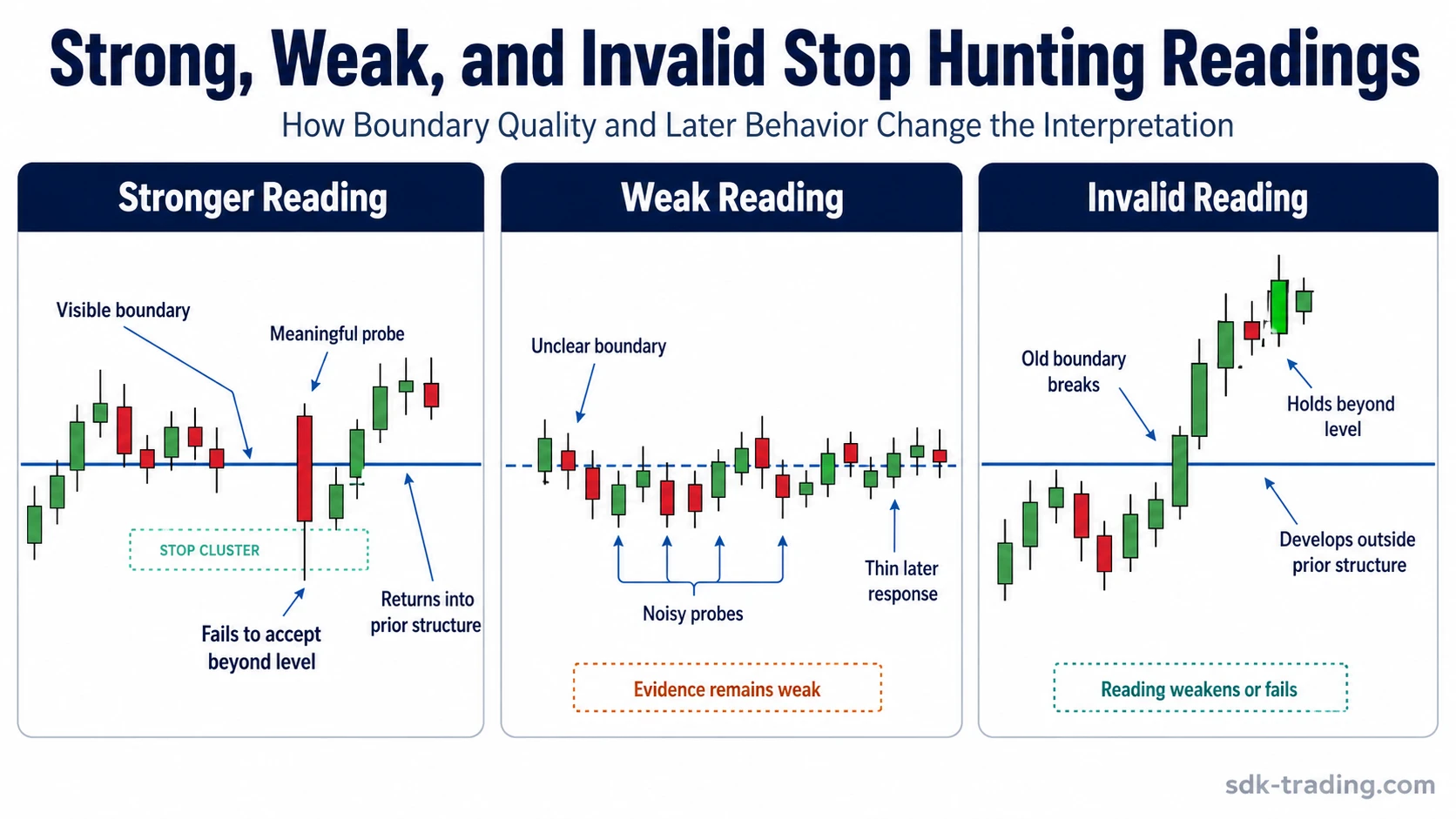
The strongest stop hunting analysis separates clean readings from weak or invalid ones. This keeps the concept from becoming a catch-all explanation for every stop trigger.
| Reading quality | Typical structure | Safer interpretation |
|---|---|---|
| Clean | Visible boundary, plausible stop concentration, meaningful probe, failure to accept beyond the old level, and coherent return into prior structure. | The stop hunting reading is more defensible because the later behavior supports failed acceptance. |
| Weak | Unclear level, noisy repeated probes, small random wick, thin response after the probe, or excessive reliance on motive claims. | The move may involve stops, but the evidence is not strong enough to treat the reading as clean. |
| Invalid | Price accepts beyond the old boundary and continues developing there. | The move looks less like a failed stop probe and more like accepted development beyond the prior level. |
Stop Hunting vs Normal Volatility
Normal volatility can hit stops without creating a clean stop hunting reading. A market can move through a level because liquidity is thin, a news event changes positioning, a breakout is developing, or the level was simply not as important as it appeared.
False-positive filter: the stop hunting label becomes weaker when the level is not clearly visible, the probe is random, the response after the probe is incoherent, or price accepts beyond the old boundary. The fact that stops were triggered is not enough.
A safer diagnostic process focuses on observable behavior: boundary quality, likely stop concentration, how price moved through the level, whether the market rejected or accepted the new area, and whether the later structure remains coherent.
Broker Myths and Manipulation Claims
Stop hunting is often discussed as if a broker, bank, hedge fund, or large participant deliberately targeted a specific trader. That claim should not be assumed from chart behavior alone. A visible level can attract orders without proving who caused the move or why it happened.
There is a difference between broker-specific misconduct and a market-structure reading around clustered orders. Broker misconduct would require evidence beyond a price pattern. A structural stop hunting reading only says that price probed a visible stop area and that later behavior should be used to judge whether the probe failed or became accepted development.
Safer wording: price probed a visible stop area. That wording describes what can be observed without claiming motive certainty.
Illustrative Stop Hunting Scenario
A market trades inside a range for several sessions. The lower boundary is visible because price has reacted there more than once. Many traders may place protective stops below that low. Price then moves below the boundary, triggers stops, and briefly accelerates lower. The reading is still incomplete at that point. If price quickly returns inside the range and cannot continue developing below the old low, the move may support a failed-acceptance stop hunting reading. If price holds below the old boundary and starts building structure there, the stop hunting interpretation weakens because the market is accepting the lower area.
This scenario is illustrative only. It does not describe a specific asset, date, trade, or outcome. Its purpose is to show why the later behavior matters more than the first cross through the level.
Stop Hunting and Related Liquidity Concepts
Stop hunting sits near several liquidity and market-structure terms, but it should not replace them. Each term answers a different question.
| Concept | Main focus | Difference from stop hunting |
|---|---|---|
| Buy side liquidity | Liquidity that may sit above visible highs. | It names a likely liquidity location, not the full stop-triggering and acceptance sequence. |
| Sell side liquidity | Liquidity that may sit below visible lows. | It identifies a downside liquidity area. Stop hunting describes a probe into a stop cluster and the later reading. |
| Liquidity sweep | A move through a visible liquidity area followed by later evaluation. | A liquidity sweep focuses on the move through a visible liquidity area and the later acceptance test. Stop hunting narrows the reading toward clustered stop-loss orders around that area and avoids claiming motive certainty. |
| Fakeout | A break beyond a level that later fails. | It focuses on the failed break. Stop hunting adds the stop-cluster and liquidity interpretation. |
| Swing failure | A failure around a prior swing point. | It is a structural failure label. Stop hunting focuses on stops clustered around the visible boundary. |
The shared idea is that visible levels can attract orders. The safer distinction is that stop hunting should remain a conditional reading, not a universal explanation for every break of a high or low.
FAQ
Is stop hunting always manipulation?
No. A stop hunting reading does not prove manipulation by itself. It can describe a move into clustered stops around a visible level, but motive certainty requires more evidence than a chart probe.
Is stop hunting the same as normal volatility?
No. Normal volatility can hit stops without producing a clean stop hunting reading. The distinction depends on boundary quality, stop clustering, probe behavior, and later acceptance or failed acceptance.
Do brokers hunt stops?
Broker-specific abuse should not be assumed from price action alone. In market-structure analysis, stop hunting is usually safer as an observational reading around visible stop clusters, not as a claim that a broker caused the move.
How is stop hunting different from a liquidity sweep?
A liquidity sweep focuses on a move through a visible liquidity area. Stop hunting focuses more specifically on clustered stop-loss orders around obvious levels and whether the later behavior supports or weakens that interpretation.
When is a stop hunting reading invalid?
The reading weakens or becomes invalid when price accepts beyond the old boundary and continues developing there. In that case, the move looks less like a failed probe and more like accepted development beyond the prior level.