Financial markets can be classified in several different ways. Some categories describe what is being traded, others describe the contract structure, maturity, issuance process, or trading venue. That is why equity markets, derivatives markets, primary markets, and OTC markets should not be treated as four equivalent categories from one single classification system.
Definition: Types of financial markets are categories used to organize instruments and trading activity by factors such as the underlying claim, contract structure, maturity, issuance layer, and venue. The classification explains what sits behind the price, but it does not determine market direction.
Core distinction: there is no single axis for classifying every financial market. Before comparing market types, first identify what the category is actually describing.
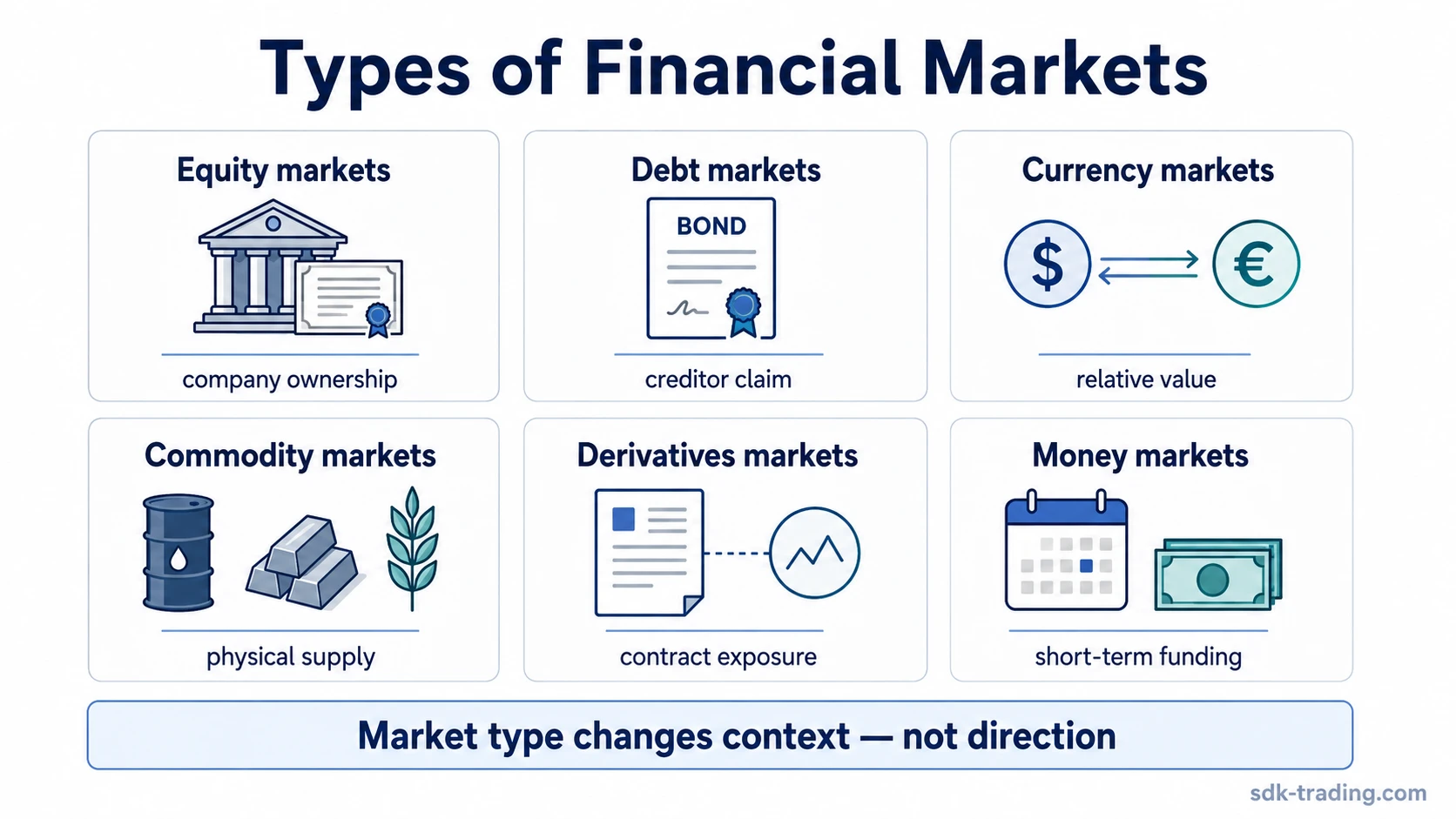
Financial Markets Are Classified on Different Axes
Many introductions present market types as one flat list. That is convenient, but it hides an important distinction: the categories do not all answer the same question.
| Classification axis | Question it answers | Examples |
|---|---|---|
| Claim or underlying exposure | What economic exposure is being traded? | Equity, debt, currency, commodity |
| Contract structure | Is the exposure held directly or created through a contract? | Derivatives such as futures, options, and swaps |
| Maturity and funding function | Is the market primarily handling short-term funding instruments? | Money markets |
| Issuance layer | Is the instrument being created or traded after issuance? | Primary and secondary markets |
| Venue model | Where and how are transactions organized? | Exchange-traded and OTC markets |
The same instrument can therefore belong to several classifications at once. A corporate bond can be part of the debt market, trade in the secondary market, and trade through either an exchange or an OTC structure depending on the instrument and venue.
Main Financial Markets by Instrument or Exposure
| Market | What is being traded | Main structural feature |
|---|---|---|
| Equity market | Shares of companies | The instrument represents an ownership interest in a company. |
| Debt market | Bonds and other credit instruments | The instrument represents a creditor claim with contractual payment and maturity terms. |
| Currency market | One currency relative to another | The price is a relative value between two monetary units. |
| Commodity market | Energy, metals, agricultural products, or related exposure | Pricing is connected to an underlying physical commodity and its supply-demand conditions. |
| Derivatives market | Contracts based on another asset, rate, index, currency, commodity, or benchmark | The contract creates exposure through defined terms rather than necessarily through direct ownership of the underlying asset. |
| Money market | Short-maturity debt and funding instruments | The segment is organized around short-term financing and liquidity management. |
Why Derivatives Are a Different Kind of Classification
Derivatives overlap with other market categories because the contract can reference an equity, bond, currency, commodity, interest rate, or index. A futures contract on crude oil is both commodity-related exposure and a derivative contract. An equity option is linked to the equity market but has its own contract terms.
This matters when reading a chart because the derivative can introduce features that do not exist in the same form in the underlying asset. Expiry, settlement, margin, leverage, strike selection, and volatility sensitivity can all affect the instrument.
Limitation: a derivative price can resemble movement in its underlying market without being economically identical to holding the underlying asset itself.
Primary vs Secondary Markets
Primary and secondary markets classify activity by the stage of the instrument rather than by the asset itself.
| Market layer | What happens | Example |
|---|---|---|
| Primary market | A new financial instrument is issued and capital moves to the issuer. | A company issues new shares or a government issues new bonds. |
| Secondary market | An existing instrument trades between market participants. | Investors trade previously issued shares or bonds. |
Most continuously quoted charts used for market analysis represent secondary-market trading rather than the original issuance process.
Exchange-Traded vs OTC Markets
Exchange-traded and over-the-counter markets classify trading by venue structure.
| Venue model | Structure | Practical difference |
|---|---|---|
| Exchange-traded | Transactions take place through a centralized venue with defined trading rules. | Quotes, contract specifications, and transaction procedures are generally more standardized. |
| OTC | Transactions take place through dealer networks or bilateral arrangements rather than one centralized exchange. | Quote visibility, liquidity, contract terms, and counterparty access can vary more across participants. |
A market can therefore be classified by both instrument and venue. Currency trading, for example, can involve an OTC spot market while currency futures trade on centralized exchanges.
How Market Type Changes the Trading Context
The classification does not predict whether price will rise or fall. It changes the questions that should be asked about the instrument behind the chart.
| Structural question | Why it matters |
|---|---|
| What claim or exposure does the instrument represent? | Ownership, credit, relative currency value, physical-goods exposure, and derivative exposure respond to different economic forces. |
| What are the contract terms? | Expiry, settlement, margin, leverage, or optionality can affect the behavior of derivative instruments. |
| How liquid is the market? | Liquidity affects spreads, continuity of pricing, and execution conditions. |
| When does the market trade? | Session structure can affect gaps and when new information reaches the price. |
| How is trading organized? | Centralized and OTC structures can differ in transparency and quote formation. |
Changes in funding, liquidity, rates, credit conditions, and risk appetite can also spread between these segments during broader market cycles.
Common Classification Mistake
Common mistake: treating equity, derivatives, primary markets, and OTC markets as mutually exclusive choices. They describe different dimensions of financial activity and can overlap.
Market type should also not be confused with trading style. Equity, debt, forex, commodity, and derivatives labels describe instruments or markets. Scalping, day trading, swing trading, and position trading describe how a trader organizes holding period and decision frequency.
Simple Classification Example
Consider an equity option that is already trading after issuance. It can be described simultaneously as a derivative because it is an options contract, equity-related because its value depends on a stock, secondary-market activity because the existing contract is being traded, and exchange-traded if the transaction takes place on a centralized options exchange.
Those descriptions do not conflict. They answer different classification questions about the same instrument.