Decision fatigue in trading is the decline in later decision quality after repeated market choices. It matters when a trader begins shortening checks, loosening criteria, hesitating, forcing action, or changing risk behavior before the trading record supports that change.
The issue is not simply feeling tired, losing a trade, reducing size, skipping a setup, or ending a session early. The useful question is whether repeated choices are changing the trader’s criteria, sequence, execution path, or record quality before evidence justifies a different approach.
- Decision fatigue in trading describes later decision-quality decay, not every emotional reaction or bad outcome.
- The main risk is compressed filtering: fewer checks, weaker selectivity, and inconsistent risk behavior after repeated choices.
- It can appear as impulsive action, freezing, skipped analysis, looser criteria, risk inconsistency, or excessive monitoring.
- It differs from overtrading, lack of discipline, overthinking, emotional trading, and cognitive load because the classification depends on what changed in the trader’s decision path.
- A false-positive filter is necessary: not every skipped trade, defensive reduction, loss, stressful session, or shorter day is decision fatigue.
What Is Decision Fatigue in Trading?
Decision fatigue in trading is a process condition where repeated trading choices begin to reduce the quality of later evaluation. The trader may still know the plan, but later choices become less selective, less consistent, or less carefully checked than earlier choices in the same session or sequence.
In trading, the fatigue is not defined by mood alone. A trader can feel pressure and still follow the intended sequence. Decision fatigue becomes a better label when pressure changes how setups are filtered, how risk is accepted, how execution is handled, or how the result is recorded.
The boundary is evidence-based: the label fits only when repeated market choices alter the trader’s normal standards before the plan, market evidence, or review record supports that alteration.
How Decision Fatigue Changes the Trading Process
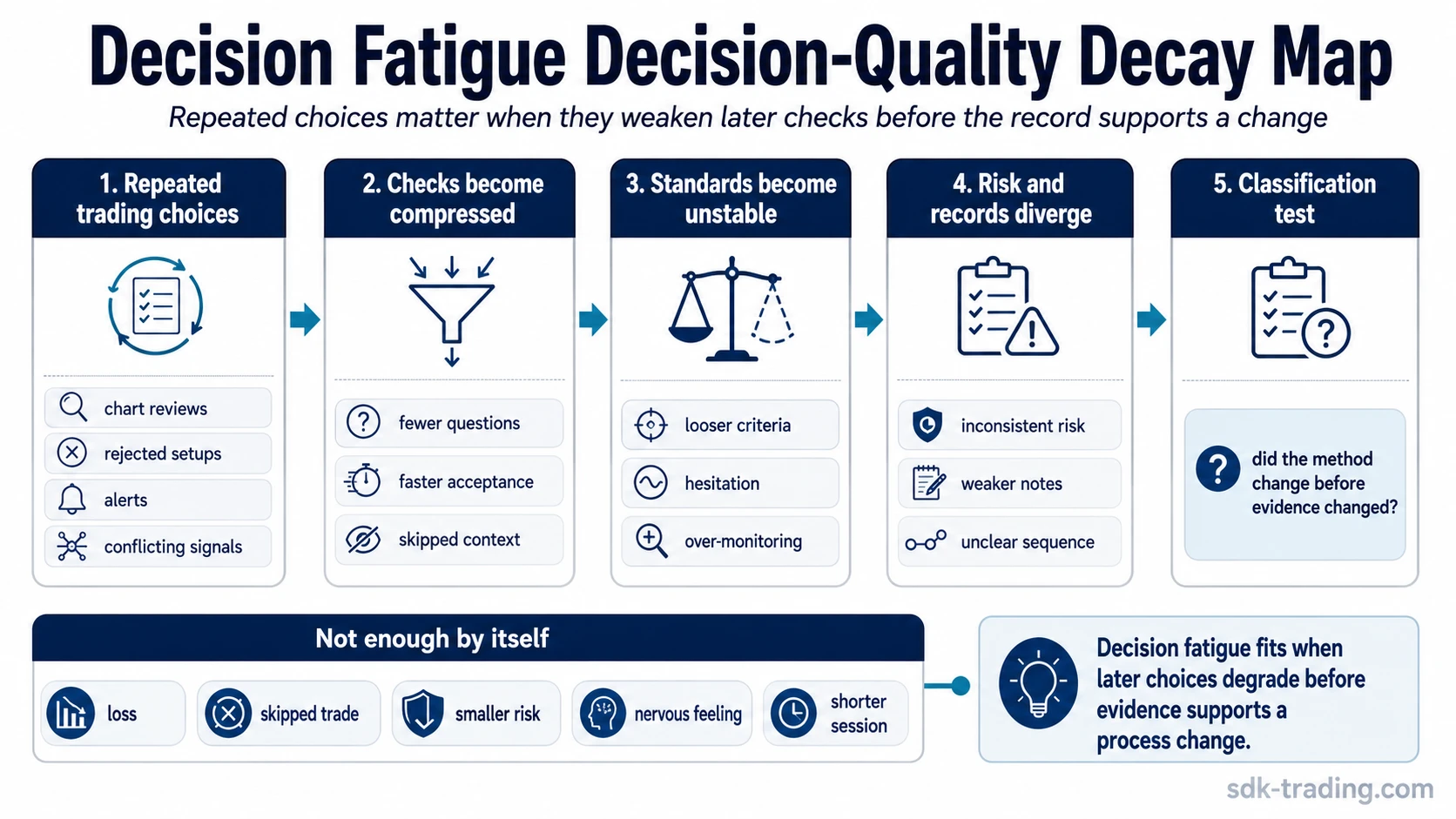
Trading can require many small judgments before any visible entry decision appears. A trader may compare charts, reject weak setups, track alerts, adjust attention across timeframes, monitor risk, and decide whether new information is meaningful or only noise.
As that load builds, later filtering can become compressed. The trader may stop asking the full set of questions, accept the first adequate reason, react faster to price movement, or avoid a valid setup because completing the normal checks feels too costly.
| Process stage | What may change under decision fatigue | Why it matters |
|---|---|---|
| Setup review | Criteria become looser or are checked less completely. | The trade may no longer match the same standard used earlier. |
| Execution decision | The trader acts quickly, freezes, or waits for unnecessary confirmation. | The action changes because the decision path changed, not because the evidence changed. |
| Risk behavior | Position size, stop logic, or risk acceptance becomes inconsistent. | The record becomes harder to evaluate because similar situations are handled differently. |
| Post-trade review | The trader records less detail or explains the outcome too quickly. | The journal stops showing whether the intended sequence was followed. |
Decision Fatigue vs Nearby Trading Psychology Concepts
Decision fatigue overlaps with several trading psychology terms, but it should not replace them. The classification depends on what changed: rules, emotions, input load, trade frequency, or the stability of later choices.
| Concept | What changes | What it is not | How to classify it |
|---|---|---|---|
| Decision fatigue in trading | Later evaluation quality declines after repeated choices. | Not every tired feeling or bad trade. | Look for compressed checks, weaker selectivity, or inconsistent later choices. |
| Lack of discipline | Rules are ignored or bypassed. | Not always caused by decision fatigue. | Classify by whether the trader knowingly broke rules or whether decision quality weakened first. |
| Emotional trading | Emotion drives the execution path. | Not every emotional feeling during trading. | Classify by whether fear, greed, frustration, or urgency changed the sequence of checks. |
| Overthinking | Evaluation expands beyond useful evidence. | Not the same as shortened filtering. | Classify by whether the trader adds unnecessary checks or abandons necessary checks. |
| Overtrading | Trade frequency or exposure expands beyond plan quality. | Not the only possible output of decision fatigue. | Classify by whether extra trades come from degraded filtering, boredom, revenge, or rule design. |
| Cognitive load | The amount of information and input pressure increases. | Not automatically decision fatigue. | Classify cognitive load as input burden; classify decision fatigue as later decision-quality decay. |
| Consistency in trading | The same standards are repeated across similar situations. | Not the same as taking identical trades every time. | Use it as the comparison point for whether later choices still follow the intended method. |
Common Signs of Decision Fatigue in Trading
These signs are useful only when they are read as changes in the trader’s operating standard, not as personality labels. One sign does not prove decision fatigue. The pattern becomes stronger when several signs appear after repeated choices and the trader’s criteria become less stable.
- Impulsive trades: A setup is accepted faster than the same trader would normally accept it.
- Hesitation or freezing: A valid setup is avoided because the normal checks feel harder to complete.
- Looser criteria: “Close enough” starts replacing the actual rules.
- Skipped analysis: Important checks are ignored even though they are normally part of the method.
- Stop or risk inconsistency: Similar situations receive different risk treatment without a clear reason.
- Over-monitoring: The trader keeps checking price movement but stops improving the record.
Classification note: These signs carry more weight when they appear later in a sequence and when they change the trader’s standards before the evidence changes.
Common Causes of Decision Fatigue in Trading
Decision fatigue can build when the trading environment requires repeated choices without enough separation between them. The source is not always the number of trades. It can also come from rejected setups, watched charts, conflicting signals, alerts, or unresolved “maybe” situations.
| Cause | Process effect | Possible trading behavior |
|---|---|---|
| Too many charts or signals | The trader must compare more inputs than the method can handle cleanly. | Filtering becomes scattered or selective only after the fact. |
| Long sessions | The same standard becomes harder to maintain across time. | Later choices become faster, weaker, or more avoidant. |
| Unclear rules | Every setup requires fresh interpretation instead of rule-based filtering. | The trader keeps deciding what the method is while also deciding what to do. |
| Excessive monitoring | Attention stays active even when no decision is required. | The trader reacts to movement instead of waiting for a defined condition. |
| Repeated wins or losses | Recent outcomes add pressure to later choices. | The trader may protect gains too aggressively, force recovery, or avoid normal risk. |
A Simple Classification Test
Decision fatigue should be classified by comparing the current choice to the trader’s normal method, not by judging the outcome. The question is not “Did the trade win?” or “Did the trader feel tired?” The question is whether the sequence changed without enough support from the trading record.
- Identify the repeated load: What came before this choice: chart reviews, setup rejections, alerts, risk adjustments, or conflicting signals?
- Locate the change: Did the trader shorten checks, loosen criteria, freeze, over-monitor, or alter risk behavior?
- Check the evidence basis: Did new evidence justify the change, or did the trader change course because the choice felt too costly to finish?
- Compare similar situations: Would the same trader normally handle this setup differently under a cleaner state?
- Separate outcome from method: A winning trade can still come from a fatigued choice, and a losing trade can still be method-consistent.
False-positive filter: Decision fatigue is not proven by a loss, a skipped trade, a smaller position, a nervous feeling, or a shorter session. A skipped trade can be disciplined. A risk reduction can be planned. A loss can happen even when the method was followed. Decision fatigue is the better label only when repeated choices degrade later checks, criteria, execution, or record quality before evidence supports changing the method.
Practical Scenario
A trader reviews several charts during a long session and rejects multiple weak setups. Later, a new setup appears that only partially matches the plan. Earlier in the session, the trader would have checked context, invalidation, risk, and setup quality before acting. This time, the trader accepts the first reason that makes the trade feel acceptable and skips the normal sequence.
The issue is not whether the trade wins or loses. The decision-fatigue question is whether repeated evaluation pressure caused the trader to accept a lower-quality path before the evidence supported that change.
When It Is Not Decision Fatigue
Decision fatigue is useful only when it explains a real change in the trader’s standards. It becomes misleading when it turns into a catch-all explanation for any discomfort, missed trade, or bad result.
| Situation | Why it may not be decision fatigue | Safer classification question |
|---|---|---|
| A trader skips a trade. | The setup may not meet the plan. | Was the trade skipped because criteria failed or because the checks could not be completed? |
| A trader reduces risk. | Risk reduction may be part of the method. | Was the reduction planned, evidence-based, or a reaction to accumulated pressure? |
| A trade loses money. | Outcome alone does not classify the choice. | Did the trader follow the intended sequence before the loss occurred? |
| A trader feels nervous. | Emotion can exist without changing the method. | Did the feeling alter setup filtering, execution, risk, or post-trade evaluation? |
| A trader stops for the day. | Stopping can be discipline. | Was stopping a pre-defined boundary or an unreviewed reaction? |
How Decision Fatigue Affects Review Quality
The central damage is not that a trader becomes emotional or tired. The central damage is that the standard applied to later choices becomes unstable. The trader may still use the same vocabulary, but the actual filtering standard is no longer the same.
That instability can show up in opposite ways. One trader may take marginal trades faster because the sequence has been shortened. Another trader may avoid valid trades because completing the checks feels too demanding. Both can come from the same underlying problem: repeated choices have changed the later path.
Useful distinction: Cognitive load is the pressure created by inputs. Decision fatigue is the deterioration in later choices after repeated decisions. The first describes the burden; the second describes the decay.
Related Concepts
Decision fatigue belongs inside execution discipline because it concerns the stability of a trader’s decision method. It is related to overtrading, trading discipline, cognitive load, trading routines, and trading plans, but it should not replace those concepts.
- Overtrading: Can be one output of decision fatigue, but extra trades may also come from boredom, revenge, or poor rule design.
- Trading discipline: Focuses on whether rules are followed; decision fatigue asks whether repeated choices weakened the trader’s ability to apply the method consistently.
- Cognitive load: Describes the amount of information the trader is processing; decision fatigue describes what happens to later choices.
- Trading plan: Gives the intended structure; decision fatigue becomes visible when later choices drift away from that structure.
- Trading routine: Can reduce repeated discretionary burden, but it does not remove the need for clear rules, review quality, and false-positive filtering.
Decision Fatigue in Trading FAQ
Is decision fatigue the same as lack of discipline?
No. Lack of discipline usually means the trader does not follow the rules. Decision fatigue is more specific: repeated decisions reduce the quality or consistency of later review, which may then lead to rule breaks or weaker filtering.
Does decision fatigue always cause overtrading?
No. Overtrading can be one output, but decision fatigue can also cause hesitation, freezing, skipped analysis, defensive risk changes, or excessive monitoring without action.
Can experienced traders experience decision fatigue?
Yes. Experience can improve process design, but it does not remove decision load. The classification still depends on whether repeated decisions weaken later review before evidence supports a process change.