Consistency in trading is the stability of a trader’s decision process across changing outcomes, not the smoothness of profits.
A consistent trader applies the same decision standard when a recent trade worked, failed, or remained unclear. The concept depends on stable criteria, reviewable decisions, and the ability to keep recent results from changing the rules too quickly.
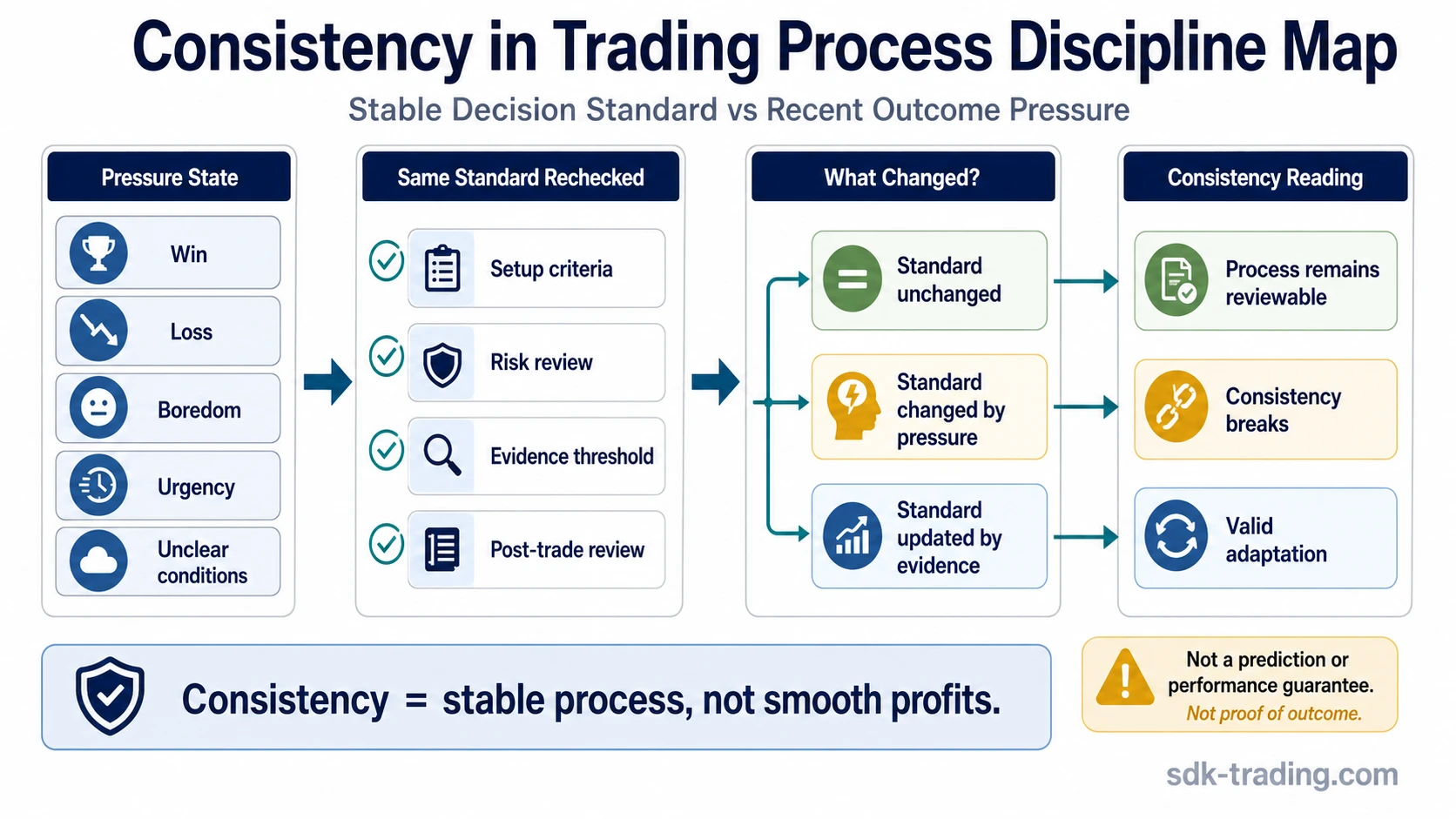
Definition: Consistency in trading means using a stable process for setup selection, risk review, execution standards, and post-trade review across different emotional and market conditions.
Important boundary: Consistency does not mean constant profits, constant trade frequency, or mechanical repetition when market context changes. It describes process stability, not outcome certainty.
Key Points
- Consistency is about decision standards, not smooth profits.
- A trader can remain consistent during a losing period if criteria and review remain stable.
- Consistency breaks when recent outcomes change size, frequency, criteria, or review discipline.
- Consistency is related to discipline, but it is narrower than broad trading discipline.
What Consistency in Trading Means
The process becomes reviewable when the same type of setup is judged by the same criteria, risk is checked before the decision is made, and the result is recorded in a way that can be compared later.
The main question is not whether every trade ends positively. The main question is whether the decision standard remains stable enough to evaluate. Without that stability, wins and losses become difficult to interpret because each decision may be based on a different rule set.
Process consistency also requires context awareness. A trader may skip a setup when conditions no longer fit the plan. That is not inconsistency by itself. The problem appears when the standard changes because of pressure rather than because the market evidence changed.
What Consistency in Trading Is Not
Consistency is often confused with outcome smoothness. A trader can follow a stable process and still experience losing trades, flat periods, or uneven results. Market outcomes are variable; the process is the part that can be made more reviewable.
Consistency is also not the same as intensity. More screen time, more trades, more journal entries, or more strategy changes do not automatically create a more stable process. Activity becomes suspect when it rises because the trader is trying to compensate for recent results rather than because the planned criteria are present.
Rigid repetition is another false version of consistency. A trader who repeats the same action after conditions have changed may look disciplined from the outside, but the decision can still be weak if it no longer matches the planned criteria.
Neutral clarification: A consistent process can still adapt. The boundary is whether adaptation comes from changed evidence or from emotional pressure after recent outcomes.
The Diagnostic Boundary: What Supports or Breaks Consistency
The cleanest way to identify consistency is to separate the process from the result. A profitable sequence can still be inconsistent if criteria keep changing. A losing sequence can still be consistent if the same documented standard is applied and reviewed.
| Diagnostic area | Process-consistent reading | False consistency or break condition |
|---|---|---|
| What it is | A stable decision standard applied across wins, losses, boredom, urgency, and unclear conditions. | A repeated action that only looks stable because the trader keeps doing the same thing regardless of evidence. |
| What it is not | It is not a promise of smooth profits or a requirement to trade at the same frequency every week. | Equating consistency with constant profitability, high activity, or never changing a plan. |
| What supports the reading | Documented criteria, similar review standards, controlled exposure checks, and comparable decision notes over time. | Vague confidence, selective journaling, or reviewing only the trades that produced strong emotions. |
| What breaks the reading | The process is weakened when recent outcomes change the trader’s decision standard even though the underlying evidence threshold has not changed. | Increasing activity after losses, relaxing criteria after wins, changing systems too quickly, or skipping review after uncomfortable results. |
How Consistency Shows Up in the Trading Process
Consistency becomes visible when the same categories are checked before decisions: the setup condition, the reason the trade is being considered, the risk process, the evidence that would weaken the idea, and the review method after the result is known.
A stable process does not require every decision to look identical. It requires the decision to be comparable. A trend setup, a range setup, and a failed-breakout scenario may have different criteria, but each one still needs a defined standard before action is taken.
| Process area | Consistent behavior | Unstable behavior |
|---|---|---|
| Setup criteria | The trader checks whether the setup matches the documented conditions. | The trader lowers the standard because a recent move was missed. |
| Risk review | The risk process is checked before the decision, not only after discomfort appears. | The trader adjusts exposure because of frustration, confidence, or the desire to recover. |
| Execution standard | The decision follows the same evidence threshold used for similar situations. | The trader accepts weaker evidence because recent outcomes created urgency. |
| Post-trade review | The trade is reviewed against process quality, not only profit or loss. | The trader studies losing trades intensely but ignores profitable rule breaks. |
Review note: Journaling supports consistency only when it captures the decision standard before and after the trade. A journal that records only emotions or outcomes may not reveal whether the process itself was stable.
Common Mistakes That Make Consistency Look Stronger Than It Is
Some behaviors can look consistent on the surface while weakening the process underneath. The risk is highest when recent outcomes start changing the trader’s standard without a clear change in market evidence.
| Mistake | Why it weakens consistency | Safer interpretation |
|---|---|---|
| Confusing a profit streak with consistency | A profitable sequence can hide unstable criteria if each decision was made for a different reason. | Judge whether the same process would still be defensible if the next few outcomes were unfavorable. |
| Switching systems too quickly | Changing the framework after a small sample can make review impossible. | Separate a broken process from normal outcome variation before replacing the framework. |
| Increasing activity after losses | More trades can become compensation behavior rather than evidence-based selection. | Rising frequency after pressure should be checked against the original setup criteria. |
| Relaxing criteria after confidence rises | Wins can make weaker evidence feel acceptable even when the standard has changed. | Profitable trades still need the same review standard as losing trades. |
| Using review only after bad outcomes | Selective review makes the process look more stable than it is. | Both profitable and losing decisions need review when the goal is process consistency. |
A Practical Scenario: Same Loss, Different Process
After a losing period, one trader reviews whether the trades met the planned criteria, whether market conditions still fit the setup type, and whether the next decision still requires the same evidence threshold. The result was negative, but the process remains reviewable because the standard did not change after pressure appeared.
Another trader responds to a similar loss by accepting weaker setups, trading more often, and skipping the normal review because recovery has become the main focus. One of those trades may still work, but the process is harder to evaluate because the decision standard changed after the loss.
The distinction is not whether the next trade wins or loses. The distinction is whether the next decision can be compared against the same criteria used before the pressure appeared.
Related Concepts: Decision Fatigue and Overtrading
Consistency can weaken when mental load reduces the quality of repeated choices. Decision fatigue describes that decline in decision quality under cognitive pressure, especially when repeated choices make the trader less selective.
Consistency can also break when pressure turns into unnecessary activity. Overtrading describes excessive or forced participation, which often appears when the trader tries to compensate for missed moves, losses, boredom, or urgency.
Both concepts are related to consistency, but neither replaces it. Consistency is the stability of the decision standard itself; mental load and excessive activity are two conditions that can disrupt that standard.
Limits of Consistency in Trading
Limitation: A consistent process can make decisions easier to review, but it cannot remove uncertainty from market outcomes. The same process can produce different results across changing conditions, and a stable rule set still needs periodic review when the market evidence changes.
Consistency also should not prevent correction. If review shows that a criterion no longer matches the traded environment, updating the process may be reasonable. The key distinction is whether the change comes from reviewable evidence or from the emotional force of the most recent outcome.
FAQ
What does consistency in trading mean?
Consistency in trading means applying a stable decision process across changing outcomes. It is based on repeatable criteria, risk review, execution standards, and post-trade review rather than smooth profits.
Can a trader be consistent while losing money?
Yes. A trader can be consistent during a losing period if the decisions still follow the documented criteria and the process remains reviewable. Losing results do not automatically prove that the process was inconsistent.
Is consistency the same as trading discipline?
No. Trading discipline is broader. Consistency is narrower because it focuses on whether the same decision standard is applied across wins, losses, pressure, boredom, and changing outcomes.