Overtrading is trading activity that expands beyond validated selection criteria, pacing rules, risk boundaries, or review discipline. It is not defined by one universal number of trades. A high-activity approach can still be deliberate when the method, opportunity set, risk limits, and record support the activity. Overtrading begins when activity increases faster than the process can justify.
Definition: Overtrading means taking, evaluating, or managing more trades than the trader’s tested process can support. The boundary is crossed when more activity is created by pressure, boredom, losses, urgency, or easier criteria rather than by valid setups and documented process evidence.
Key Points
- Overtrading is a process-boundary problem, not simply a high trade count.
- The key test is whether added activity still follows validated criteria, pacing, risk limits, and review quality.
- Frequent trading can be valid when the strategy, timeframe, opportunity set, and record support it.
- Warning signs include easier entry criteria, compressed review, rising position-taking without better setup quality, and after-the-fact justification.
- Reducing overtrading is not only about taking fewer trades; it is about restoring the decision boundary that separates valid activity from reaction-driven activity.
What Is Overtrading?
Overtrading occurs when a trader’s activity expands beyond the rules and evidence that normally control execution. The extra activity may appear as more trades, faster re-entry, repeated scanning, unnecessary position adjustment, or continued decision-making after the original plan has already been used.
The important distinction is that activity itself is not the problem. The problem is unsupported activity. A trader can take many trades in a liquid, fast-moving environment if the setups match the method and the record shows that the process remains stable. Another trader can overtrade with only a few trades if those trades come from lowered standards, revenge, fear of missing out, or refusal to stay flat.
Boundary: Overtrading should not be diagnosed from trade count alone. It should be diagnosed from the relationship between trade count, setup quality, risk control, review spacing, and the evidence recorded before the trade was taken.
Why Overtrading Is Not Just a High Trade Count
A fixed number of trades cannot define overtrading because strategies differ. A scalper, day trader, swing trader, and position trader all operate with different opportunity sets and decision rhythms. A normal number of trades for one method may be excessive for another.
The more useful question is whether the trader’s activity still matches the method. If trade frequency rises because valid setups appear more often and the same criteria are still applied, the activity may be method-supported. If frequency rises because the trader starts accepting weaker setups, chasing movement, widening the meaning of a signal, or skipping review, the activity has moved toward overtrading.
| Activity pattern | Safer interpretation |
|---|---|
| More trades with the same criteria, risk rules, and review quality | Potentially valid active trading if the record supports the change. |
| More trades after losses, frustration, boredom, or missed moves | Possible overtrading trigger because activity may be replacing process control. |
| More trades with weaker setup quality or looser entry standards | Stronger overtrading warning because criteria drift is already visible. |
| Fewer trades but repeated forced entries outside the plan | Still possible overtrading because the issue is unsupported activity, not only frequency. |
Overtrading Diagnostic Boundary
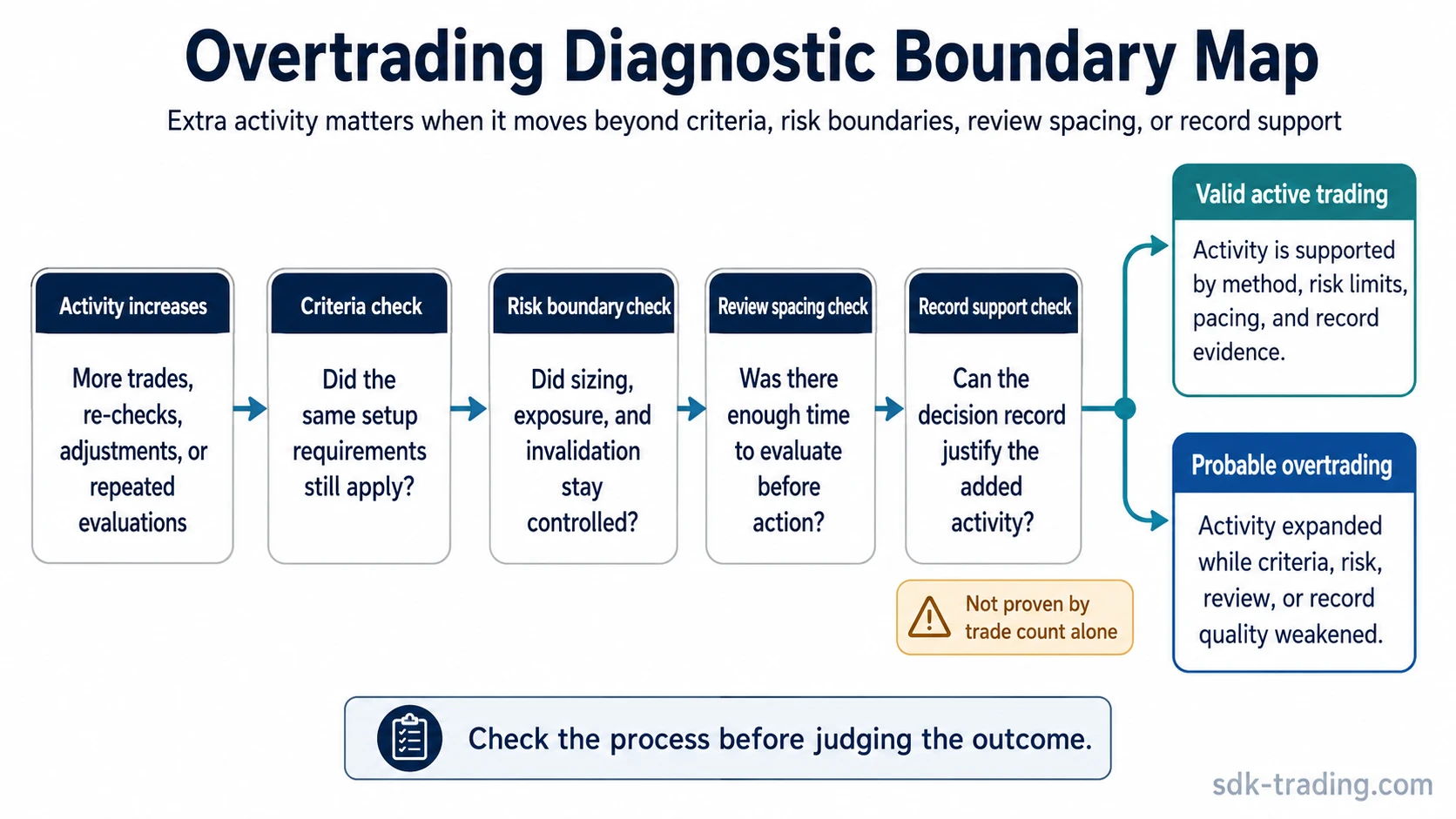
The diagnostic boundary separates valid active trading from reaction-driven activity. The more boxes that are true, the more likely the issue is not activity level but process drift.
- Activity count changed: trades, re-entries, adjustments, or repeated evaluations increased compared with the trader’s normal process.
- Setup quality did not improve: the additional activity did not come from clearly better opportunity quality or a broader validated opportunity set.
- Criteria became easier to satisfy: marginal patterns, weak confirmations, or vague context started qualifying as enough.
- Risk boundaries became more flexible: sizing, exposure, stop logic, or invalidation rules became easier to bend.
- Review spacing compressed: decisions were made faster, with less time between signal, evaluation, execution, and recordkeeping.
- The record cannot justify the change: the journal or trade log does not explain why the added activity was valid before the trade was taken.
Practical test: The question is not “Did I trade a lot?” The question is “Can my record show that the extra activity still followed my criteria, pacing, risk limits, and review process?”
How Overtrading Changes the Trading Process
Overtrading usually appears through small changes before it becomes obvious. The trader may still believe the plan is being followed, but the meaning of a valid setup starts to stretch. A pattern that previously required confirmation may be treated as enough. A level that needed context may become a reason to enter. A trade that once required clean risk definition may be accepted because the market feels active.
This drift can affect the entire decision sequence. Selection becomes wider, pacing becomes faster, risk rules become easier to adjust, and review becomes less useful because the record is written after the pressure has already shaped the decision. The trader may then judge the decision mainly by outcome rather than by whether the process was intact at the moment of execution.
| Process area | How overtrading can distort it |
|---|---|
| Selection criteria | More setups begin to qualify even though the original criteria have not changed in the written plan. |
| Pacing | The time between observation, decision, execution, and review becomes shorter. |
| Risk control | Risk boundaries become negotiable because the trader wants to stay active or recover quickly. |
| Post-trade review | The record starts explaining why the trade was reasonable after the fact instead of documenting the reason before action. |
Signs of Overtrading
Overtrading signs are strongest when they show a change in decision quality, not just a change in activity. A busy session is not automatically a problem. The warning appears when more activity comes with weaker criteria, less patience, more emotional urgency, or a poorer record.
- Setup standards become softer: trades are accepted with less confirmation than the method normally requires.
- Flat periods feel uncomfortable: not trading starts to feel like missing out rather than following the process.
- Losses create immediate re-entry pressure: the next decision is shaped by the previous result instead of the next valid setup.
- Profits create expansion pressure: early gains lead to extra trades that were not part of the original plan.
- Review becomes shorter: the trader spends less time checking context, invalidation, and risk before acting.
- Justification moves after execution: reasons are built around the trade after it is already open.
- The journal becomes vague: entries describe feelings, movement, or urgency more than criteria, risk, and invalidation.
Common mistake: Calling every losing trade overtrading makes the diagnosis weaker. A trade can lose while still following the process. Overtrading is more specific: activity expanded beyond the process before the outcome was known.
What Usually Triggers Overtrading
Triggers are inputs, not proof. A loss, missed trade, fast market, or strong emotion does not automatically mean the next trade is overtrading. The trigger matters because it can pressure the trader to lower the boundary that normally separates valid setups from activity for its own sake.
| Trigger | How it can lead to overtrading |
|---|---|
| Losses | The trader may try to recover quickly instead of waiting for the next valid setup. |
| Missed movement | Fear of missing out can turn late participation into a substitute for process evidence. |
| Boredom | Low-quality opportunities may start to look acceptable because inactivity feels unproductive. |
| P&L fixation | The trader may manage decisions around account movement instead of setup quality and risk definition. |
| Loose rules | If criteria are not specific, almost any movement can be interpreted as a possible trade. |
| Decision fatigue | Repeated choices can make later checks weaker, especially when review quality is already declining. |
Overtrading vs Active Trading
Active trading and overtrading can look similar from the outside because both may involve frequent decisions. The difference is the source of the activity. Active trading is method-driven. Overtrading is reaction-driven or unsupported by the record.
| Question | Active trading | Overtrading |
|---|---|---|
| Why did activity increase? | More valid opportunities appeared within the method. | Pressure, emotion, boredom, or recovery urgency increased. |
| Did criteria remain stable? | The same setup requirements still applied. | The definition of an acceptable setup became easier. |
| Did risk boundaries remain intact? | Risk limits stayed consistent with the process. | Risk rules became flexible to allow more activity. |
| Can the record justify the activity? | The trade log explains the decision before action. | The record is vague, delayed, or built around after-the-fact justification. |
Overtrading can look like a trading discipline problem, but the narrower issue is whether activity increased without stronger process evidence. A trader may still care about rules and still drift if the rules are too elastic during pressure.
Why Overtrading Damages Review Quality
Overtrading weakens review because it creates more decisions than the record can explain cleanly. When review quality declines, the trader may not know whether results came from valid setups, weaker criteria, emotional re-entry, changed risk, or normal variance.
A useful trading record should show the reason for the trade, the criteria used, the risk boundary, the invalidation idea, and the context that made the decision acceptable. When activity expands without that evidence, review becomes noisy. The trader may then adjust the process based on unclear feedback.
Example scenario: A trader normally waits for structure, confirmation, and defined risk before entering. After missing a move, the trader starts entering on earlier signals and writes the reason later. The issue is not that the trader became more active. The issue is that the activity moved ahead of the criteria that normally make the decision reviewable.
How to Reduce Overtrading Without Relying Only on Trade Caps
Reducing overtrading does not always mean forcing a lower trade cap. A cap can help when activity is clearly excessive, but it can also hide the real problem if the trader still accepts weak setups inside the cap. The better control is to restore the boundary between valid activity and unsupported activity.
- Define what qualifies before the session: criteria should be specific enough that pressure cannot easily stretch them.
- Separate setup quality from the desire to act: the market can be active without offering a valid trade for the method.
- Record the reason before execution: if the reason cannot be written clearly before action, the decision may not be ready.
- Check whether risk changed to permit activity: flexible risk rules can hide process drift.
- Review non-trading decisions: staying flat can be evidence of process control, not inactivity failure.
Guardrail: The strongest control is not “trade less” in isolation. The stronger control is “trade only when the setup, risk boundary, pacing, and record all support the decision.”
Overtrading and Consistency
Overtrading often conflicts with consistency in trading because the trader’s process changes under pressure. The same trader may use one standard after a calm start, another standard after a loss, and a third standard after missing a move. That inconsistency makes results harder to interpret because the method being reviewed is no longer the same method that was planned.
The useful distinction is that consistency describes repeatable adherence over time, while overtrading describes a specific activity expansion beyond the process boundary. A trader can be inconsistent without overtrading, and a trader can overtrade because consistency has already weakened.
Related Concepts
| Concept | Relationship to overtrading |
|---|---|
| Trading discipline | Broader rule adherence and behavioral control. Overtrading is one possible failure mode inside that broader discipline problem. |
| Consistency in trading | Repeatable process behavior over time. Overtrading often appears when consistency weakens under pressure. |
| Decision fatigue | Quality decay after repeated choices. It can contribute to overtrading when later checks become weaker. |
| Trading plan | The documented structure that defines criteria, risk boundaries, and review rules. Overtrading often exposes where that structure is too vague. |
FAQ
Is overtrading just taking too many trades?
No. Overtrading is not defined by a universal trade count. It begins when activity expands beyond validated criteria, pacing rules, risk boundaries, or review quality.
Can active trading be different from overtrading?
Yes. Active trading can be rule-supported and deliberate. Overtrading begins when activity becomes reaction-driven, criteria become easier to satisfy, or the record cannot justify the added activity.
Is revenge trading the same as overtrading?
No. Revenge trading can trigger overtrading, but it is not identical. Revenge trading starts from an emotional response to loss; overtrading is the broader activity drift that may follow.
Is broker churning the same as overtrading?
No. Broker churning is a separate broker-misconduct concept. Overtrading here means a trader’s own activity expanding beyond validated criteria, pacing, risk boundaries, or review quality.