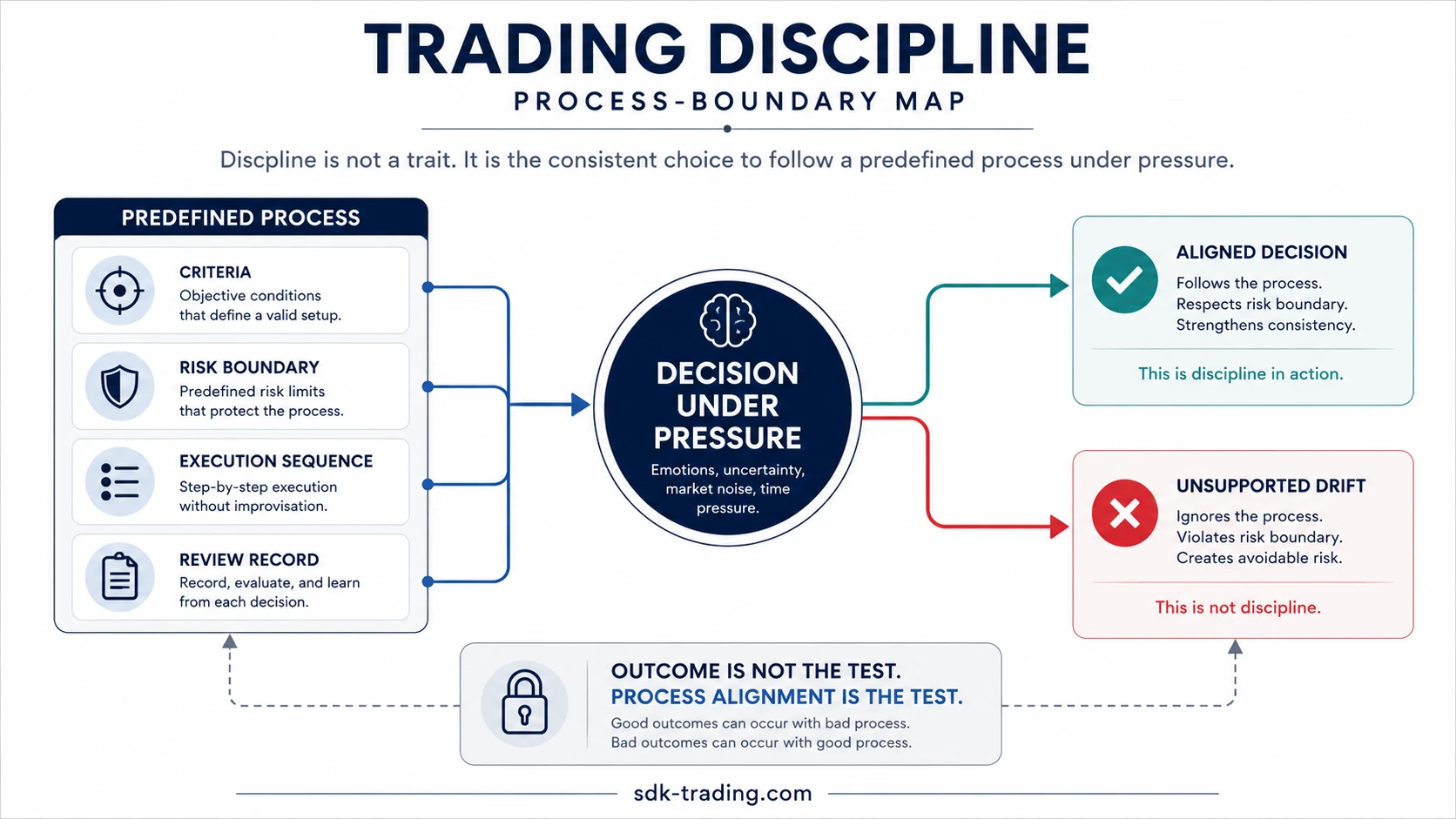
Trading discipline is the ability to keep trading behavior aligned with predefined criteria, risk boundaries, execution sequence, and review standards when pressure, recent results, or emotion make deviation tempting.
It is not a personality trait, a motivational state, or proof that a trade will work. A disciplined trade can still lose money, and an undisciplined trade can still make money by chance. The useful question is whether the live decision stayed aligned with what was defined before pressure appeared.
- Trading discipline is about process adherence, not the outcome of one trade.
- The main boundary is whether criteria, risk limits, execution sequence, and review standards remain intact under pressure.
- Emotional pressure is not automatically a discipline failure; it becomes a problem when it changes the decision before evidence supports that change.
- A review record helps separate a planned choice from a post-trade excuse.
What Trading Discipline Means
Trading discipline means following a predefined trading process when the live decision becomes uncomfortable. The process may include setup criteria, risk limits, position-sizing rules, entry sequence, exit conditions, and review standards.
The word discipline is often used as if it only means self-control. In trading, the more useful meaning is narrower: behavior stays connected to rules that were defined before fear, frustration, excitement, or urgency entered the decision.
This makes trading discipline observable. It can be checked against what was planned, what changed, why it changed, and whether the change was supported by evidence available at the time.
Why Trading Discipline Is Not the Same as a Trading Plan
A trading plan defines the intended structure before execution. Trading discipline is the behavior that keeps the trader aligned with that structure when live conditions create pressure to deviate.
| Concept | Main role | Discipline question |
|---|---|---|
| Trading plan | Defines criteria, risk limits, and execution rules before the trade. | Was the decision still aligned with the plan when pressure appeared? |
| Trading discipline | Maintains rule adherence during live decisions. | Did emotion, urgency, or recent results change the behavior without valid evidence? |
| Trading journal | Records what happened and supports later review. | Does the record show adherence, or does it only explain the outcome after the fact? |
A trader can have a detailed plan and still trade without discipline if live decisions repeatedly override the plan. A trader can also feel nervous and still remain disciplined if the trade stays inside predefined criteria and risk boundaries.
The Main Components of Trading Discipline
Trading discipline becomes easier to evaluate when it is separated into specific decision components instead of treated as a vague character label.
| Component | What it controls | What weak discipline can look like |
|---|---|---|
| Criteria adherence | Whether the trade matches predefined setup conditions. | Entering because the market is moving, even though the required conditions are incomplete. |
| Risk boundary | Whether size, stop logic, and maximum loss remain inside the plan. | Increasing size, widening risk, or moving a boundary because the trade feels more urgent. |
| Execution sequence | Whether the trader follows the intended order of checks before action. | Skipping confirmation, preparation, or record steps because the opportunity feels time-sensitive. |
| Emotional pressure handling | Whether fear, frustration, excitement, or recent results change the decision. | Taking the trade to recover, avoid missing out, or prove a point rather than because the criteria are met. |
| Review record | Whether the decision can be compared with the original plan after the outcome is known. | Explaining the trade after the fact without a record of what justified the decision beforehand. |
How Trading Discipline Breaks Under Pressure
Trading discipline usually weakens when pressure changes the decision before the trader has enough evidence to justify the change. The pressure may come from a missed move, a recent loss, a winning streak, a fast market, or the desire to recover quickly.
- Criteria loosen: A setup that would normally be rejected starts to look acceptable because the market is moving.
- Risk shifts: Position size, stop distance, or loss tolerance changes after emotion has entered the decision.
- Execution sequence shortens: The trader skips the normal checks because the trade feels time-sensitive.
- Review shifts into justification: The record explains the outcome instead of comparing the decision with the original rules.
A losing trade is not automatically an undisciplined trade. The relevant test is whether the trade followed predefined criteria and risk boundaries. Outcome alone cannot prove process quality.
A Trading Discipline Diagnostic Checklist
A diagnostic checklist should identify observable behavior, not assign a personality label or produce a numeric discipline score.
- Criteria: Was the trade supported by predefined setup conditions before action was taken?
- Risk: Did position size, stop logic, and loss boundary stay inside the plan?
- Timing: Was the execution sequence followed, or was it compressed by urgency?
- Pressure: Did fear, frustration, excitement, or recent results change the decision?
- Record: Was the reason for the decision recorded before the outcome became known?
- Review: Did the review improve future rules, or did it excuse a deviation after the fact?
The practical discipline test is behavioral: compare the live decision with the rules that existed before the trade. If the rule changed only after pressure appeared, the issue is not the emotion itself; it is the unsupported change.
How Discipline Changes Under a Missed-Move Scenario
A trader has a rule to wait for a setup, define risk, and record the reason before entry. After missing a fast move, the trader sees a similar move starting and enters before the usual criteria are complete. The trade may still work, but the process has changed: urgency replaced the planned sequence.
In a more disciplined version of the same situation, the trader can still feel frustration about the missed move, but the next decision remains tied to criteria, risk boundary, and written rationale. The emotion is present; it does not control the decision.
Common Misunderstandings About Trading Discipline
| Misunderstanding | Safer interpretation |
|---|---|
| Discipline means removing emotion. | Emotion can exist without controlling the trade. The issue begins when emotion overrides predefined criteria or risk boundaries. |
| A profitable trade proves discipline. | A trade can make money even if the decision process was poor. Result quality and decision quality are separate checks. |
| A losing trade proves poor discipline. | A planned trade can lose money while still following the process. The review should check adherence before judging the outcome. |
| More rules automatically create discipline. | Rules help only if they are usable under pressure and reviewed honestly after execution. |
| Journaling by itself creates discipline. | A record supports discipline only when it captures the decision basis and exposes unsupported deviations. |
How Trading Discipline Differs From Nearby Concepts
Trading discipline overlaps with several nearby concepts, but each one answers a different question.
| Nearby concept | Boundary |
|---|---|
| Trading plan | The plan defines the structure. Discipline describes whether behavior stays aligned with that structure under pressure. |
| Overtrading | Overtrading is excessive activity beyond criteria. Trading discipline is broader because it can also fail through skipped trades, altered sizing, moved boundaries, or poor review. |
| Trading journal | The journal is evidence support. It records whether the decision matched the process, but it is not the discipline itself. |
| Consistency | Consistency is repeatable behavior over time. Trading discipline is the pressure-tested adherence that can make consistency possible. |
| Decision fatigue | Decision fatigue can weaken later choices after repeated evaluation. It may affect discipline, but it is not the same concept. |
Limits of Trading Discipline
Trading discipline can improve the quality of a trader’s decision process, but it does not make a strategy valid by itself. A trader can follow a weak process with discipline and still get poor results. The process must still be tested, reviewed, and adjusted when evidence shows that the rules are not working as intended.
Discipline also does not require taking every planned trade. Standing aside can be disciplined if the required criteria are missing, risk cannot be defined, or the trader cannot complete the review sequence. The difference is whether the decision is supported by the process rather than by fear, impulse, or post-trade justification.
Trading discipline is a control boundary, not a performance guarantee. It can reduce avoidable process errors, but it cannot remove uncertainty, market risk, or the possibility of a planned loss.
Trading Discipline FAQ
Is trading discipline the same as a trading plan?
No. A trading plan defines the rules before execution. Trading discipline is the ability to keep behavior aligned with those rules when live pressure makes deviation tempting.
Is overtrading always a discipline problem?
Not always. Activity becomes a discipline issue when extra trades move beyond predefined criteria, risk boundaries, review spacing, or record support.
Can a disciplined trade still lose money?
Yes. A disciplined trade can lose money because discipline controls the process, not the market outcome. The review should separate planned risk from unsupported deviation.