A trading plan is not just a checklist, template, or motivational note. A trading plan is a predefined decision framework that states when participation is allowed, how risk is bounded, which execution criteria matter, what exceptions are permitted, and how the decision can be reviewed after the trade.
Trading plan definition: A trading plan defines the rules and boundaries a trader uses before live market pressure can distort the decision. It separates planned criteria from reactive behavior, so the trade can be judged against a stated process rather than against the emotion of the moment.
A trading plan is different from a trading strategy. A strategy describes the type of opportunity being considered, such as a pattern, setup, market condition, or method of interpretation. The plan defines how that opportunity is allowed to become an actual decision: what must be present, what risk boundary applies, what would invalidate the idea, and what must be recorded afterward.
Key Points About a Trading Plan
- A trading plan defines decision criteria before live pressure appears.
- It is not the same as a trading strategy, signal, or prediction tool.
- Risk boundaries, exceptions, and reviewability are central parts of the plan.
- A vague plan cannot be audited after the trade because the decision rules were never clear.
- A plan does not guarantee better results, prevent losses, or prove market direction.
What a Trading Plan Is Supposed to Control
A trading plan controls the conditions around the decision. It does not control the market outcome. The useful question is not whether the plan can make a trade work, but whether it can make the decision explicit enough to review later.
A plan that can be reviewed usually answers five questions before the trade is considered. What market or instrument is eligible? What condition allows participation? What risk boundary applies? What would make the idea invalid? What record will show whether the decision followed the plan or drifted away from it?
Core distinction: A trading strategy may describe the opportunity. A trading plan describes the permission structure around that opportunity. Without that permission structure, the trader may still have an idea, but the decision is harder to evaluate after pressure enters the process.
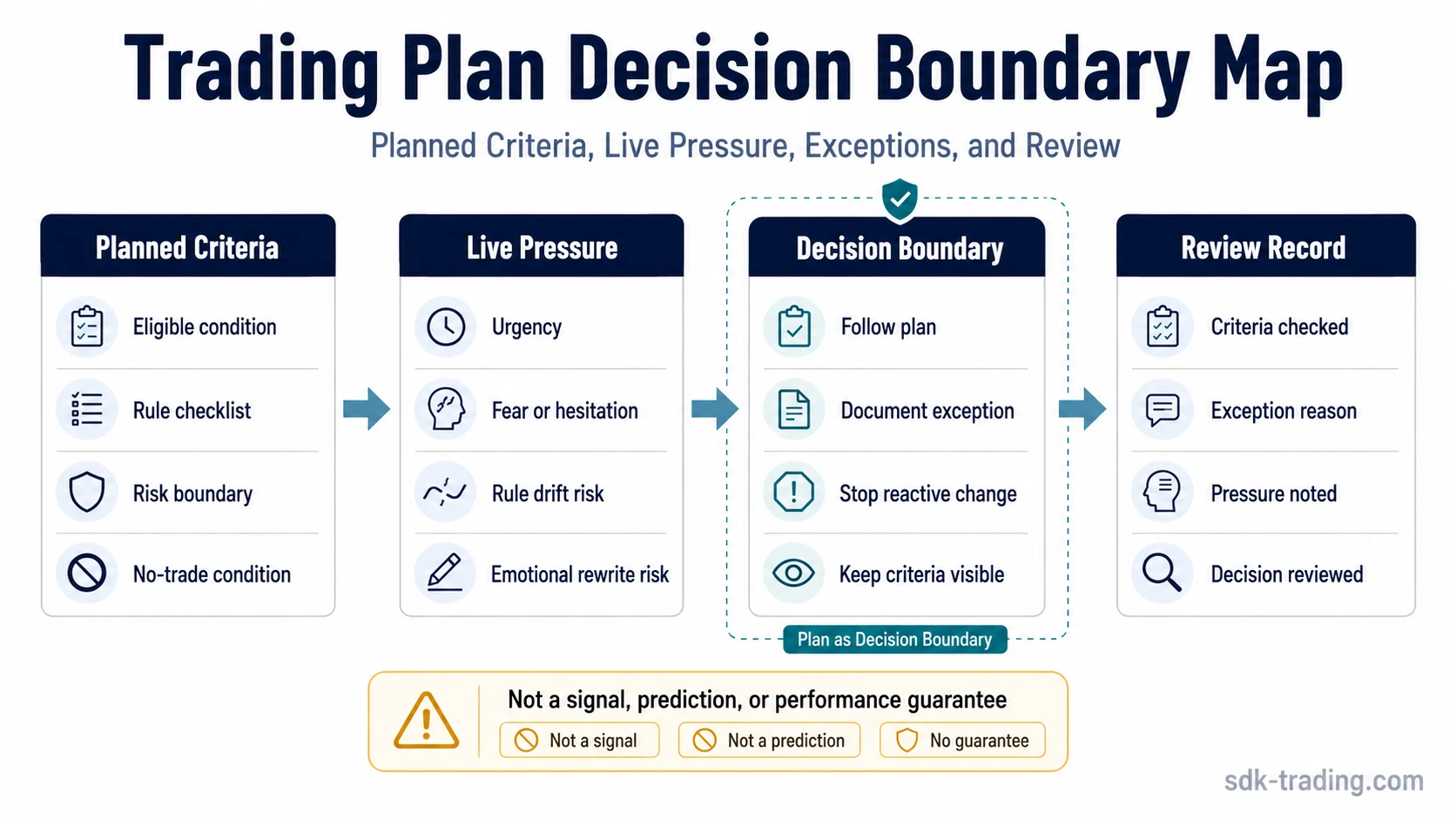
Trading Plan Components
The strongest trading plans are not necessarily long. They are specific enough to separate planned action from improvisation. Each component should be written in a way that can be checked later, not merely remembered as an intention.
| Plan area | What it defines | Why it matters | What makes it weak or non-reviewable |
|---|---|---|---|
| Objective | The purpose of the trading process and the type of decisions being allowed. | It prevents the plan from becoming a loose collection of unrelated rules. | The objective is vague, motivational, or disconnected from actual decision criteria. |
| Market or instrument criteria | Which markets, timeframes, or conditions are eligible for consideration. | It limits random participation and reduces exposure to situations outside the plan. | Anything can be traded if it feels interesting, urgent, or active enough. |
| Entry criteria | The condition that must exist before a trade idea can become an execution decision. | It separates planned participation from chasing, hesitation, or impulse entry. | The rule depends on hindsight, mood, or a phrase that cannot be checked later. |
| Risk boundary | The point where the idea is no longer acceptable under the plan. | It keeps risk from expanding while the trader is under pressure. | The boundary is absent, adjustable without reason, or only decided after the trade is live. |
| Exit or invalidation criteria | The conditions that end the trade idea or require reassessment. | It separates a planned change from emotional reaction to price movement. | The trader can always find a new reason to stay involved after the original logic fails. |
| Exception rules | When deviation from the normal plan is allowed and how it must be documented. | It prevents every live adjustment from being treated as valid flexibility. | Exceptions are unlimited, undocumented, or justified only after the fact. |
| Review routine | What must be recorded so the decision can be checked against the plan later. | It turns the plan into a learning and accountability tool rather than a static document. | The record shows only the result, not the decision context or rule adherence. |
Trading Plan vs Trading Strategy
A trading strategy explains the method used to find or interpret an opportunity. A trading plan explains how that opportunity is filtered, sized, managed, and reviewed inside a decision process. Confusing the two creates a common problem: the trader may have a setup idea but no clear boundary for participation, risk, exception handling, or review.
| Question | Trading strategy | Trading plan |
|---|---|---|
| Main role | Defines the type of opportunity or market behavior being watched. | Defines the decision rules used before, during, and after participation. |
| Primary focus | Setup logic, market condition, pattern, signal, or framework. | Eligibility, risk boundary, execution criteria, exceptions, and review. |
| Main weakness if unclear | The trader may not know what kind of opportunity is being pursued. | The trader may react to live pressure without a reviewable decision standard. |
A strategy can exist without a complete plan, but that usually leaves the decision process exposed to pressure. A plan can reference a strategy, but it should still state the rules that decide whether the strategy is allowed to be used in the current conditions.
When a Trading Plan Becomes Usable
A trading plan becomes usable when it can be checked after the decision. The plan does not need to predict what the market will do. It needs to define what the trader was allowed to do, why the action was allowed, and whether the later decision matched the stated criteria.
Reviewability test: A trading plan is reviewable when another person could read the criteria, compare them with the decision record, and see whether the trade followed the plan, broke the plan, or used a documented exception.
- The rule can be checked later: The criteria are specific enough to compare against the decision record.
- Risk is bounded before pressure: The plan states where the idea becomes unacceptable before the trade is live.
- Exceptions are defined: Adjustments are not automatically treated as discipline just because they happened during market movement.
- Changes are documented: A plan adjustment has a reason and a record, not only a post-trade explanation.
- The decision is separate from emotion: Urgency, fear, boredom, or frustration may still appear, but they do not silently replace the criteria.
What Makes a Trading Plan Fail
A trading plan can fail even when it is written down. The most common failure is not the absence of a document, but the absence of criteria that can survive live pressure and later review.
Important limitation: A trading plan does not guarantee profitability, prevent losses, or make execution automatic. It can only define a decision standard. The market outcome remains uncertain, and the trader still needs consistent behavior to apply the plan.
| Failure condition | Why it weakens the plan | Safer interpretation |
|---|---|---|
| Vague rules | The trader cannot tell whether the decision followed the plan. | Rules should describe observable conditions, not only intentions. |
| Missing risk boundary | The decision can keep changing as price moves. | The plan should define where the idea is no longer acceptable. |
| Unbounded exceptions | Every deviation can be justified as flexibility. | Exceptions should be limited and documented before they become habits. |
| Reactive live changes | Pressure replaces the original decision standard. | Adjustments should be separated from emotional response and reviewed afterward. |
| No review record | The trader can only judge the result, not the quality of the decision. | A trading journal can support the plan by recording criteria, pressure, action, and review notes. |
Trading Plan and Trading Discipline
A written plan does not create trading discipline by itself. The plan defines the standard; discipline is the behavior of applying that standard when live conditions create pressure to ignore, stretch, or rewrite it.
This is why a plan should not rely only on confidence, motivation, or the belief that the trader will remember what to do. A plan is stronger when it reduces the number of discretionary decisions that must be made while price is moving quickly.
Plan and behavior boundary: The plan is the written decision standard. Discipline is the repeated act of following or honestly reviewing that standard. A trading routine may help prepare the environment, and a trading journal may help review the decision, but neither replaces the need for clear plan criteria.
Trading Plan Example in Context
Before the session, a trader writes that participation is allowed only when the market condition matches the planned setup, the risk boundary is clear, and any exception must be recorded with a reason. During the session, price moves quickly and creates pressure to act before all criteria are present. If the trader waits for the stated condition, the decision remains aligned with the plan. If the trader acts early but records the exception and the reason at the time, the decision can still be reviewed as an exception. If the trader acts early, changes the reason afterward, and records only the outcome, the plan has become non-reviewable.
The important point is not whether the trade later wins or loses. The useful distinction is whether the decision can be compared with the plan after the pressure has passed. A losing trade may still follow the plan. A winning trade may still expose rule drift if the decision ignored the criteria and was justified only by the result.
How to Check Whether a Trading Plan Is Too Vague
A trading plan is too vague when it cannot separate a planned decision from a reactive decision. The wording may sound responsible, but if it cannot be tested against actual behavior, it will be difficult to use as a review tool.
- Can the entry condition be identified without hindsight? If not, the rule may be too subjective.
- Can the risk boundary be stated before the trade is live? If not, the plan may expand under pressure.
- Can an exception be distinguished from rule drift? If not, flexibility may become an excuse for inconsistency.
- Can the journal record show why the decision happened? If not, the review will focus only on outcome.
- Can repeated mistakes be grouped into a pattern? If not, the plan may not produce useful feedback.
When a plan lacks participation boundaries, overtrading can become harder to detect. The problem is not only the number of trades. The deeper issue is that the trader has not defined when no trade is the correct planned decision.
What a Trading Plan Is Not
A trading plan is not a prediction. It does not prove that a market will move in a specific direction. It does not turn a setup into a guaranteed outcome. It does not remove uncertainty from execution.
A trading plan is also not a complete substitute for a trading journal, routine, or strategy. The journal records what happened and what was decided. The routine supports preparation and consistency around the session. The strategy defines the opportunity logic. The plan connects those pieces into a decision standard that can be followed and reviewed.
Boundary statement: A trading plan is useful when it makes decisions explicit, bounded, and reviewable. It becomes weak when it turns into a vague promise to be disciplined, a list of preferred setups without risk boundaries, or a document that can be rewritten after every emotional decision.