When live market pressure appears, controlling emotions in trading means keeping fear, greed, frustration, or hesitation from changing the planned decision process. The goal is not to remove emotion completely, but to protect planned criteria while pressure is live.
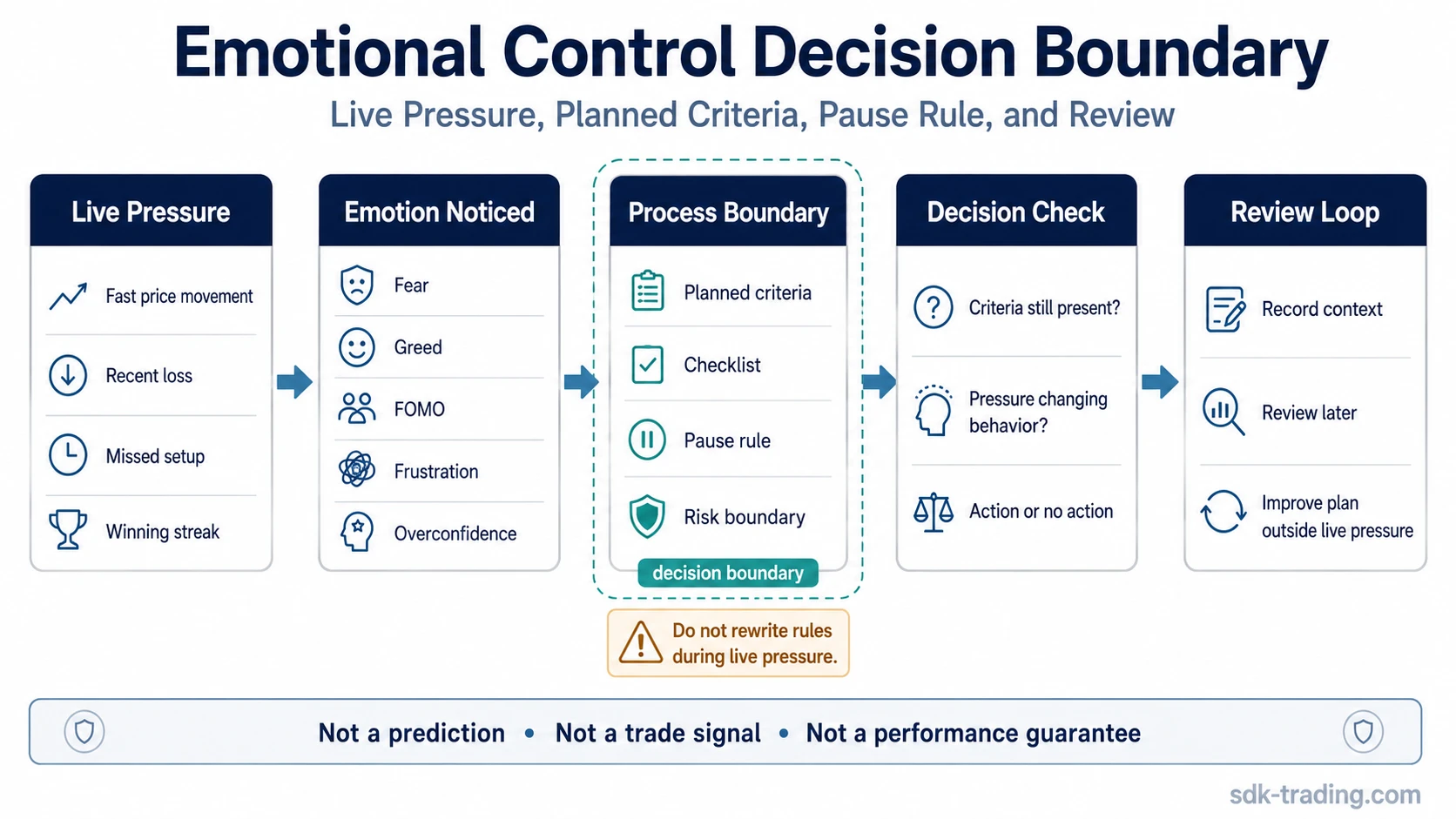
The problem usually appears at the boundary between a planned decision and a reactive decision. A trader may have written criteria, but live price movement, a recent loss, a missed setup, or a winning streak can create pressure to change the plan in real time. Emotional control means using process rules before that pressure becomes the decision-maker.
Core idea: emotional control in trading means treating emotion as information to notice, not as permission to change criteria, risk boundaries, or review standards during live pressure.
Key Points
- Emotions cannot be removed completely, but they can be separated from the decision process.
- Fear, greed, FOMO, revenge impulse, frustration, hope, and overconfidence become dangerous when they override planned criteria.
- A written plan, checklist, pause rule, and review loop create a boundary between observation and reaction.
- The plan can be improved during review, but changing it during live pressure usually weakens process discipline.
- Emotional control does not remove uncertainty or guarantee better outcomes.
What It Means to Control Emotions in Trading
Controlling emotions in trading means keeping the decision sequence stable when pressure changes. The trader still notices fear, greed, hesitation, anger, or excitement, but those emotions do not automatically rewrite the plan.
A process-controlled decision has a defined order: planned criteria first, pressure check second, action or no-action decision third, and review later. This order matters because emotional pressure often asks for an immediate change: take action faster, avoid a valid decision, increase exposure, chase a missed move, or force another trade after a loss.
Important distinction: emotion is not the failure. The failure is acting on emotion without checking whether the decision still fits the written process.
Emotional Triggers That Change Trading Decisions
Emotional trading often starts with a specific trigger rather than a general lack of discipline. The trigger creates pressure, and the pressure tries to change the decision standard.
| Emotional trigger | Common impulsive response | Process control | Review note |
|---|---|---|---|
| Fear | Avoiding a planned decision even when criteria are still present. | Check whether the original criteria are still valid before changing behavior. | Record whether the hesitation came from evidence or discomfort. |
| Greed | Expanding beyond the plan because the move looks stronger than expected. | Return to the planned risk boundary and decision checklist. | Review whether the decision standard changed after excitement appeared. |
| FOMO | Chasing a move after the planned decision point has passed. | Use a pause rule before responding to missed movement. | Track whether late decisions came from criteria or fear of missing out. |
| Frustration | Forcing another decision after a loss, delay, or missed setup. | Use a break rule or reduced screen-pressure rule. | Review whether the next decision was independent or revenge-driven. |
| Hope | Ignoring evidence that the planned decision is no longer aligned with the process. | Compare the current situation with the written invalidation or review criteria. | Record whether the decision relied on evidence or a desired outcome. |
| Overconfidence | Relaxing criteria after recent wins. | Apply the same checklist regardless of recent outcome. | Review whether wins changed the standard for the next decision. |
How Process Rules Reduce Emotional Trading
Process rules reduce emotional trading by creating a delay between the emotional trigger and the decision. That delay does not need to be complicated. It only needs to be clear enough that the trader knows what must be checked before reacting.
A simple structure can include a written plan, a checklist, a pause rule, a risk boundary, and a journal review. Each part has a different job. The plan defines the decision standard before pressure appears. The checklist tests whether the planned criteria are still present. The pause rule slows down reactive behavior. The risk boundary prevents emotional expansion. The journal shows whether the same pressure pattern keeps repeating.
Boundary condition: the plan can be changed during review, not during live pressure. Live pressure is where the plan is tested. Review is where the plan is improved.
A Simple Trigger-Control-Review Framework
A useful emotional-control framework separates the pressure moment into three parts: trigger, control, and review.
- Trigger: identify the emotional pressure without treating it as a decision. Fear, greed, FOMO, frustration, hope, and overconfidence are labels for pressure states, not instructions.
- Control: return to the written process. Check the planned criteria, the checklist, the pause rule, and the risk boundary before changing behavior.
- Review: record what happened after the decision. The review should ask whether the trader followed the process, not whether the outcome felt good or bad.
Practical scenario: a losing trade or missed setup creates pressure to act again quickly. Instead of forcing a new decision, the trader pauses, checks the predefined criteria, protects the risk boundary, and records the decision context for review. The purpose is not to predict the next market move. The purpose is to prevent a pressure state from replacing the planned process.
Common Mistakes When Trading Under Pressure
The most common mistakes are not always dramatic. Many happen through small changes that feel reasonable in the moment but break the process over time.
| Mistake | Why it creates risk | Process response |
|---|---|---|
| Changing size after emotion appears | The decision may shift from planned exposure to emotional recovery or excitement. | Keep sizing logic inside the written plan and review changes outside live pressure. |
| Skipping planned criteria | The trader may act because the situation feels urgent rather than because the setup still fits the process. | Require the checklist before the decision is treated as valid. |
| Changing decision logic during pressure | The decision may become hope-based, fear-based, or outcome-focused instead of process-based. | Record the pressure and review whether the original plan logic still applied. |
| Overtrading after a loss | The next decision may become a reaction to the previous outcome rather than a separate process decision. | Use a break rule or a reduced decision window after high-pressure outcomes. |
| Forcing trades after a winning streak | Recent success can weaken selectivity and make lower-quality decisions feel acceptable. | Apply the same checklist after wins as after losses. |
What Emotional Control Cannot Guarantee
Journaling, checklists, pause rules, and planned criteria can reduce impulsive behavior, but they do not remove uncertainty or guarantee better trading outcomes. A process can be followed correctly and still lead to an unfavorable result.
That limitation matters because emotional control is sometimes misunderstood as a way to make trading feel calm or certain. A better standard is reviewability. If a decision can be reviewed against the written process, the trader can identify whether the issue was the plan, the execution of the plan, or normal market uncertainty.
Limitation: emotional control is a decision-quality tool, not a performance guarantee. It helps separate planned behavior from reactive behavior, but it does not prove market direction or remove risk.
How This Fits Into Trading Psychology
Emotional control is one part of trading psychology. The broader topic includes discipline, expectations, risk perception, confidence, frustration, and how traders respond to uncertainty.
The narrow job here is process stability. When emotion appears, the trader needs a way to keep planned criteria, pressure checks, and review discipline separate from the urge to react. That separation is what turns emotional control from a vague mindset idea into a practical decision boundary.